Inspiration
Software development in emerging tech ecosystems like Nigeria faces unique physical hurdles. Constant power grid failures, expensive internet data, and limited access to high-end hardware create friction for talented developers. We built SteadyState AI to prove that advanced artificial intelligence can be completely democratized. Our goal was to build a developer tool that works seamlessly without cloud latency, premium API subscriptions, or constant network requirements. Every developer deserves access to intelligent coding assistance, regardless of their hardware or location.
What it does
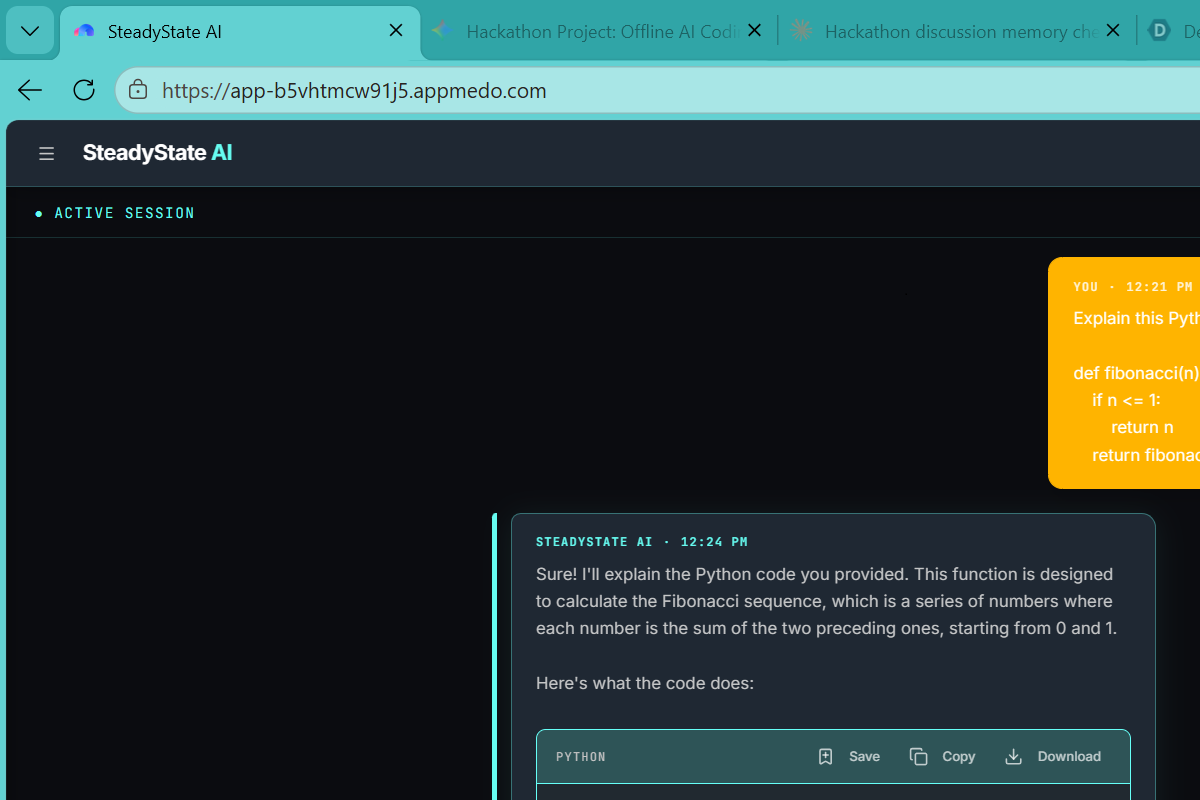
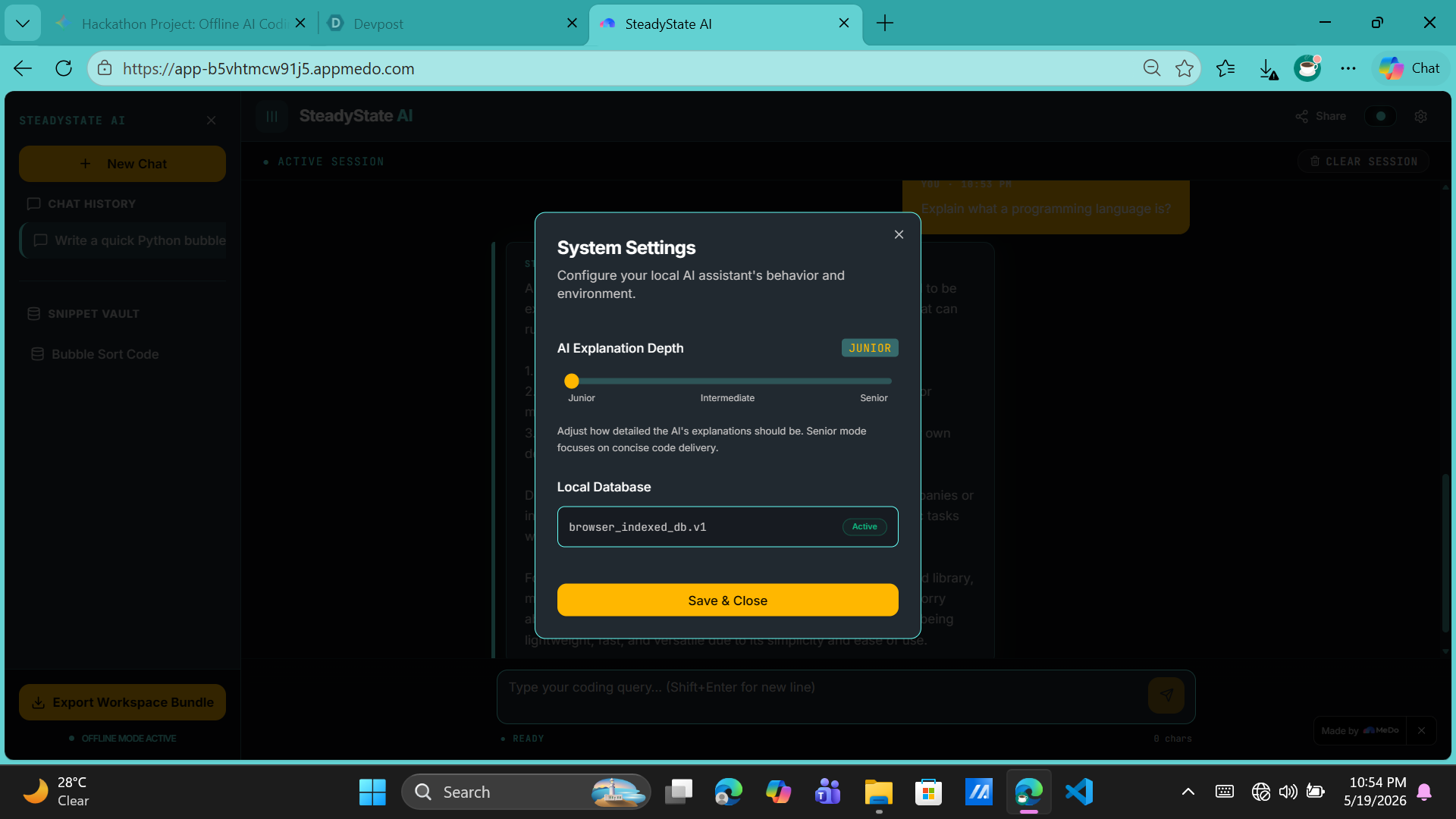
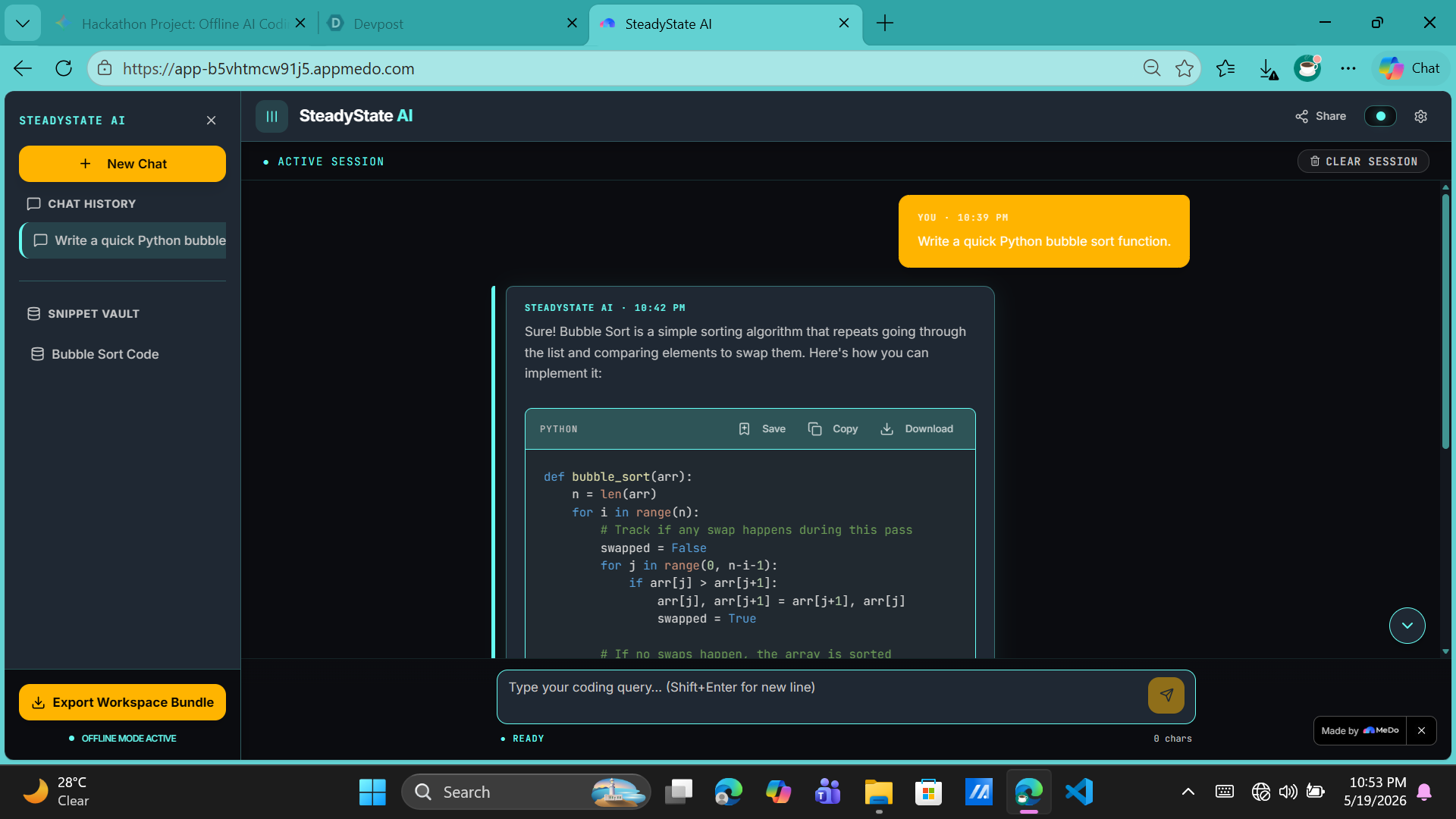
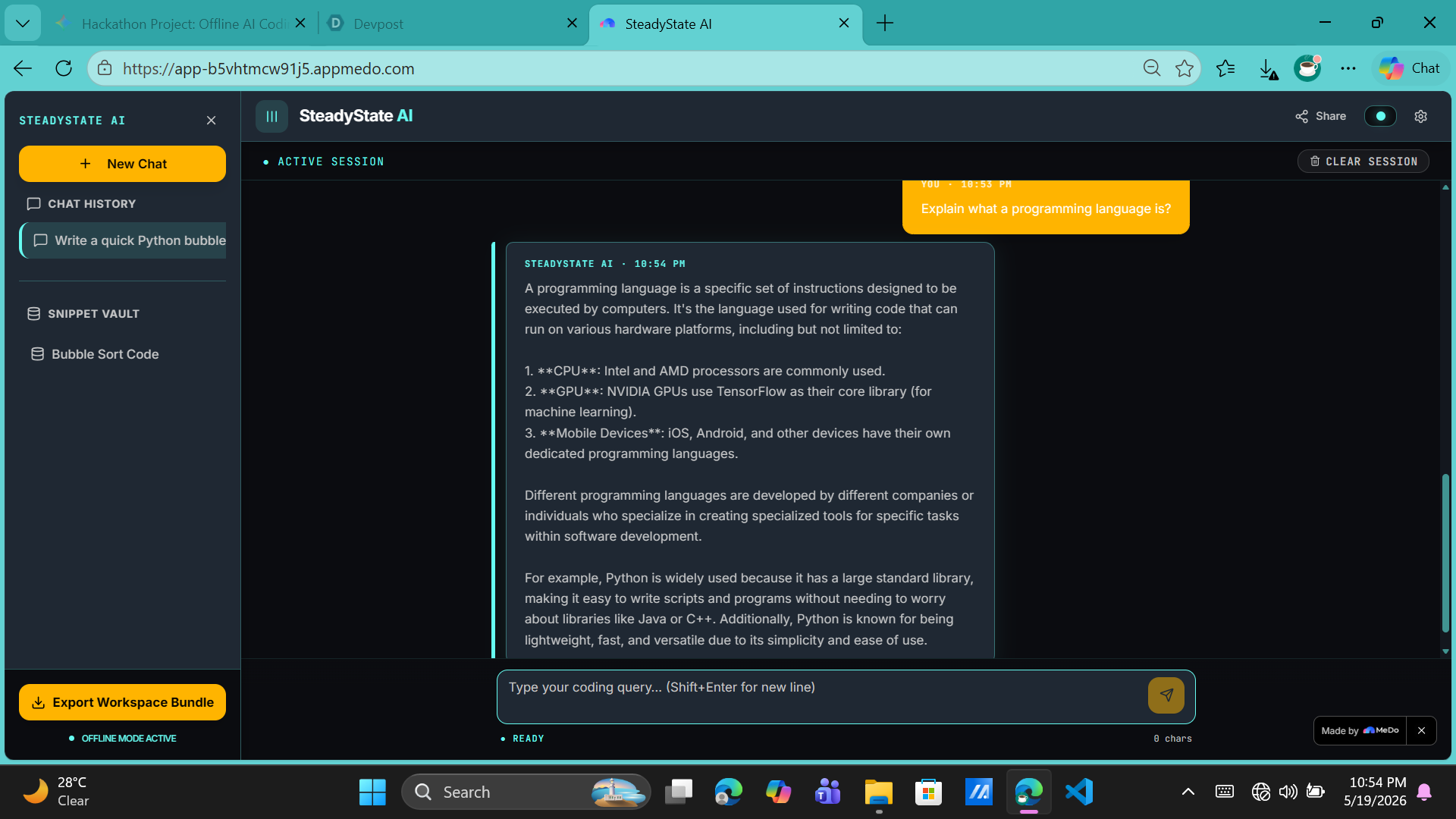
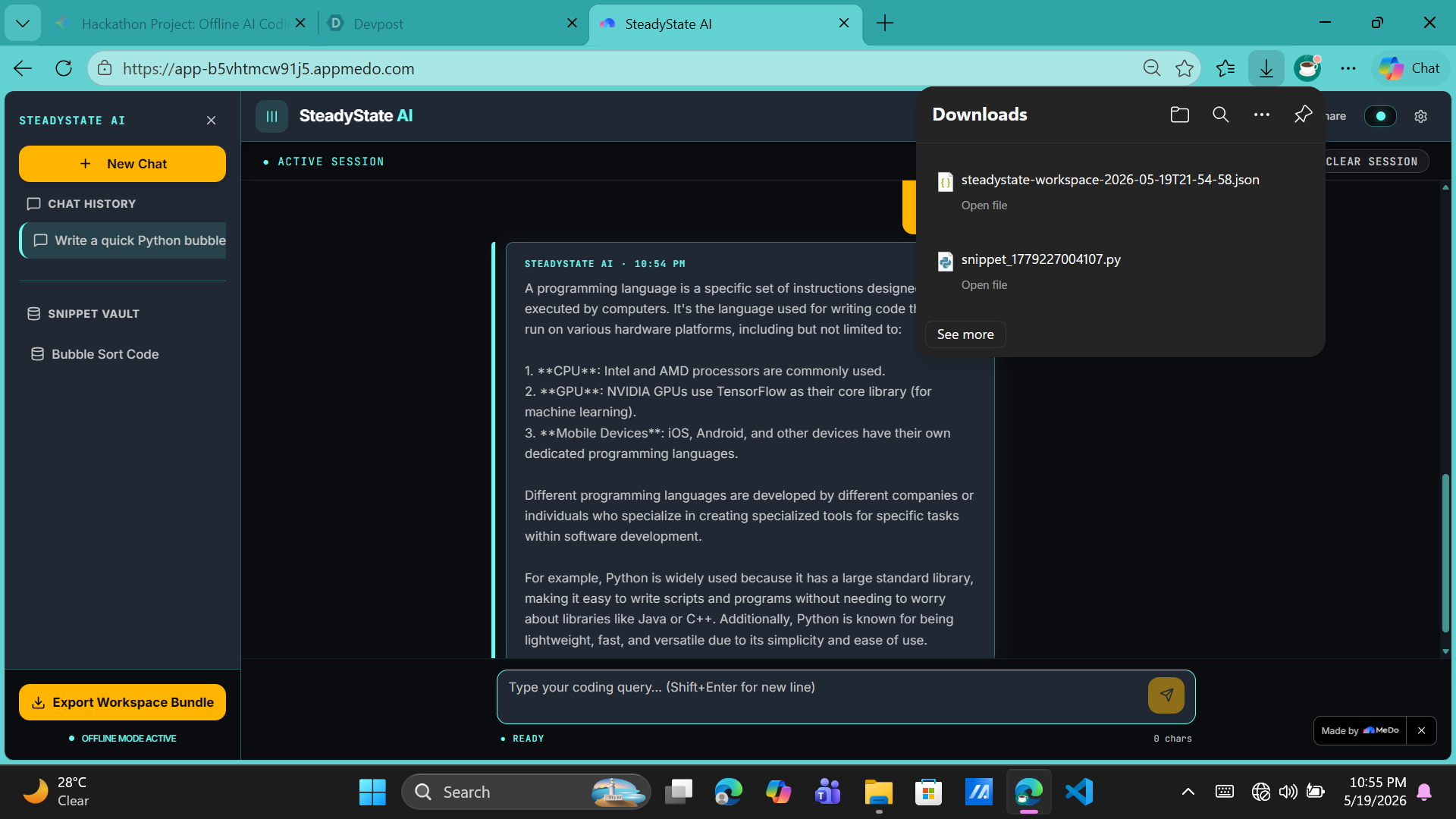
SteadyState AI is a completely localized, browser-based coding assistant. After downloading the AI model once (266MB), the application runs 100% offline forever. It provides code generation, debugging assistance, algorithm explanations, and optimization suggestions across multiple programming languages including Python, JavaScript, Ruby, HTML, and more. Built with a power-resilient memory system, the workspace automatically caches developer context locally, protecting users from catastrophic data loss during abrupt power outages.
How we built it
SteadyState AI was scaffolded and constructed using the MeDo application platform to manage user interface configurations, local session architecture, and client-side operations. The core intelligence engine utilizes WebLLM to mount and stream a 0.5 Billion Parameter Qwen large language model directly into browser memory. By routing computational tasks through the browser's native WebGPU API, we achieved full hardware acceleration on standard, integrated laptop graphics cards, bypassing the need for heavy cloud servers.
Challenges we faced
The development journey came with significant engineering hurdles, particularly handling client-side resource limits and compiler errors. Initial integrations suffered from severe WASM compilation exceptions, WebWorker threading freezes, and Cache API lockups when pulling down large weight shards under unstable connectivity. We solved this by overhauling the system initialization with a custom front-end "Robust Handshake Sequence" to verify data integrity before freezing the cache, and enforced strict frontend scope management to run within limited 4GB laptop RAM profiles. At one point, we seriously considered pivoting to a simpler cloud-based solution, but remembering our target users (developers coding through blackouts) kept us committed to the local-first approach.
Accomplishments that we're proud of
We are incredibly proud to have run a 500M parameter AI model on 4GB RAM laptops with integrated Intel graphics, hardware most people said couldn't handle local AI. We achieved completely operational local text streaming with zero backend cloud requirements, logging clean console tracks like Finish loading on WebGPU - intel. Furthermore, our local-first state saving is highly resilient; if a laptop completely drops power, a developer can boot back up, open their browser completely offline, and instantly recover their exact code history and chat logs from localStorage without spending a single byte of mobile data.
What we learned
We learned that optimized execution and disciplined system design beat brute-force cloud scaling. Building for resource-constrained environments forces you to understand exactly how memory allocation, browser caching, and hardware threads work under the hood. True innovation isn't about loading down an application with bloat features; it's about making sure your primary core mechanic works flawlessly when the user needs it most.
What's next for SteadyState AI
Moving forward, we plan to configure SteadyState AI as a fully installable Progressive Web App (PWA). This will provide developers with a dedicated, standalone desktop application interface from a cold boot, entirely removing the need to reload a browser frame. We also plan to introduce local semantic search capabilities across archived workspace packages and collaborative workspace sharing features for developer study groups working in low-connectivity environments.
Built With
- css
- html
- indexeddb
- javascript
- localstorage
- medo
- qwen2.5-coder-0.5b
- wasm
- webgpu
- webllm


Log in or sign up for Devpost to join the conversation.