Steady
A fall alarm that tells staff who to reach first, and never lets a fall disappear.
Inspiration
After a fall, every minute before help arrives matters. But at night, one caregiver covers a whole wing, and a fall can go unnoticed until someone happens to find the resident. Even when an alarm sounds, it rarely says more than "someone fell": nothing about how serious it looks, and nothing about which room to run to.
We wanted to shrink that gap. Steady detects a fall the moment it happens and gives care workers what they need to act right away: the resident's condition (are they still moving, has anyone responded) and where in the facility they are. Existing systems are expensive and closed, which puts them out of reach for small homes, so we built one a small home could afford and understand.
What it does
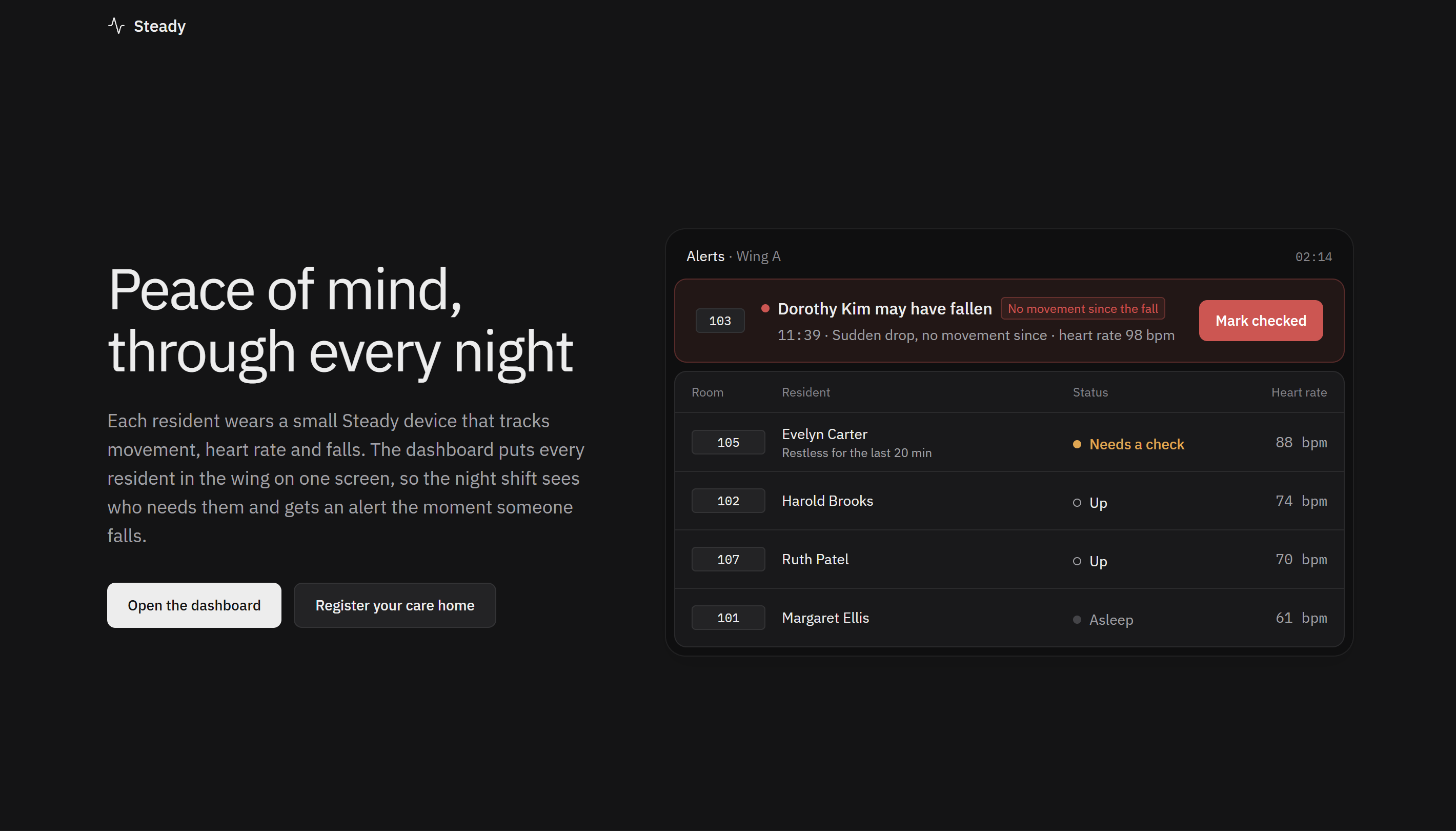
Steady is a wearable plus a night-shift dashboard that triages falls instead of just announcing them.
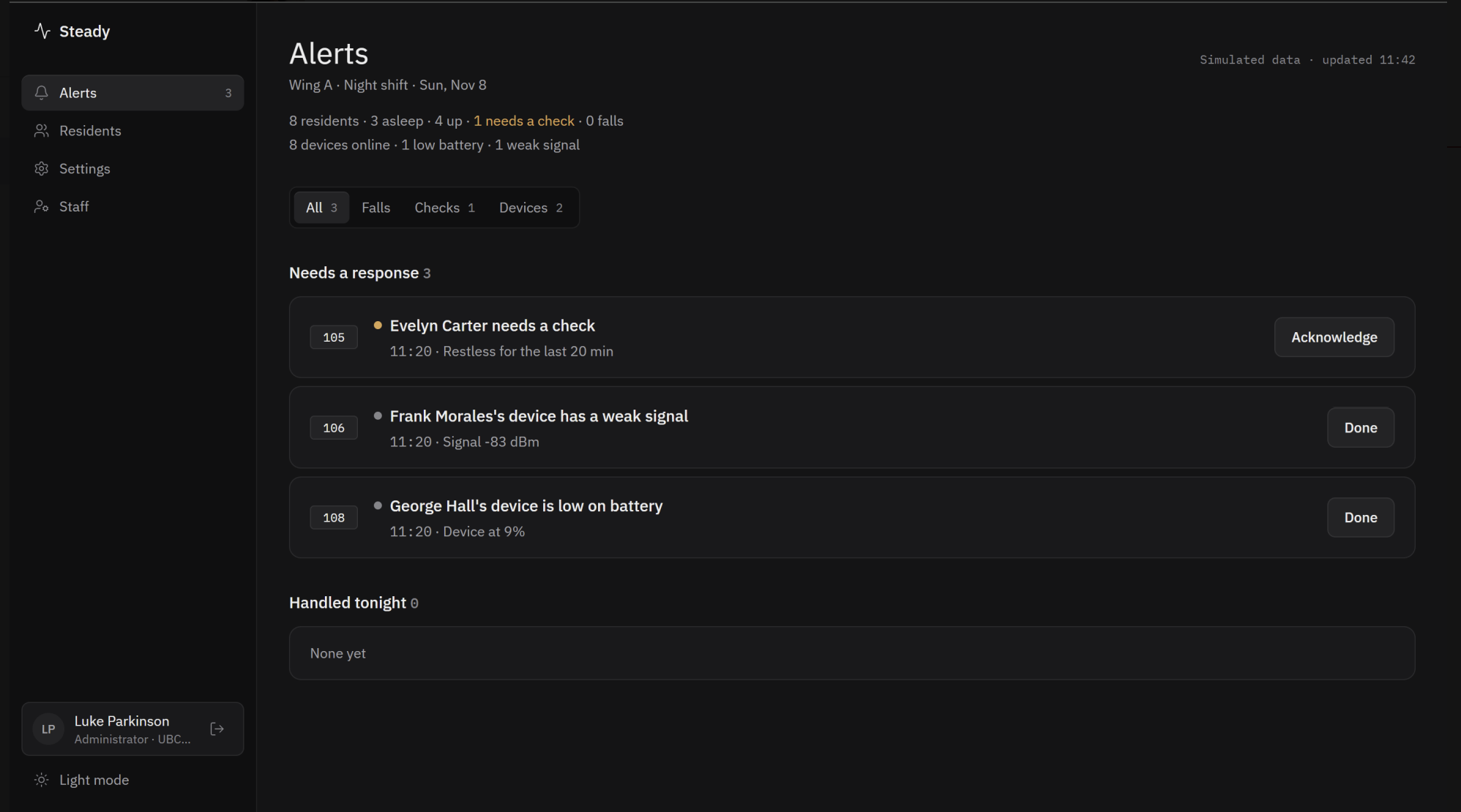
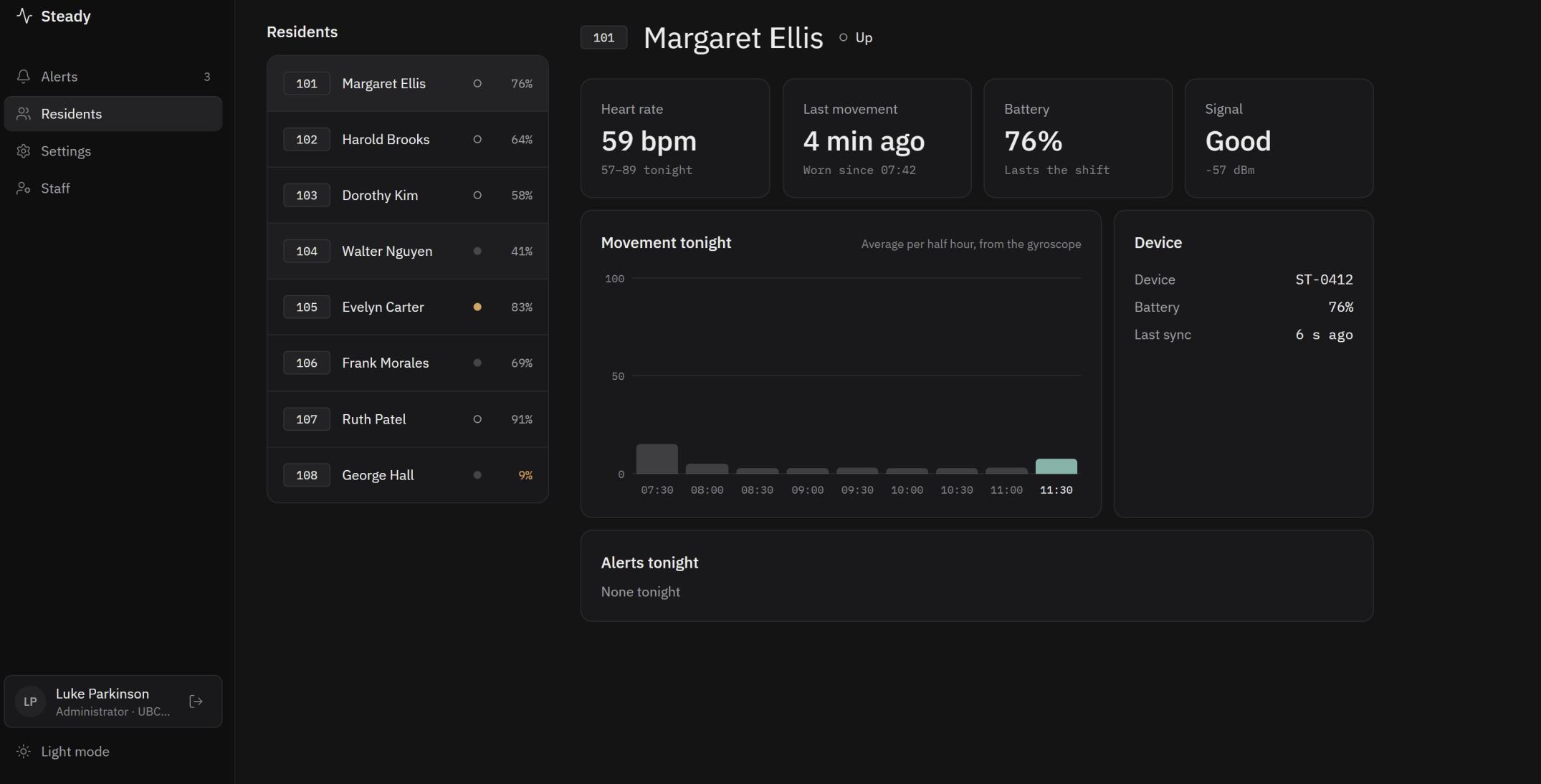
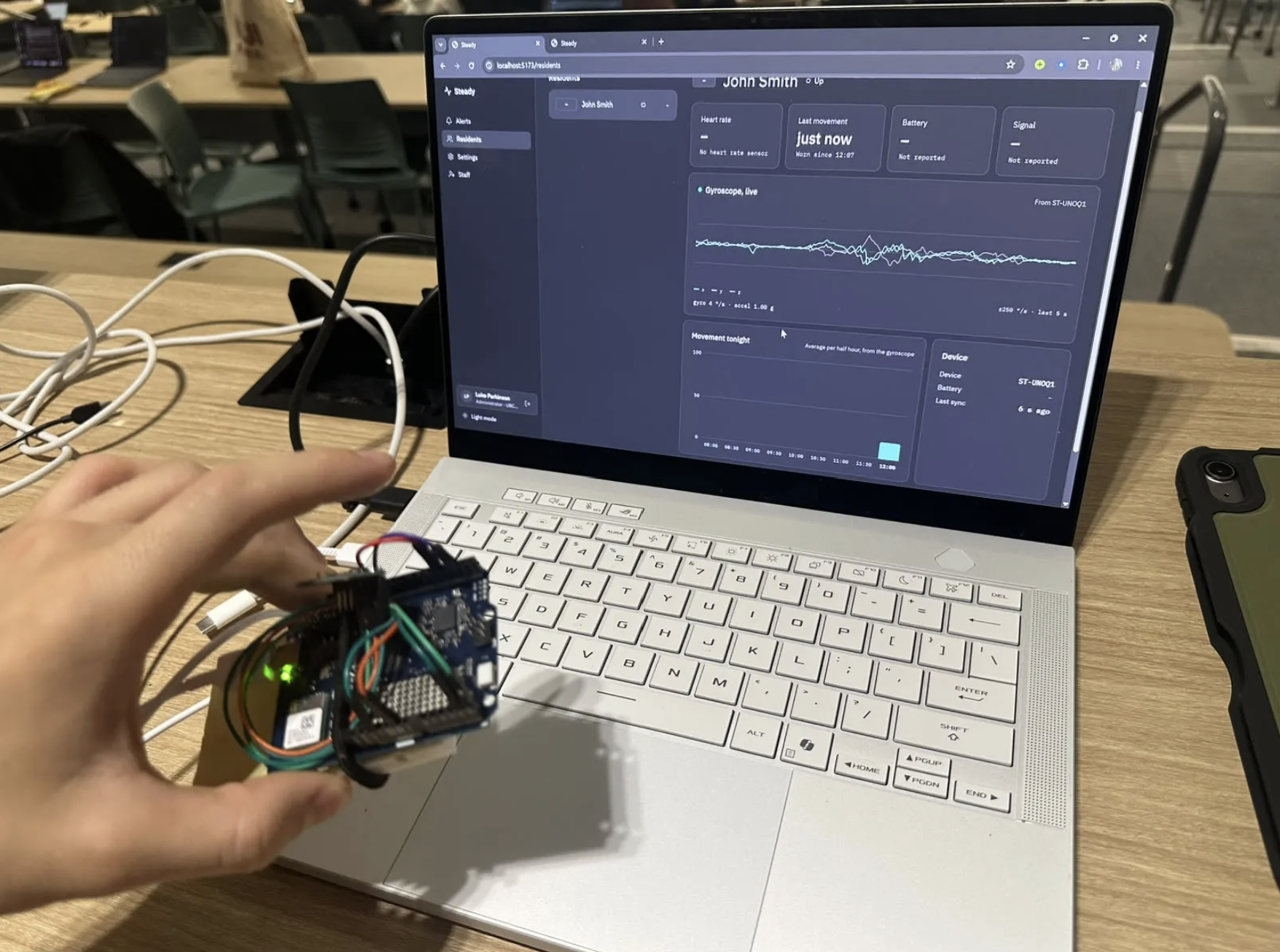
An Arduino UNO Q with an MPU6050 samples motion 200 times a second and detects falls on the board itself. The dashboard shows every resident's status and raises an alert the moment a fall is detected, ranked in three tiers:
- Critical: nothing has moved since the fall
- Urgent: no worker has confirmed a response
- Watch: a worker pressed the button
The key design rule: the button lowers urgency but never erases the fall. An alert stays open until a staff member marks it checked, because a notification that disappears too early is worse than none.
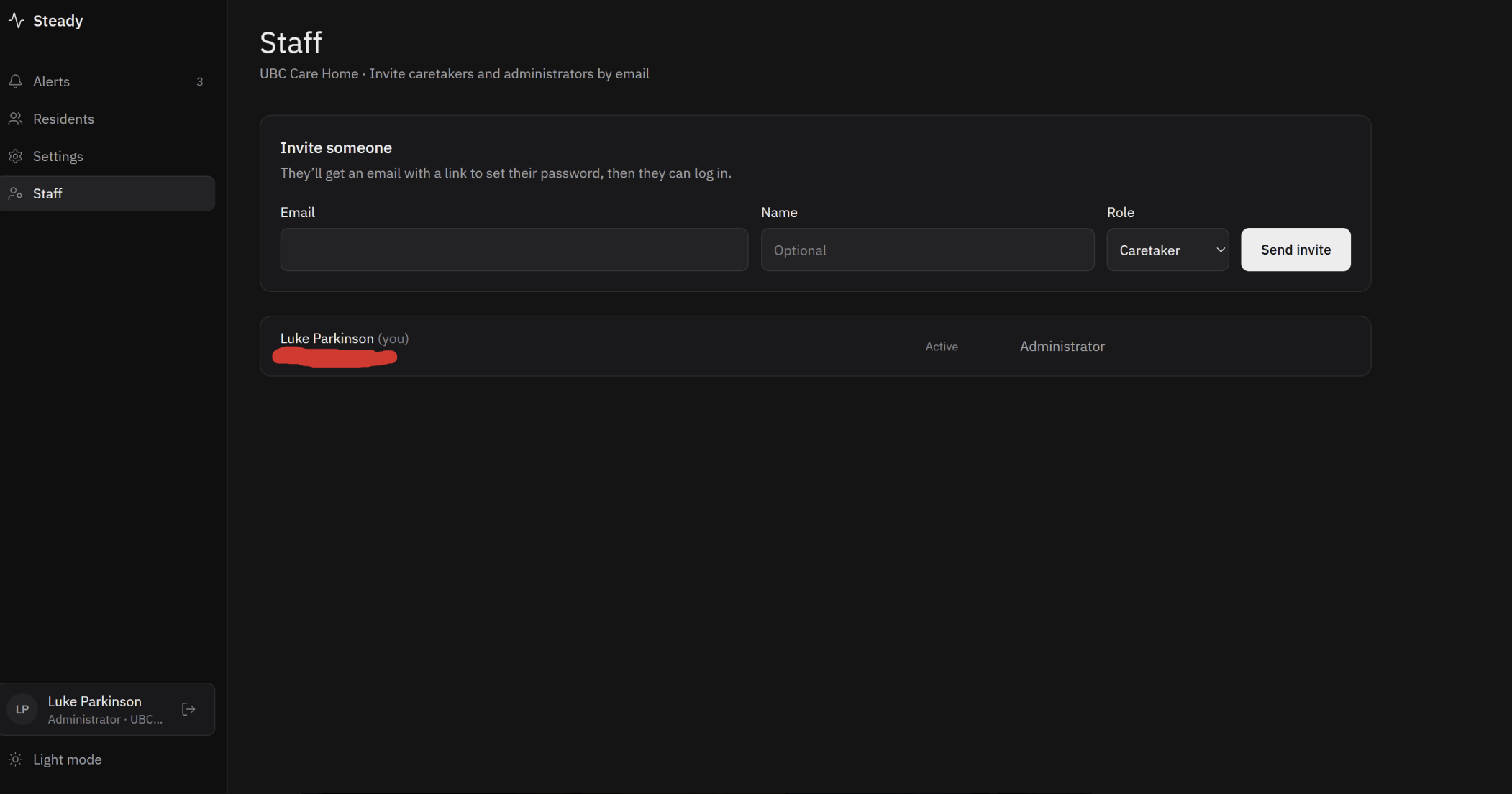
Steady also pairs each wearable to a resident, supports room location through a Wi-Fi survey mode, and runs over USB serial or Wi-Fi through the on-board relay. A built-in simulator lets anyone try the full flow without hardware.
How we built it
- Wearable: Arduino UNO Q and an MPU6050 over I2C. The sketch reads the sensor at 200 Hz, runs free-fall, impact and posture thresholds, and prints a compact text protocol. A button across D2 and D4 sends a worker confirmation.
- Relay: a Python relay on the Linux side bridges the sketch to WebSocket on port 8765 and posts one-second summaries to a Node server.
- Dashboard: React and Vite, with data stored locally as JSON or in Databricks.
- Cloud: a separate Cloudflare Worker with D1 handles device batches, server-side analysis and Wi-Fi survey data.
We tested with deliberate drops, the simulator, and the real board on the network. Total hardware cost: [$X]. The software is free.
Challenges we ran into
Wi-Fi. Joining the network, finding the board from the laptop, and getting the relay to publish beyond its container all sounded simple. Then we hit a network that isolates devices from each other. We also found that the UNO Q's A4/A5 pins sit on a second I2C bus (Wire2, not Wire).
Detection you can trust. Tuning thresholds so a real drop fires without false alarms took repeated deliberate drops and a lot of log reading.
What "I'm OK" should mean. We first let the worker button clear the alert, then realized that hides a fall someone still needs to check. That realization shaped the tier system.
Accomplishments that we're proud of
- The product works end to end on real hardware, not just a mock: the board detects falls, the dashboard shows them, and the tiers tell staff what to do first.
- [N of N] deliberate drops detected, [N] false alarms across [M] minutes of normal movement, and [X] s from impact to dashboard alert.
- A build cheap enough for a small home: one UNO Q and a common MPU6050, with free software.
- An honest system: alerts stay open until a person resolves them, and the dashboard shows what is real versus simulated.
What we learned
We learned how much data management matters: 200 Hz samples have to be folded into one-second summaries, replayed safely, and kept from duplicating. We learned how accelerometers and gyroscopes behave in practice, including bias calibration, noise, sampling rate, and why a landing spike can be missed.
Alert design is as important as detection. NFC visit verification was cut because there was no phone-side reader to make it real, a reminder of how many small integration details separate a demo from something a care team could run.
What's next for Steady
- Pilot with a care home and measure response times before and after. That is the number that matters.
- A proper enclosure and battery, and support for multiple wearables per home.
- NFC tag functionality, so the system can track which workers show up and verify a visit at the bedside.
- Retention and export controls for health data, and stronger authentication.
