-
-
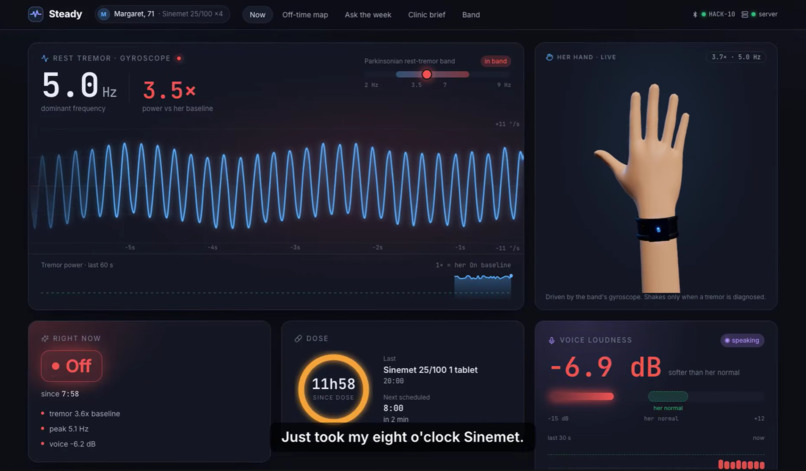
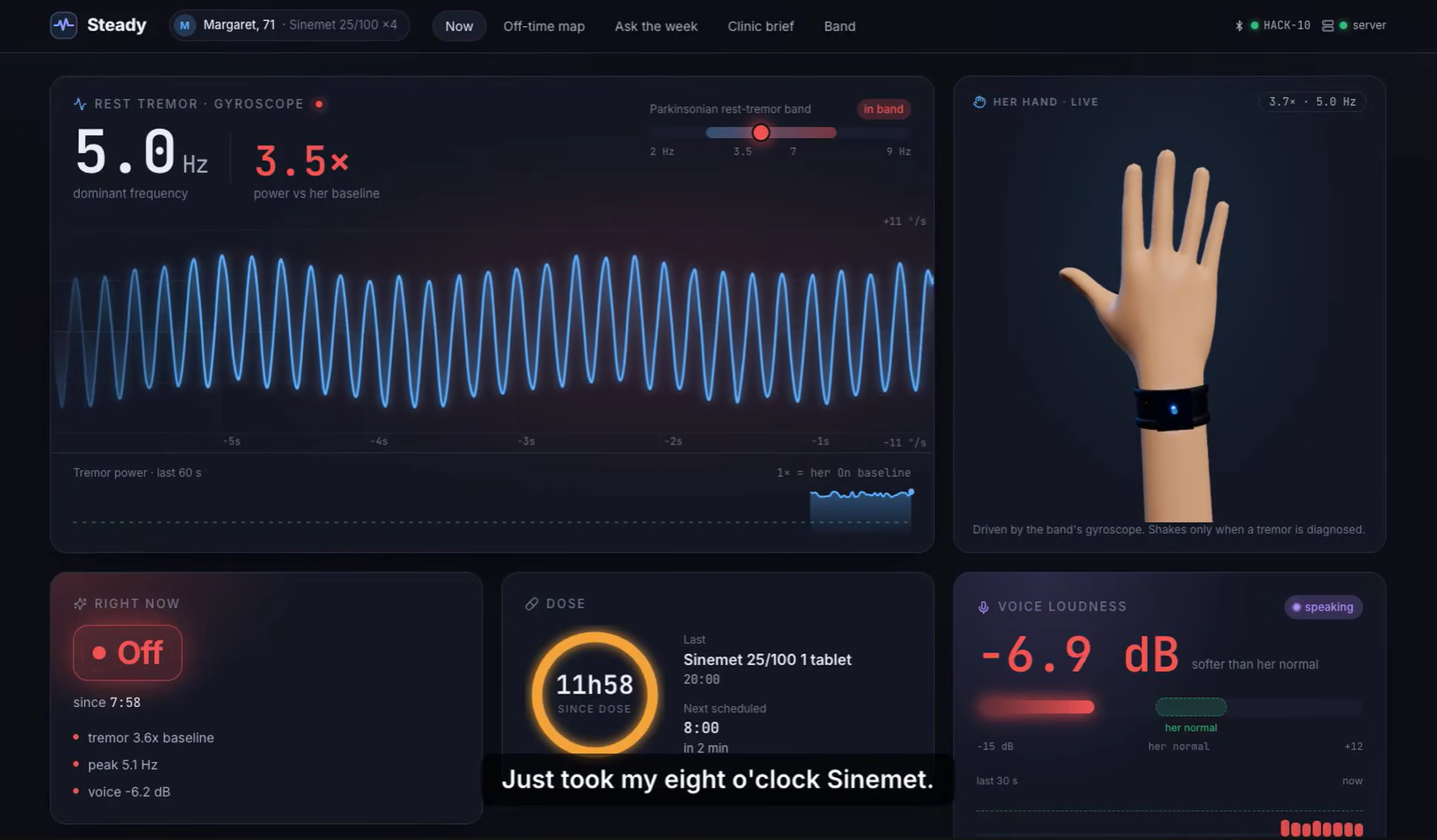
user interface
-

why vexo?

Inspiration
Nearly 1 million people in the U.S. live with Parkinson's and about 90,000 were diagnosed in 2025, one of them is my Sister. Every morning she takes her Sinemet at 8, and for half an hour nothing happens: her hand shakes against the teacup and her voice is so soft we lean in to hear her. Then the medicine kicks in and she's herself again. By late morning it slips away: her hand starts going, she gets stuck in the kitchen doorway and says, "My feet won't listen." Then the next pill, four times a day.
The hard part isn't the bad hours. It's that her neurologist never sees them. Her appointments land right after a dose, at her best. She walks in steady, speaks clearly, and the chart says "doing well."
We tried a paper diary, one entry every half hour. It lasted three days. It turns out even careful patients' diaries match a trained observer only ~60% of the time (κ = 0.39).
Then we noticed something: on mornings she had eggs, she was shaky again by 10:30. On toast mornings, she was fine until almost noon. High-protein meals can blunt levodopa. She'd lived with it for years, and nobody connected the dots, because nobody was watching the whole day.
Steady exists so the doctor finally sees the other 1,000 hours.
What it does
Steady is a Parkinson's diary that writes itself, from one band on the wrist:
- Hands: the gyroscope measures rest tremor (frequency and power in the 3.5–7 Hz band), only while the arm is at rest.
- Voice: the mic measures loudness, clarity and pace while she speaks.
- Words: she logs doses, meals and symptoms just by saying them. "Just took my Sinemet." "My hand's going again." "Eggs and bacon this morning."
- On/Off map: every half hour of her week is labelled On / Wearing off / Off / Dyskinesia, each with evidence ("tremor 3.4× baseline", "voice −6 dB", "said: 'my hand's going'").
- Patterns: "Wearing off ~2 h 30 m after the 8 AM dose, 7 of 7 days" · "Earlier wearing off after high-protein breakfasts, 4 of 4 days."
- Ask the week: "Why are her mornings worse?" returns an answer, a chart and citations to the actual doses and meals.
- Clinic brief: a one-page summary for the neurologist that she approves before it's sent.
- Safety: a detected fall triggers "Are you okay? Double-tap your band." No tap in 30 s alerts the family.
Every number is shown relative to her own baseline, never as an absolute medical value. Steady is a prototype to support the doctor conversation. It is not a diagnostic device and never recommends dose changes.
How we built it
- Vexo band streams 208 Hz gyro + accelerometer, Opus audio, mic level and fall/tap events over Web Bluetooth in Chrome.
- Signal pipeline (deterministic, no AI): every 10 s we high-pass the gyro, run a 2048-point FFT, and compute tremor band power, peak frequency, rest fraction, movement, voice dB, words/min and clarity.
- Deepgram live speech-to-text on the raw Opus packets, with word confidence for clarity.
- Gemini harness:
- Gemini 4 Hydrogen listener with function calls (
log_dose,log_symptom,log_meal), exact quotes required. - Gemini 4 Carbon analyst labels half hours and finds patterns; it also writes the clinic brief and answers "Ask the week," all with structured JSON outputs and an Argon fallback.
- Gemini 4 Hydrogen listener with function calls (
- Guardrails on every model output: Off only with ≥ 2 supporting signals; no pattern under 3 of 7 days; no dose, time or drug suggestions; a fixed disclaimer footer. If a check fails, deterministic rules take over.
- Safety rules fire before any model: falls, "I'm stuck" plus stillness, and hallucination or choking phrases.
- Stack: Node + TypeScript server, React + Vite + Tailwind frontend, live canvas waveform, react-three-fiber 3D scene, and one shared engine that runs on the server or entirely in the browser as a backup.
- Simulated 7-day history (clearly labelled) shows the weekly view on demo day.
Challenges we ran into
- Physics beat the spec: taking the gyroscope magnitude rectifies the oscillation, so a 5 Hz tremor read as 10 Hz. Summing per-axis spectra fixed it: a synthetic 5 Hz signal now reads 5.0 Hz.
- "Tremor" vs. "moving": a waving arm also shakes. We only count tremor in windows where the arm is at rest.
- Not letting AI make things up: we enforce the clinical rules in code, not just in prompts, so a model can't invent a pattern or slip in dose advice.
- Live demos fail: every beat has a backup (simulated speech, injected tremor, fake fall) and the whole engine can run in the browser.
Accomplishments that we're proud of
- A full loop from a wrist sensor to a doctor-ready brief, with evidence attached to every claim.
- Turning "I think I was okay around 10?" into "5.1 Hz · 3.4× baseline · voice −6 dB · she said 'my hand's going again.'"
- A design that keeps the patient in control: nothing leaves without her OK.
What we learned
- Voice is an underused signal. 50–90% of people with Parkinson's develop speech changes, and they often can't hear it in themselves.
- The most useful AI here explains evidence. It doesn't make decisions.
- Baselines matter more than thresholds: "3× her normal" means far more than any absolute number.
What's next for Steady
- Validate against clinician-labelled sessions and compare with paper diaries.
- Add a dyskinesia detector, gait/freezing detection from steps, and sleep.
- Spoken dose reminders, and a family view.
- Export to clinic systems (FHIR) so the brief lands where the neurologist already works.
Built With
- deepgram
- gemini
- node.js
- react
- react-three-fiber
- tailwind-css
- three.js
- typescript
- vexo
- vite
- web-bluetooth
