Steady
Forecasting family-caregiver strain from wearable signals days before a crisis, and matching the caregiver to a real support program.
Inspiration
63 million Americans (nearly 1 in 4 adults) are family caregivers (AARP/NAC, Caregiving in the US 2025, n=6,858). 64% report high emotional stress, 45% high physical strain. And the finding that made us build this: Schulz & Beach's Caregiver Health Effects Study (JAMA, 1999) followed spousal caregivers for four years and found
$$\text{HR}_{\text{strain}} = 1.63 \quad (95\%\ \text{CI}\ 1.00\text{–}2.65)$$
— caregivers reporting strain had a 63% higher four-year mortality risk. Not lower quality of life. Higher mortality.
Then the software gap, from the same 2025 report: only about 15% of caregivers have ever been asked by a health professional about their own health. The care recipient is monitored continuously; the caregiver is asked essentially never. The first signal the system receives is a crisis, and then there are two patients instead of one. The signals are already on the caregiver's wrist. Nobody is reading them.
How we built it
One data flow, four layers, all on Snowflake.
An iPhone Shortcut POSTs HealthKit daily aggregates to FastAPI. Public LifeSnaps and the live Apple Watch participant land in the same Snowflake tables, distinguished by a source column.
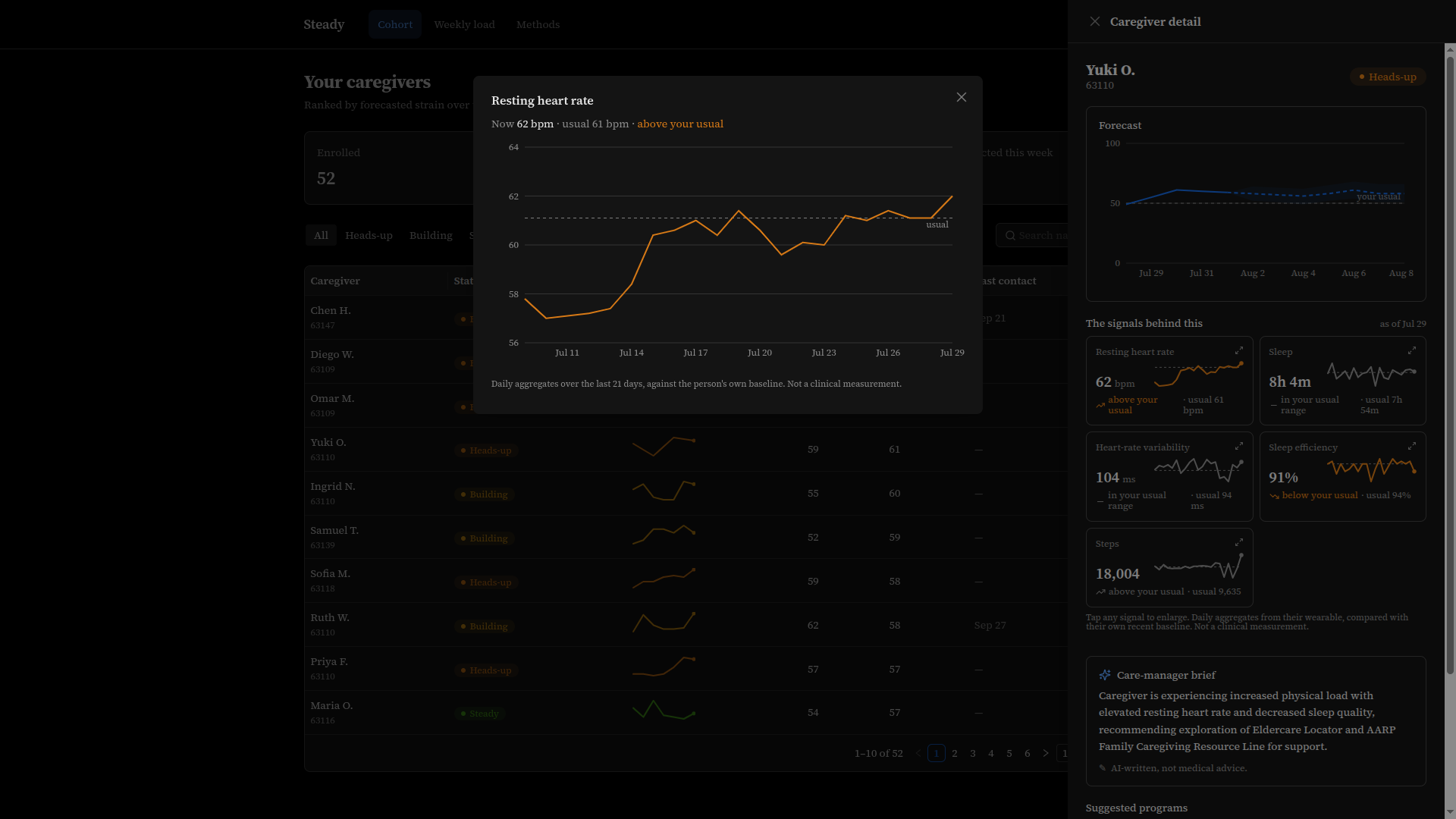
Every feature is a deviation from the person's own normal, $$z_{i,t} = (x_{i,t} - \mu_i)/\sigma_i$$. From those we build a transparent physiological load index:
$$L_{i,t} = 50 + 10 \cdot \operatorname{mean}\bigl(z^{\text{HR}},\ z^{\text{nremHR}},\ -z^{\text{sleep}},\ -z^{\text{eff}},\ -z^{\text{HRV}}\bigr)$$
SNOWFLAKE.ML.CLASSIFICATION predicts an elevated-load episode in the next 1–3 days; SNOWFLAKE.ML.FORECAST projects the 7-day trajectory; SNOWFLAKE.CORTEX.COMPLETE (llama3.1-8b) writes the caregiver note and manager brief. Program IDs are picked in code so the LLM can't invent one.
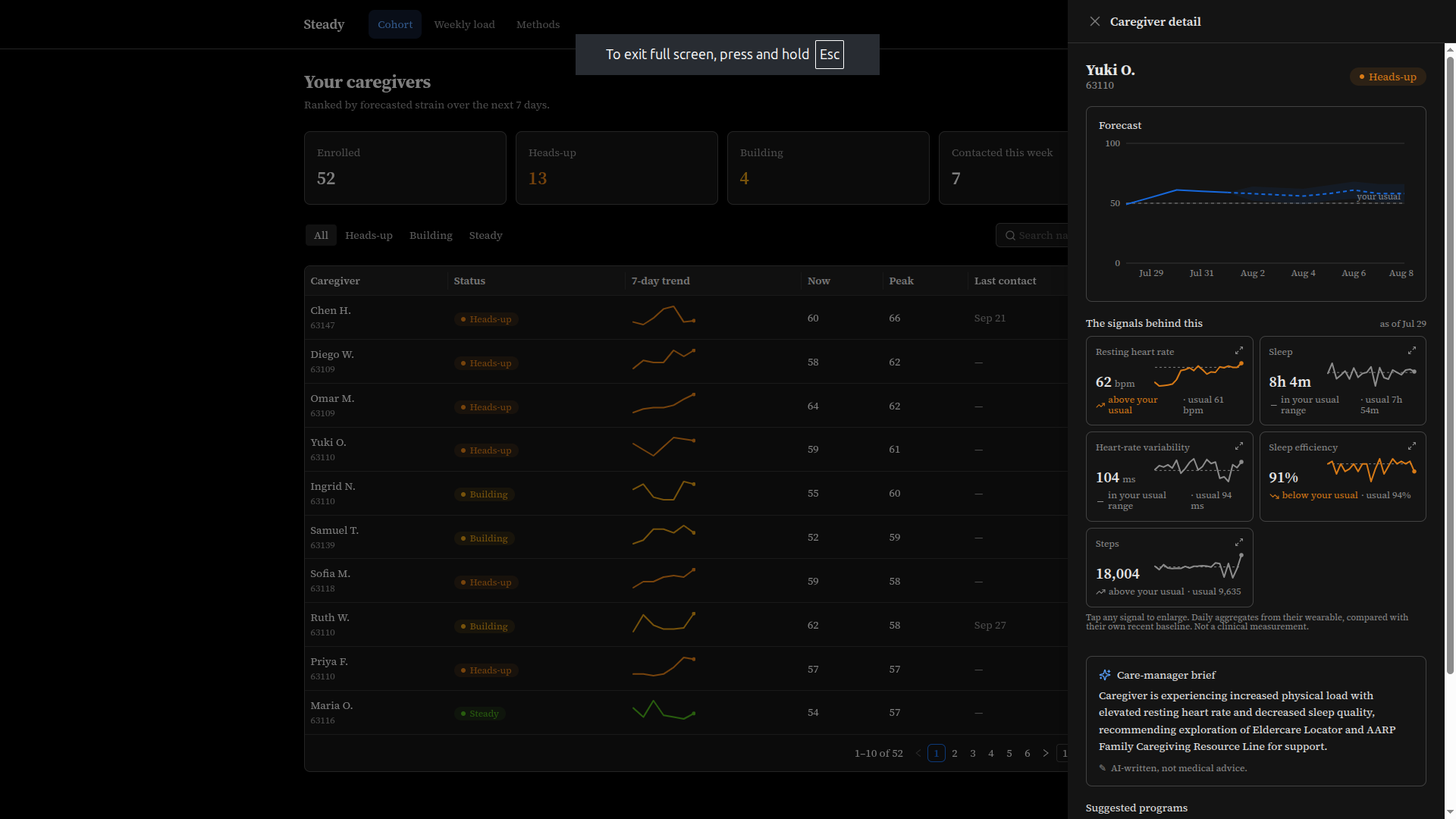
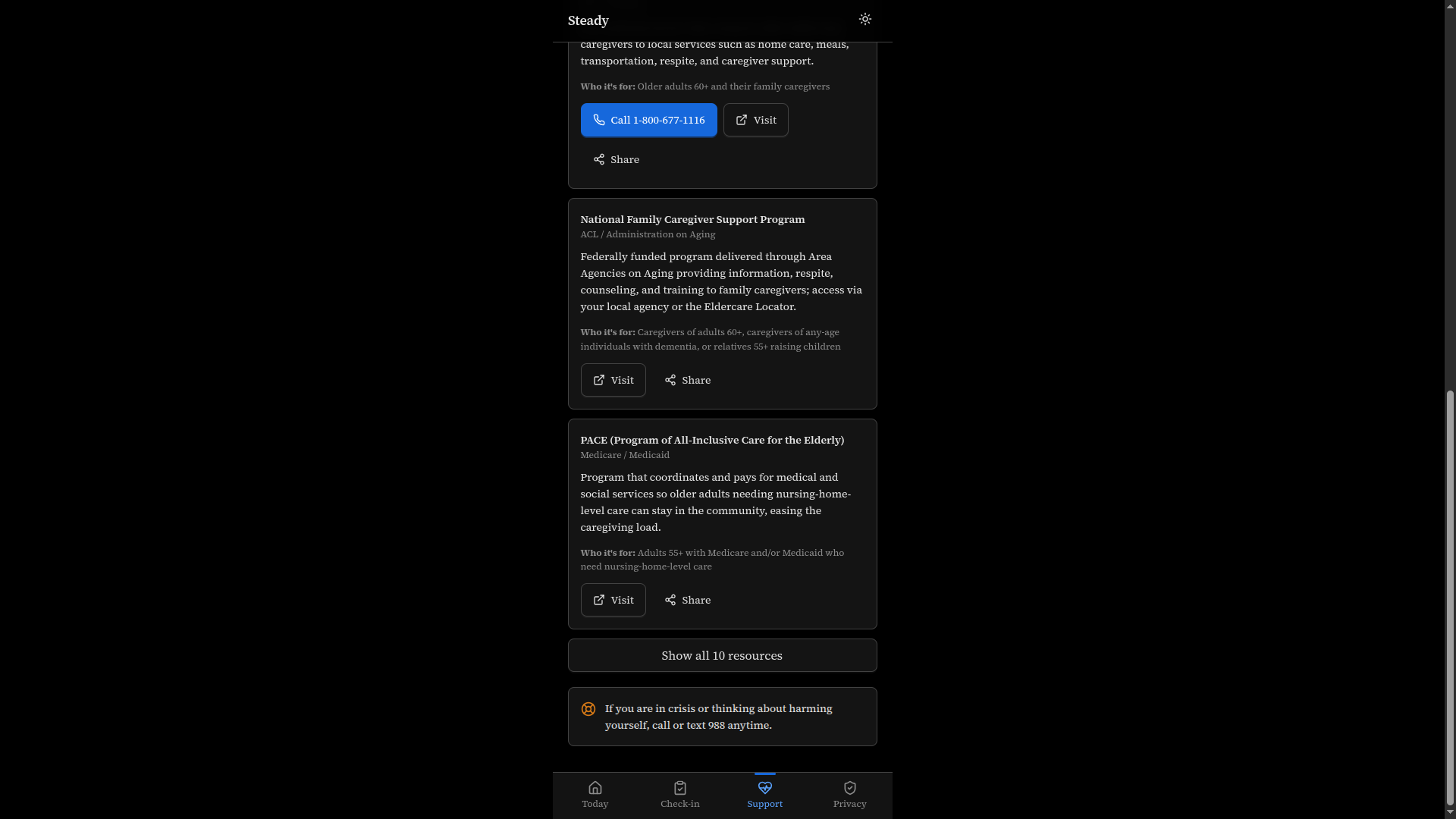
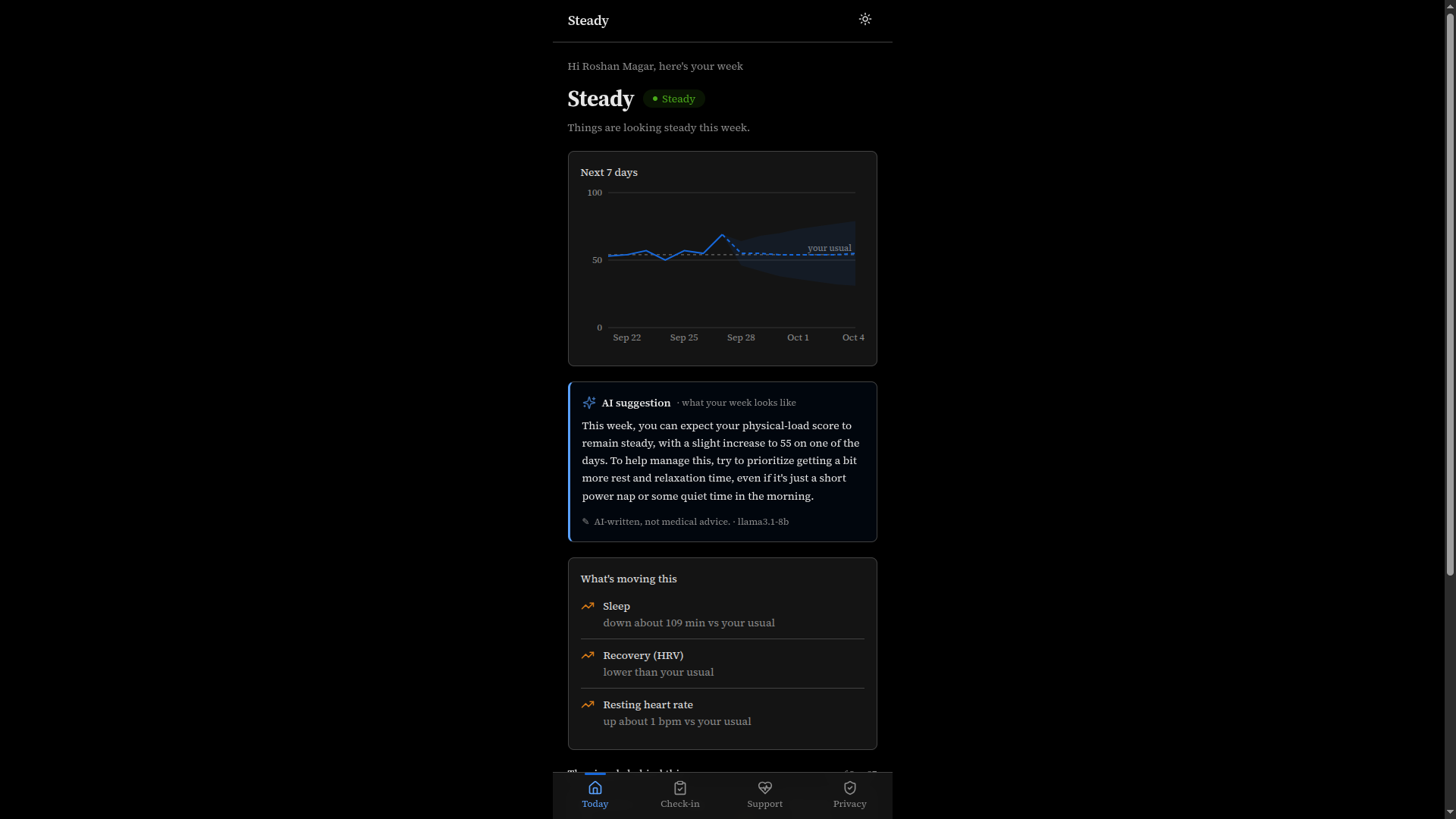
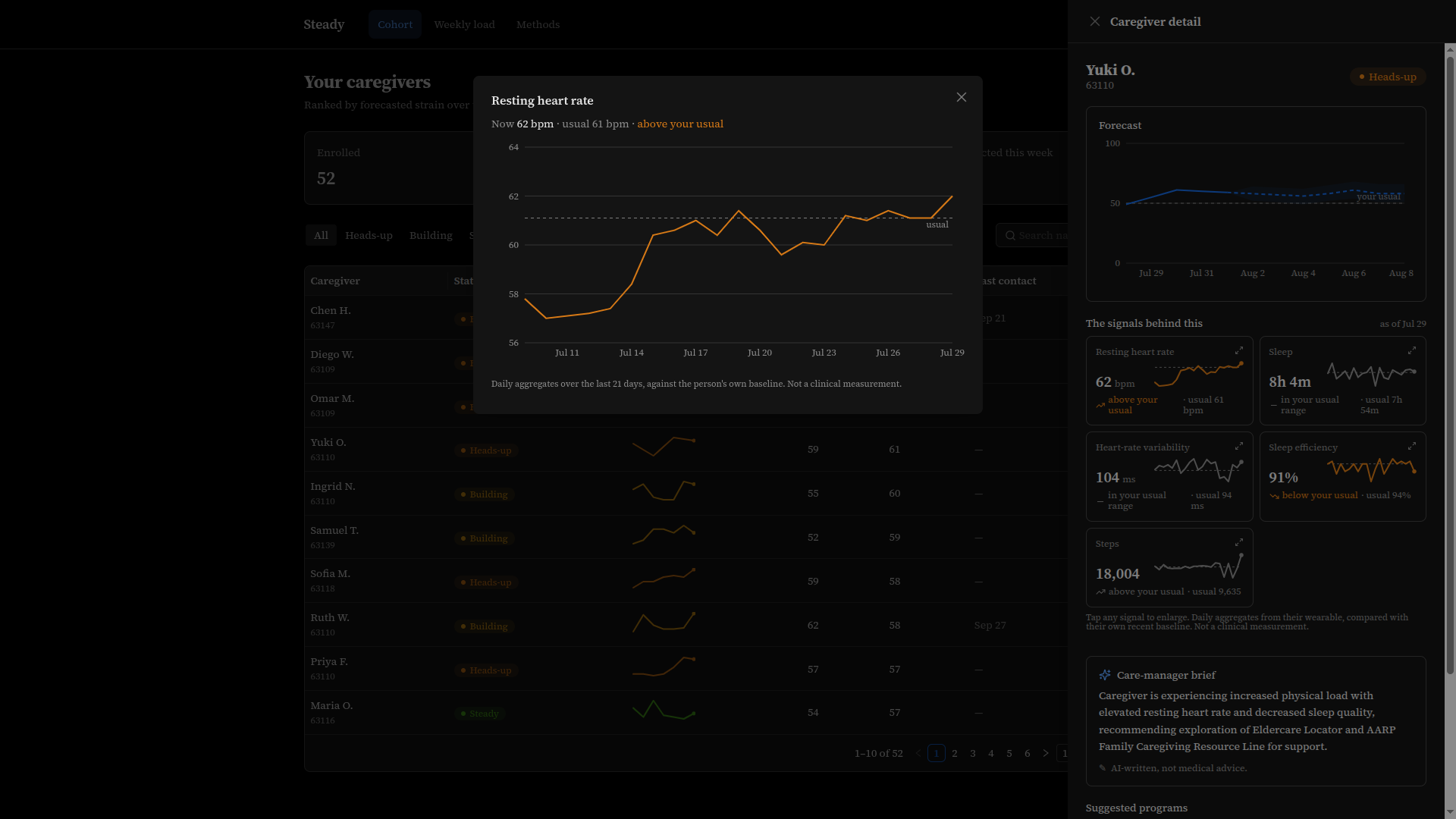
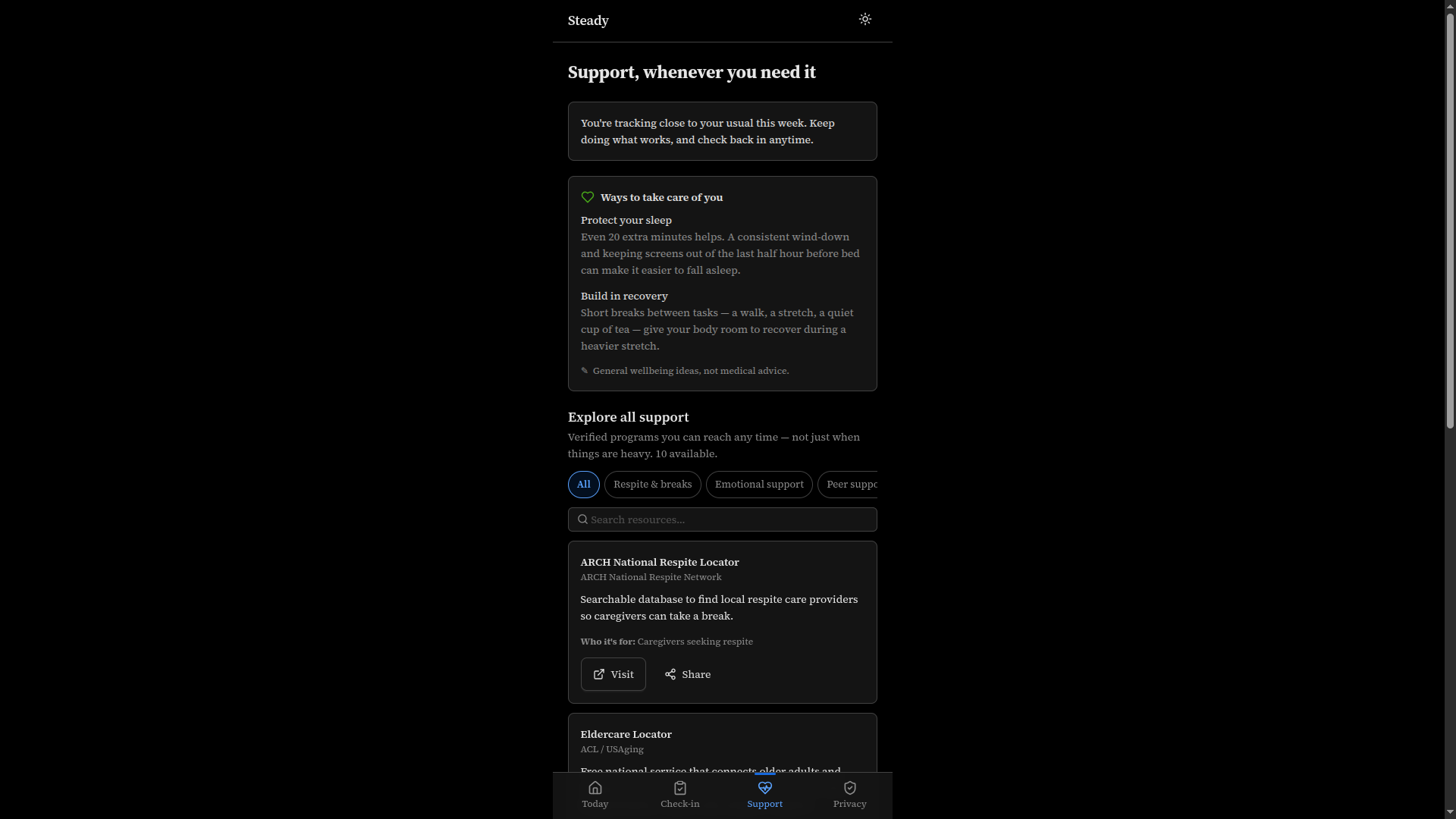
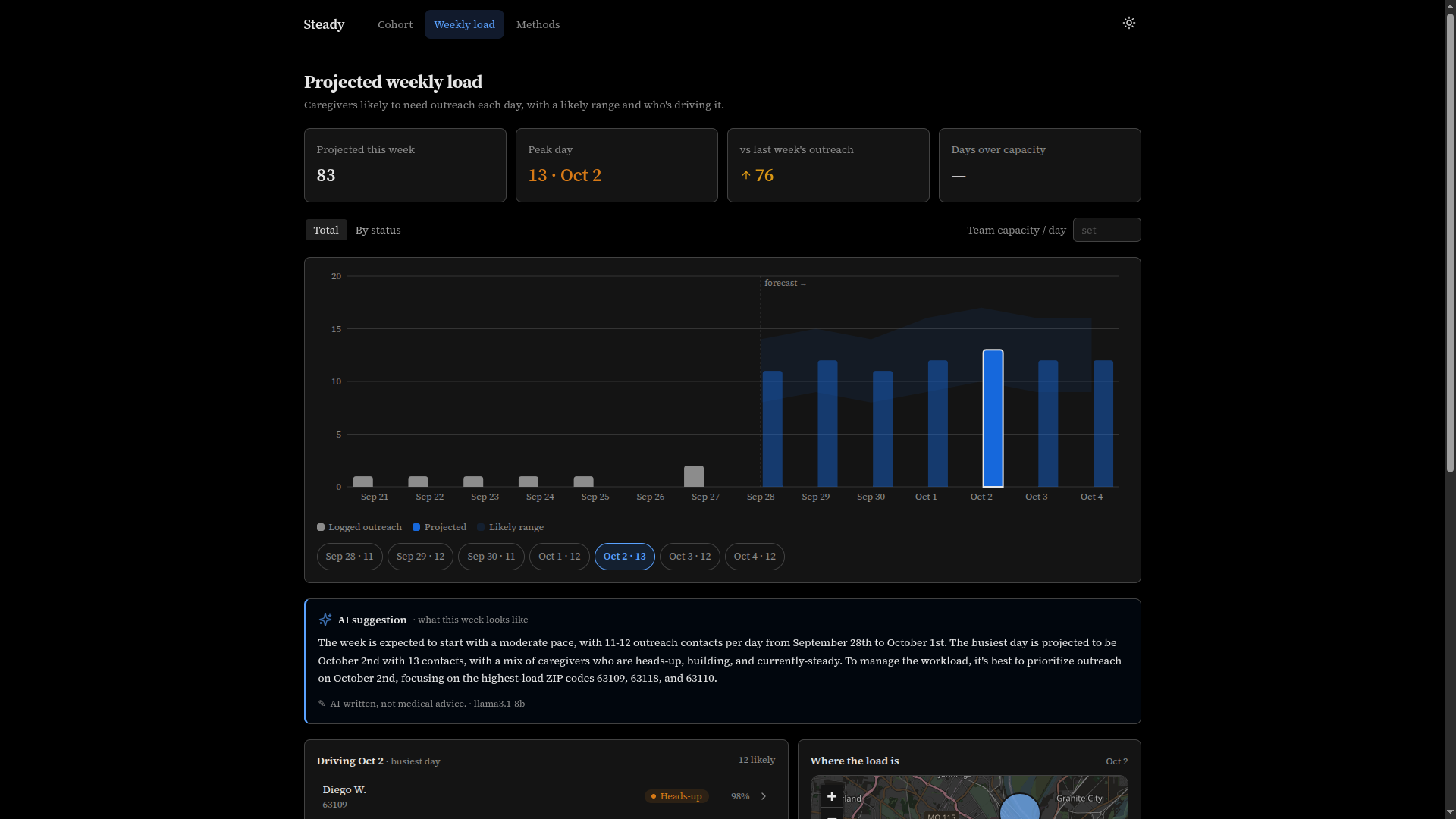
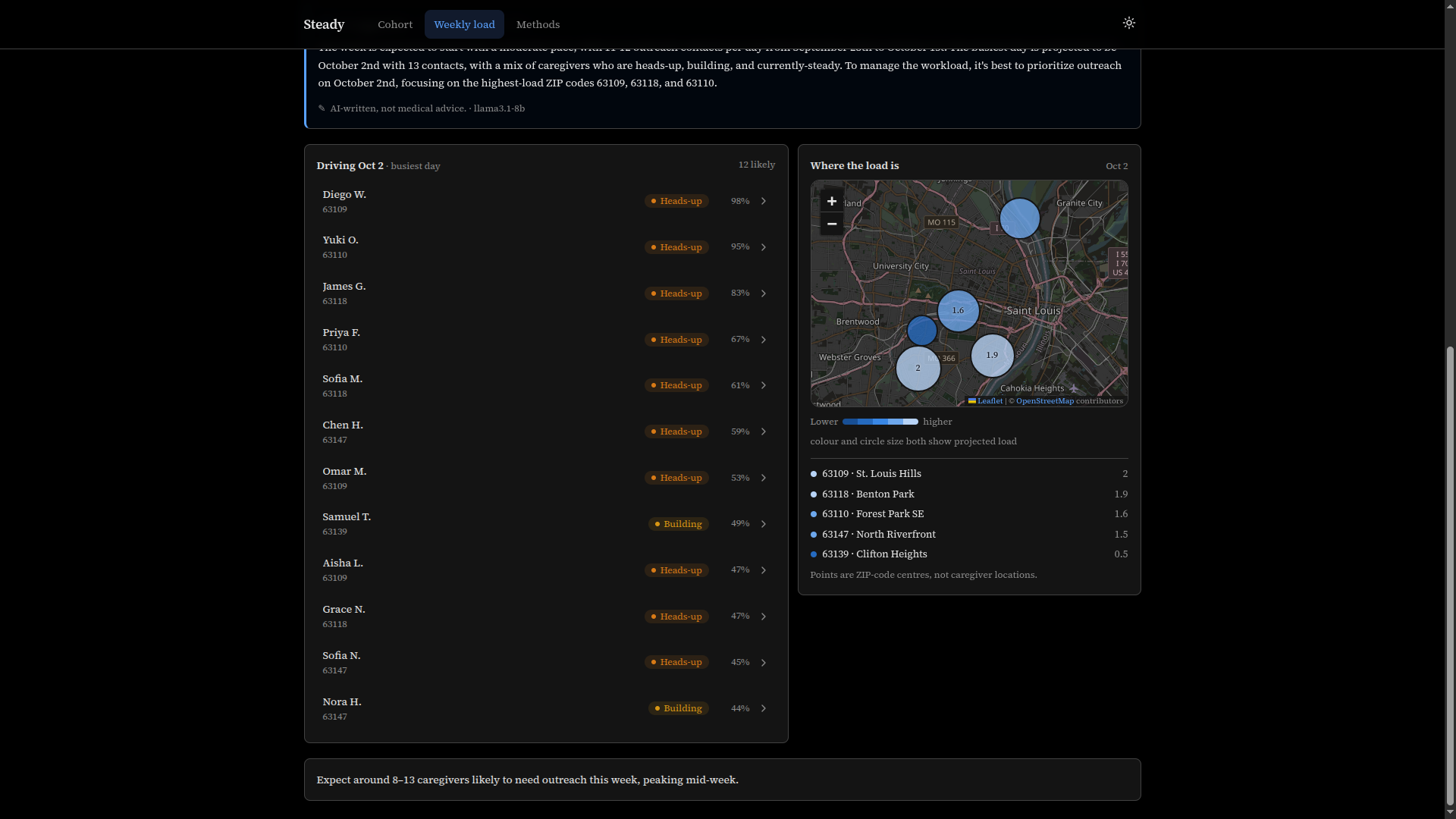
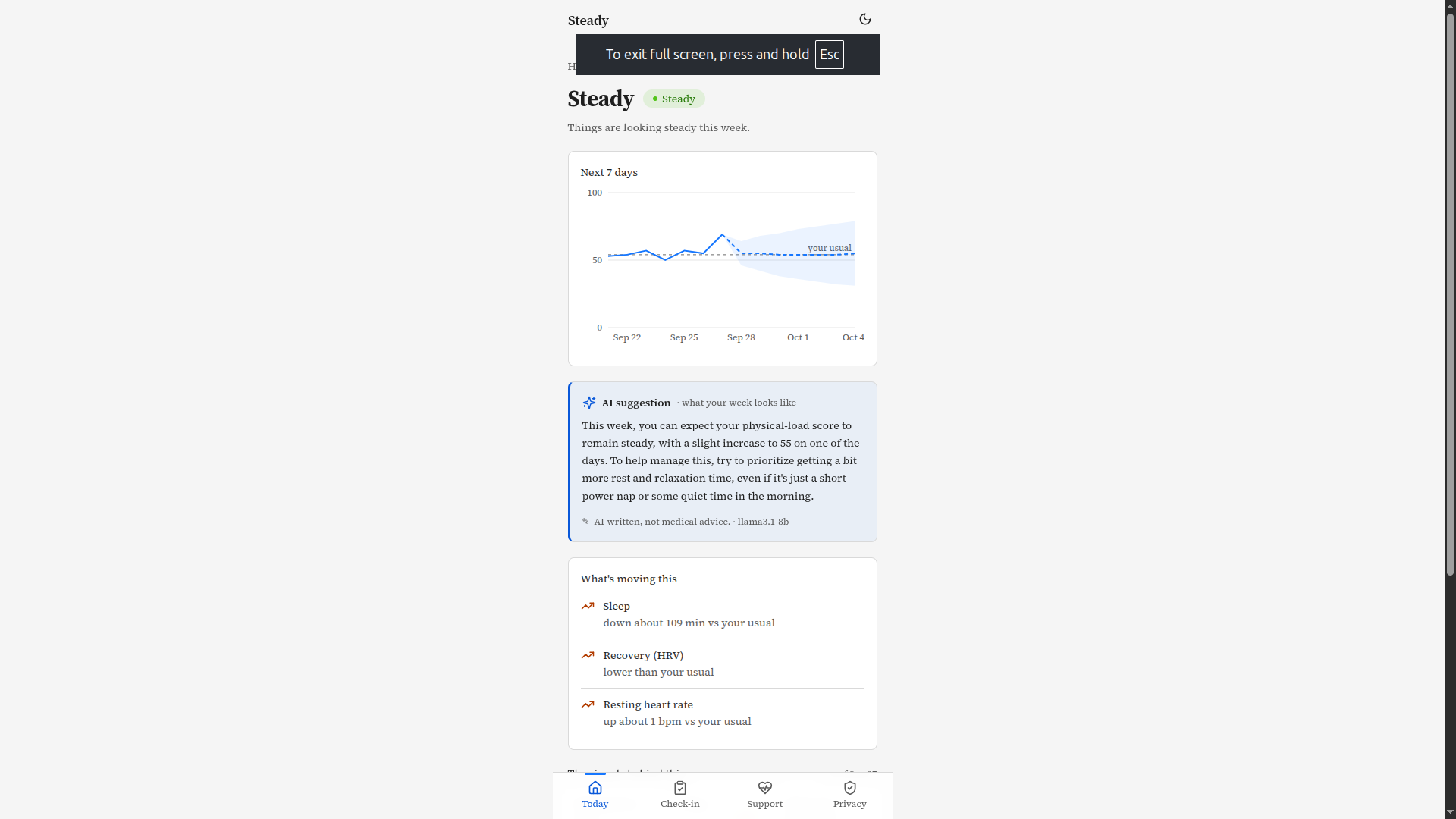
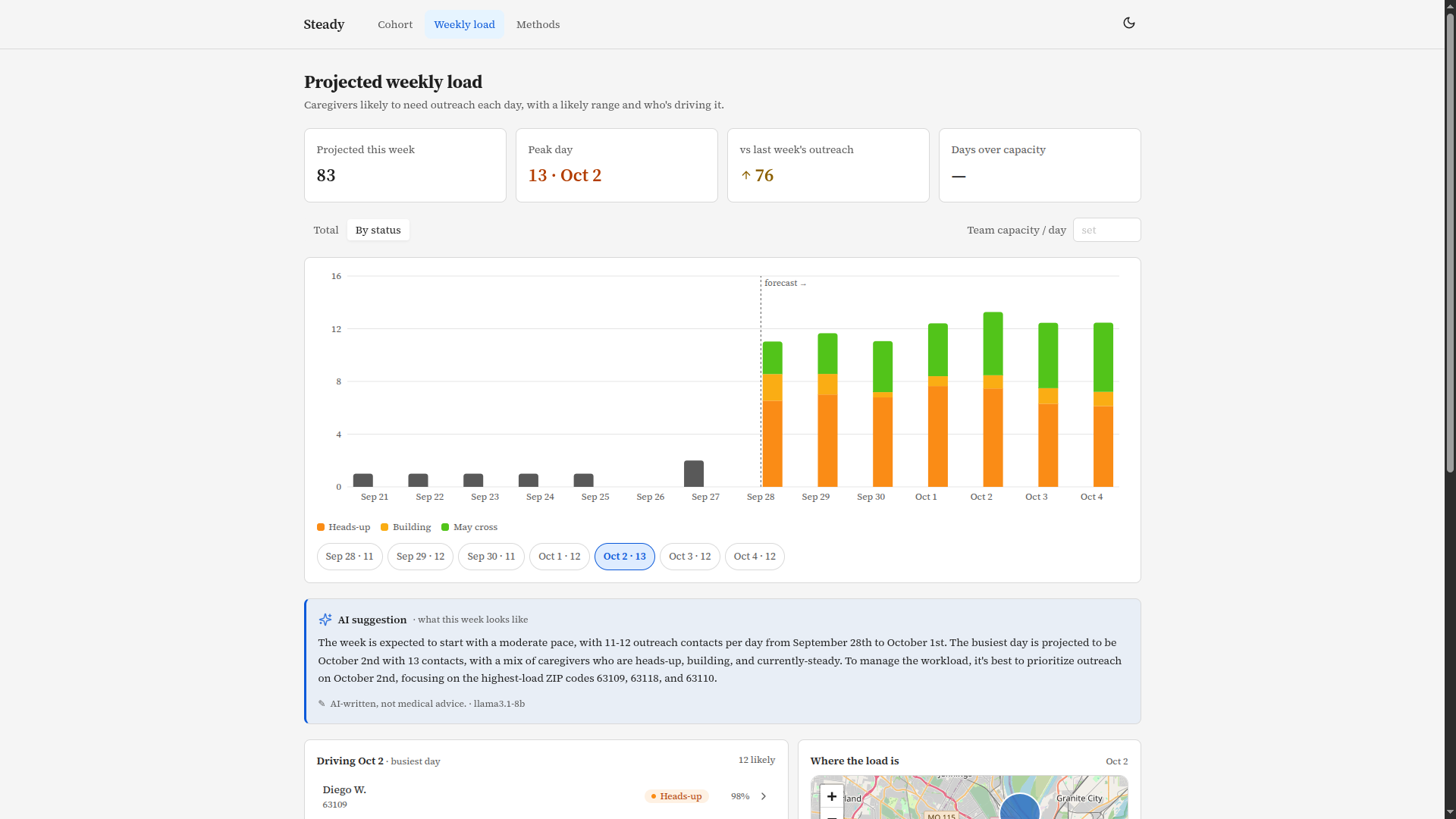
Caregivers get a mobile view: status, 7-day band, each signal against their own baseline. Care managers get a ranked caseload, a projected weekly-load band, and a drawer with a Cortex-drafted outreach draft.
Challenges
We faced challenges getting evidence that wearables really do predict the stress/strain of a person. Besides that, developing an apple watch/iOS feature without a Mac was one of the biggest technical challenges. Apart from that there were several AI/ML related challenges that we were able to solve with existing literature.
Our first target was self-reported mood. Wearables did not predict it: $$r \approx 0$$, $$\text{AUC} \approx 0.46$$. We pivoted to the deterministic load index above.
Our forecast then lost to naive persistence at every horizon: expected for a smooth series. So the forecast stayed for the trajectory + uncertainty band, and the predictive claim moved to episode classification:
$$y_{i,t} = \mathbb{1}\left[ \max_{\tau \in {1,2,3}} L_{i, t+\tau} \geq Q_{0.70}^{(i)}(L) \right]$$
Person-held-out GroupKFold: $$\text{AUC} = 0.803$$, $$F_1 = 0.577$$ (vs. 0.565 persistence), Precision = 0.61 (vs. 0.55).
Stress-detection papers advertise $$F_1 \geq 0.98$$, but those are lab numbers. On real-world external validation the same models drop to $$F_1 \approx 0.58$$; personalized approaches report $$F_1 \in [0.62, 0.66]$$. Our numbers sit inside the real-world band.
Keeping an LLM honest. select_programs() picks IDs in code; Cortex only writes prose around them. Guardrail tests enforce it: invented IDs dropped, ≤ 2 programs, medical-advice phrasing flagged, crisis language routed to 988.
What we learned
Snowflake is Awesome!
The hardest engineering in an ML hackathon is deciding what claim you're allowed to make. Twice we had a working pipeline attached to a claim that didn't survive a baseline, and both times the fix was to change the claim, not the code. A GroupKFold split and a naive baseline killed more of our ideas than any bug did.
Concretely: ML.FORECAST exogenous variables need future values, which rules out live wearables as inputs: hence the two-stage split. Per-person z-scores are what make cross-device transfer conceivable at all. And a 60-second cache is the difference between a dashboard that feels instant and one that waits for a warehouse to wake up.
Limits
Trained on LifeSnaps: general Fitbit wearers, not caregivers (71 participants, 63 usable). Load is a physiological proxy, not a clinical measure. The live Apple Watch participant demonstrates the pipeline end-to-end and is not model validation. Only daily aggregates leave the phone. Steady is opt-in decision support, not a diagnostic device.
Built With
- amazon-web-services
- fastapi
- react
- snowflake

Log in or sign up for Devpost to join the conversation.