-
-
01-cover: SteadPal: the paycheck freelancers never had. A feature concept for PayPal. Click PayPal. Build your future
-
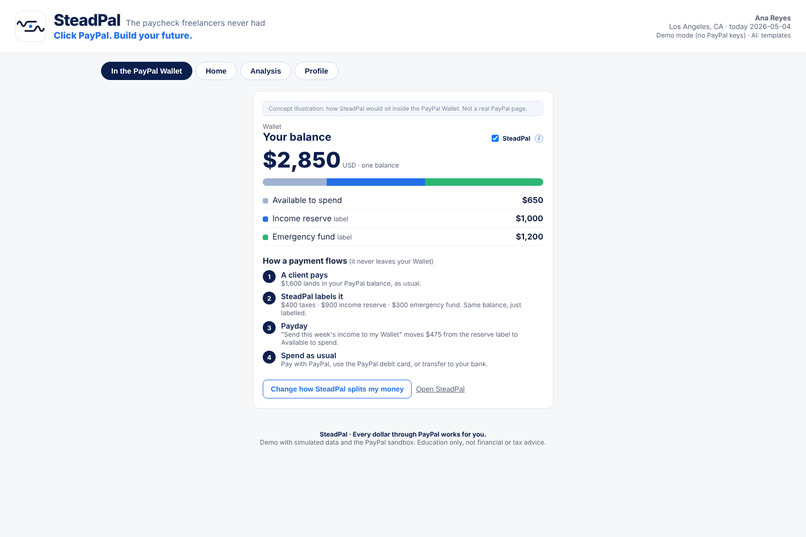
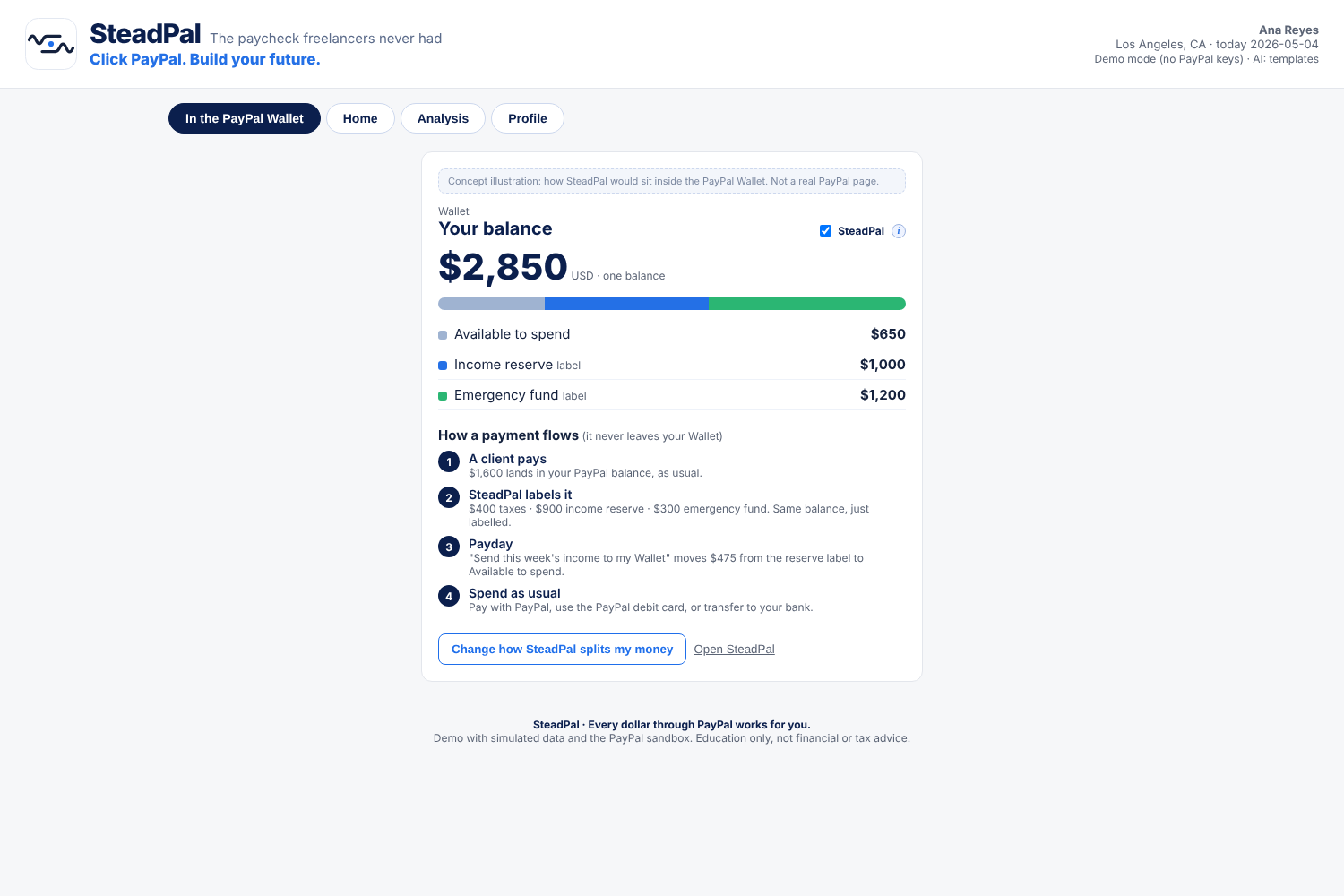
02-wallet: Inside the PayPal Wallet: one balance, labelled into pots. The money never leaves PayPal and SteadPal can be switched off anytime
-
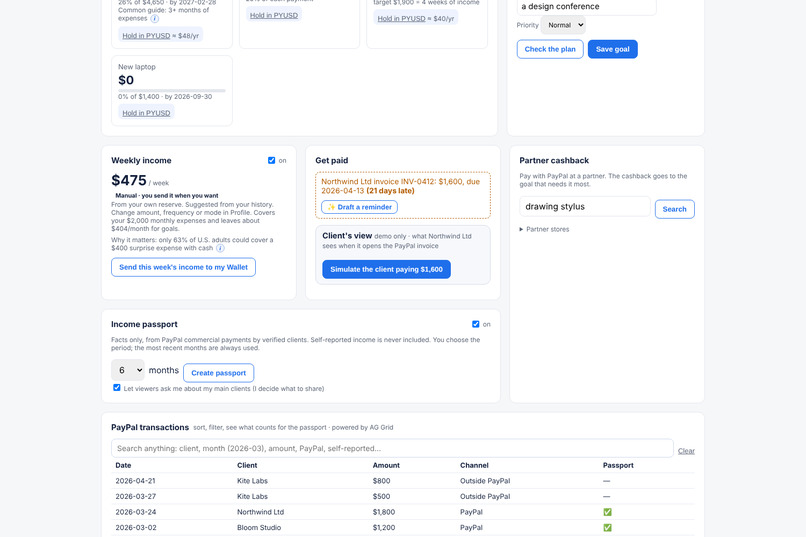
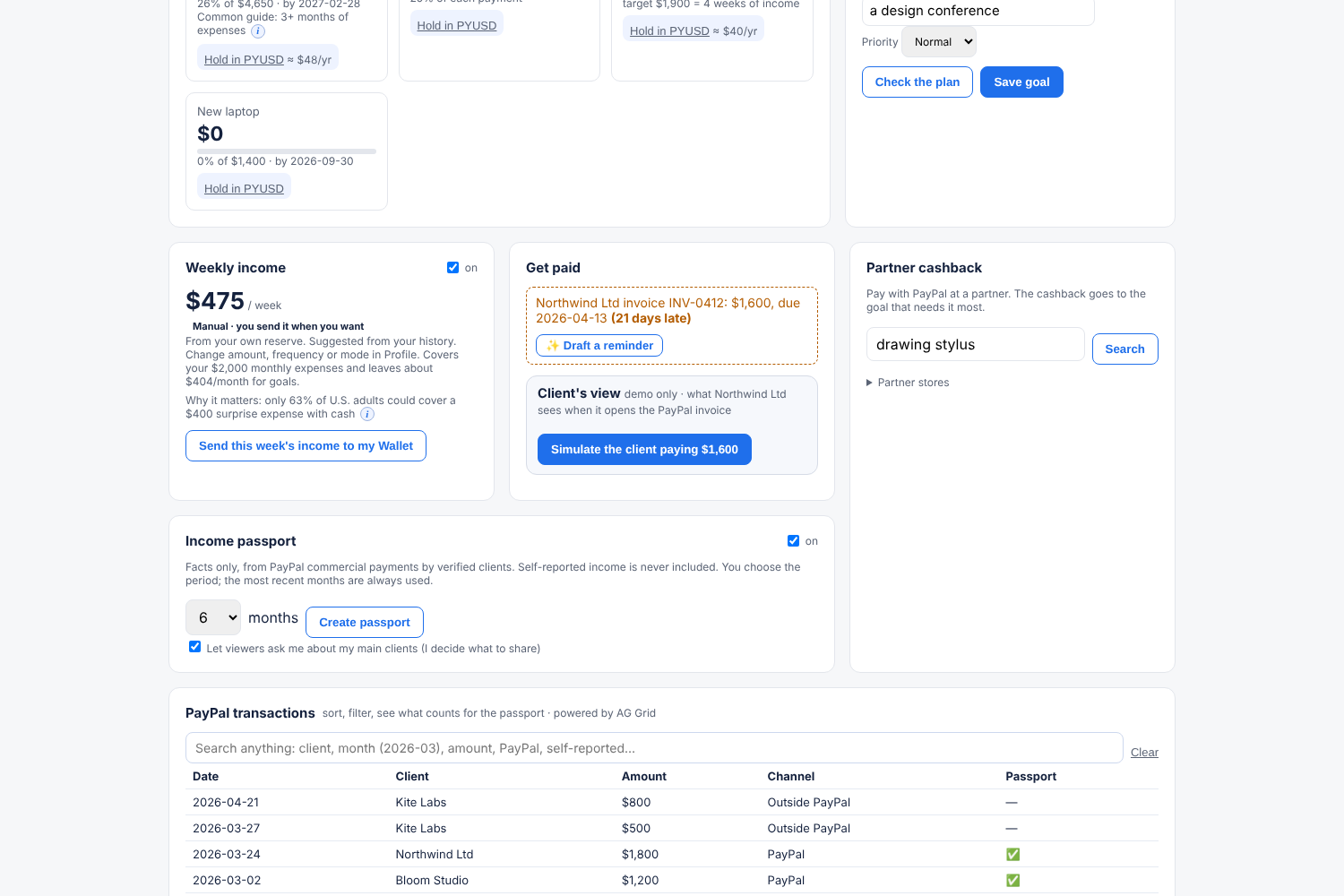
03-client-view Get paid: a late $1,600 invoice, an AI reminder, and a separate Client's view where the client pays with PayPal or Pay Later.
-
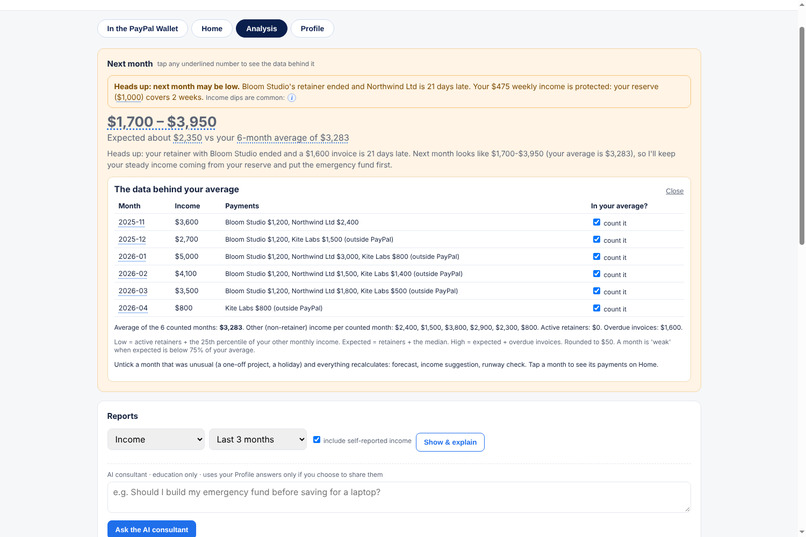
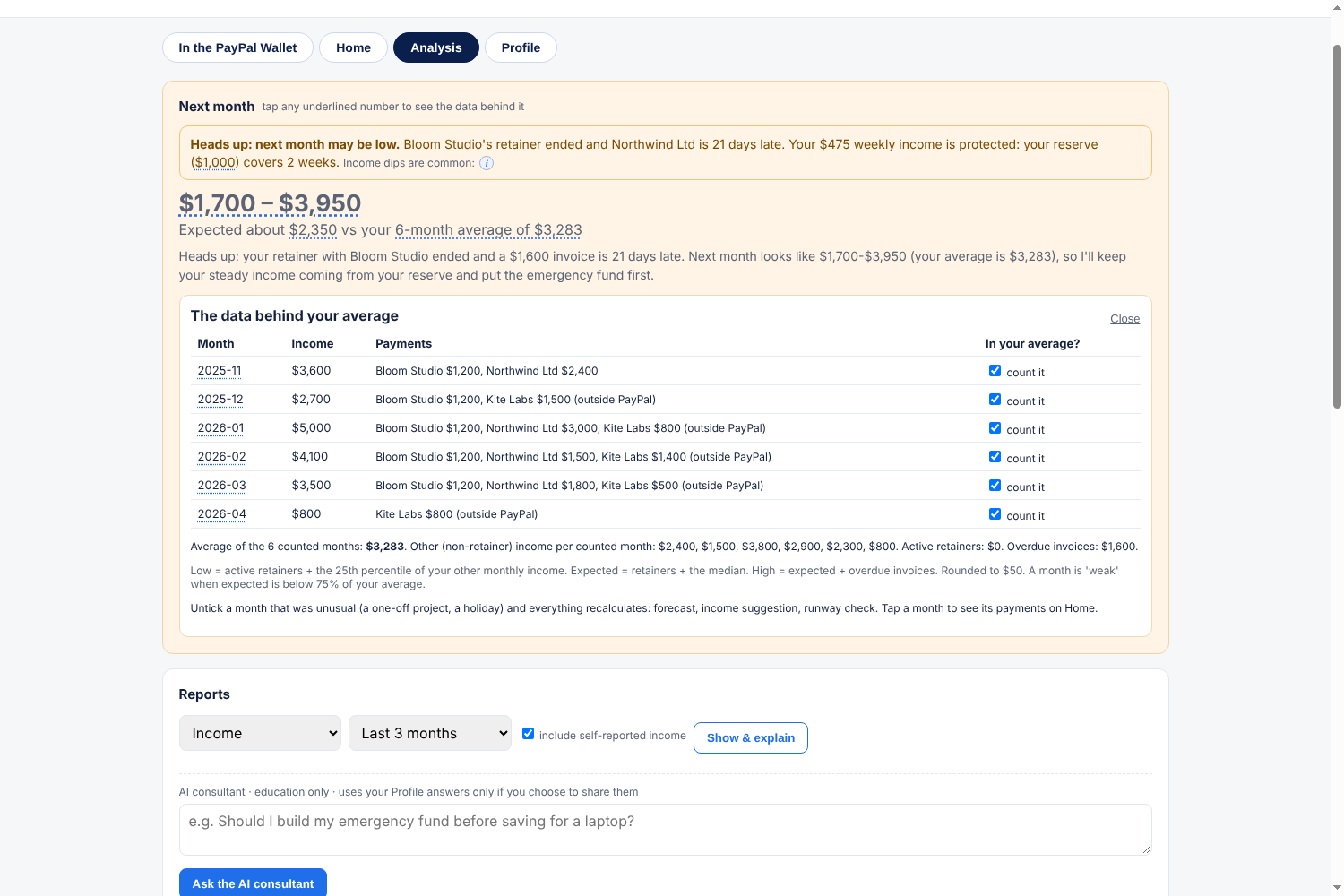
04-forecast-evidence: A warning before a weak month. Every number links to the data behind it, and unusual months can be left out.
-
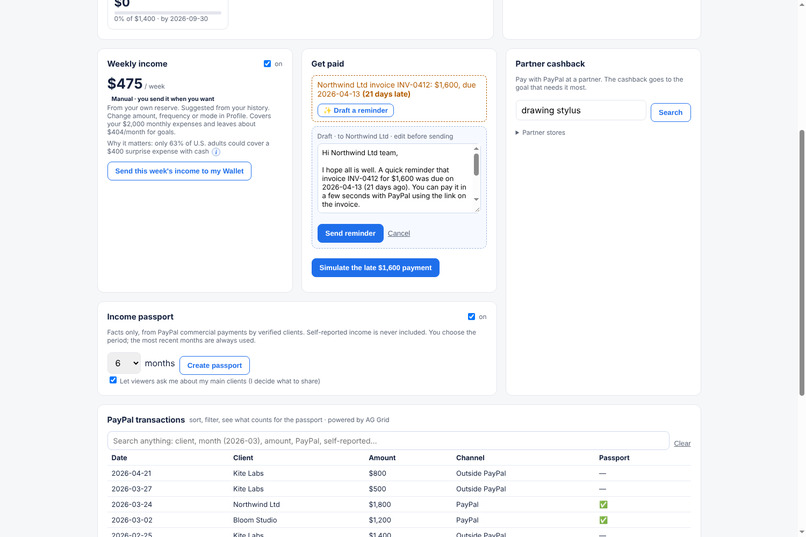
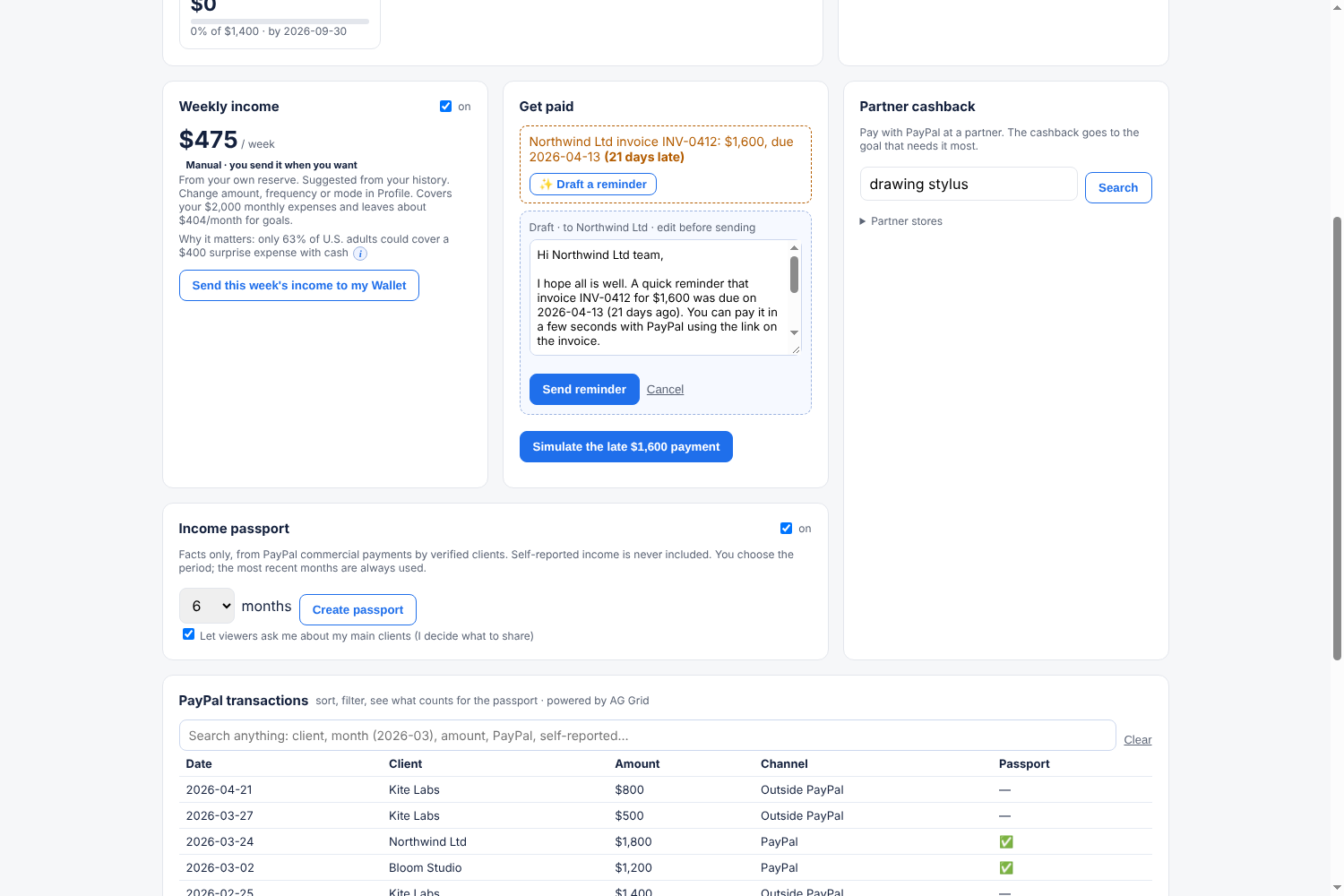
05-ai-reminder: Claude drafts a polite reminder for a late invoice. She edits it and sends it through PayPal; the client can use Pay Later.
-
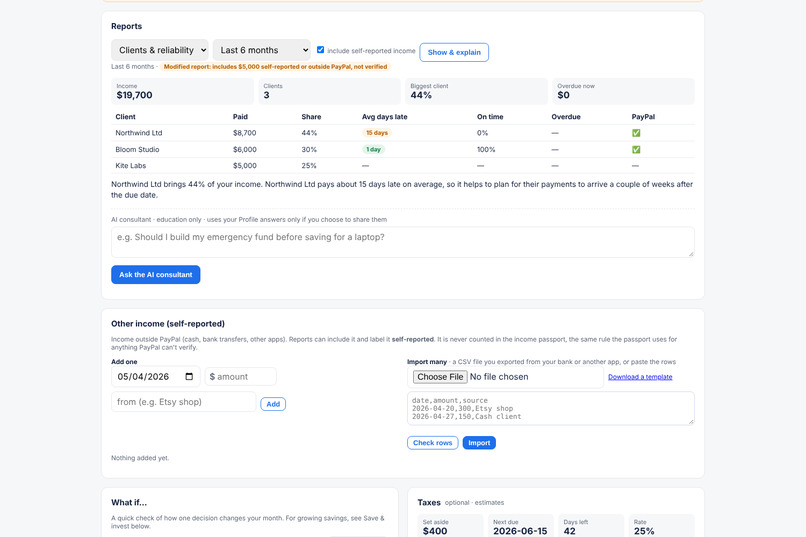
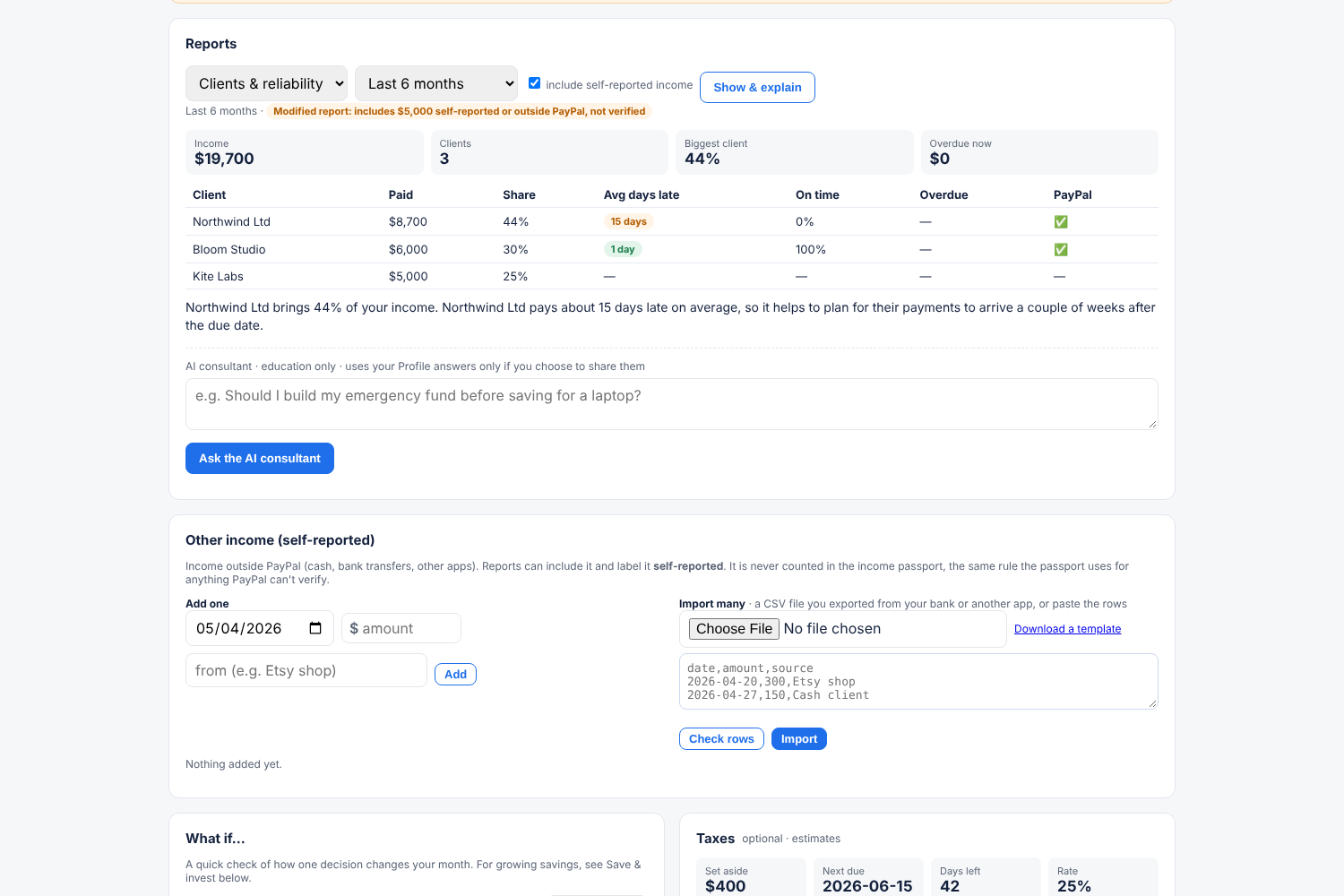
06-reports: Reports for any period: which clients pay late and how much depends on each. An AI consultant answers her questions.
-
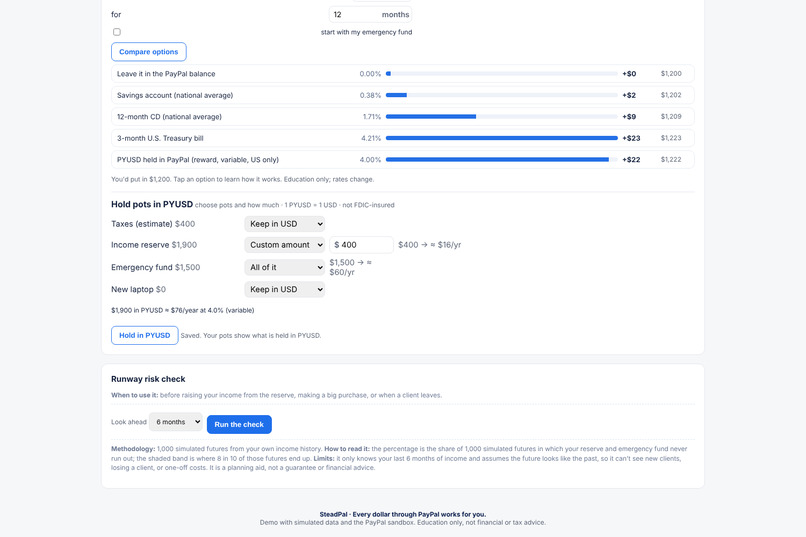
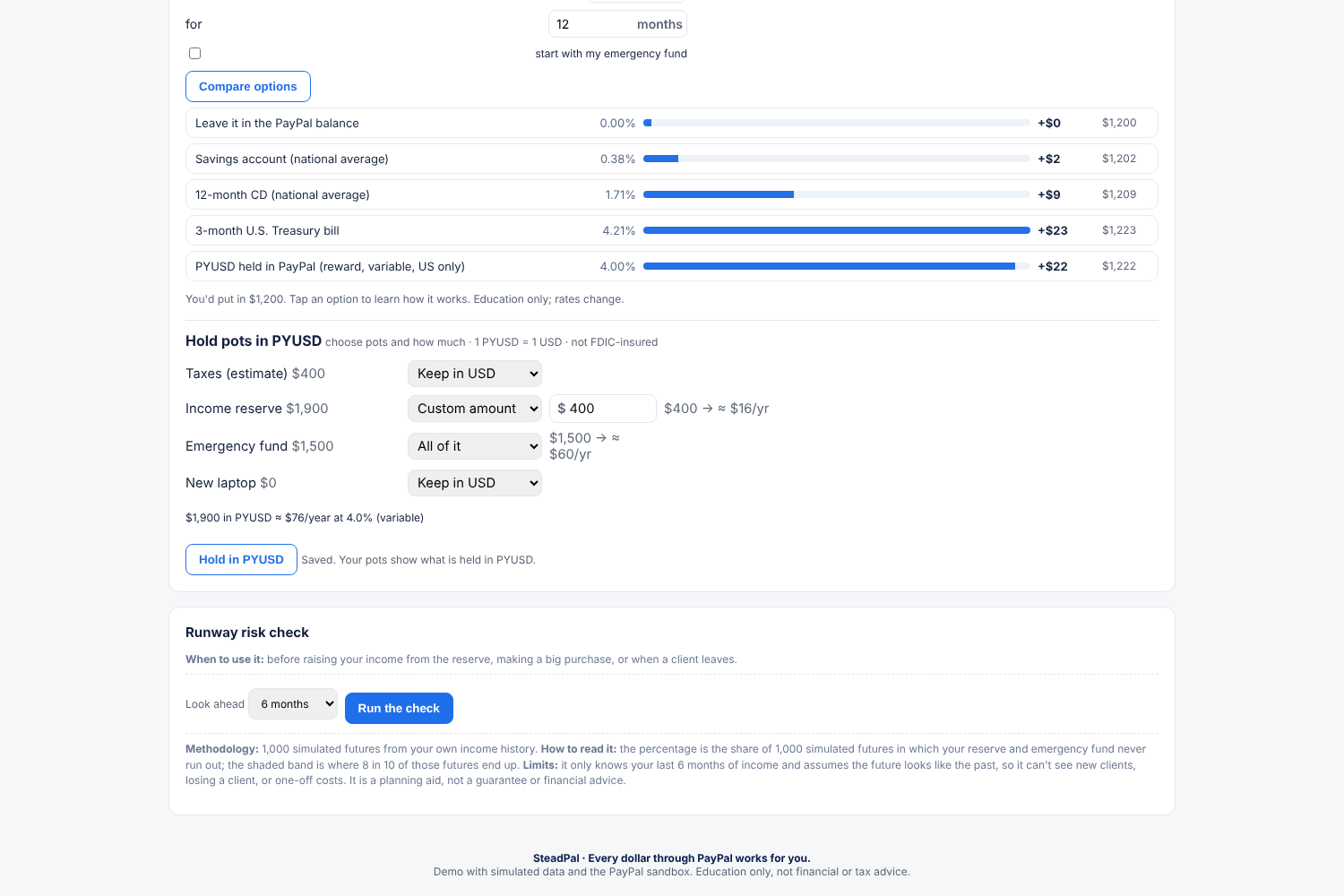
07-save-invest Save & invest at official rates, and hold any pot in PYUSD: all, half or a custom amount.
-
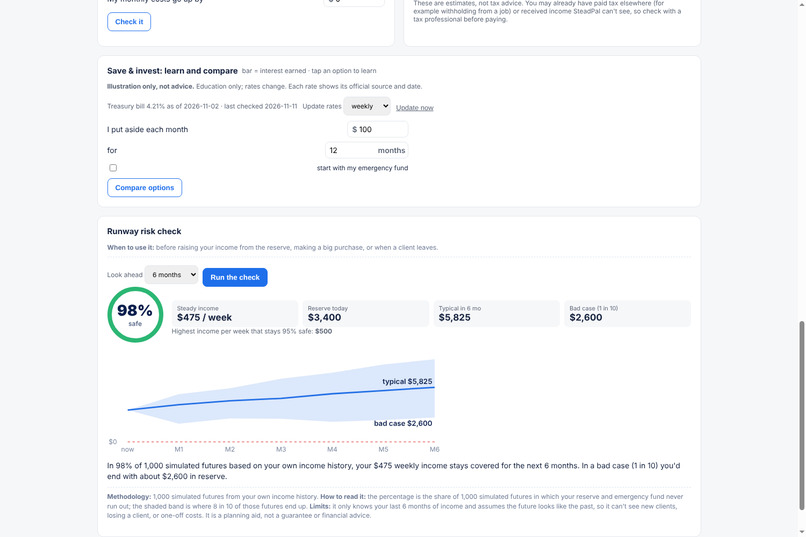
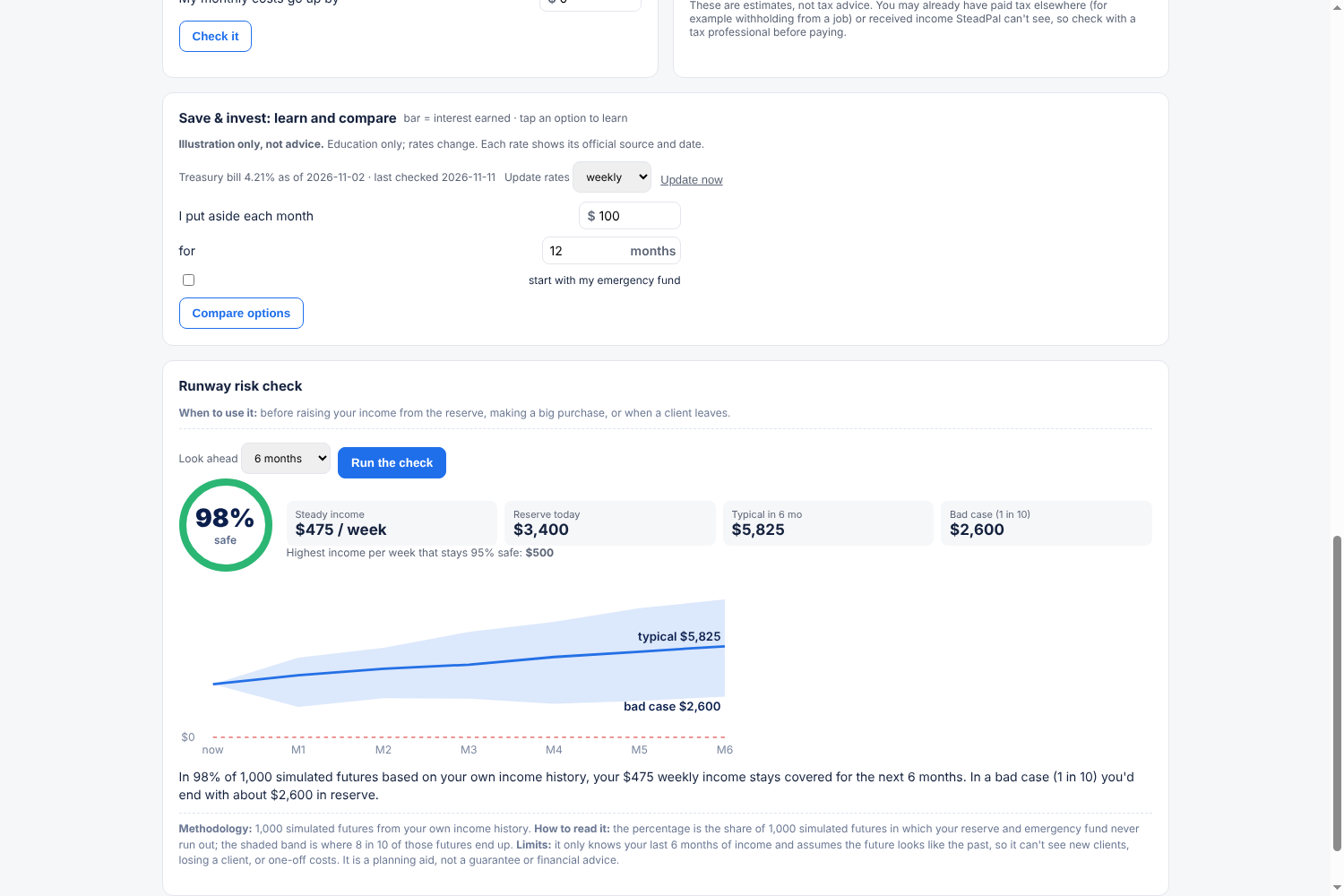
08-runway-risk: Is her income safe? 1,000 simulated futures from her own history show the chance her reserve lasts 6 months.
-
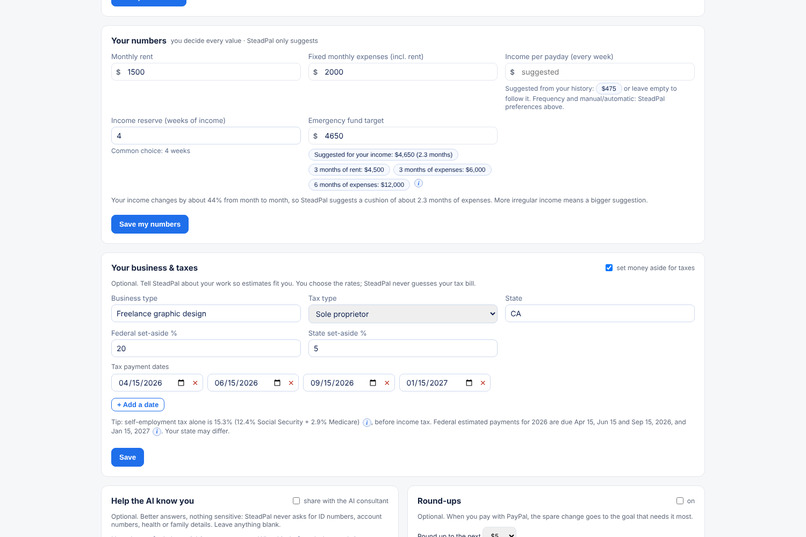
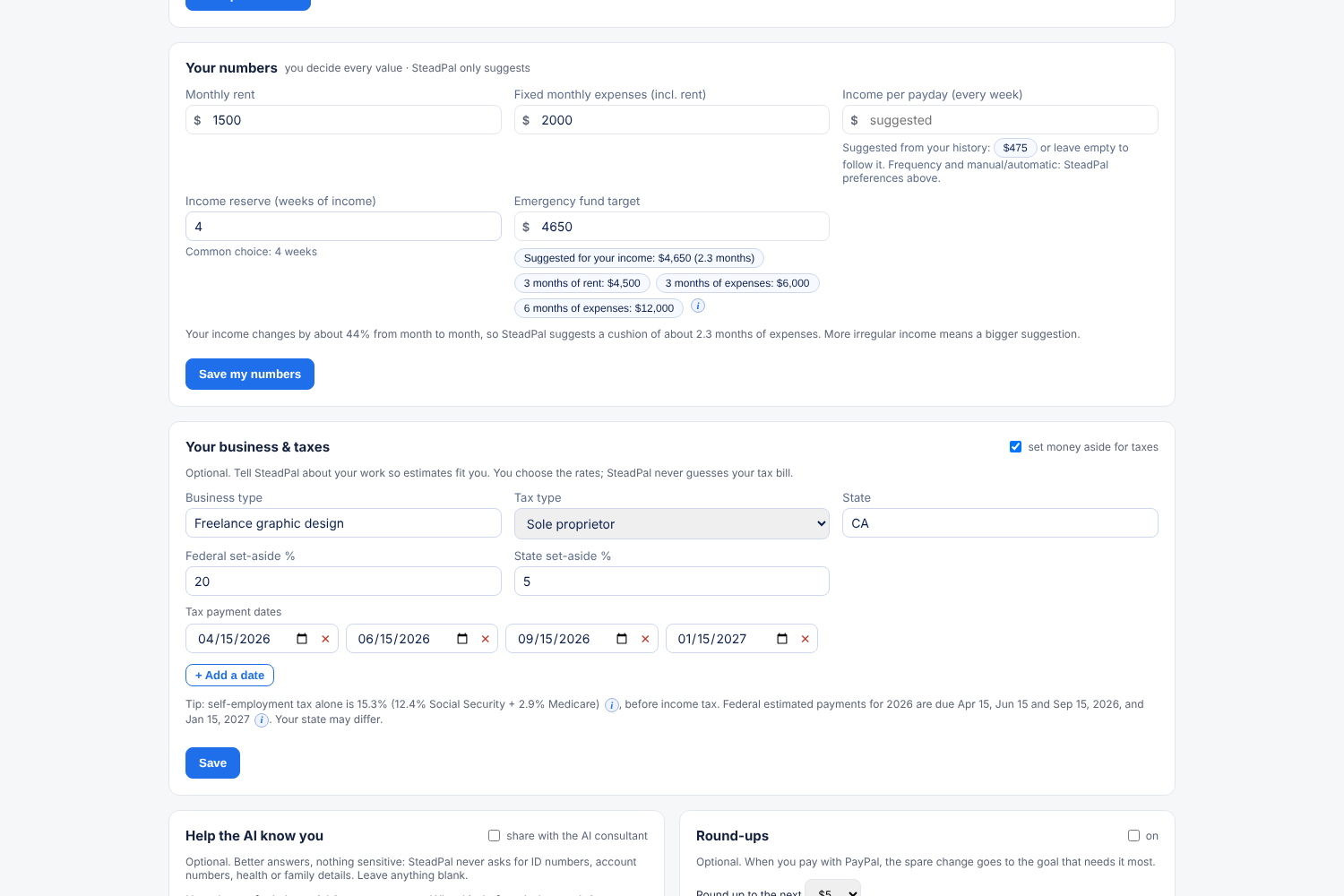
9- Profile: her numbers, business and taxes (optional), and how each payment is split. Most features can be turned on or off.
-
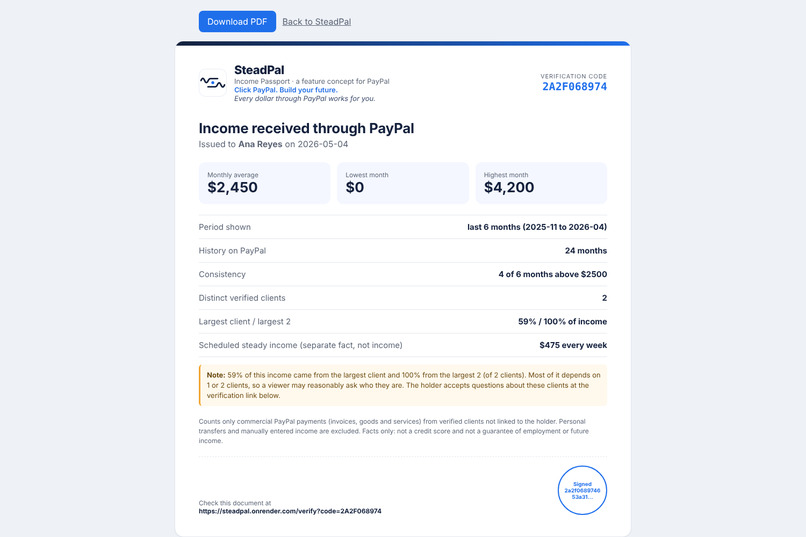
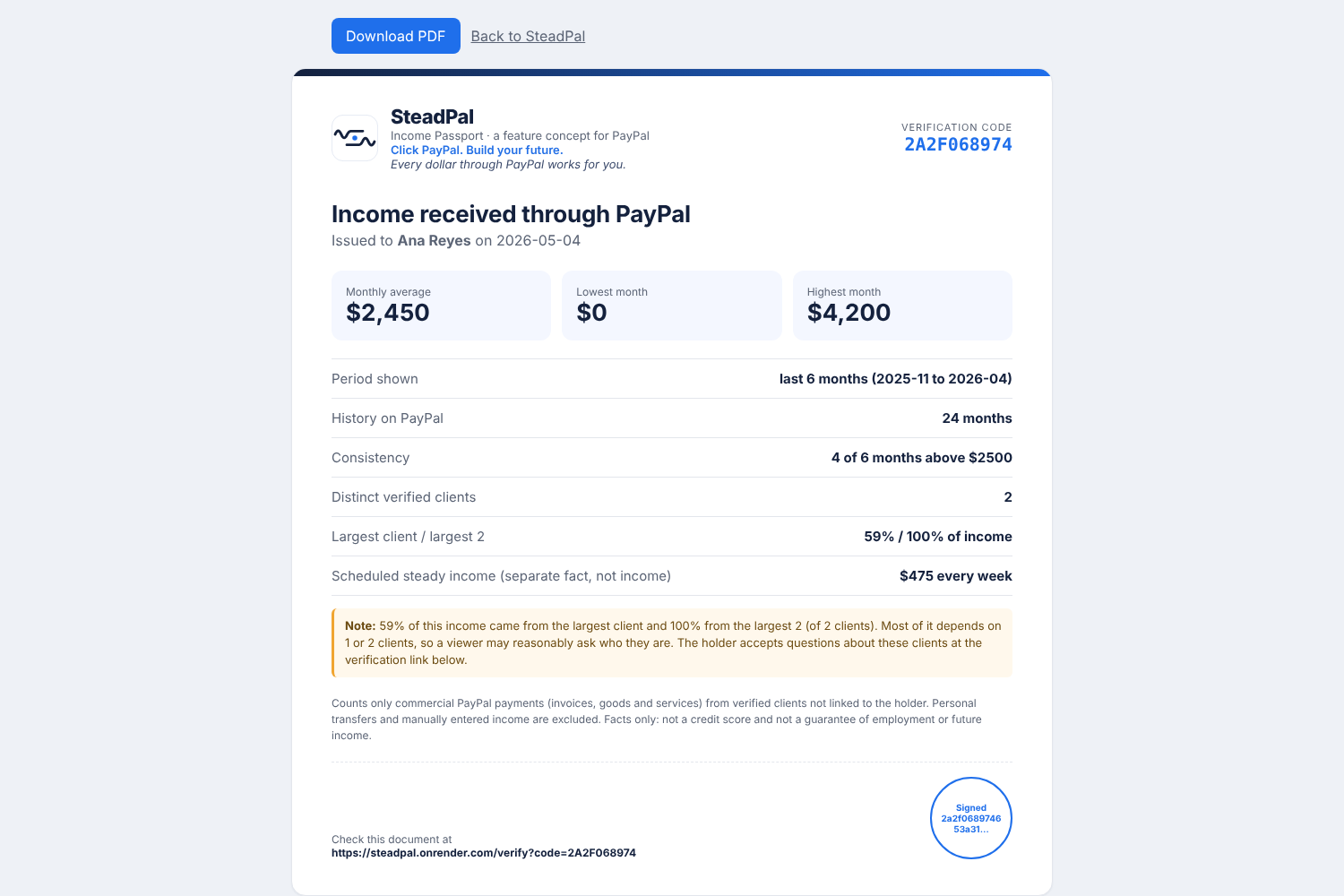
10-income-passport: A signed income passport: facts from PayPal payments only, never a score, with a code anyone can verify
Inspiration
The research behind SteadPal is about social protection for people with irregular income: freelancers, gig workers and informal workers. They earn $3,500 one month and $800 the next, but rent stays the same. Nobody sets money aside for their taxes, emergencies or a steady paycheck.
In the US, 64 million people (38% of the workforce) did freelance work in 2023, according to Upwork's Freelance Forward study. Many of them are paid through PayPal, and that money lands in one balance with no plan. We wanted the PayPal button to do more than move money: every dollar through PayPal should work for the person receiving it.
What it does
SteadPal is a feature concept inside the PayPal Wallet that turns every payment into a plan. It has three tabs (Home, Analysis and Profile), and you can try it as Ana, a freelance designer in Los Angeles, with a 10-step guided demo that plays with a voiceover.
- Smart split: when a client pays, the money is split into pots (taxes, an income reserve, an emergency fund and goals). Pots are labels over the PayPal balance, so the money never leaves PayPal.
- Steady income: Ana pays herself a weekly (or biweekly, monthly or custom) income from her own reserve, never more than her history supports. No lending.
- Partner cashback and round-ups: real products from Channel3, paid with PayPal. The cashback and optional round-ups go to the goal that needs them most, not to the wallet.
- Income passport: a signed certificate with facts from PayPal payments only (monthly average, lowest and highest month, verified clients), a note when one or two clients bring most of the income, a code anyone can verify, and a 30-day expiry. Facts only, never a score.
- Next month: SteadPal sees a weak month coming (a retainer ended, an invoice is late) and every number opens the data behind it.
- Reports and self-reported income: income, clients and how late they pay, cash flow, taxes and goals, for any period, with an AI consultant. Income outside PayPal can be added or imported, and those reports are marked as modified.
- What if: shows how a purchase delays her goals. SteadPal shows the trade-off; she decides.
- Save & invest, and PYUSD: compares savings options at official rates (FDIC, Federal Reserve, PayPal's PYUSD reward). Ana can hold any pot, all of it, half or a custom amount, in PYUSD, with a clear note that PYUSD is not FDIC-insured.
- Runway risk: 1,000 simulated futures from her own history show how likely her income stays covered.
- Profile: business type, tax type, state and tax dates (taxes are optional), plus her split, pay frequency and goals. SteadPal, and any of its features, can be turned on or off anytime.
How I built it
- Server: Node.js with no dependencies, deployed on Render with auto-deploy from GitHub.
- PayPal (sandbox): JavaScript SDK and Orders v2 (the client pays an invoice, Pay Later, partner purchases), Invoicing v2 (create, send, remind) and Payouts (steady income). In the demo, the client's payment buttons sit in a separate "Client's view" box, because the client pays, not Ana.
- AI: Claude through the Anthropic API explains every decision, drafts reminders, writes report summaries and answers questions. Its system prompt only allows the numbers it is given and education, never investment advice.
- Principle: the AI explains, the code calculates and verifies, the user decides. A deterministic engine computes every number: statistics, forecast, reserve target (1 + 3 × the income's coefficient of variation, between 1 and 6 months of expenses), safe income, the split and a validator that rejects any split that does not add up. The runway check is a bootstrap Monte Carlo of the user's own income.
- Partners: Channel3 for real product search, AG Grid for the transactions table, Render for hosting. Voiceover generated with ElevenLabs.
Challenges I ran into
- Silent AI failures. The app fell back to templates without saying so. First the Claude model rejected a deprecated
temperaturesetting, then the answer came after a thinking block the code did not read. We added an/api/ai/checkendpoint to show the real error, read only the text blocks and raised the token limit. - Keeping the AI's numbers honest. The model can phrase a split wrongly, so the engine computes every amount, a validator rejects any split that does not add up to the payment, and the AI only receives those final numbers.
- Statistics on little data. A freelancer may have only a few months of history. The reserve uses the coefficient of variation of the last 6 months (leaving out months the user marks as unusual), clamped between 1 and 6 months of expenses, and the runway check resamples her own months 1,000 times with a fixed seed so results are repeatable.
- A tamper-proof passport without a database. The certificate is signed with an HMAC key kept in Render environment variables, so the public verification page can prove a code is genuine without storing personal data.
- Staying on the right side of the rules. SteadPal does not lend, does not hold money and does not score people. The passport only states facts from PayPal's own records, at the user's request.
- Fraud. The passport only counts commercial payments from verified clients that are not linked to the user.
Accomplishments that I'M proud of
- A full working product: 3 tabs, a 10-step guided demo with voiceover, real PayPal sandbox payments and a live AI.
- An actuarial idea (a reserve sized to how irregular your income is, and a Monte Carlo runway check) explained in one sentence a freelancer understands.
- Every rate shows its official source and date.
What I learned
- PayPal's REST APIs (Orders, Invoicing, Payouts) and how much they can do for small businesses.
- How to design AI that people can trust: let it explain and draft, and keep the math in code.
- To test the live deployment early, because the AI and PayPal permissions only showed problems on the real server.
What's next for SteadPal
- Live data through Transaction Search and Log in with PayPal for consent.
- Pay Later on every invoice, so clients can spread payments while freelancers are paid in full now.
- SteadPal for Venmo and gig workers.
- Emerging markets: PYUSD payouts for freelancers abroad and family-support pots through Xoom, with licensed partners.
- An agent mode that acts only with the user's approval: send invoices, move money between pots.
