Inspiration
Booking a hotel should be exciting, but it often feels like a suffering long journey. Every trip brings the same repetitive routine: set a budget, filter by rating, rule out unsuitable accommodation types, evaluate the location, scan both the highest- and lowest-rated reviews for hidden advantages or deal breakers, compare prices across platforms, and repeat the entire process for the next trip.
Traditional booking platforms may remember what users searched for, but they rarely remember why someone chooses one hotel over another.
We built Staylight around a simple question:
What if hotel search could learn what “right for you” means?
Staylight is a personal hotel-selection assistant that remembers a traveler’s long-term preferences, understands the unique needs of each trip through conversation, and turns overwhelming hotel listings into a focused, explainable shortlist.
What It Does
Staylight separates hotel requirements into two layers:
- Long-term preferences, such as value, location, cleanliness, quietness, and guest rating
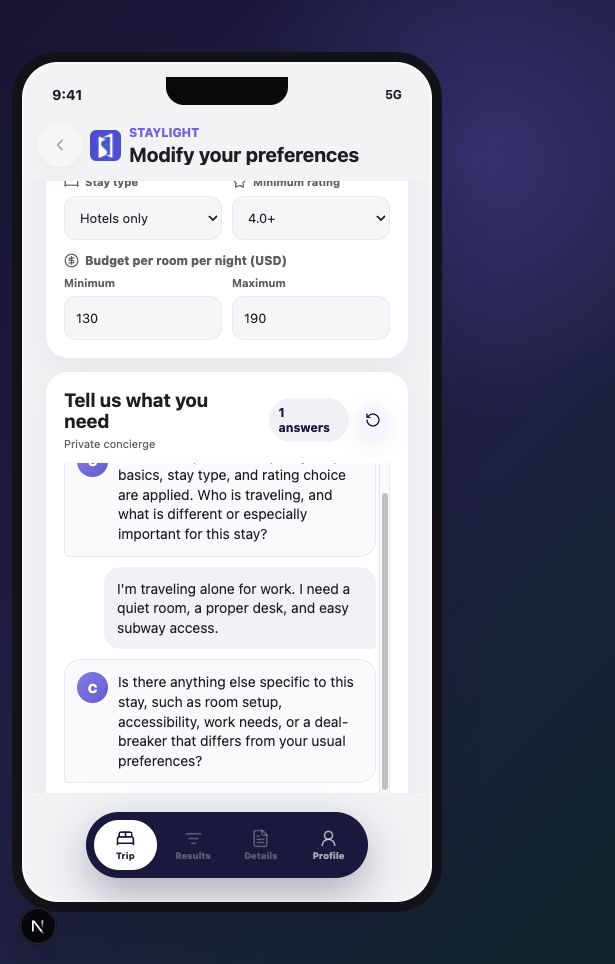
- Trip-specific needs, such as traveling with family, needing a desk, avoiding nightlife areas, or requiring a bathtub
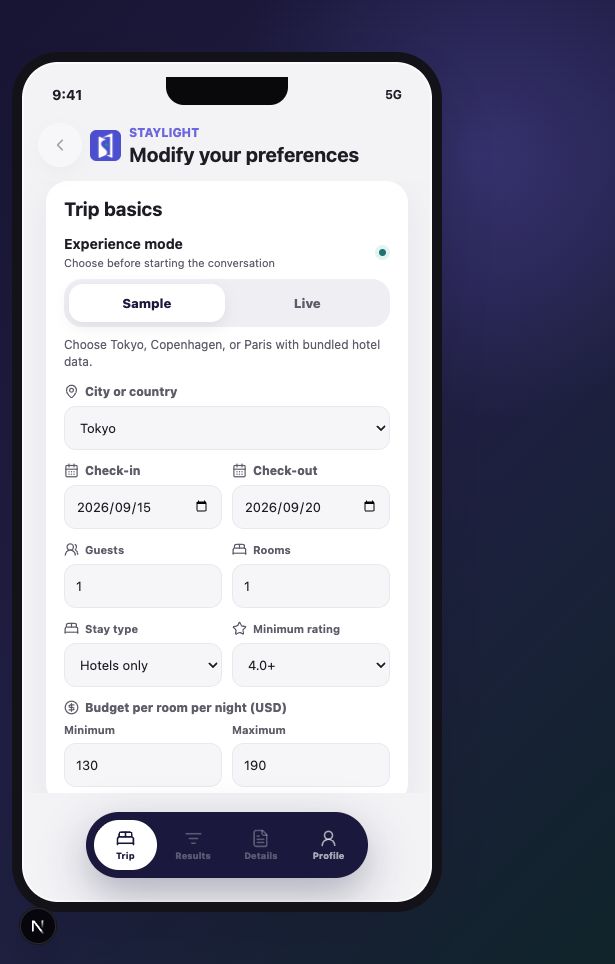
Instead of asking users to repeat everything, Staylight stores stable preferences locally on their device. For each new trip, users only need to enter structured basics such as destination, dates, number of guests and rooms, accommodation type, minimum rating, and nightly budget.
A conversational concierge then asks what is different or especially important for that stay. Staylight transforms the conversation into meaningful requirements and deal breakers without treating every word as a search filter.
The app then:
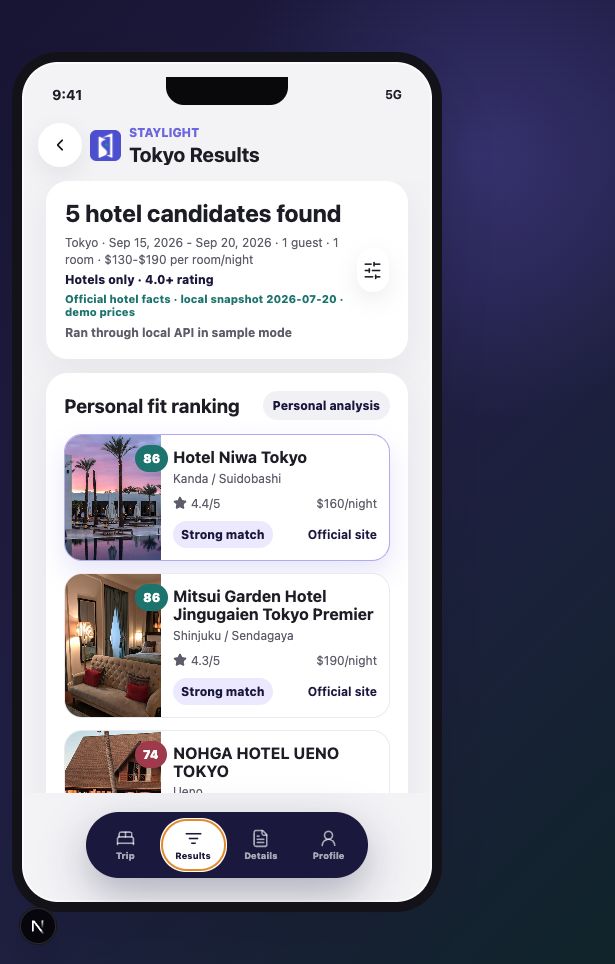
- Removes hotels that violate explicit deal breakers.
- Applies hard filters for budget and accommodation type.
- Ranks the remaining hotels using deterministic personal-fit scoring.
- Extracts recurring concerns from low-scoring reviews as Watch-outs.
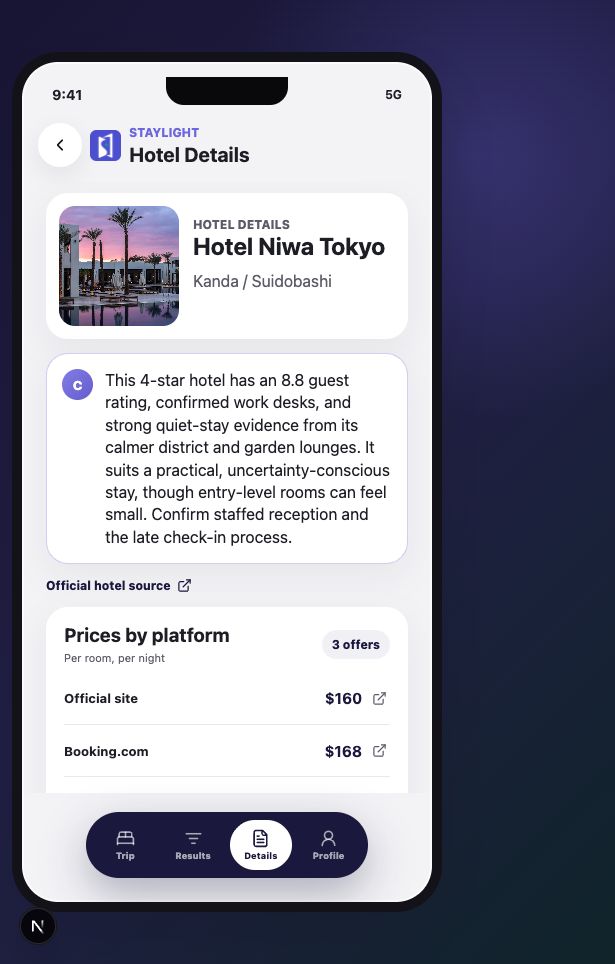
- Generates a concise explanation addressing each user requirement.
- Shows the lowest available price and links to multiple booking platforms.
How We Built It
Staylight is a mobile-first web application built with:
- Next.js 15
- React 19
- TypeScript
- OpenAI API
- SerpApi
- Zod for structured validation
- A custom deterministic ranking and filtering engine
GPT has two focused responsibilities.
First, it conducts the trip interview and transforms natural conversation into structured requirements, keywords, preferences, and deal breakers.
Second, it synthesizes hotel facts, review evidence, and matching results into clear, personalized explanations on the Hotel Details page.
We deliberately keep critical decisions outside the model. Budget limits, accommodation type, rating thresholds, deal-breaker exclusions, price comparison, and ranking calculations are enforced by deterministic code. The model can interpret and explain the results, but it cannot override these constraints.
For accessibility and reliable judging, Staylight includes two modes:
- Sample mode uses bundled hotel snapshots for Tokyo, Copenhagen, and Paris and works without API keys.
- Live mode accepts open destination input and retrieves current hotel candidates through external search.
API keys remain in server-side environment variables. They are never stored in browser storage or exposed to the client.
Challenges we ran into
The hardest challenge was balancing conversational flexibility with strict search behavior.
Natural-language requirements can be vague, overlapping, or negative. “Close to the city center” is a preference, while “absolutely no hostels” is a deal breaker. We had to prevent the system from turning every sentence into a keyword while still capturing meaningful intent.
Live hotel data introduced another challenge. Different providers expose different combinations of prices, ratings, amenities, and review evidence. We designed the app to distinguish between:
- Confirmed evidence
- Conflicting evidence
- Information that is genuinely unavailable
Producing useful explanations was another challenge. Early versions either addressed too few requirements or asked users to contact the hotel for information already available in listings and reviews.
We refined the prompting and evidence pipeline so Staylight addresses each distinct requirement, prioritizes available evidence, acknowledges genuine uncertainty, and keeps the final explanation concise.
What's Next for Staylight Staylight currently uses SerpApi for live hotel discovery. Next, we plan to integrate additional hotel, booking, and review APIs to expand global coverage, improve price comparison, and provide richer evidence across platforms. We also want to build a broader review intelligence layer using authorized APIs, licensed datasets, and publicly available sources where permitted. This will help Staylight identify recurring strengths and concerns across platforms, evaluate evidence confidence, and deliver more reliable personalized recommendations.
Built With
- codex
- css3
- gpt-5.6
- html5
- localstorage
- lucide
- next.js
- node.js
- openai-api
- react
- rest-api
- serpapi
- typescript
- zod

Log in or sign up for Devpost to join the conversation.