-
-
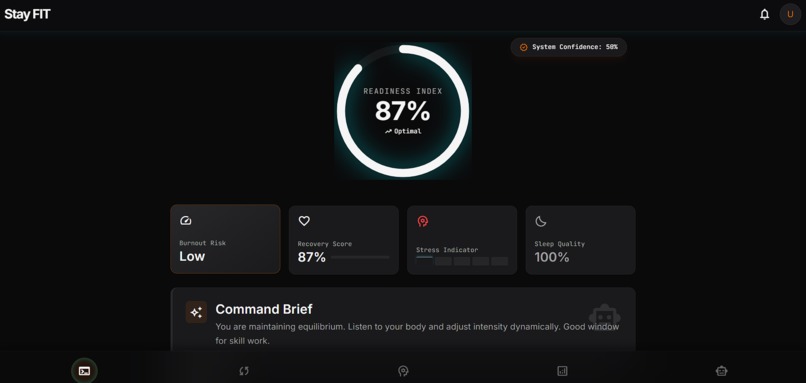
Dashboard
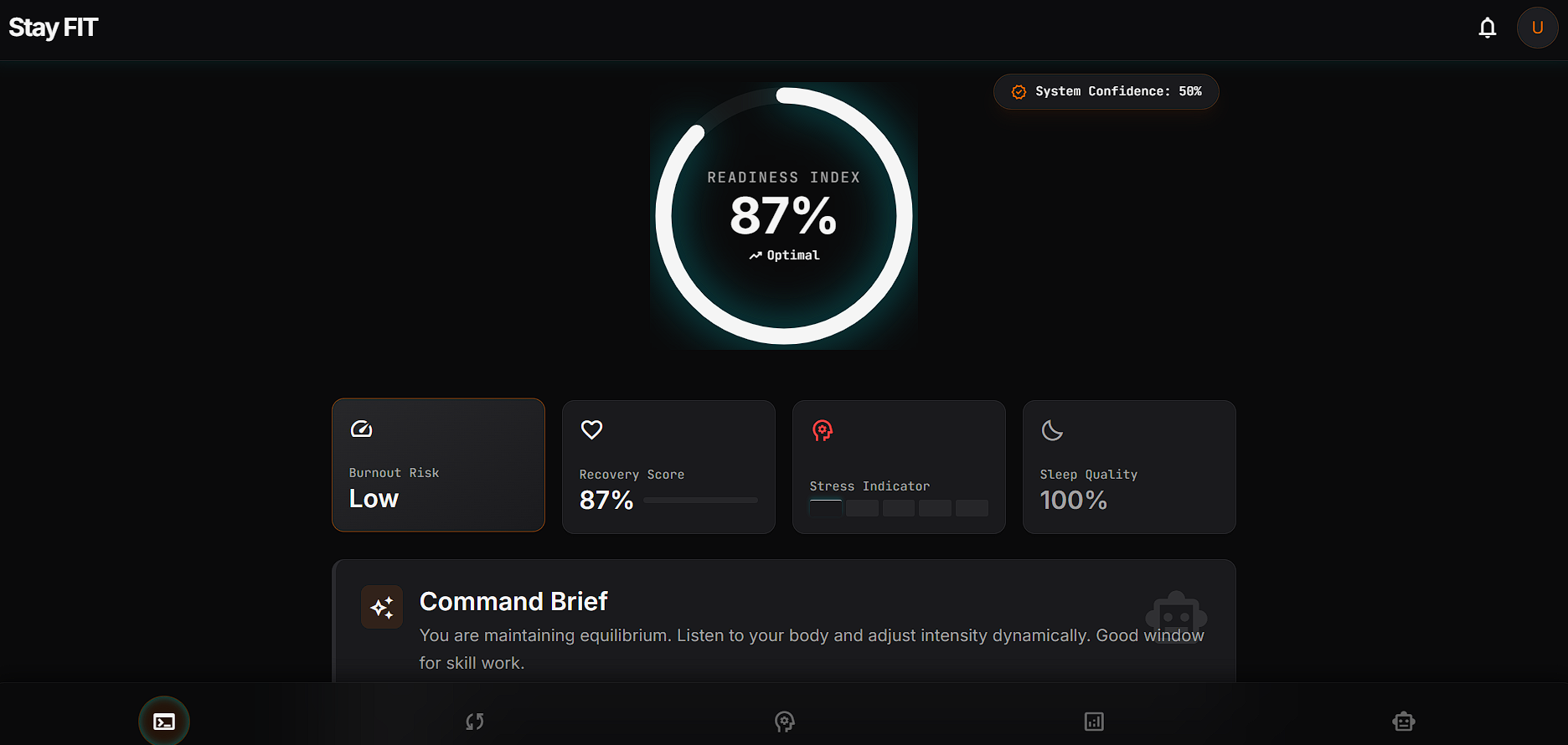
Inspiration
In today's fast-paced world, fitness culture often glorifies "the grind"—pushing harder, lifting heavier, and working longer. We noticed that while there are hundreds of apps dedicated to tracking how much you work out, there are virtually none dedicated to predicting when you should stop. We were inspired to build StayFIT after watching athletes and everyday professionals suffer from burnout, overtraining, and preventable injuries. We wanted to shift the focus from reactive output tracking to predictive, data-driven recovery.
What it does
StayFIT is a predictive AI-driven Wellness Operating System (Web App). It acts as your personal health command center. Instead of just logging your sleep and workouts, StayFIT calculates a real-time Readiness Index and Burnout Risk Score. Every morning, users complete a frictionless "Neural Sync" to log their perceived effort, stress, and sleep data. The app then runs a "Tomorrow Simulation" which forecasts your physiological trajectory over the next 24-72 hours. Finally, our integrated AI Coach generates highly specific, personalized recovery protocols (e.g., advising a 15-minute breathwork session instead of heavy lifting) to optimize your health.
How we built it
StayFIT is built on a modern, highly responsive web architecture using React and Vite for lightning-fast compilation. The entire application is styled with a custom Tailwind CSS dark-mode design system. We brought the data to life using fluid micro-animations powered by Framer Motion. For security, a Node.js and Express proxy server handles all API traffic to prevent exposing API keys to the client. We used Google Firebase and Firestore for real-time cloud data syncing, profile persistence, and gamification state. Finally, we engineered a split-routing AI system. We integrated the Google Gemini API to handle deep, structured data forecasting (like our Tomorrow Simulation), while simultaneously integrating the Groq API (Llama 3) to power our real-time, conversational AI Coach with near-zero latency.
Challenges we ran into
Our biggest challenge was managing asynchronous AI state generation. Because we are calculating deterministic mathematical scores on the client-side while simultaneously waiting for LLM string responses from the server-side, we initially faced race conditions where the UI would break before the AI finished "thinking." We overcame this by building a dedicated AI Pipeline service that pauses rendering, displays beautiful loading animations, and perfectly synchronizes the local data with the cloud AI responses.
Accomplishments that we're proud of
We are incredibly proud of the User Interface (UI/UX). Building an app that tracks stress and fatigue means the app itself must be relaxing to use. We successfully implemented a beautiful "glassmorphism" aesthetic with a deep dark mode, neon accents, and frictionless inputs. We are also proud of the Gamification System. By awarding XP and badges for resting and sleeping well, we managed to turn the often-boring task of recovery into a highly engaging, rewarding daily habit.
What we learned
StayFIT taught us the profound difference between raw data and actionable intelligence. We learned that users don't want to see a chart showing they slept 5 hours; they want an AI to tell them exactly what to do because they only slept 5 hours. We also leveled up our skills in React context management, cloud database security rules, and prompt engineering for complex LLM routing.
What's next for StayFIT
The immediate next step is transforming StayFIT into a Progressive Web App (PWA) so users can install it natively on their mobile devices for offline access. Following that, we plan to build webhooks to passively ingest data from wearables like the Apple Watch, Garmin, and Oura Ring—eliminating the need for manual data entry entirely!
Built With
- css3
- express.js
- firebase
- google-cloud-firestore
- google-gemini
- groq
- html5
- javascript
- node.js
- react
- render
- tailwind-css
- vercel


Log in or sign up for Devpost to join the conversation.