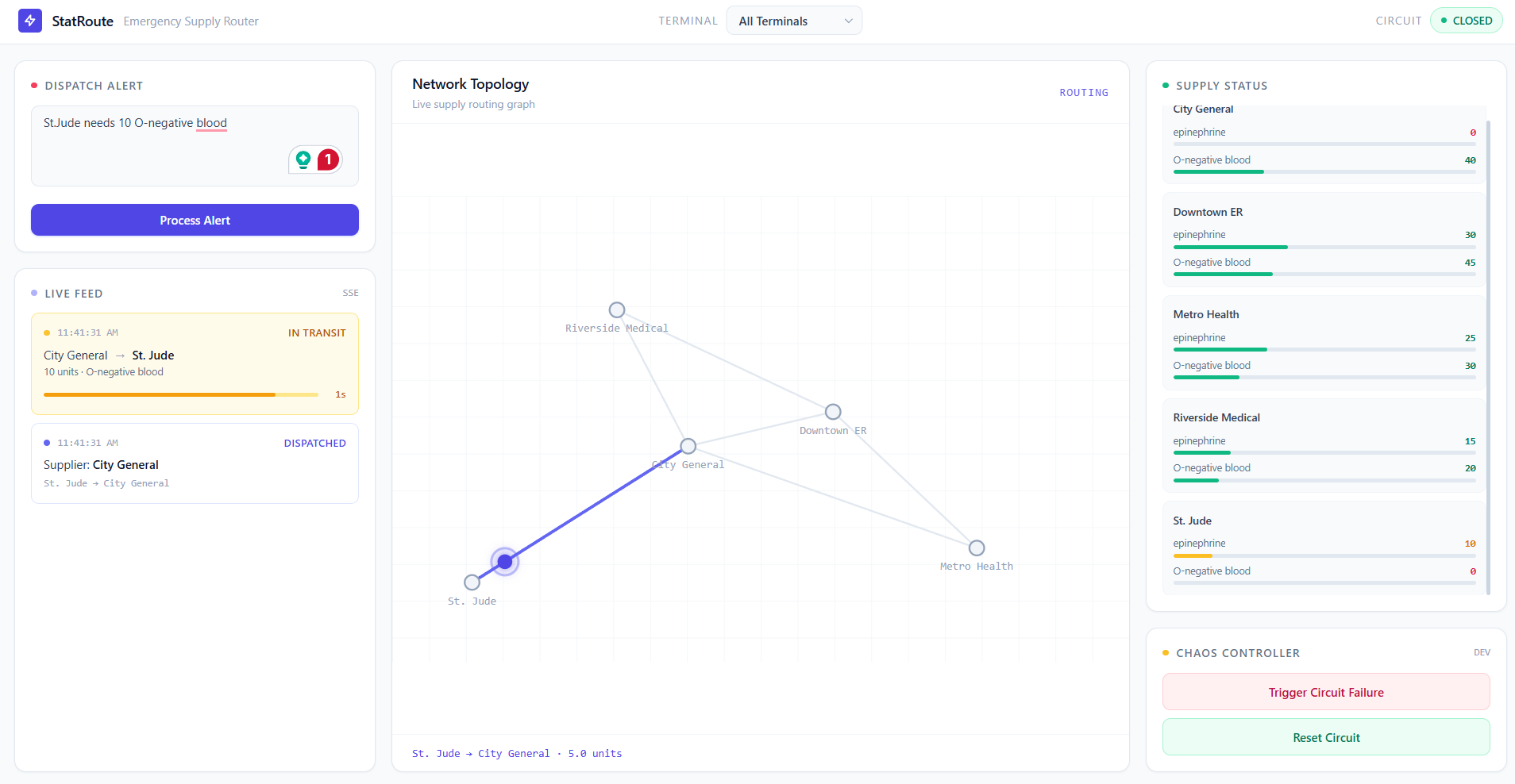
Modern AI tools should be used to make an immediate impact on human lives. In medical emergencies, coordinators waste life-saving minutes making manual phone calls to locate critical supplies like O-negative blood while fighting rigid, confusing software. StatRoute was created to handle the chaos of an emergency instantly so healthcare workers can focus on saving lives.
How We Built It StatRoute functions as an instantaneous, live-streaming medical command center:
AI Intake: A FastAPI backend uses Google Gemini 1.5 Flash to instantly translate unstructured, panicked text radio transcripts into clean, structured data requirements.
Algorithmic Routing: A custom Reverse Dijkstra's Algorithm engine searches outward from the emergency site. In a single calculation, it scans the entire network, ranks nearby hospitals by distance, and matches supply inventories.
Live Streaming Interface: Using HTMX and Server-Sent Events (SSE), routing results are pushed to the frontend, animating delivery paths on an interactive map in real-time without page refreshes.
Challenges We Faced During stress testing, we found a critical race condition where our fast-loading Redis cache would blindly serve old routing answers, completely unaware that the primary database downstream had failed.
To fix this, we re-architected the pipeline to validate our Circuit Breaker state before checking memory shortcuts. If the database fails three times, the circuit breaker trips open, completely short-circuits the broken database path, and instantly serves an immutable fallback route directly out of server memory in less than a millisecond.
What We Learned This project shifted my mindset from writing code line-by-line to designing complete system architectures. Using AI tools to handle basic syntax allowed me to focus entirely on graph theory math, database atomicity, and infrastructure resilience. I learned how to build mission-critical systems designed to survive when everything else fails.
Built With
- and
- compose
- docker
- fastapi
- gemini-3.1-flash-lite-api
- htmx
- postgresql
- pybreaker
- python-3.12
- redis
- sentry
- supabase


Log in or sign up for Devpost to join the conversation.