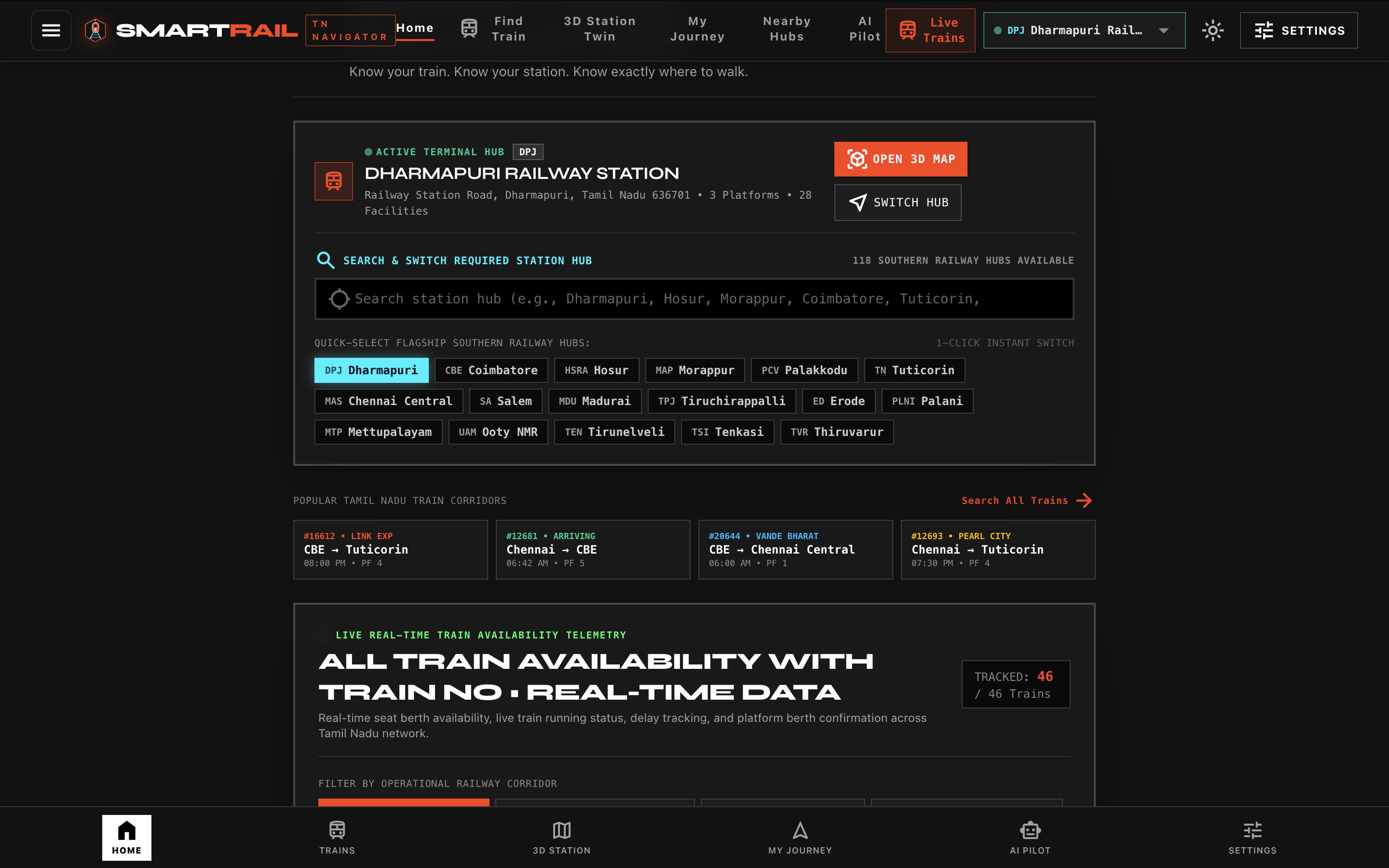
- The Story Behind the Project A railway journey should begin with confidence. A passenger should be able to find the right train, understand where it is, reach the correct platform, and locate essential facilities without unnecessary confusion.
However, large and unfamiliar railway stations can make even a simple journey stressful. A passenger may know the train number and departure time but still struggle to find the platform, ticket counter, waiting room, washroom, elevator, or dining area. The challenge can be greater for first-time visitors, passengers with disabilities, and people who are unfamiliar with the local language.
Most existing railway applications concentrate on train schedules and ticket-related services. Station navigation and facility discovery may remain separate tasks, often leaving passengers dependent on signboards or manual enquiries.
This problem inspired SmartRail Navigator: an AI-powered web application intended to bring train information and station navigation together in one platform.
- The Passenger's Journey Imagine a passenger arriving at an unfamiliar railway station. Instead of moving around the station searching for information, the passenger can use SmartRail Navigator as a digital travel companion.
The journey begins on the home page. The passenger can view the selected station, popular train routes, and train availability information. If the passenger needs a particular service, the Find My Train feature allows a search using a train number, train name, source, or destination.
After selecting a train, the passenger can review its route, timings, running status, platform details, and seat availability information. The application also includes a My Active Journey section, which presents the selected journey with ETA, a countdown, journey progress, station timings, and a shortcut to station navigation.
But knowing the platform number is only part of the problem. The passenger must still find it inside the station. This is where the interactive 3D Station Map becomes useful. It is designed to help passengers locate platforms, elevators, washrooms, dining areas, and other important facilities.
If the passenger is unsure where to go, AI Pilot provides an AI-powered railway assistant for questions about train timings, platforms, station facilities, and accessible routes. The passenger can also use Nearby Hubs to discover railway stations around their current GPS location, explore station details, compare hubs, and switch the active station.
Together, these features aim to make the railway experience more understandable and convenient---from finding a train to navigating the station.
- The Problem SmartRail Navigator Addresses The project focuses on a set of connected passenger difficulties:
- Navigating large and unfamiliar railway stations can be confusing.
- Finding platforms, ticket counters, waiting rooms, washrooms, and other facilities can take time.
- Existing railway applications primarily focus on train information and may provide limited indoor navigation assistance.
- Train information and station maps are often available separately.
- Passengers with disabilities may have difficulty identifying suitable routes and facilities.
- Language barriers can make it harder for passengers to understand station information.
- Manual enquiries can lead to confusion, delays, and inconvenience. The central idea is to reduce this fragmentation by combining train information, interactive station maps, AI assistance, GPS-based station discovery, and accessibility support.
- The Proposed Solution SmartRail Navigator is proposed as an integrated railway navigation web application. Its main objectives are to:
- Search for trains using train number, train name, source, and destination.
- Present train schedules and related journey information.
- Provide interactive station maps for indoor navigation.
- Help users locate platforms and essential station facilities.
- Integrate an AI assistant for railway-related questions.
- Identify nearby railway stations using GPS.
- Offer multilingual support in six Indian languages.
- Provide accessibility options, including support for wheelchair users.
- Bring train information and station navigation into a single platform. The project is designed around the passenger's needs rather than treating train discovery and station navigation as unrelated activities.
- Main Features and Modules 5.1 Home Page -- The Starting Point The home page displays the selected railway station, popular train routes, and train availability information. It acts as the starting point from which passengers can access the application's main services. 5.2 Find My Train -- Train Discovery The Find My Train module allows users to search for trains and view their routes, timings, running status, platform details, and seat availability. Search can be based on train number, name, source, or destination. 5.3 3D Station Map -- Finding the Way The 3D Station Map provides an interactive view intended to help passengers locate important station facilities. These include platforms, elevators, washrooms, dining areas, and other facilities. The goal is to make station navigation easier than relying only on signboards or manual enquiries. 5.4 My Active Journey -- Following the Trip The My Active Journey module tracks the selected train journey through information such as ETA, countdown, journey progress, and station timings. It also provides a shortcut to station navigation, connecting journey information with the passenger's next navigation task. 5.5 AI Pilot -- Railway Assistance AI Pilot is the application's AI-powered assistant. It is designed to answer railway-related questions about train timings, platforms, station facilities, and accessible routes. The proposed architecture identifies the Google Gemini API as the AI assistance component and includes multilingual assistance and a fallback when the API is unavailable. 5.6 Nearby Hubs -- Discovering Stations Nearby Hubs uses GPS-based location to detect nearby railway stations. Passengers can explore station details, compare railway hubs, and switch their active station. This feature is intended to help users discover relevant stations around them.
- How the Proposed Architecture Works The architecture shown in the project presentation is organized into six layers. Each layer has a distinct responsibility. A. User and Input Layer This layer receives the passenger's inputs and preferences, including:
- Train search inputs
- Station selection
- GPS location
- Language preferences
- Accessibility preferences B. Frontend and User Interface Layer The presentation identifies React 19 and TypeScript for the frontend. This layer contains the user-facing application features, including interactive station maps, the train status dashboard, and Web Speech API support. C. Backend and API Layer The backend layer is based on a Node.js runtime and an Express.js server. REST API endpoints handle communication, while request validation and routing organize incoming requests. D. Railway Data and Location Layer This layer brings together the information required by the application:
- Train schedules and status through data-dependent APIs
- Station and facility data
- Haversine-based nearby-station search
- Indoor route and map data E. AI Assistance Layer The architecture identifies the Google Gemini API for AI assistance. This layer supports railway query responses, multilingual assistance, and fallback behavior when the API is unavailable. F. Navigation and Accessibility Layer The final layer focuses on helping passengers move through stations. Its proposed capabilities include facility directions, wheelchair-friendly routes, voice guidance, and offline maps as a future enhancement.
The architecture connects user inputs to the frontend, backend, railway data, AI assistance, and navigation features. Responses are then presented to the passenger through the application.
- Accessibility and Multilingual Support A railway navigation platform should be useful to passengers with different needs and levels of familiarity with a station.
SmartRail Navigator therefore includes accessibility as part of its proposed design. The presentation identifies wheelchair-friendly routes, accessibility preferences, and voice guidance as important elements. It also proposes multilingual support in six Indian languages so that passengers can access assistance in a language they understand.
These features reflect the project's broader objective: railway navigation should be easier and more inclusive, not just more digital.
- Existing Approach and the Difference Proposed The existing approach described in the presentation relies heavily on separate railway information services, station signboards, and manual enquiries. Train schedules and ticket booking may be available through applications, while indoor navigation and facility information can remain limited or disconnected.
SmartRail Navigator proposes a more integrated approach: Existing approach described in the SmartRail Navigator's proposed project approach Train information and station maps Combines train information and may be separate station navigation
Passengers often depend on Provides an interactive station map signboards
Indoor navigation support may be Helps locate platforms and station limited facilities
Manual enquiries may cause Adds an AI railway assistant confusion
Nearby station discovery may Uses GPS-based nearby station require separate searching discovery Accessibility and language support Includes accessibility options and may be limited multilingual assistance This comparison describes the intended contribution of the proposed system; it does not claim that every existing railway service lacks these capabilities.
- Research Foundation The literature survey in the presentation discusses research related to train tracking, indoor positioning, and accessible navigation. The studies cover IoT-based metro tracking, real-time train tracking, mobile indoor navigation, smartphone-based navigation for blind users, audio-visual guidance, camera-based indoor positioning, and seamless positioning using multiple technologies.
The survey also identifies limitations such as dependence on sensors and network connectivity, the need for accurate location data, and the requirement for suitable indoor maps or compatible positioning technologies.
These studies provide context for the project's focus on combining train information with station navigation and accessibility support.
- Conclusion SmartRail Navigator is built around a simple idea: passengers should not have to solve several disconnected information problems just to complete one railway journey.
By bringing together train search, journey information, interactive station maps, GPS-based nearby station discovery, AI assistance, multilingual support, and accessibility-oriented navigation, the project proposes a more connected railway travel experience.
The application aims to help passengers understand their journey, identify where they need to go, and locate important facilities with greater convenience. Its value lies in treating the railway journey as a complete experience---from discovering a train to finding the right place inside the station.
- Future Enhancements The presentation identifies the following possibilities for future development:
- SOS alerts: Help passengers contact railway staff during medical emergencies or other critical situations.
- Enhanced station maps: Improve station maps with indoor navigation and augmented reality (AR).
- Voice-based navigation: Add voice navigation and further multilingual AI assistance.
- Lost-and-found support: Allow passengers to report lost belongings and track their recovery through the application.
- Mobile and offline access: Develop a mobile application with offline mapping. These enhancements could extend the platform beyond information and navigation into a broader passenger-support system.
Core idea: An AI-powered railway web application that integrates train information, station navigation, GPS-based station discovery, and accessibility support.
Key modules: Home Page, Find My Train, 3D Station Map, My Active Journey, AI Pilot, and Nearby Hubs.
Technologies and components identified in the architecture: React 19, TypeScript, Node.js, Express.js, REST APIs, Google Gemini API, Web Speech API, GPS, and Haversine-based nearby-station search.

Log in or sign up for Devpost to join the conversation.