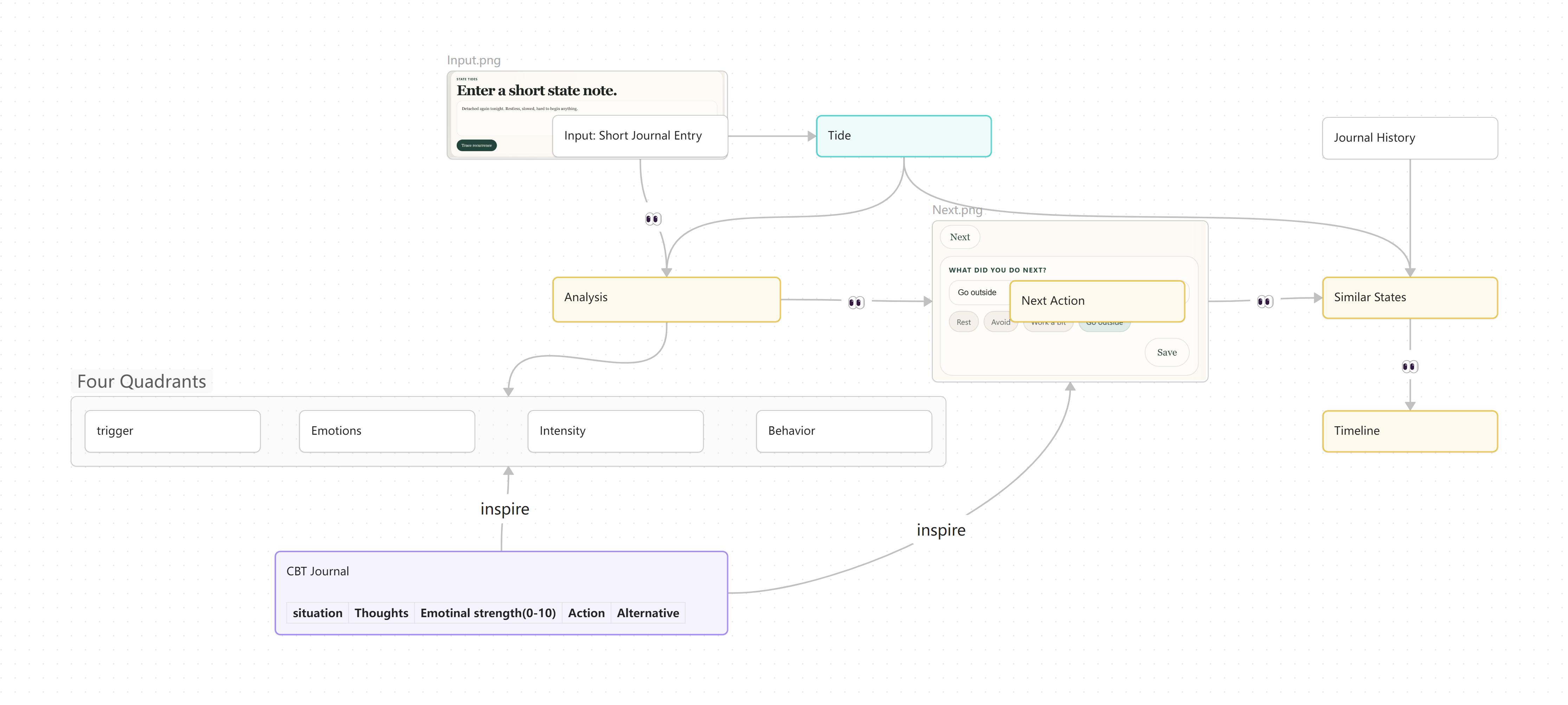
What Inspired the product
The idea of this product came from Cognitive Behavioral Therapy (CBT), specifically using a structured way to think about thoughts/emotions/behaviors.
One of the things CBT often does is creates structured journals for people to process their experiences by breaking them down into trigger(s), feeling, intensity, action.
However, I found that people do not tend to complete structured journaling (or those types of forms) when they're feeling overwhelmed.
In addition, many people (in non-structured ways) express thoughts/feelings such as:
“I feel like this all the time” “I never change.”
This led me to ask the question — Can I help people that have a feeling of permanence (and what that means) to see that they can be non-permanent?
What State Tides Does
State Tides takes fragmented thoughts and shows patterns of repetition over time.
Instead of providing therapeutic approaches to emotions or providing suggestions for coping with emotions, the project focuses on:
Where a state repeats (point of origin/reoccurrence); Where a state does not reoccur (absence); State is not a continuous.
The application:
Converts a single input to structured state information Maps a state against a timeline of where it has occurred in the past; Highlights gaps in state occurrence (timeframe with none); and User responses are often different.
The purpose of State Tides is not to determine for individuals what they should do or how they should perceive their experience, but rather to depict that which feel(s) like / appear(s) to be a permanent state is often not.
How I developed it
I created State Tides as a lightweight prototype with the following components:
- A minimal front-end for fragmented input
- A structured internal model based on CBT (Trigger, Emotion, and Behaviour)
- A dot-based timeline showing discrete appearance rather than trend
- A graph showing the relation between states, emotions and behaviours
- A "Next Action" flow that captures and compares user response to previous ones
I used the Claude API as a semantic layer to:
- Spell out structure from free form input
- Map of input to the corresponding existing state
- Detect newness and create a new state dynamically
Importantly, none of this presents itself as a CBT form because it uses inferred structure as opposed to requiring it.
Challenges I faced
One of my challenges was trying to find the balance between structure and simplicity.
CBT has a lot of structural power behind it, but exposing that structure directly would have turned this product into a cumbersome journaling tool.
I accomplished this by:
- Hiding complexity behind a small number of interactions
- Ensuring structured outputs did not overwhelm users
- Constraining model outputs in order to reduce noisy or invalid labels
- Designing visualisations that highlighted gaps rather than trends.
A second challenge was retaining the central premise that:
This is not an analysis tool; it is an experiential process that helps shift perception.
My proud accomplishments:
• Making abstract psychological concepts an interaction • Designing a timeline to show absence as valuable data • Providing users with a way of questioning "I am like this” without providing prescriptive advice • Incorporating AI to do structuring and keep user interface simple • Creating a cohesive experience across time, state, and behaviour
Most important, I created a moment for users to see their patterns (the way they experience their lives) and understand they aren't as fixed as they believed.
What I learned:
I learned that: • Insight does not come from having data but how that data is presented • Simplicity has the potential to be more powerful than having complete analysis • Users do not want to fill out forms, but rather feel something shift in their experience • Absence (gaps) can be more meaningful than presence
Additionally, I have learned the importance of controlling AI outputs. • Without control, the output of the system was going to create unmanageable noise • With a degree of control, the output of the system would create meaningful output.
What's Coming Next for State Tides:
There are several areas for further development for the next iteration of State Tides. • Incorporating actual longitudinal data from research (as opposed to demo datasets) • Making improvements on the cluster and evolution of states over time • Creating more behavioral patterns and diversity in actions • Adding more types of input/modality (e.g., images, context) • Investigating passive sensing abilities (in a way that is private)
Built With
- claude
- json
- next.js
- typescript

Log in or sign up for Devpost to join the conversation.