
Inspiration
Many citizens are unaware of the government-sponsored schemes available to them or find it difficult to understand the eligibility criteria, required documents, and application procedures. Socio-economic information is often scattered across different records, making scheme discovery a confusing and time-consuming process.
This inspired us to develop the State Scheme Eligibility Predictor Engine Utilizing Unified Socio-Economic Data Wallets—a platform designed to simplify scheme discovery and help citizens identify government schemes that may match their socio-economic circumstances.
What it does
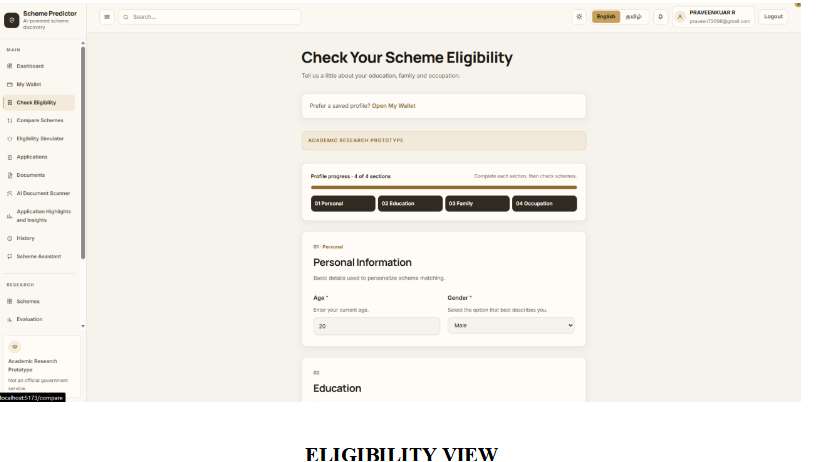
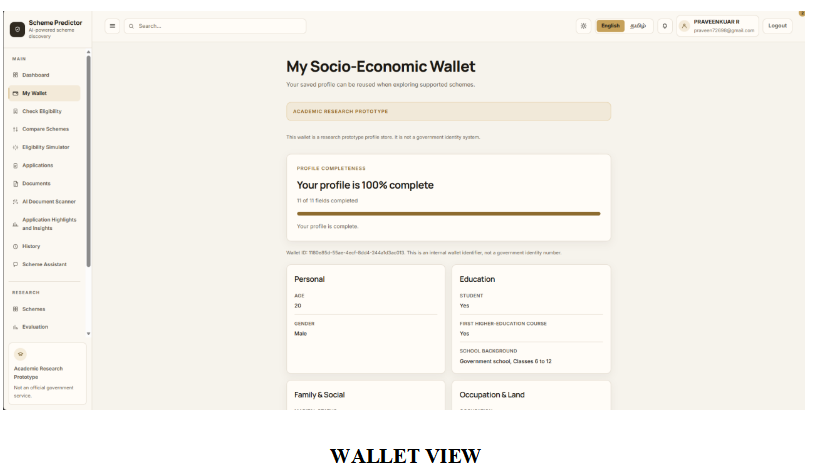
The platform uses a unified socio-economic data wallet concept to organize citizen information and evaluate eligibility for government-sponsored schemes.
Key features include:
- Socio-Economic Data Wallet: Organizes relevant citizen information for eligibility evaluation.
- Scheme Catalog: Maintains information about available government schemes and their eligibility requirements.
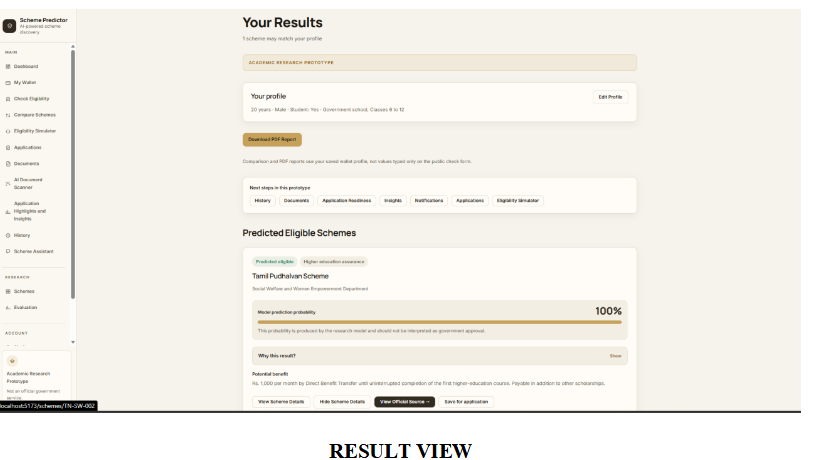
- Eligibility Prediction: Applies rule-based evaluation and machine learning to identify potentially eligible schemes.
- Explainable Recommendations: Provides reasons behind recommendations, including relevant eligibility rules and model predictions.
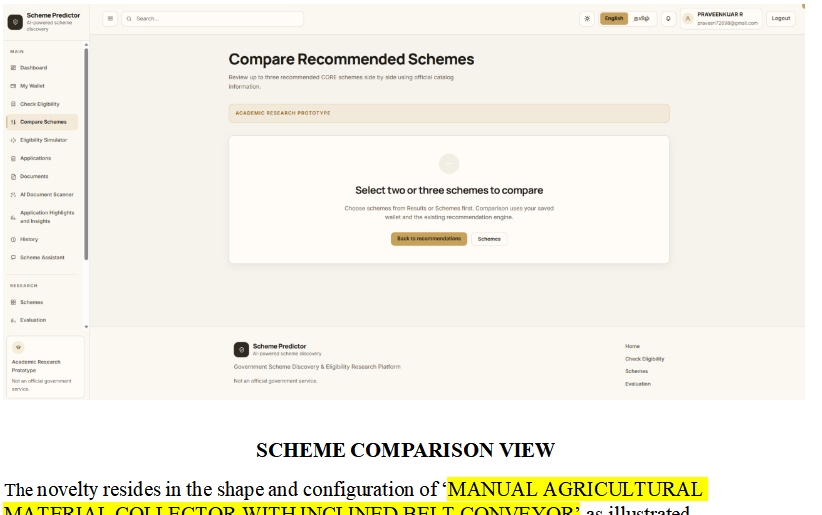
- Scheme Discovery: Helps users explore schemes that may be relevant to their circumstances.
- Authentication and Access Control: Supports secure access to user information.
- Confidence and Fallback Mechanisms: Helps handle uncertain predictions and cases where additional rule-based evaluation is needed.
The system is intended to assist citizens in discovering relevant schemes. Final eligibility and approval remain subject to the applicable government rules and verification process.
How we built it
We developed the project using a combination of web technologies, database management, machine learning, and rule-based decision logic.
The system architecture includes a frontend for user interaction, a backend for processing requests, a database for storing citizen and scheme information, and a prediction engine for evaluating eligibility.
Machine learning techniques such as TF-IDF, Multinomial Naive Bayes, and Logistic Regression are used for text processing and classification tasks. Rule-based evaluation complements the model by checking eligibility conditions and providing understandable explanations.
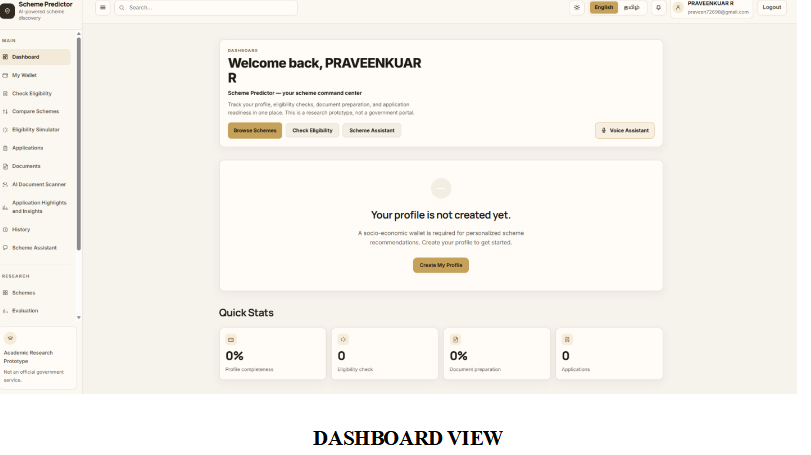
The backend manages authentication, data processing, and communication between the application and prediction engine. The interface brings together profile management, scheme discovery, recommendations, notifications, and evaluation results.
Challenges we faced
One of the main challenges was combining rule-based eligibility checks with machine learning predictions while keeping the results understandable to users.
Other challenges included organizing socio-economic information, handling incomplete or uncertain inputs, integrating the machine learning component with the web backend, and making recommendations easier to interpret.
We addressed these challenges by combining explicit eligibility rules with model predictions, adding confidence-based handling and fallback logic, and developing explainable recommendations that show the reasons behind the system's decisions.
What we learned
Through this project, we gained practical experience in full-stack development, database integration, machine learning integration, text classification, and explainable decision systems.
We also learned that building a useful AI-powered application requires more than producing a prediction. The system must communicate its reasoning, handle uncertain inputs responsibly, protect user information, and provide a clear and accessible experience.
Future scope
Future improvements could include integrating verified government scheme data through official sources, supporting regional languages, improving eligibility accuracy through validated datasets, adding document checklists, and providing application guidance.
Our goal is to make government scheme discovery more accessible, transparent, and convenient for citizens through a unified, explainable, and data-driven platform.
Built With
- artificial-intelligence
- css
- explainable
- express.js
- html
- javascript
- jwt
- logistic-regression
- machine-learning
- mongodb
- mongoose
- naive-bayes
- natural-language-processing
- node.js
- python
- react
- rest-api
- scikit-learn
- tailwind-css
- tf-idf

Log in or sign up for Devpost to join the conversation.