-
-
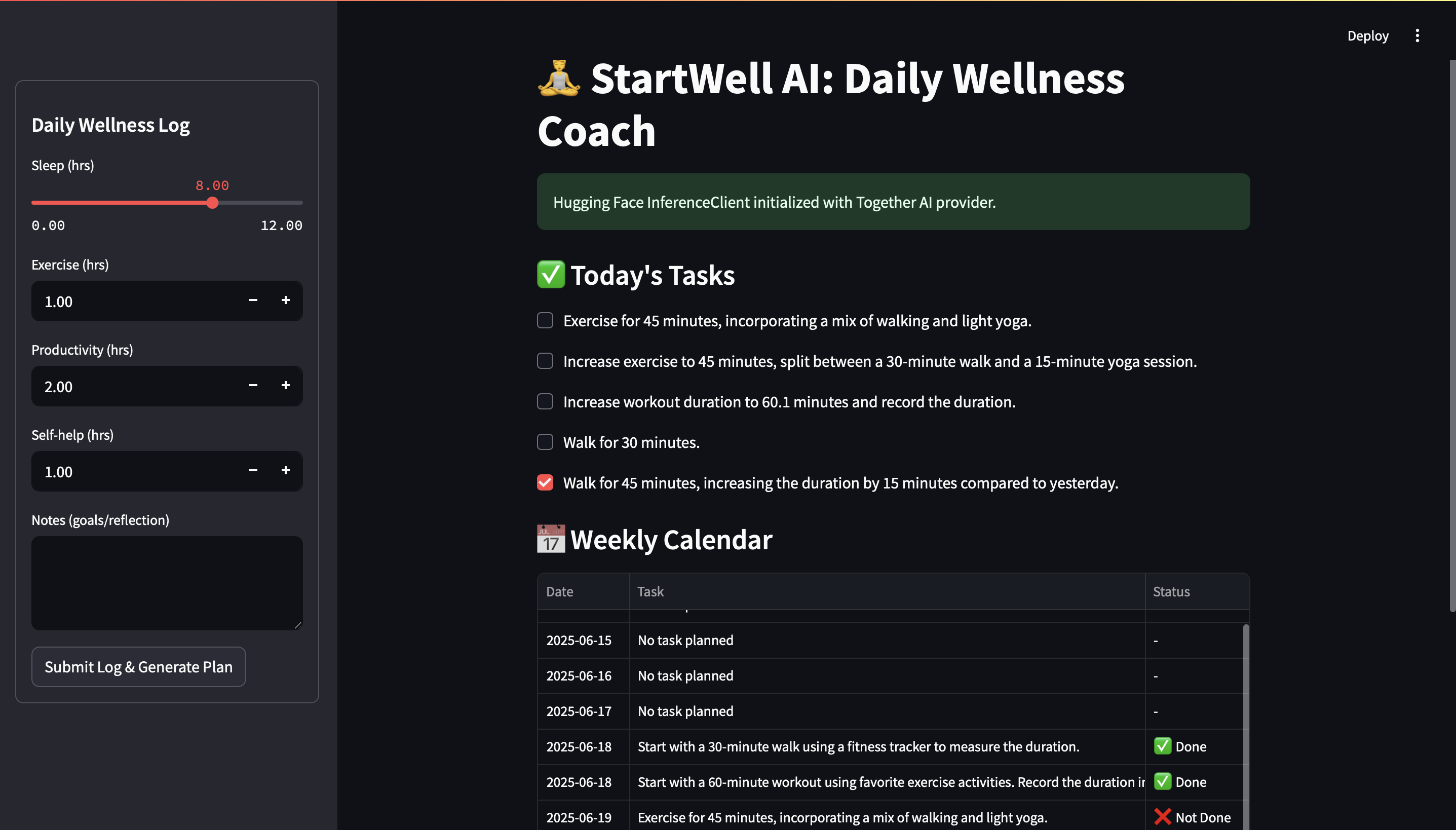
UI of the wellness assistant
Inspiration
I started building this because I constantly struggled to balance college life, health, and fun. My routine would get thrown off track by assignments and social plans, and I found it hard to keep up with simple things like sleep, exercise, and even my own self‑care. I knew I wasn’t alone, so I decided to create an AI agent that could help me—and anyone else—stay on top of their wellness habits without adding more stress.
What it does
Daily Wellness Coach takes your daily logs (sleep, exercise, productivity, self‑help, and free‑form notes) and:
Generates a SMART weekly goal based on your past week’s data. Plans out daily tasks for the next seven days to help you reach that goal. Tracks completion in an internal calendar so you can see at a glance which tasks you nailed and which you missed. Provides personalized advice each week—pointing out what went well, what could improve, and offering encouragement.
How we built it
LangGraph handles the multi‑agent workflow (Intake → GoalAgent → Planner → Advisor).
Hugging Face Inference API powers the LLMs (no need to host huge models locally).
ChromaDB saves your embedded logs for context retrieval.
SQLite stores your numeric daily logs (sleep, exercise, productivity, self‑help) and marks tasks done/undone.
Streamlit provides a simple, interactive UI for logging data, viewing goals, checking off tasks, and displaying advice.
Challenges we ran into
Workflow orchestration: Debugging state transitions between agents and ensuring each node returned the right data.
Library updates: Adapting to Chroma’s new API and handling Torch + Streamlit conflicts on macOS.
API limits: Balancing free‑tier Hugging Face quotas with interactive performance.
UI responsiveness: Keeping the Streamlit interface smooth while waiting for remote inference calls.
Accomplishments that we're proud of
Building a full, multi‑agent pipeline that actually works end‑to‑end.
Integrating diverse tools (LangGraph, ChromaDb, SQLite, Streamlit) into a seamless app.
Creating something that helps real people—not just a demo, but a usable wellness companion.
Overcoming version conflicts and deployment hurdles to deliver a polished prototype.
What we learned
How to design and debug complex AI workflows using agent‑based architectures.
The pain points of state management and error handling when chaining multiple models.
The power of RAG (retrieval augmented generation) to ground AI advice in real user data.
That AI can really support healthy habits—but only when the experience is simple and reliable.
What's next for StartWell AI
In‑app reminders: Push notifications or scheduled alerts for your daily tasks.
Custom widget: A lightweight browser widget or mobile companion that surfaces goals and tasks wherever you study.
Social features: Peer matching for joint accountability and group challenges.
Data insights: Trend analysis and visual charts so users can spot long‑term patterns in their wellness habits.
Built With
- chromadb
- huggingface
- langgraph
- python
- streamlit
- visual-studio

Log in or sign up for Devpost to join the conversation.