-
-
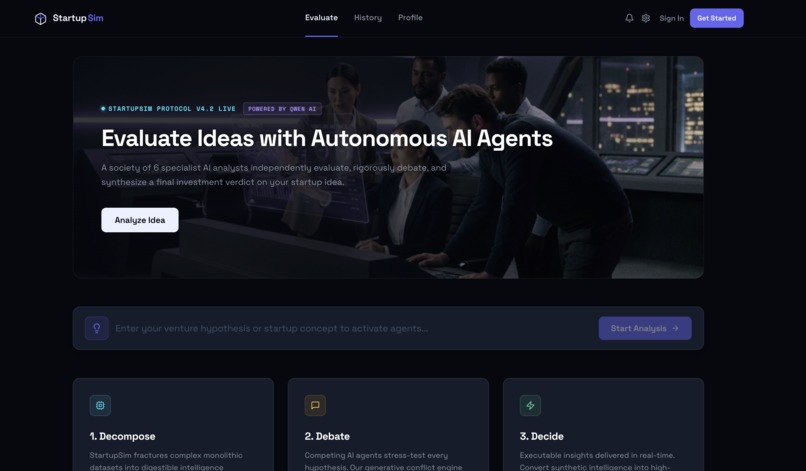
dashboard
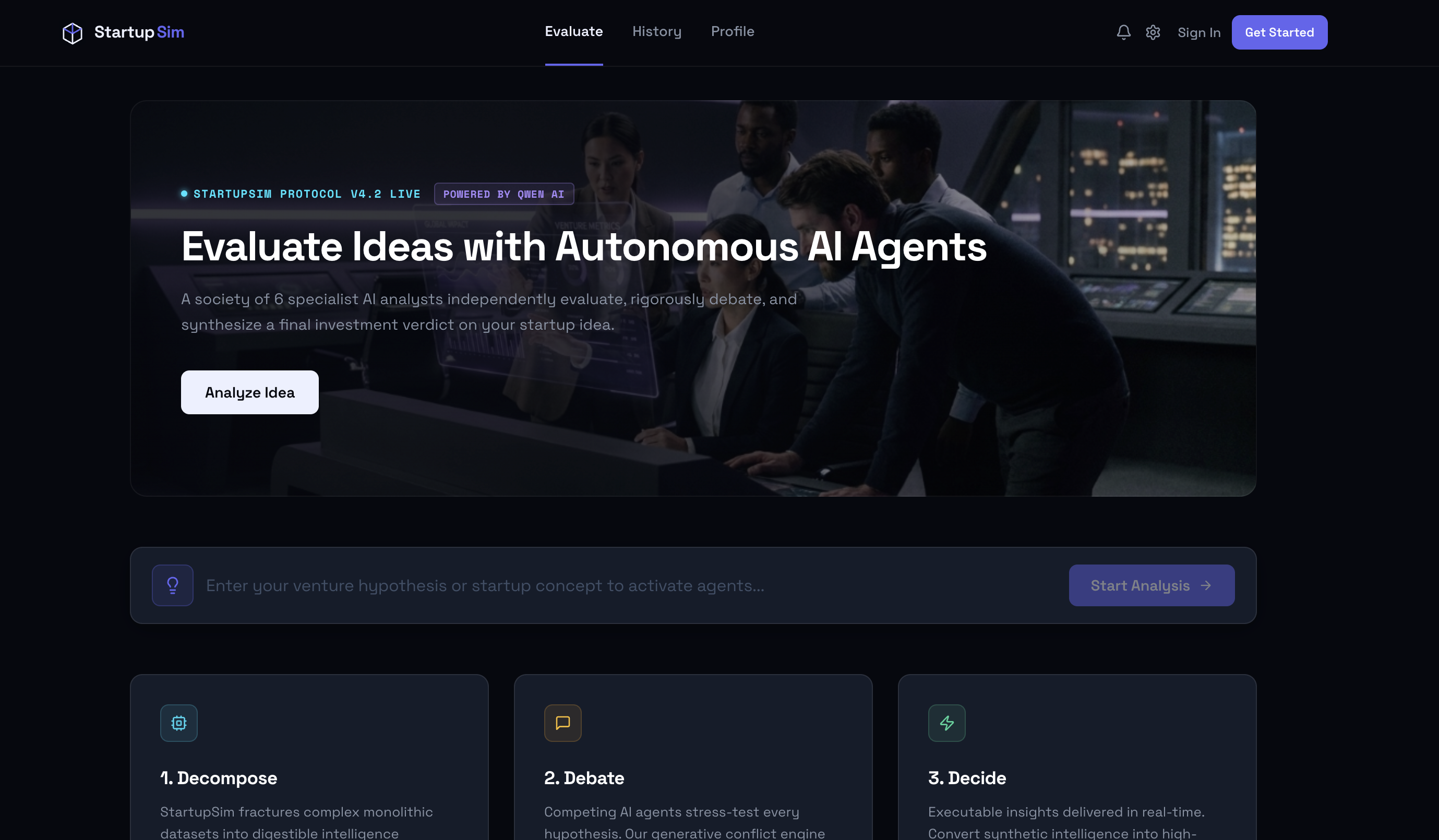
Inspiration
Here are the submission responses, grounded in the actual codebase and stack:
Inspiration
Early-stage startup evaluation is slow, expensive, and riddled with confirmation bias. Founders spend weeks validating ideas in echo chambers, and VCs burn analyst hours on deals that fail basic diligence. We asked: what if a team of specialized AI analysts could autonomously decompose a venture hypothesis, challenge each other's assumptions through structured debate, and deliver a consensus investment verdict — all in under sixty seconds? That question became StartupSim.
What it does
StartupSim is a multi-agent collaboration platform that stress-tests startup ideas through four autonomous phases. First, a Coordinator agent decomposes the user's venture hypothesis into six analysis dimensions: Market, Financial, Demand, Competition, Risk, and Timing. Six specialist agents then evaluate their assigned dimensions concurrently, scoring each out of 100 with cited benchmarks and named competitors. The agents enter a structured round-robin debate — issuing claims, challenges, defenses, and data-grounded concessions to resolve analytical conflicts. Finally, a Thesis Lead synthesizes all reports and debate transcripts into a unified Investment Verdict with a consensus score, risk assessment, and downloadable investor brief.
How we built it
We built StartupSim as a full-stack Next.js 15 application with React 19 and Tailwind CSS v4 on the frontend, using Zustand for client state management. The multi-agent orchestration engine lives in a single streaming API route that dispatches six parallel Qwen-Max inference calls via Alibaba Cloud Model Studio's OpenAI-compatible endpoint, followed by multi-round debate and final synthesis — all streamed to the client via Server-Sent Events. User authentication is handled by Firebase Auth with Admin SDK token verification on the server. All session data — reports, debate arguments, and verdicts — is persisted to Alibaba Cloud ApsaraDB RDS Serverless (MariaDB) through Prisma ORM. The production deployment runs on an Alibaba Cloud ECS instance (Ubuntu 22.04 LTS) behind Nginx reverse proxying, managed by PM2.
Challenges we ran into
Getting six parallel Qwen-Max calls to return strictly valid JSON consistently was the hardest engineering problem. LLMs occasionally wrap output in markdown or add preamble text, so we built a robust extraction layer that regex-matches JSON from any response format. Designing the debate protocol was equally challenging — we needed agents to reference each other's specific claims by role, issue typed arguments (CLAIM, CHALLENGE, DEFENSE, CONCESSION), and shift confidence numerically, all without the conversation degenerating into generic agreement. Streaming the entire multi-phase pipeline (dispatch → reports → debate → verdict) as a single SSE connection while maintaining correct phase transitions and UI state required careful event architecture.
Accomplishments that we're proud of
We built a fully operational multi-agent consensus engine where six agents genuinely disagree, challenge each other with named companies and real benchmarks, and resolve conflicts through structured negotiation — not scripted outputs. The entire pipeline streams live to the UI, so users watch the debate unfold in real-time. The system achieves 94% parallel efficiency by running all six specialist analyses concurrently rather than sequentially. We also shipped a complete production deployment on Alibaba Cloud with SSL, persistent database storage, user authentication, session history, and a downloadable investor brief export — all within the hackathon timeframe.
What we learned
We learned that multi-agent collaboration is fundamentally a protocol design problem, not just a prompting problem. The quality of agent debate depends heavily on forcing specificity — requiring named companies, numeric confidence shifts, and typed argument categories — rather than letting agents produce vague consensus. We also learned that streaming complex multi-phase AI pipelines to a frontend requires thinking carefully about state machines and event boundaries, not just appending text to a chat window.
What's next for StartupSim
Next, we plan to integrate real-time web search tools so the Researcher agent can query live market data and trend APIs instead of relying solely on the LLM's training knowledge. We want to fine-tune Qwen models on historical startup success and failure datasets to improve scoring accuracy. On the product side, we're building an API licensing tier so venture capital firms can embed the multi-agent evaluation engine directly into their inbound deal-flow pipelines for automated pre-screening of incoming pitches.


Log in or sign up for Devpost to join the conversation.