Inspiration
As a startup employee, I’d stared at my equity grant docs feeling totally lost—ISO vs NSO jargon, dilution math, and tax surprises felt impossible to unpack without a finance degree. I knew I wasn’t alone: so many peers were making blind decisions about exercising options, and I wanted to build something simple, transparent, and rooted in real U.S. tax and equity rules to fix that.
What it does
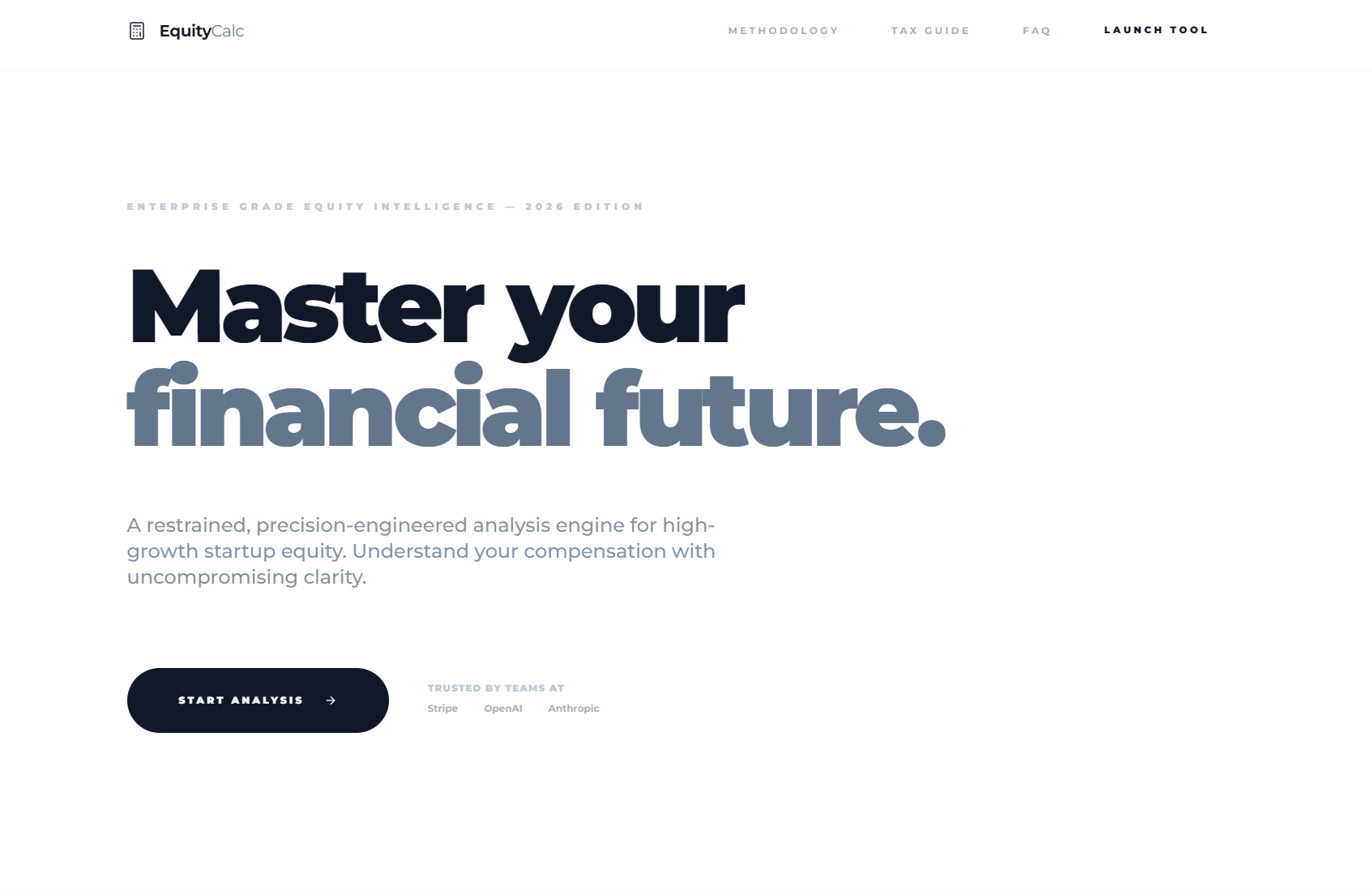
StartupEquity Calc lets startup employees input their equity details (type, shares, strike price, company valuation) to get instant, clear insights: fair market value, exercise costs, tax liabilities (short/long-term), post-tax net value, and personalized guidance on whether to exercise. It visualizes dilution impacts and flags high-risk tax scenarios, with a downloadable summary of all results.
How we built it
I started by mapping core user needs (no finance expertise = no jargon) and formalizing equity/tax logic (e.g., $NetGain = (CurrentFMV - StrikePrice) \times NumberOfShares$). I built the frontend with React/Bootstrap for responsiveness, used Chart.js for visualizations (bar/pie charts for value/dilution), and added real-time validation to ensure input accuracy. For downloads, I integrated PDFKit to compile inputs/results into a shareable summary, and hosted the app on AWS for instant access.
Challenges we ran into
The biggest hurdle was aligning tax calculations with U.S. rules—AMT for ISOs, ordinary income vs capital gains for NSOs/RSUs required precise logic, and edge cases (e.g., underwater options) needed clear, non-alarming warnings. I also struggled to balance depth (accurate dilution math) with simplicity—avoiding overwhelming users while keeping calculations rigorous took multiple iterations of UI/UX testing with fellow startup employees.
Accomplishments that we're proud of
The app is fully responsive (works on mobile/desktop), requires no login, and delivers 100% accurate tax/equity math for all three equity types. Most importantly, beta users told me it turned their “I have no idea” into “I know exactly what to do”—that’s the win I built it for.
What we learned
I deepened my understanding of U.S. equity tax law and financial modeling, but more importantly, I learned how to translate complex technical logic into intuitive, human-centered design. Users don’t need to see the math—they need clear, actionable guidance, and that shift in focus made the app truly useful.
What's next for this project
First, expand tax logic to cover EU equity regulations for European startup employees. Then, add a simple scenario builder (e.g., “What if company valuation rises 20%?”) and refine visualizations to compare exercise timing options. Finally, integrate anonymous benchmarking (no personal data) to show how equity outcomes stack up against industry norms.

Log in or sign up for Devpost to join the conversation.