Inspiration
StartStep was inspired by a very common ADHD experience: knowing exactly what needs to be done, yet feeling physically unable to begin. Traditional productivity apps assume that motivation appears first and action follows. For many ADHD users, the opposite is true—action must become tiny enough that the brain stops treating it as a threat.
We wanted to build a tool that felt less like a task manager and more like a compassionate friend sitting beside you saying, “Let’s just do the first 15 seconds together.” The goal was not maximizing output; it was reducing shame, lowering activation energy, and helping users experience the momentum of starting.
What it does
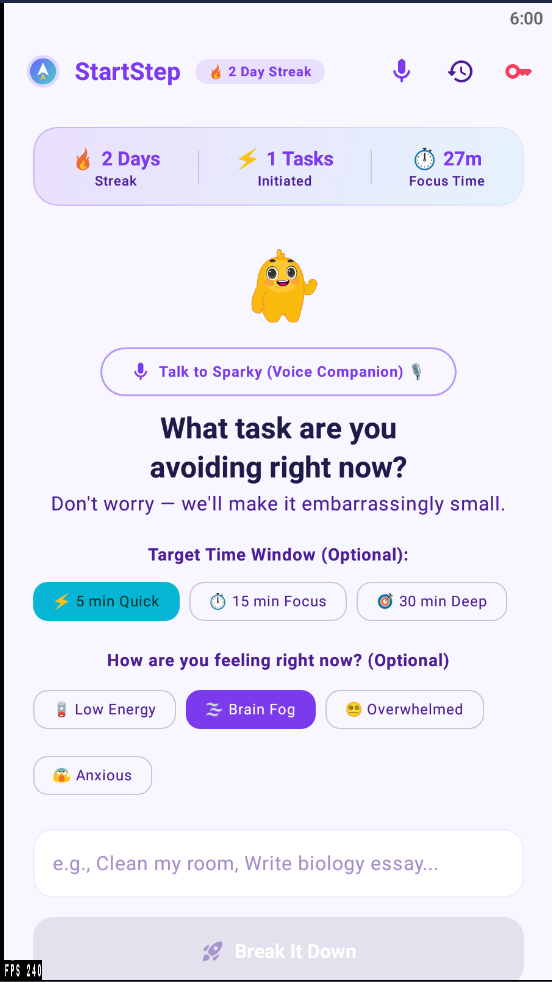
StartStep is an AI-powered Android app that helps users overcome task-initiation paralysis by transforming overwhelming tasks into micro-steps that feel almost impossible to fail.
Key capabilities include:
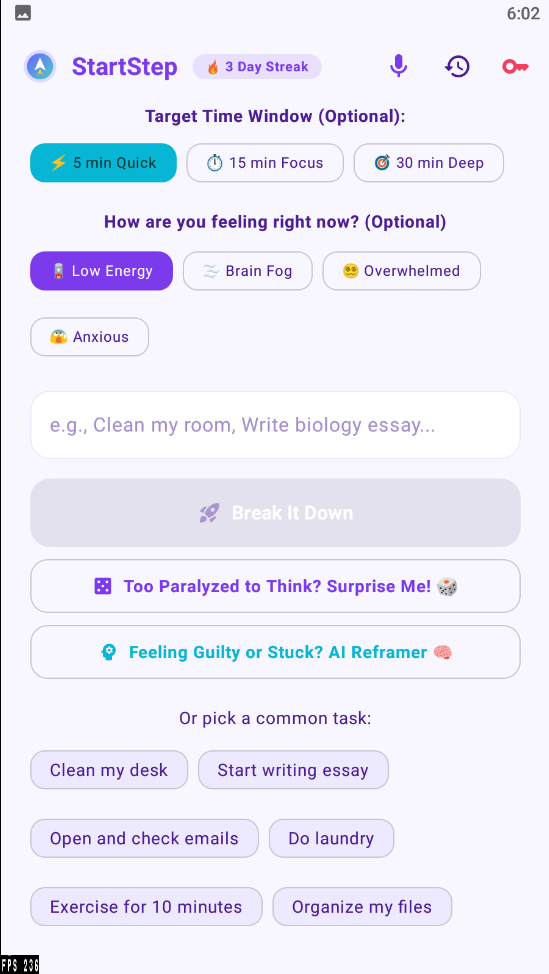
- AI-generated 15–30 second physical micro-steps.
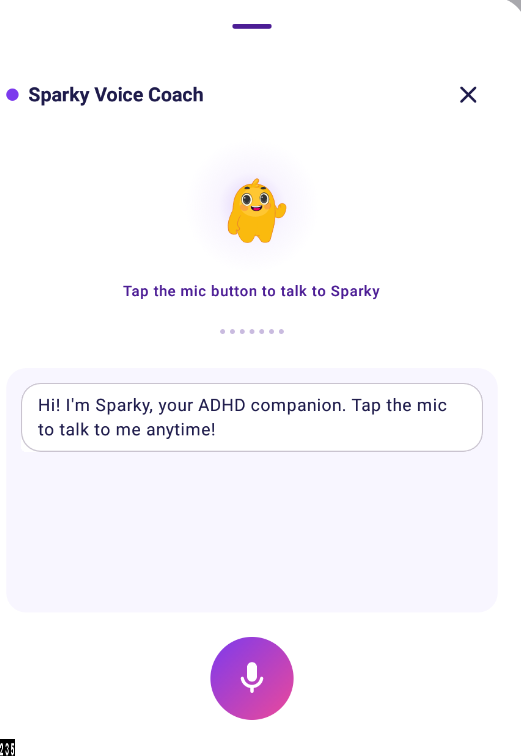
- Real-time voice companion Sparky that users can talk to naturally.
- Speech recognition for hands-free interaction.
- Natural spoken responses using ElevenLabs Bella voice.
- CBT-style cognitive reframing for procrastination guilt.
- “I’m Stuck” decomposition for breaking down a difficult step even further.
- Built-in focus soundscapes (brown, pink, and white noise).
- Gentle progress tracking and streaks designed to avoid shame.
- AI-powered encouragement notifications when the app is backgrounded during an active task.
The result is a tool that supports both executive function and emotional regulation during the hardest part of productivity: getting started.
How we built it
We built StartStep as a fully native Android application using Kotlin and Jetpack Compose.
Core technologies
- Jetpack Compose + Material 3 for the UI.
- Groq API (Llama 3.3 70B Versatile) for sub-second task breakdowns and conversational responses.
- ElevenLabs API (Bella voice) for expressive speech synthesis.
- Android SpeechRecognizer for real-time speech-to-text.
- Room Database for task and step persistence.
- DataStore for preferences and onboarding state.
- OkHttp + Retrofit for networking.
- Lottie Compose for mascot animations.
- AudioTrack for synthesized offline focus soundscapes.
We designed the app around a modular architecture with separate data, domain, and UI layers. Prompt engineering was a major part of development; we carefully constrained the AI so that the first step would always be extremely small, concrete, and physically actionable.
Challenges we ran into
Building StartStep involved several non-trivial challenges:
- Latency: Voice conversations feel awkward if responses take too long. We optimized prompts and networking to achieve near real-time interactions.
- Prompt reliability: LLMs naturally produce helpful but sometimes overly ambitious advice. We had to iteratively refine prompts to force ultra-small first actions.
- Speech recognition edge cases: Handling partial transcripts, silence timeouts, microphone permissions, and noisy environments required significant testing.
- Audio synchronization: Coordinating Lottie mascot states with streaming TTS playback and waveform visualization was surprisingly complex.
- Emotional tone: Productivity apps often become accidentally judgmental. We repeatedly tested wording to ensure every message remained supportive and non-shaming.
- Background notifications: Triggering helpful reminders only when a user truly disengaged from an active task required careful lifecycle management.
Accomplishments that we're proud of
We are especially proud that StartStep feels emotionally safe rather than merely functional.
Highlights include:
- Achieving sub-second AI task breakdowns on a mobile device workflow.
- Creating a mascot companion that supports both voice and text conversation.
- Building a complete offline soundscape engine with zero downloaded audio assets.
- Designing a polished glassmorphic ADHD-focused UI in Jetpack Compose.
- Implementing an “I’m Stuck” recursive decomposition system that keeps lowering the barrier until action becomes manageable.
- Delivering a fully working end-to-end prototype that can be installed and run on a real Android device.
Most importantly, early testers reported that they were able to start tasks they had been avoiding for days, which is exactly the outcome we hoped for.
What we learned
This project taught us that productivity for ADHD is fundamentally an accessibility problem, not a motivation problem.
Technical lessons:
- Real-time voice UX depends heavily on perceived latency and conversational pacing.
- Compose makes it possible to build highly dynamic interfaces with relatively little boilerplate.
- Audio handling on Android becomes much more complex when multiple sources (TTS, microphone, synthesized soundscapes) interact.
Human-centered lessons:
- Compassionate language measurably changes user engagement.
- Users respond better to tiny guaranteed wins than to ambitious plans.
- Visual animation and voice feedback can reduce the sense of isolation during difficult tasks.
What's next for StartStep — ADHD Task Initiation & AI Micro-Step Coach
Our roadmap focuses on making StartStep a more personalized daily support system.
Planned features:
- On-device fallback AI for offline micro-step generation.
- Adaptive personalization based on energy level, time of day, and task history.
- Wear OS companion app for quick voice check-ins.
- Calendar and to-do integrations (Google Calendar, Todoist, Notion).
- Body-doubling mode where Sparky stays present during a work session.
- Focus session analytics that identify when users are most likely to initiate tasks successfully.
- Shared accountability circles for friends, partners, or study groups.
- Expanded accessibility support including multilingual voice models and dyslexia-friendly reading modes.
- Clinical collaboration with ADHD coaches and therapists to evaluate effectiveness.
Our long-term vision is for StartStep to become a gentle executive-function companion that helps ADHD users start one tiny step at a time—without guilt, pressure, or perfectionism.
Built With
- groq
- jetpack
- kotlin


Log in or sign up for Devpost to join the conversation.