Inspiration
Many learning tools assume the learner has already started: they wait for a good question, a clear plan, and enough attention to decide what to do next. But the harder problem is often beginning, seeing how ideas connect, returning after an interruption, and knowing whether the material was actually understood.
StartOne was created to close that gap between intending to learn and completing a meaningful learning task. It is ADHD-informed, but makes no medical, diagnostic, or treatment claims.
What it does
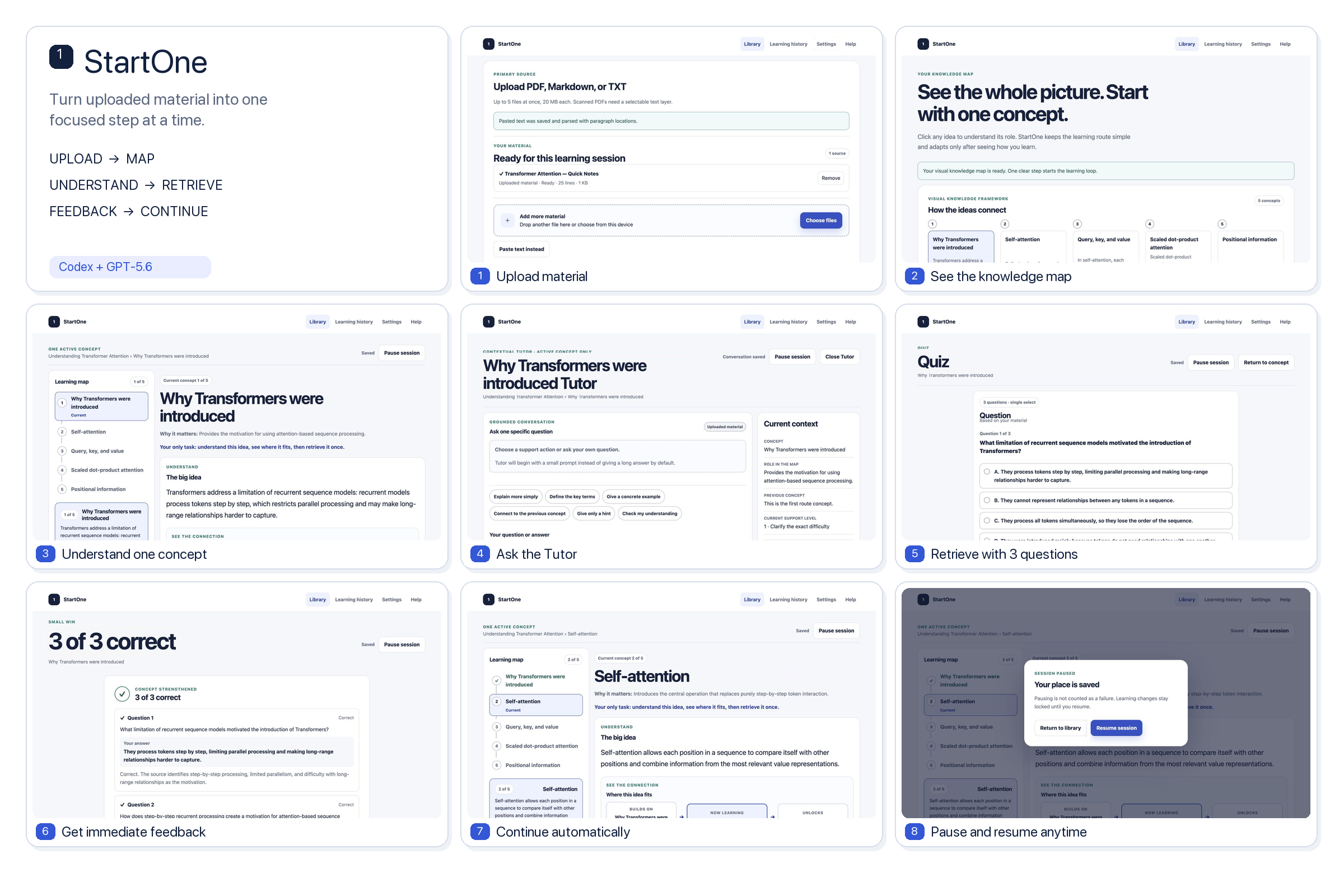
StartOne turns learning material supplied by the learner into a focused path from first action to demonstrated understanding.
- The learner uploads or pastes material and starts with one click—there is no goal form, pre-test, or time-and-energy questionnaire.
- GPT-5.6 identifies the core concepts and creates a connected visual knowledge map.
- Each concept includes a beginner-friendly explanation, its place in the larger framework, key parts, relationships, an example, and a memory anchor.
- A contextual AI Tutor explains the active concept, answers questions, and guides the learner without changing the learning route.
- A Guided Mastery Loop combines a three-question Quiz, free recall, progressive hints, immediate feedback, encouragement, and targeted remediation.
- Learning performance is stored as factual
LearningEvidence, never as a recommendation. - A bounded Adaptive Planning Agent reads that evidence and selects exactly one safe next action, allowing the learner to continue without facing another planning decision.
- The product learns only from material supplied by the learner. It never searches the web. If important information is missing, it keeps the learner’s place and asks for additional material.
- Autosave and precise restart points make it easy to pause and continue without penalty.
The result is a simple momentum loop:
Start → See the structure → Understand one concept → Retrieve it → Receive useful feedback → Continue automatically
How we built it
StartOne uses Python, FastAPI, Uvicorn, SQLite, and dependency-free HTML, CSS, and JavaScript. It is deployed on Render, and all OpenAI API calls remain server-side.
GPT-5.6 is used through the OpenAI Responses API for source coverage, knowledge-map generation, concept explanations, Tutor guidance, Quiz and recall activities, structured feedback, remediation, and bounded planning decisions.
Structured model responses are validated with Pydantic schemas. Source references are also validated against the learner’s actual workspace before they can be stored or displayed. The planning Agent uses one forced, strict function call with parallel calls disabled, and no learning request receives a web-search tool.
Codex transformed a detailed product specification, UI prototype, and acceptance-test suite into the working application. It accelerated schema design, source parsing, state-machine implementation, security review, responsive UI development, automated testing, deployment, and repeated browser verification.
The key product decisions remained human-directed: uploaded material as the only learning source, one active concept at a time, no upfront setup form, a strict separation between Tutor, Guided Mastery, LearningEvidence, and the planning Agent, and an English-only interface designed to minimize distraction.
Challenges we ran into
The hardest challenge was keeping each AI capability inside a clear boundary.
The Tutor needed to explain and guide without changing the learning route. Feedback could suggest a small corrective action inside the current concept but could not make a global planning decision. LearningEvidence had to remain observation-only. The Agent could choose the next action but could not teach, score, or silently expand the learning scope.
Grounding was another challenge. A model cannot be trusted to invent page or paragraph locations, so StartOne creates deterministic source chunks and validates every returned reference before persistence or rendering.
The interface also required repeated simplification. Browser testing revealed unnecessary setup decisions, evaluator-facing information, confusing feedback layouts, clipped mobile elements, and learning features that were technically present but not visually clear. These issues were removed or redesigned around one dominant action and one active concept.
Accomplishments that we are proud of
- A complete learning flow from one-click preparation to visual understanding, active retrieval, feedback, and automatic continuation.
- A real GPT-5.6 production path covering the knowledge map, Tutor, practice, feedback, and planning Agent.
- Strict uploaded-material grounding across every learning stage.
- A visual, interactive knowledge framework instead of a simple list of lessons.
- Three-question Quiz and free-recall experiences with concise, understandable feedback.
- Reliable pause, resume, autosave, recovery, and responsive mobile behavior.
- An English-only production interface with solid backgrounds, visible focus states, semantic controls, and minimal distracting information.
- Automated regression tests plus a successful live GPT-5.6 end-to-end smoke test.
What we learned
Trustworthy educational AI benefits from smaller, explicit interfaces between capabilities.
Structured Outputs provide predictable data shapes, but reliability also requires server-side source validation, state validation, provenance rules, and restricted tool access. We also learned that recovery is part of the learning experience: giving someone one concrete restart action can be as important as generating a good explanation.
Most importantly, reducing decisions does not mean reducing learning depth. A learner can still build a rich knowledge structure when the system reveals that structure progressively and keeps only the current action visually dominant.
What’s next
The hackathon release uses anonymous workspaces and SQLite. Future versions could add opt-in accounts, managed long-term storage, spaced review scheduling, richer document formats, educator-created source packs, and privacy-preserving learning analytics.
The core boundary will remain unchanged: StartOne will help learners understand and remember the material they intentionally provide, without silently expanding the scope.iration

Log in or sign up for Devpost to join the conversation.