-
-
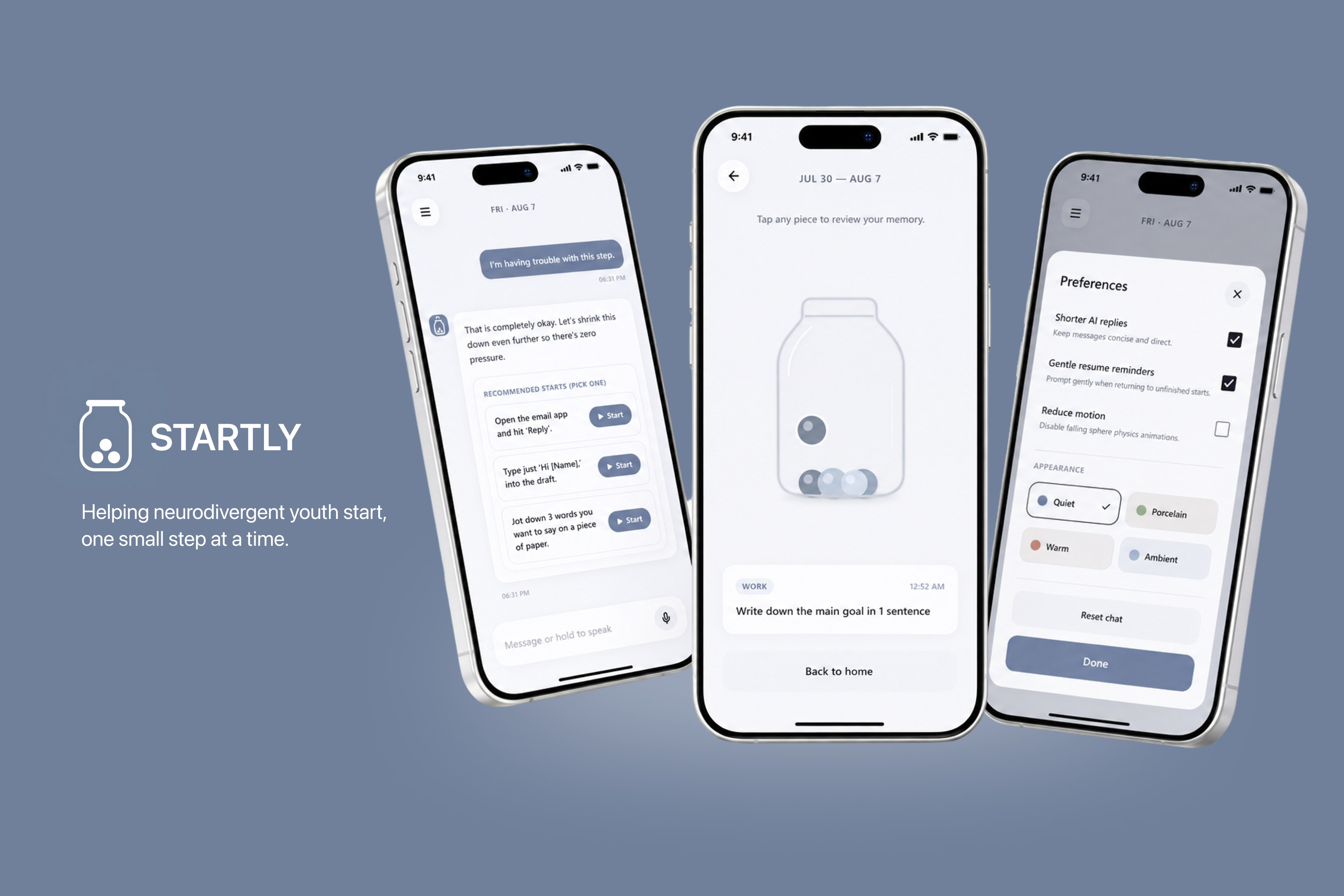
Hero Image
-
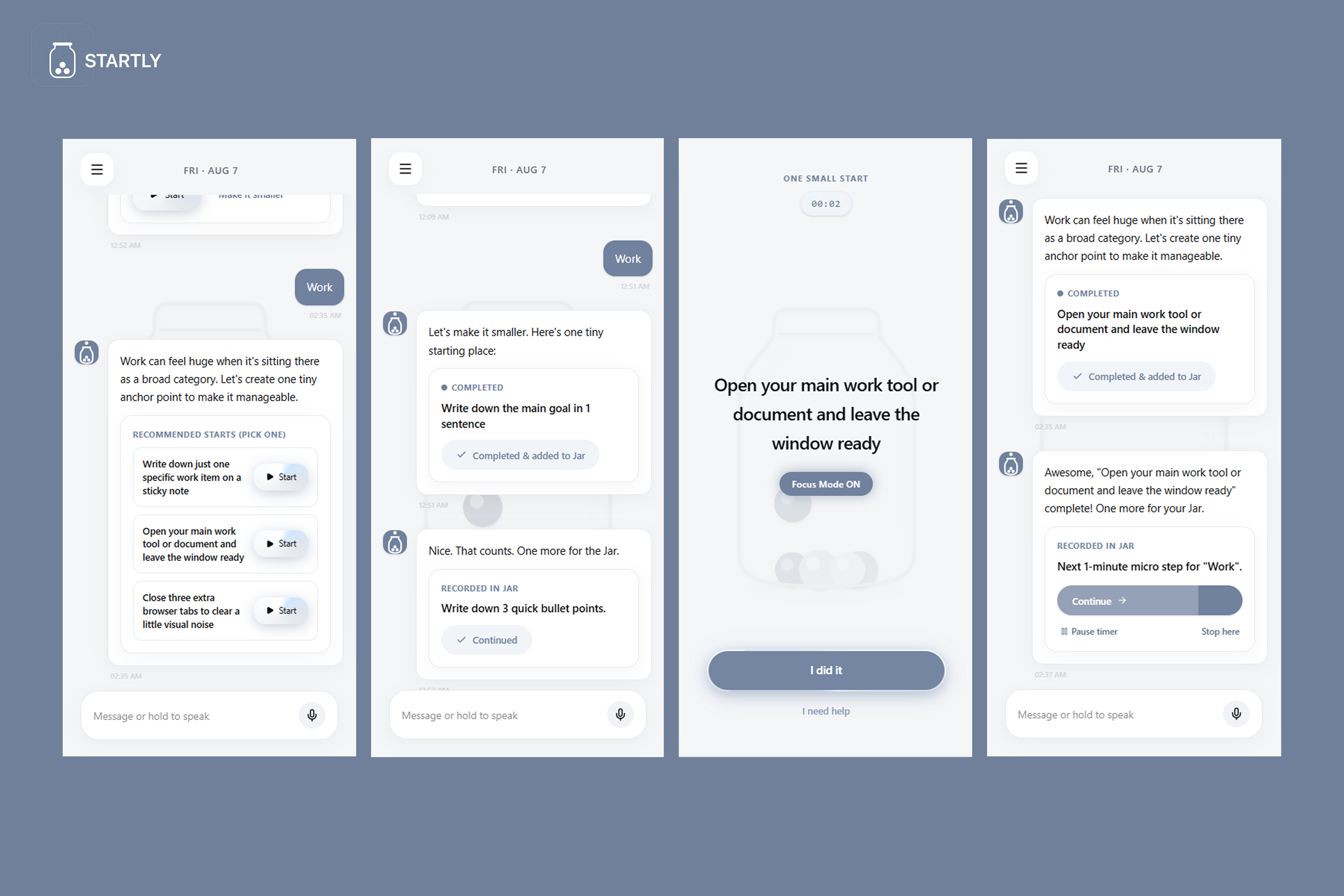
Main Workspace
-
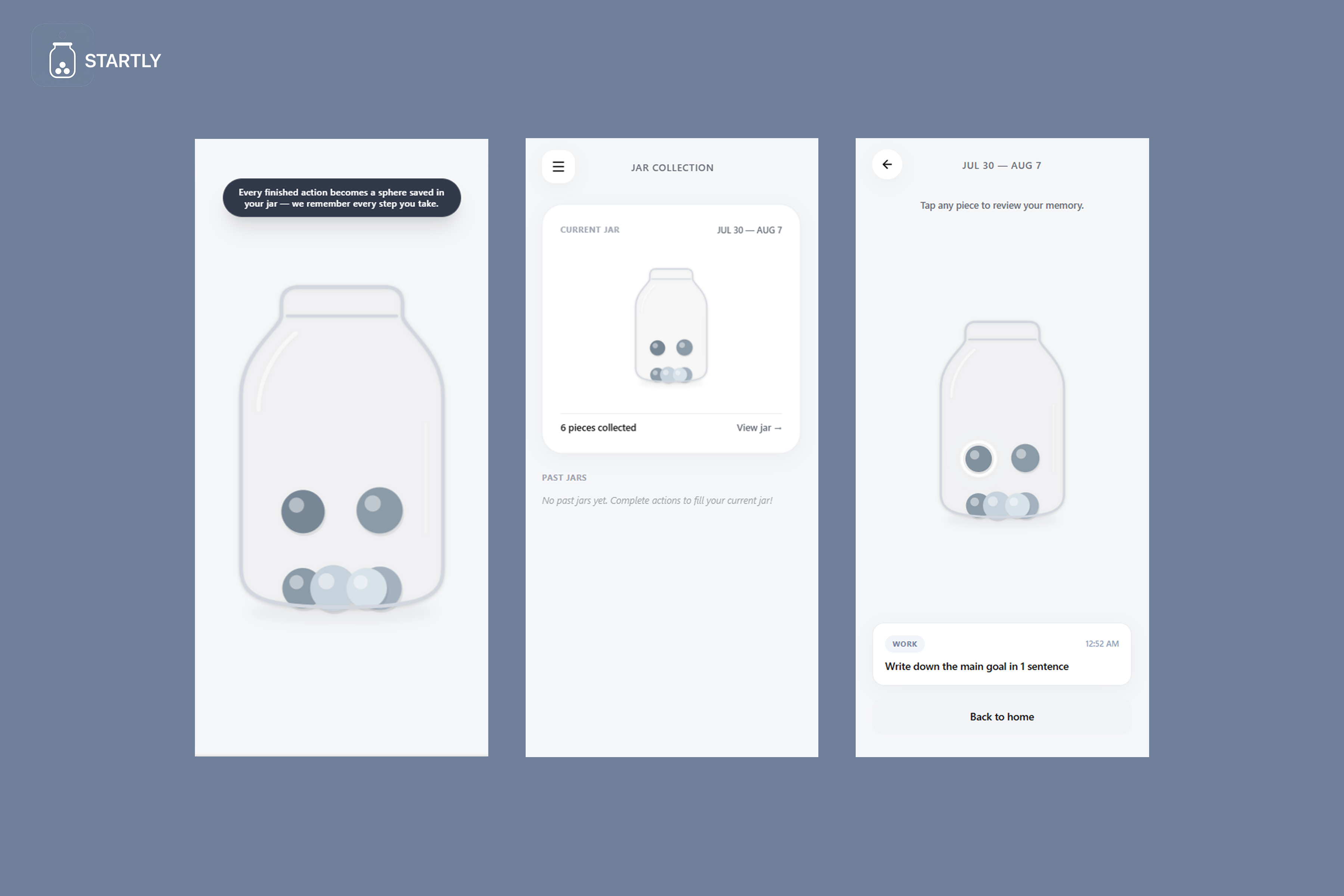
Jar Collection Design
-
System
-
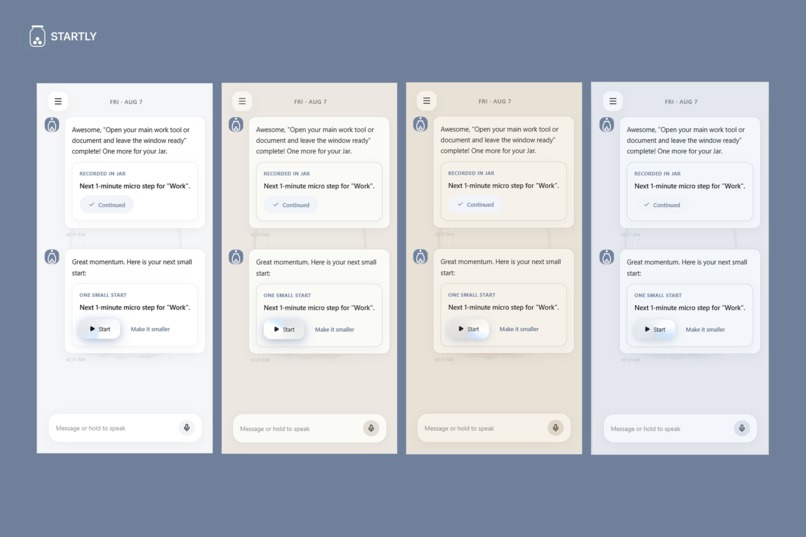
Themes (Color Design)
Inspiration ##
The idea for Startly came from both research and personal experience.
I have always struggled with procrastination, staying focused, and starting tasks. Sometimes I know exactly what I need to do, but I still keep delaying it. My mind also tends to jump between multiple things at the same time, which makes getting started even harder. While I do not use my own experience as a substitute for neurodivergent user research, it made this problem feel very familiar to me and helped me understand why task initiation can be such a real barrier.
During the hackathon, I spent a lot of time researching neurodivergence, ADHD, executive function, task initiation, motivation, and attention, with a specific focus on the experiences of neurodivergent youth. I spoke with neurodivergent people and people who experience ADHD-related challenges, and I used AI to help me collect and organize academic papers, expert advice, community discussions, product reviews, and first-person experiences.
One of the biggest inspirations for Startly was James Clear's Atomic Habits. I especially liked his explanation of why people procrastinate and why habits are difficult to build. A large task can feel overwhelming, the reward often feels too far away, and simply starting can feel harder than the task itself.
His idea of making a behavior extremely easy to start strongly influenced Startly. Instead of thinking about a two-hour task, what if we only ask the user to do the first two minutes? Once someone starts, it becomes much easier to build momentum and continue.
I was also inspired by the Paper Clip Strategy described by James Clear. The idea is very simple: every time you complete an action, you physically move one paper clip from one container to another. Even though the reward itself is small, progress becomes visible.
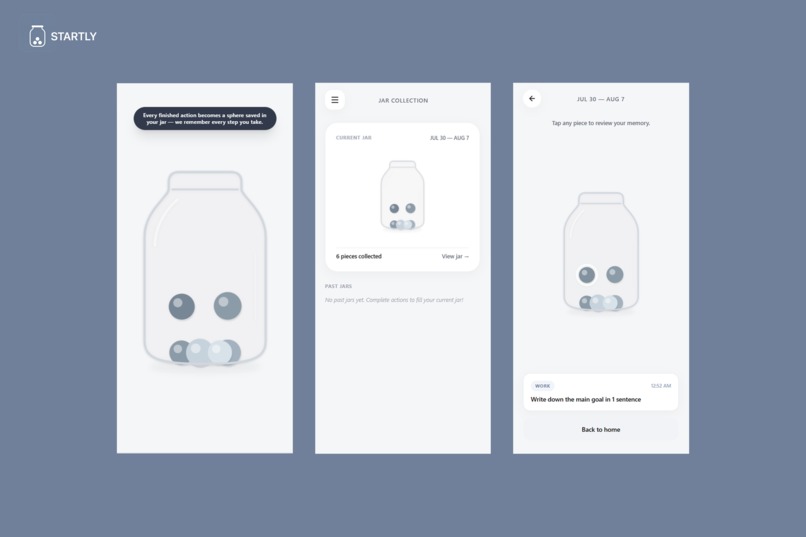
That idea eventually became Startly's Jar system. Every time the user takes a real action, a new piece falls into the Jar. Instead of waiting until an entire task is finished, Startly moves the reward forward and makes progress visible immediately.
That became one of the most important ideas behind the project:
Startly is not trying to track or pressure users until they finish everything. It is trying to make starting easier, make progress visible, and create enough momentum for the next action to feel easier.
What it does ##
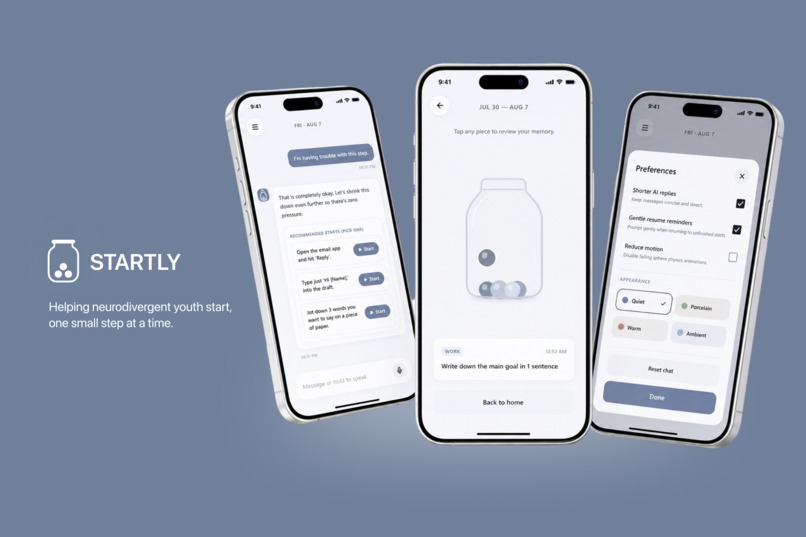
Startly is an AI companion designed for neurodivergent youth who experience task initiation and executive function challenges, including young people with ADHD.
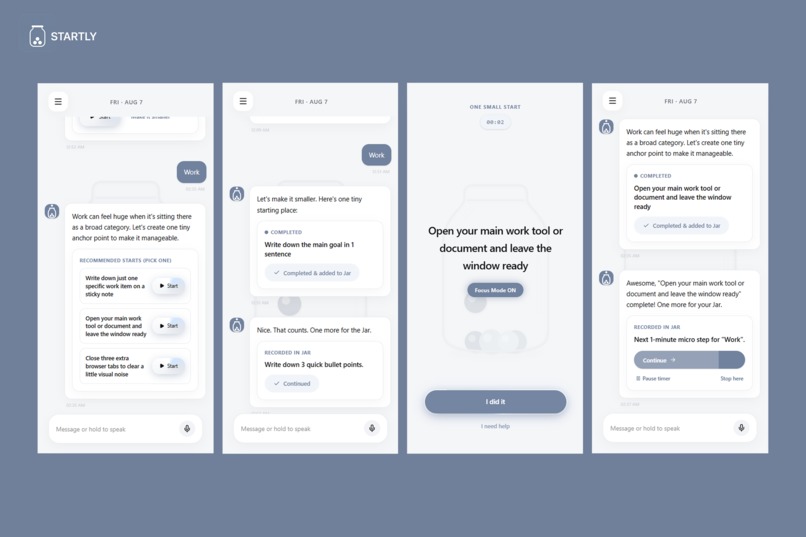
The user can simply talk to Startly about something they are avoiding or having trouble starting. Instead of generating another long plan or to-do list, the AI understands the situation and breaks the task into a much smaller action that feels achievable right now.
If that action still feels too difficult, Startly can make it even smaller. The product is built around reducing friction at every step.
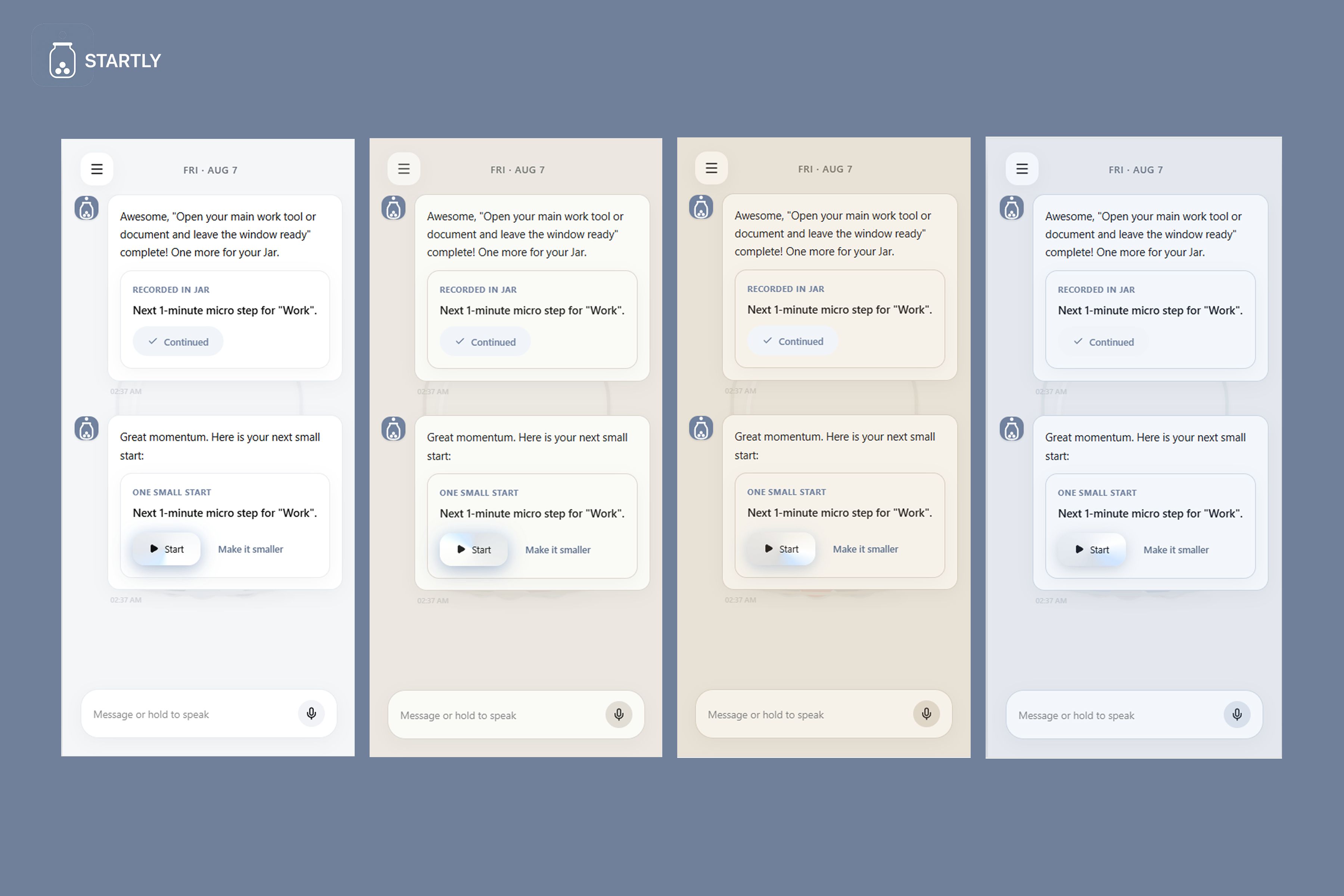
The AI guides the user instead of asking them to manually organize everything. To reduce friction between actions, I also borrowed from Netflix’s “Play Next Episode” pattern: once a user completes one small action, Startly can automatically continue into the next suggested step unless the user pauses or stops. The goal is to remove unnecessary clicks, preserve momentum, and make continuing feel easier than restarting. The working mode then creates a more focused environment with fewer distractions and a more immersive interface. In a future mobile version, this could also connect with notification and device-focus controls to reduce interruptions from other apps. The working mode creates a more focused environment with fewer distractions and a more immersive interface. In a future mobile version, this could also connect with notification and device-focus controls to reduce interruptions from other apps.
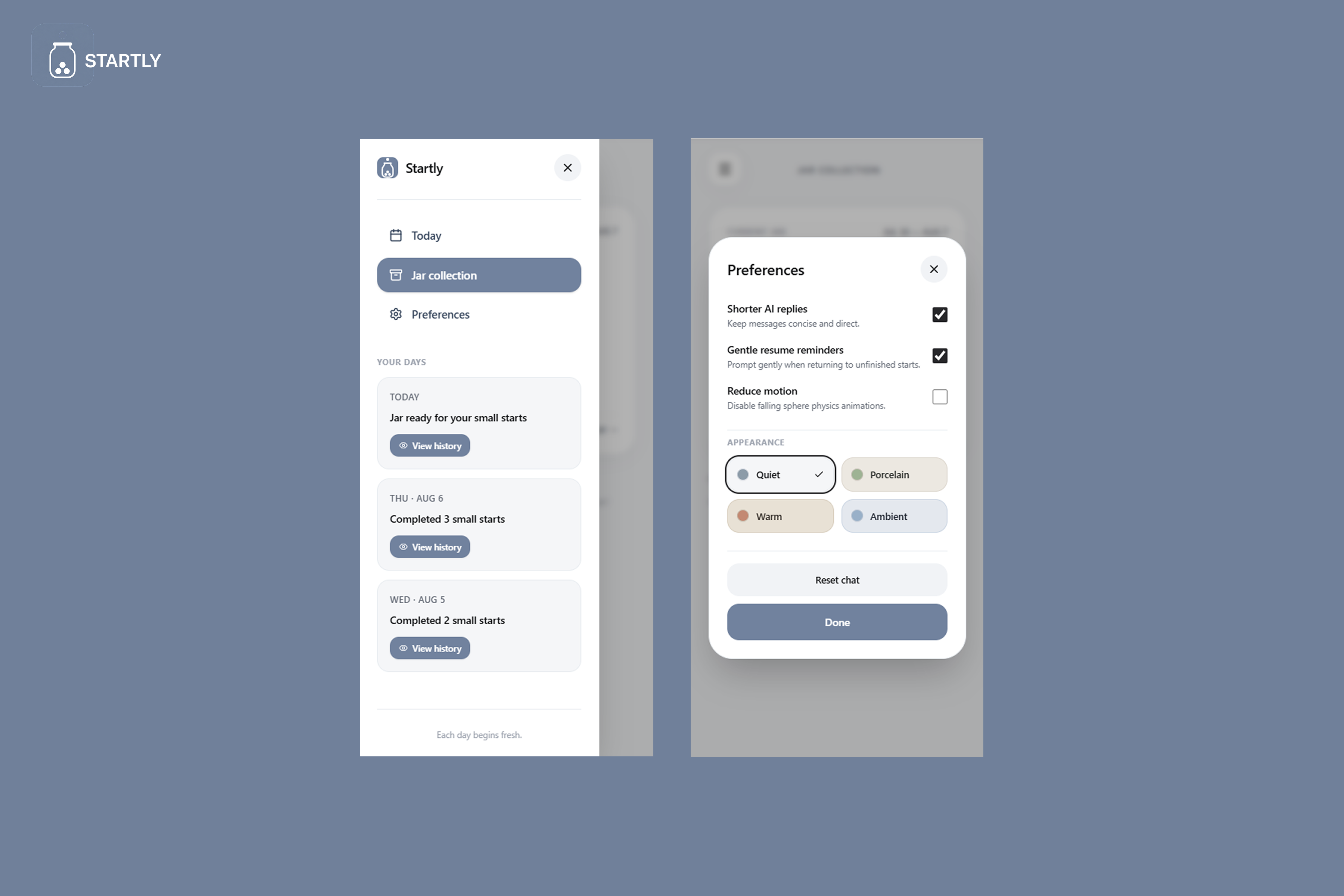
The Jar creates the reward loop. Every action adds another piece to the collection, so progress becomes something the user can actually see growing. The Jar is not meant to measure whether someone is productive enough. It simply shows evidence that they took action.
The overall goal is to lower the cost of starting, improve the environment around focus, give immediate feedback, and make small progress feel meaningful.
How we built it ##
I used a lot of AI tools during this hackathon, mainly to help me find information faster, organize large amounts of information, and reduce repetitive work.
I started with research focused on neurodivergent users and task initiation. I spoke with neurodivergent people and people who experience ADHD-related challenges, while also reflecting on my own struggles with procrastination, attention, and task initiation.
From that research, I summarized recurring pain points and explored possible solutions.
After the research was organized, I used ChatGPT together with Figma to speed up the design process. ChatGPT helped me organize research findings directly into Figma, build moodboards, explore wireframes, structure the UX, and develop the UI.
Once the UI was polished, I used those Figma designs as references for Google AI Studio. Google AI Studio helped me turn the design into a working prototype and publish a shareable link so real testers could try it.
I continued updating the prototype based on testing and feedback. After that, I exported the code from Google AI Studio to GitHub, cleaned and organized the project files, and prepared the final repository and submission for the hackathon.
AI helped me move much faster, but the overall process still followed a normal design workflow:
research → synthesis → design → prototype → testing → iteration
Challenges we ran into ##
One of the biggest challenges was using AI to develop the prototype.
At the beginning, AI-generated implementations often looked completely different from what I actually wanted. It misunderstood the Jar, changed the interaction logic, added unnecessary UI, or turned simple ideas into complicated screens.
There were moments when I started worrying that the AI would never be able to build the interaction I had designed. Eventually, I realized that trying to solve everything by sending more prompts was making the project worse. I stopped and reorganized my workflow.
Even when AI makes development much faster, I do not think we should skip any part of the design process. Research, synthesis, wireframes, UI, implementation, and testing still matter. Each stage needs human review before moving to the next one.
I also learned that testing needs to happen early. It is much better to let someone actually use the prototype, hear what feels confusing or uncomfortable, and quickly iterate than to build the entire experience alone and only test it at the end.
Accomplishments that we're proud of ##
What I am most proud of is that I did not spend this hackathon only thinking about how to build a prototype.
I spent a large amount of time reading, researching, and trying to understand the actual pain points neurodivergent youth experience around task initiation and executive function.
That research helped me avoid many product ideas that initially seem obvious but can easily become another version of the same productivity tool. I did not want to build another planner or task tracker. And I also did not want the product to have complicated navigation, lots of pages, buttons, dashboards, calendars, or features that users have to constantly maintain.
For neurodivergent users who already experience task initiation friction or cognitive overload, those things can create even more friction.
So I used a “less is more” approach.
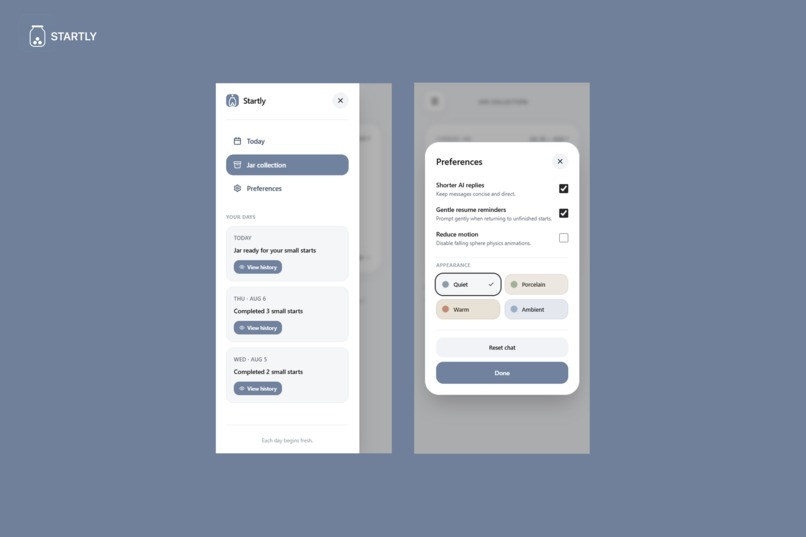
Startly has no bottom navigation and very little UI that users need to learn. Most of the experience happens naturally through the AI conversation. Ideally, someone should be able to open it and understand how to use it without a tutorial.
I also deliberately chose not to build a complicated Insights page, productivity dashboard, daily check-in system, or streak mechanic. Those systems can easily create guilt. If someone forgets to check in for several days, breaks a streak, or sees a calendar showing how little they completed, the progress system itself can become another source of pressure.
The Jar works in the opposite direction. The user only sees what they have already done. Every action adds another piece. Nothing is taken away. Instead of showing the user how far behind they are, it continuously shows evidence that they have made progress.
That is probably one of my favorite design decisions in Startly.
What we learned ##
This project taught me a lot about both product design and working with AI.
The biggest lesson was that good design is not about adding more features, more buttons, or more text.
This becomes especially important when designing for neurodivergent youth and when the product is trying to support task initiation, executive function, focus, or emotional friction.
In these situations, UX matters enormously. A complicated interface can become part of the problem. Smooth transitions, clear visual hierarchy, simple interaction, rewarding animation, and an interface that quickly captures attention can directly change how willing someone feels to continue using the product.
I also learned that AI does not replace a design workflow.
AI helped me research faster, organize information, create prototypes, and reduce repetitive work. But whenever I tried to skip a step and let AI figure everything out on its own, the result became less accurate. AI made the process faster, but every stage still needed to be checked and directed by a person.
Finally, I learned how important it is to test with real neurodivergent users throughout the process. You should not design everything from beginning to end alone and assume the experience works. Real feedback is what lets you find problems early and iterate quickly.
What's next for Startly
If Startly became a real product, I would focus heavily on making the UX much more polished, engaging, and immersive for neurodivergent youth.
I would spend more time refining the transitions, animation, visual guidance, and the feeling of moving between conversation, starting a task, working, and receiving a reward.
I would also explore a much deeper focus environment.
For example, a real mobile version could connect with the phone's focus and notification systems so that when the user enters a working state, Startly could reduce notifications and interruptions from other apps and help create a more immersive environment with less temptation to keep checking the phone.
One thing this hackathon made very clear to me is that design is not better just because it has more functionality. Especially when designing for neurodivergent youth and supporting challenges around task initiation, executive function, attention, and emotional resistance, the interaction itself can be just as important as the feature.
A smooth animation, strong visual feedback, and a simple UX can make the experience feel much easier and more engaging. A few days of a hackathon is not enough time to refine every detail to that level, and even AI can still only help produce a relatively rough prototype in such a short period of time.
If I have the opportunity to continue Startly, I would spend much more time carefully designing the complete UX journey and motion system, testing every interaction with neurodivergent youth, and making the product feel truly centered around the people it was designed for.

Log in or sign up for Devpost to join the conversation.