-
-
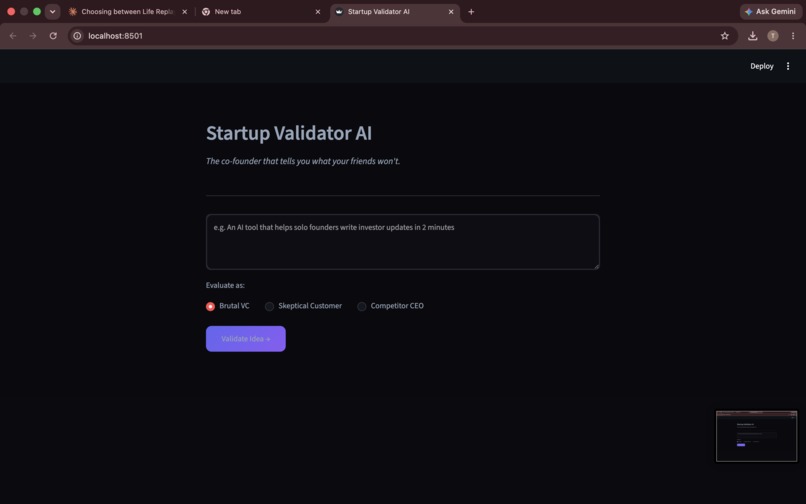
UI
Inspiration
Every founder has people around them who say their idea is great. Friends are encouraging. Family is supportive. But none of them will tell you the hard truth early enough to matter.
We built Startup Validator AI because the most expensive mistake in startups isn't a bad idea — it's a bad idea you spent 12 months building.
We wanted a tool that simulates the harshest feedback you'd ever get, before you write a single line of product code.
What it does
Startup Validator AI stress-tests any startup idea in under 10 seconds from three brutal perspectives:
Brutal VC — A 20-year investor who has funded only 2% of pitches. Asks about your moat, market size, and names real startups that tried this and failed.
Skeptical Customer — A real user burned by overhyped products. Asks why they'd trust you over existing solutions and whether they'd actually pay for this.
Competitor CEO — A well-funded rival analyzing your threat level. Tells you exactly how they'd crush you within 90 days.
Each validation gives you:
- A score out of 100
- A one-line brutal verdict
- Your single biggest killer risk
- Market analysis with real comparables
- Green flags and red flags
- 3 hard questions you must be able to answer ## How we built it
- Python + Streamlit for the UI
- Google Gemini API for AI analysis
- Custom prompt engineering for each persona
- Structured JSON output for clean data rendering
- Session-based validation history ## Challenges I ran into Getting the AI to give specific, non-generic feedback was the hardest part. Early versions kept saying things like "the market is competitive" — which is useless. We fixed this by engineering prompts that force the model to name real companies, cite real funding rounds, and give a calibrated score where most ideas score below 50. ## Accomplishments that we're proud of
- Built and deployed in one hackathon
- Three distinct AI personas with genuinely different perspectives
- Clean, demo-ready UI that works live on stage
- Prompt engineering that produces specific, credible, actionable output ## What we learned Prompt engineering is product design. The difference between a useful AI tool and a generic one is entirely in how precisely you define the persona, constrain the output format, and force specificity. ## What's next for Start_up validator
- Web search integration for live market data
- Multi-agent pipeline: research → critique → score
- "Fix This" loop where founders respond to killer risks and re-score
- Shareable validation report as PDF

Log in or sign up for Devpost to join the conversation.