-
-
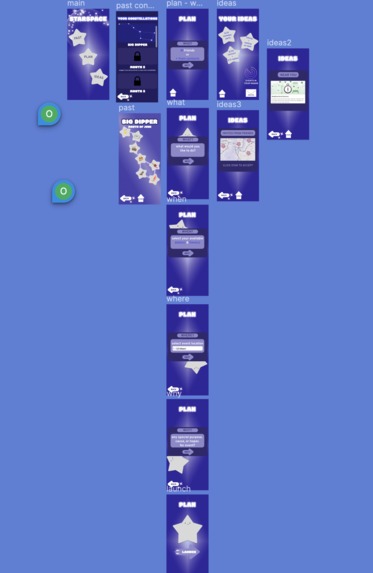
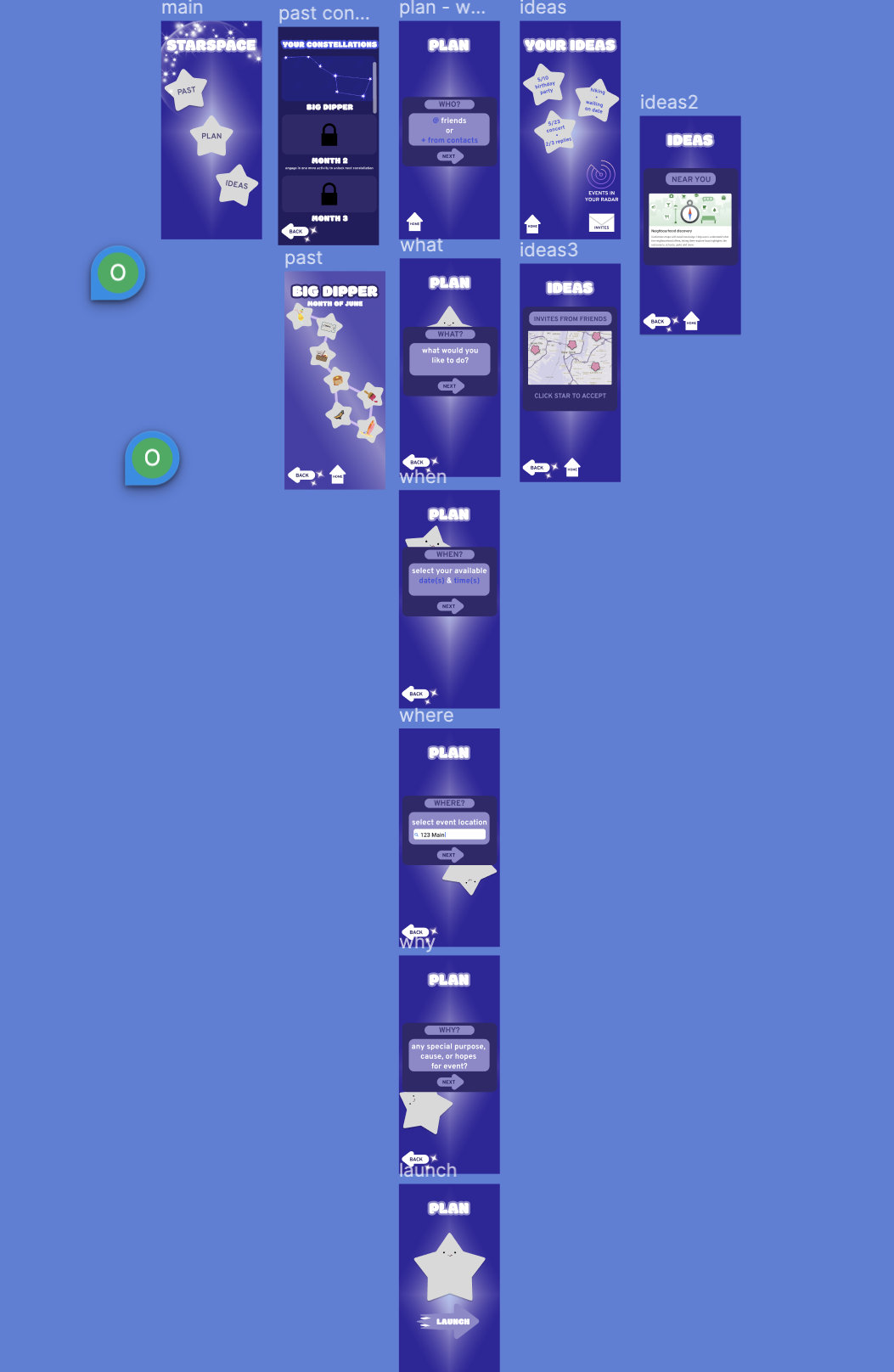
overview of all slides
We were inspired by how we want to engage with our friends today. Everyone has busy lives, and without every person's schedule on hand, planning a time and day that works for everyone can be a challenge. We wanted a way for friends to stay engaged with each other by also shifting the focus away condensed highlights of millions of people and centralizing focus into oneself and their own accomplishments. We also appreciate the idea of BeReal's social media functionality, in the way that it lets you engage with your friends in a way that isn't super scroll-addictive or negative.
Starspace allows you to connect with your world, with you as the star. Firstly you can coordinate with your friends and family, scheduling the details of what to do and where. You can also select the date(s) and time(s) that work for you, and when you send the plan to others, they can approve or select their own date. Once you create a plan, it goes into a section for future events. In the Future Events tab, you can see all your potential plans, as well as invites you have from others. You can also see Google Maps' API suggestion of events happening near you. When you have carried through with the event activity, you can go to this tab and select the plan to mark it as done. This moves the plan into a section called Constellations. All your past events go here, and once a certain amount has been completed, you can unlock a constellation. You can revisit past events to see the details, but more specially, add photos and stickers and write summaries or reflections of how it was. Each past events is accessible only to you and the people who were sent the plan initially. Starspace encourages socializing as it helps you plan fun activities for you and your friends. It also creates a place for you to scrapbook memories. It operates as a social media in this sense, because memories can be shared across individuals. Though it is only available to people who were a part of the memory, and you as a user can only see the events and memories you are involved in. This centers the Starspace experience around your life.
Prior to venushacks, our team had never tried coding outside of simplistic line by line programming in simple IDEs. We found an online collaborative interface tool named figma, and we were able to visualize our idea onto a percievable platform. We animated a demo throughout the app using the protoyping features within Figma. Began learning javascript and html languages using Replit so that we can implement real functionality throughout our application design model. We knew we wanted a map portion to be an integral tool within starspace, so we dove into google maps api and worked on implementing html js code with our starspace website.
As our team never had experience with interface tools or connecting backend with frontend programs, we struggled finding a specific platform to connect our interface into a functioning reality. At the beginning of Saturday, we asked a mentor on what we should use to implement app development. They advised we begin installing react native and flutter, but soon ran into problems getting these applications fully equipped onto our macOS computers. We got a different mentor to help out this time, but they claimed flutter and react native was too hard to install and learn with less than 21 hours left, and that we should convert our app into a website so we could code using javascript. After spending a few hours learning html, css, and java, another mentor came by and advised that we shouldn’t be “raw coding” websites in Replit. We returned back to researching other platforms that may execute our backend portion of the project, until we ultimately ran out of time and chose to focus on what we already had in our Replit and figma.
I’m incredibly proud of our resilience and willingness to learn so many new and foreign concepts of computer science. I’m also very grateful to have found venus hacks in general. Our team has never participated a hackathon before and I’m incredibly grateful that this happened to be our first one. It was a super fun learning experience and environment and we’re all excited to participate in another hackathon!
We attended many workshops and the most valuable takeaway was to never underestimate the amount of time it could take to install a new developing platform. Being familiar with the terminal and certain commands is something that will help us out in the long run when learning new programming languages and installing new developers. We learned a lot about web development: how css, html, and javascript are thirds that create a whole website. We learned about different app development softwares, how to install them, game development software navigation via Unity, GitHub git commands and functionality, and the key factors of brand + product design.
An essential portion of making our idea into a reality is learning more about the platforms that specialize in app development. The reason we created this project was because our team all similarly had difficulty scheduling hangouts with our friends or finding something fun to do when school is over, thus we want to eventually use star space for ourselves and friends. We personally love all the different mechanisms in the google maps API, and aim to become well versed enough cross-platform so we can make starspace as helpful and fun of a tool as possible.
Built With
- css
- figma
- google-maps
- html
- javascript
- replit


Log in or sign up for Devpost to join the conversation.