Inspiration
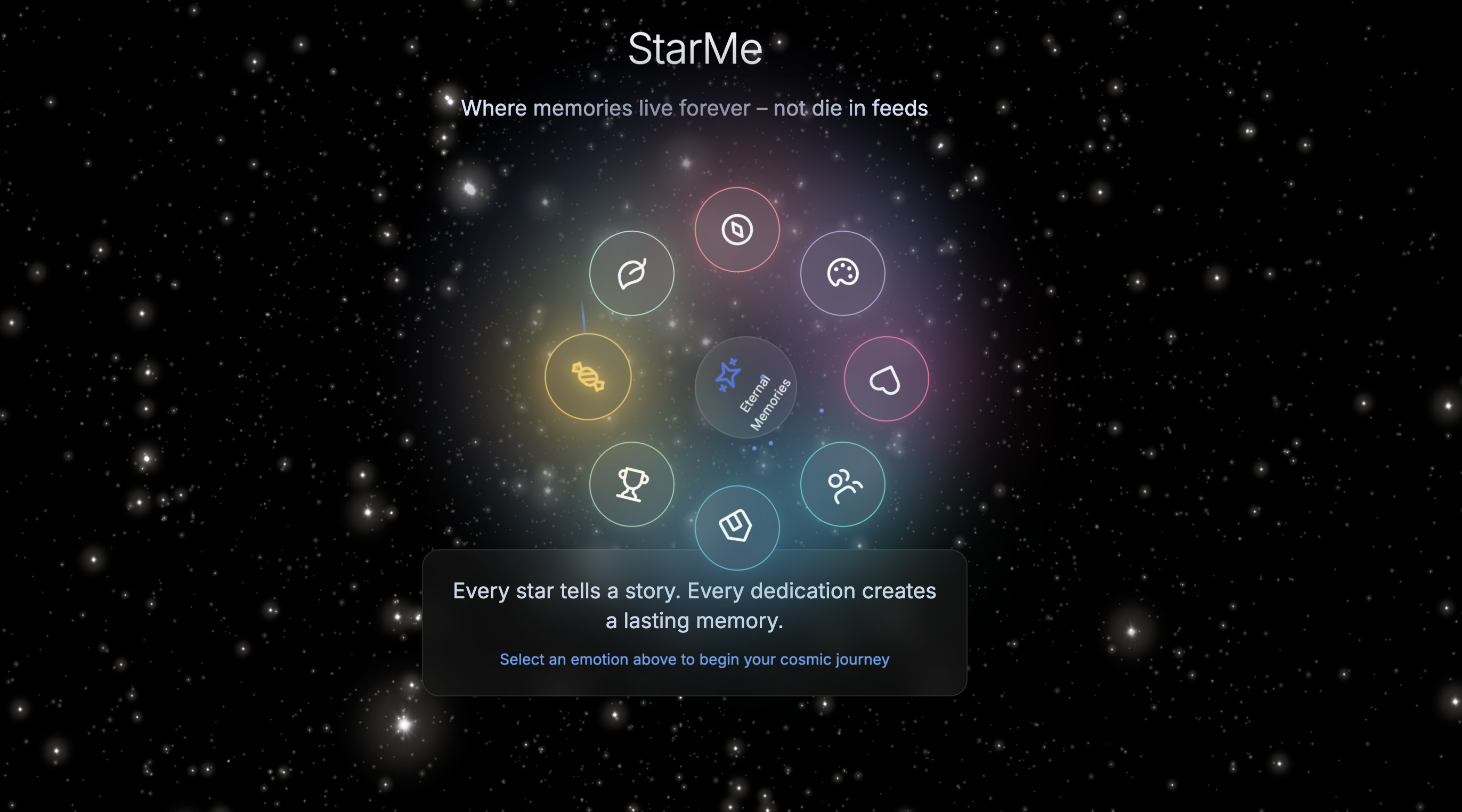
StarMe is an immersive, emotionally-driven social platform where people name stars and attach lasting memories—messages, dedications, photos, or AI-crafted tributes—creating a permanent celestial record of love, loss, celebration, and transformation.
In a world of fleeting memes and vanishing stories, I longed for something lasting—something as timeless as the night sky that once inspired our ancestors. I miss the weight of a handwritten letter, the warmth of a greeting card tucked in a pocket, and the care that went into every message. StarMe is my attempt to weave those enduring sentiments into the cosmos, linking our most precious memories to real stars so they, too, can shine forever.
What it does
StarMe lets you explore a realistic 3D night sky, pick any star to name after someone special, and send or receive paid memory messages—photos, stories, or AI‑generated poems—attached permanently to that star’s constellation. Each star has its own shareable page and time‑locked “legacy” unlocks, while optional premium upgrades (non‑fungible coordinates, plaques, AR experiences) deepen the emotional connection and turn memories into timeless celestial beacons.
How we built it
Built as a Next.js 14 web‑first app with TypeScript, Tailwind CSS, and @react-three/fiber powering a full‑screen interactive 3D starfield, StarMe uses Supabase. Dynamic Next.js routes (/star/[id], /gift) drive personalized shareable pages, while Framer Motion and Tailwind deliver polished modals for naming stars and sending paid memory messages—all scaffolded via Bolt.new prompts and deployed on Vercel for instant, scalable global access.
Challenges we ran into
In our hackathon sprint, we wrestled with integrating a performant Three.js starfield in a tight timeline, balancing polished 3D interactions with responsive mobile layouts; wiring Bolt.new–generated code into our React/Supabase stack; and quickly iterating on UX details—modals, routing, and Framer Motion transitions—all while ensuring our Stripe checkout and dynamic shareable pages were fully functional and bug‑free.
Accomplishments that we're proud of
We rapidly assembled a cross‑functional team—finding Etienne via the Bolt Discord—and in just 72 hours delivered a fully interactive 3D starfield, seamless React/Supabase integration, live memory‑token gifting, dynamic shareable star pages, and end‑to‑end Stripe checkout with Framer Motion polish—turning a bold concept into an elegant, working prototype.
What we learned
We learned the power of rapid iteration and low‑code tooling—Bolt.new’s prompts kick‑started our scaffold, but true magic happened when we combined that with hands‑on. Collaborating remotely (shout‑out to Etienne!) reinforced the importance of clear communication and modular code, while building end‑to‑end payment and data flows under time pressure taught us how to prioritize user‑facing polish without sacrificing core functionality.
What's next for StarMe
In the coming weeks, we’ll focus on user testing and UX polish—refining mobile touch controls, adding our chatbot browse mode, and smoothing out 3D interactions—while building out our editorial “Star of the Day” feed, embedding Notion/Discord widgets for social virality, and laying groundwork for AR sky overlays; concurrently, we’ll prototype a basic B2B Slack integration for team recognition and iterate on our memory‑token pricing to validate demand and drive early revenue.


Log in or sign up for Devpost to join the conversation.