See a Stardust demo: https://youtu.be/JS5krZMv52U
Background
in 1999, researchers were worried that an asteroid, 1999 AN10, would eventually find its way to Earth. They did not have enough data to rule out a potential 2027 collision with Earth. But they actually did have enough data. 1999 AN10 was photographed 44 years early, before anyone even realized it was an asteroid. The process of astronomers searching older images of asteroids to find an object that was recently discovered is called asteroid precovery. Precovery helped astronomers rule out the 2027 collision path of 1999 AN10. The problem is that asteroid precovery is a time-consuming process that requires astronomers to manually search images for prior sightings. Astronomers spend days, weeks, or months attempting to precover flight path data while we wait in limbo, uncertain about the future of our planet.
What it does
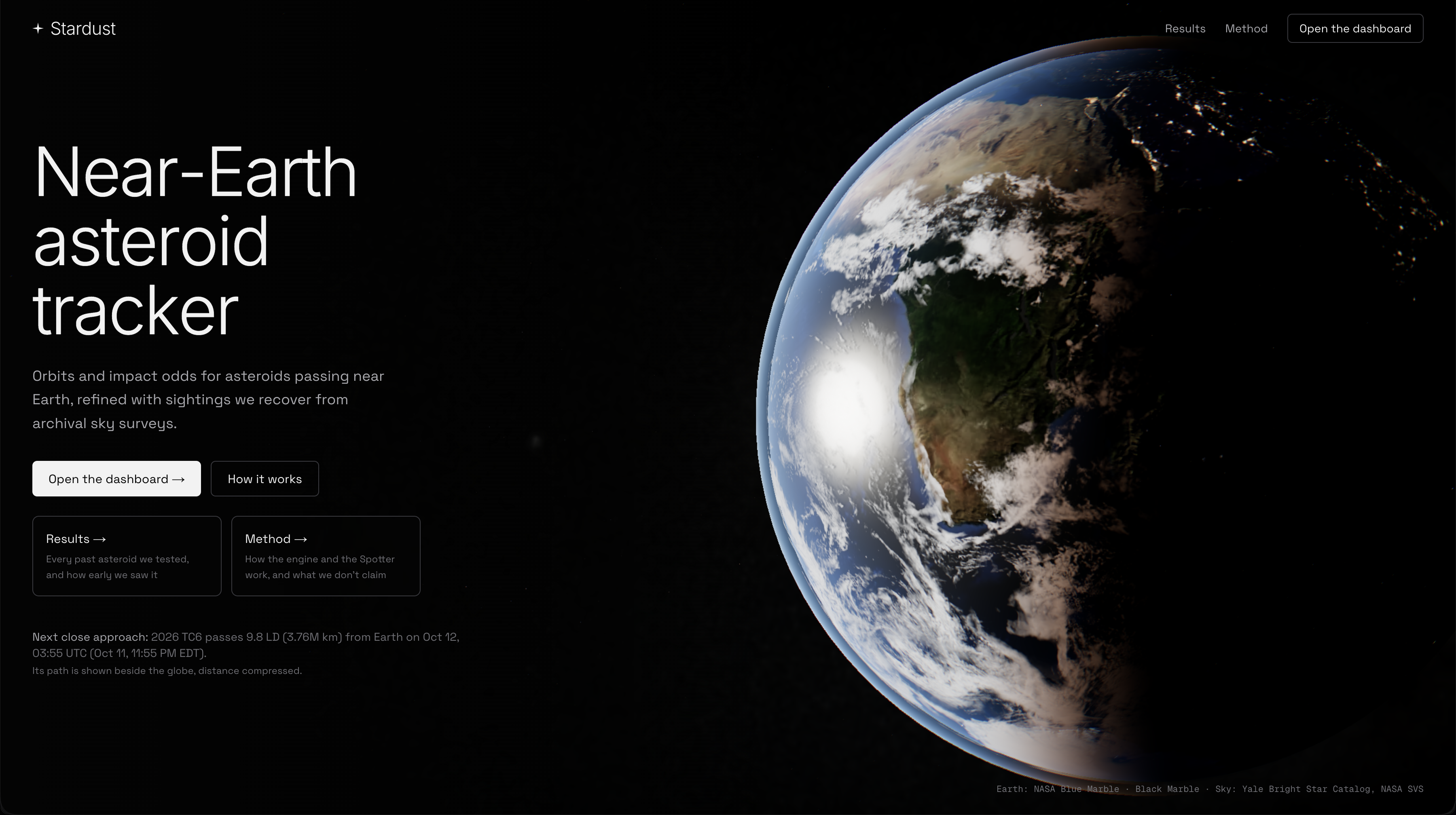
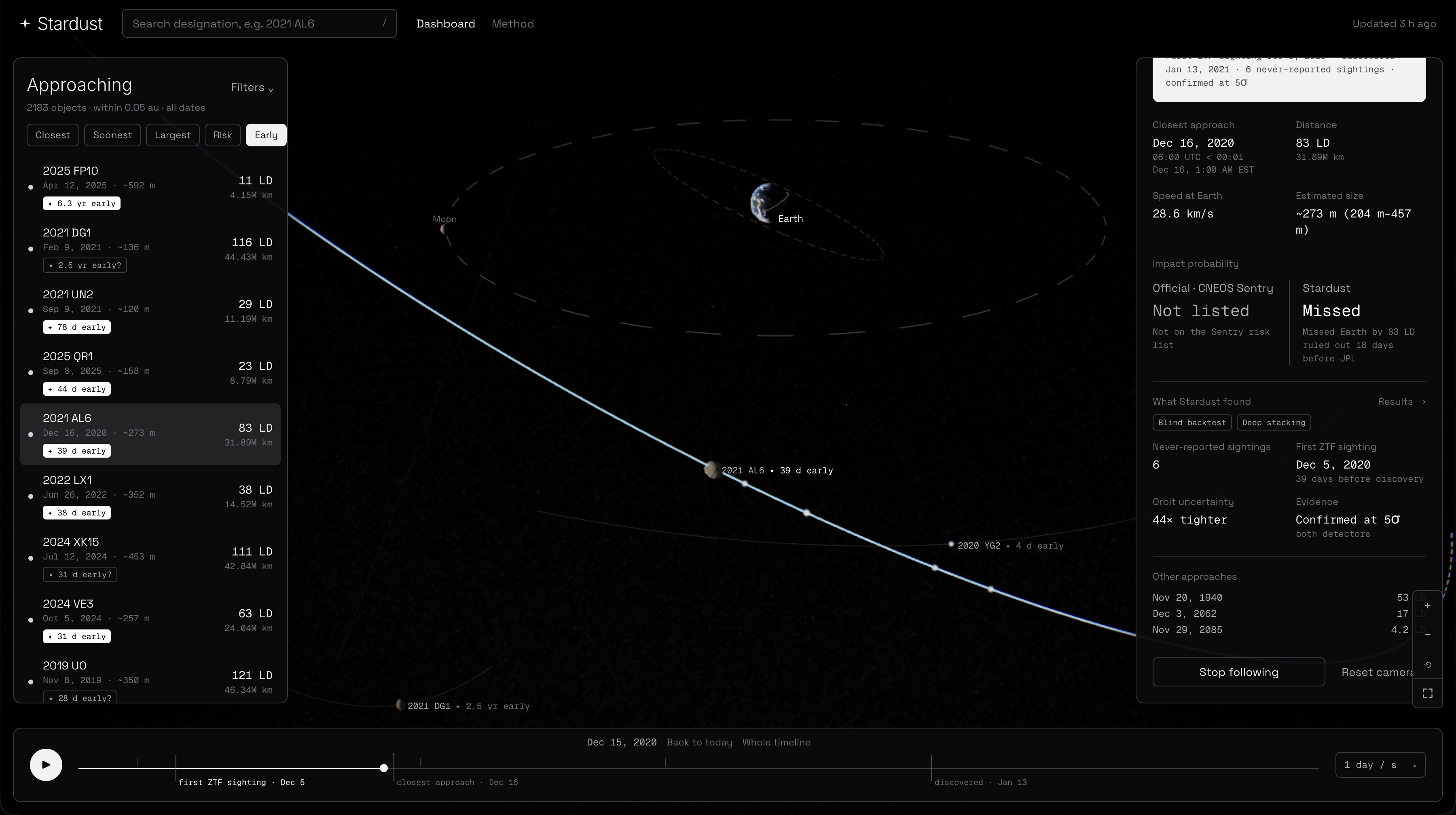
Stardust accelerates the precovery process using a machine learning model and CUDA-accelerated flight simulations. Stardust precovers asteroids in archival images from an average of two weeks before their discovery, and up to 6.3 years earlier. Four days after discovery, this precovery process makes a new asteroid's orbit typically 7× more certain, and up to 1000×. Stardust achieved these results by precovering over 300 never-before-seen sightings of asteroids that produced these accurate flight paths. Stardust can produce more accurate flight paths at a faster pace compared to labs like Lawrence Livermore National Lab and Georgia Tech, saving astronomers crucial time to work on saving the planet. We display these results at our website, showing the tightened flight path and rapid asteroid discovery in a beautiful interface, allowing scientists and the general public to quickly gather information about asteroids from the 1990s onward. Asteroid flight paths can be played back, allowing users to see
How we built it
We used public images from the Zwicky Transient Facility (ZTF), which photographs the northern sky every few nights with the Samuel Oschin telescope at Caltech's Palomar Observatory. Using the known positions of asteroids, we developed Stardust's two major components: our flight path engine and machine learning model. Our flight path engine uses Find_Orb on the asteroid sightings to fit an initial least-squares flight path model. We then use Find_Orb's covariance matrix to compute 20,000 varying flight paths of each asteroid, simulated on the GPU, to create a bounding box for each asteroid that restricts where the asteroid can be found. Each cutout that is within the bounding box is fed into our machine learning model. Our ML model is a CNN that follows the standard U-Net architecture, taking in a cutout and producing a heatmap of each asteroid as an output. If the CNN finds the asteroid within the bounding box in at least 3 photos across 2 nights, the finding is tracked as an asteroid sighting. We trained our model on 172 telescope images that were broken up into over 10,000 64x64 cutouts, about 4,200 of which show an asteroid. We evaluated the model on 2,517 separate cutouts, achieving a 95.5% detection rate on photos where the asteroid is bright and a 57.5% detection rate where the asteroid is faintly in view, compared to a classical method's 11.2% and 0% respectively. We built our frontend in Next.js and hosted our frontend and database with Vercel.
Challenges we ran into
We ran into two main challenges. Calibrating the ML model's post-inference confidence threshold to the right level that prevents false alarms while still accurately detecting asteroids proved challenging. We also faced challenges in deployment, as we transitioned databases and hosting platforms because we realized the free tier of Firebase simply is not sufficient for our use cases.
What we learned
We learned so much about asteroid imaging and the precovery process, but we really learned the power of machine learning. The U-Net architecture is extremely good at extracting features from difficult images and with the right image preprocessing, U-Net can extract many more different attributes.
What's next for Stardust
Stardust can help astronomers rapidly protect the planet, and we would love to explore this more in the future. We'll focus on continuous inference on asteroid images from ZTF immediately when captured and potentially explore edge applications for rapid asteroid detection.


Log in or sign up for Devpost to join the conversation.