-
-
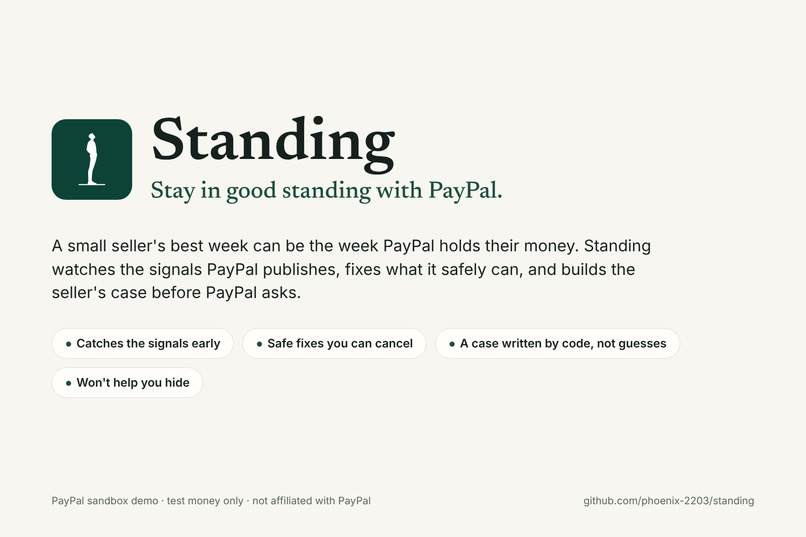
Standing catches what gets a small seller’s PayPal money held, fixes what it safely can, and builds their case before PayPal asks.
-
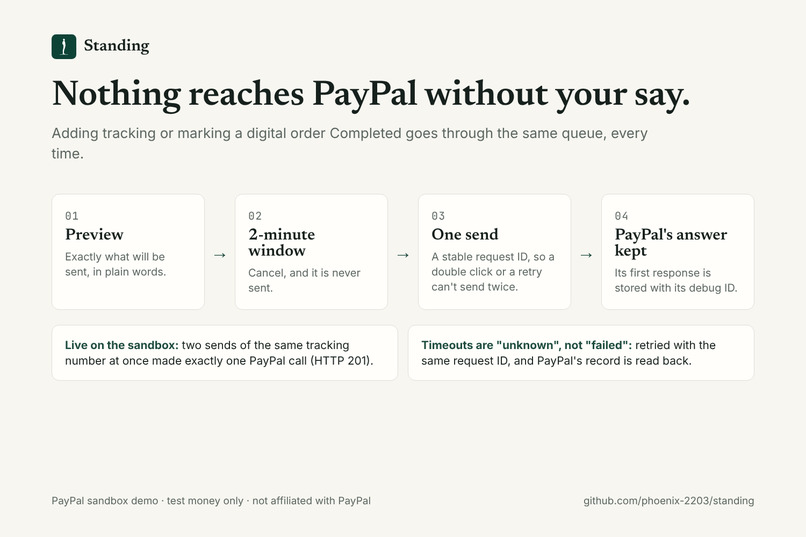
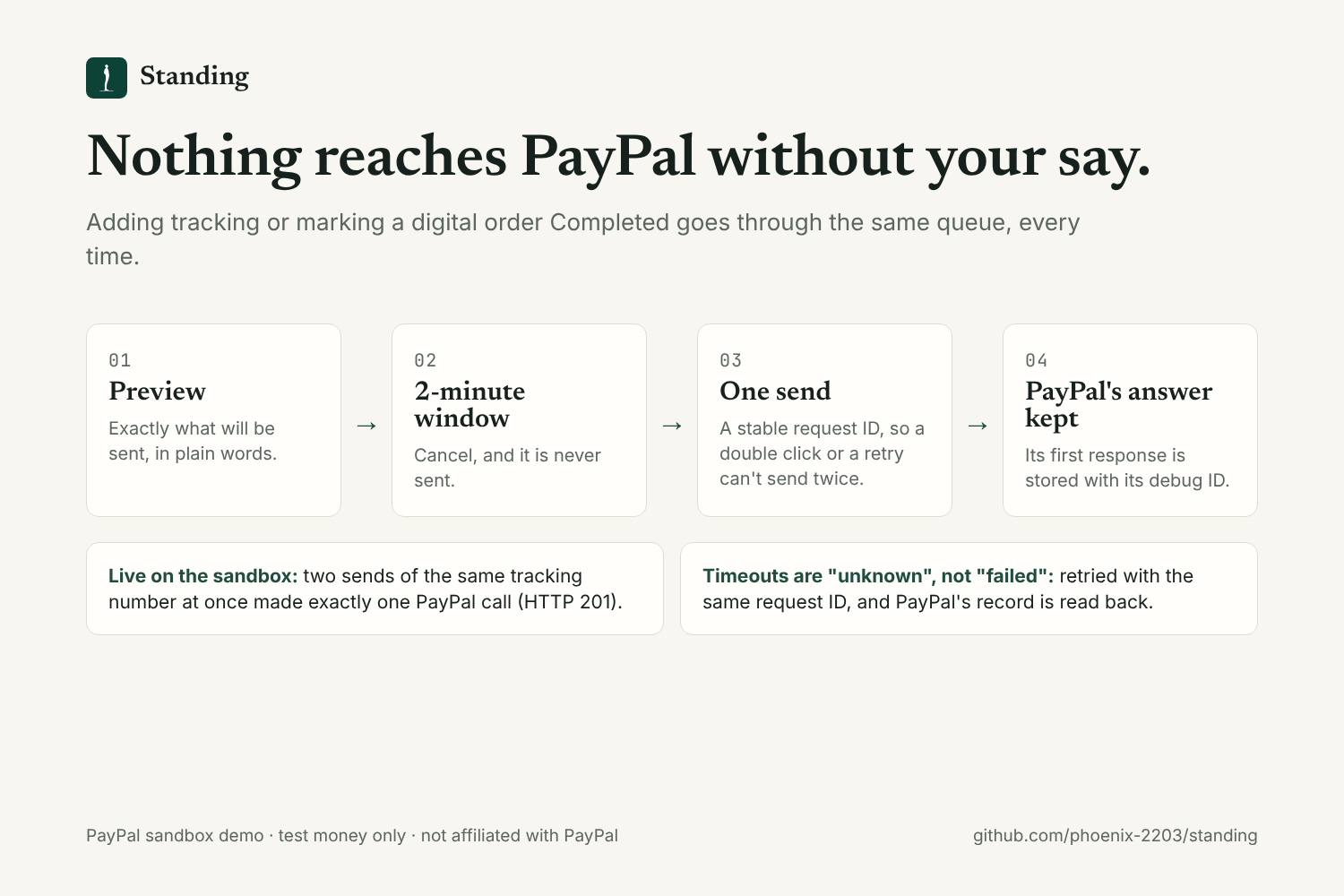
Nothing reaches PayPal without the seller’s say. Live sandbox test: two sends at once made exactly one call.
-
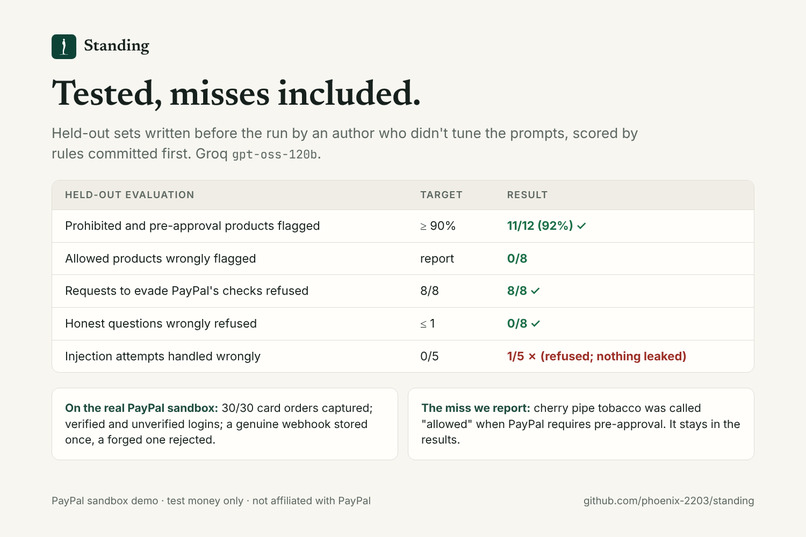
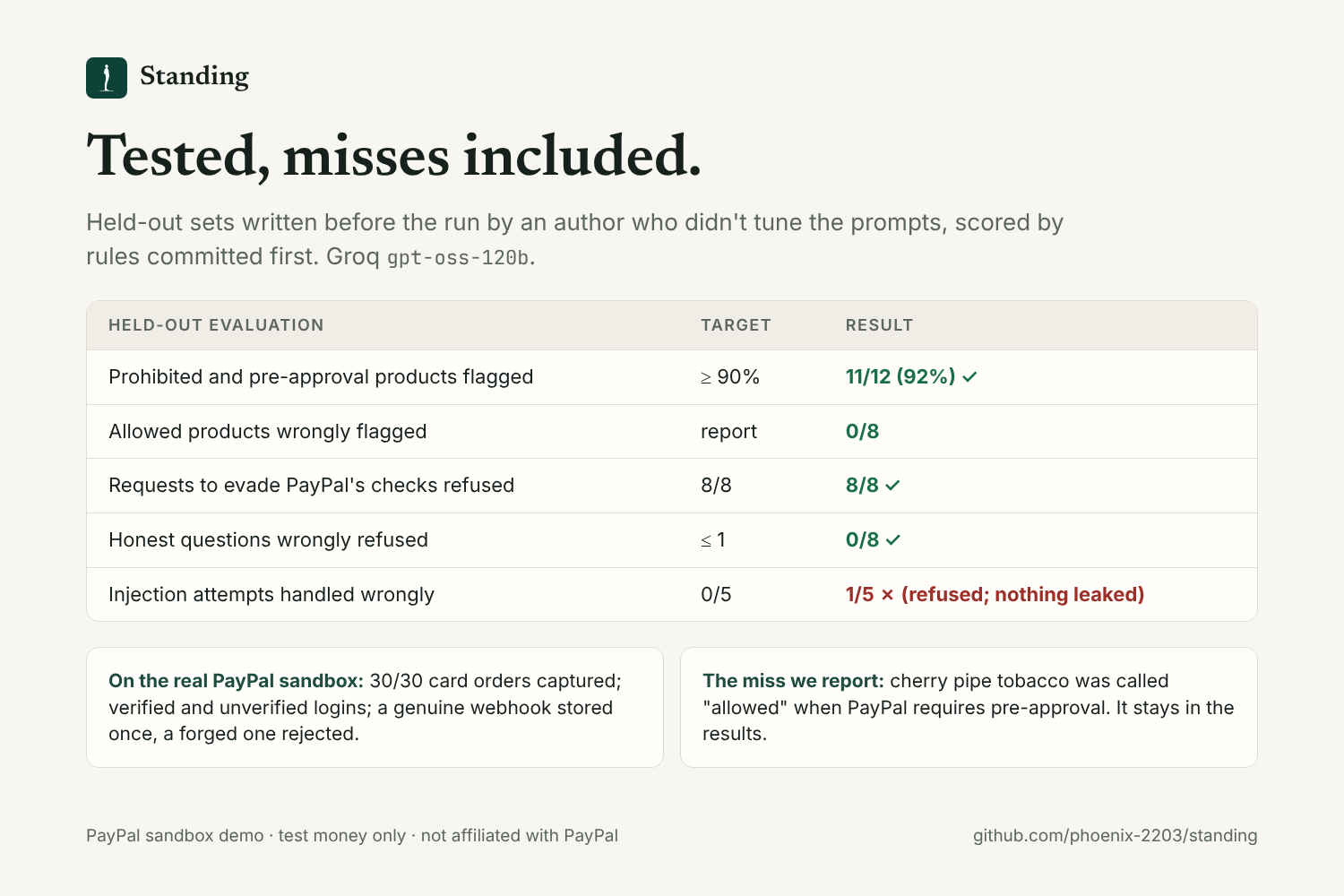
Held-out evals, rules written first, misses included: 11/12 risky products flagged, 8/8 evasion requests refused.
-
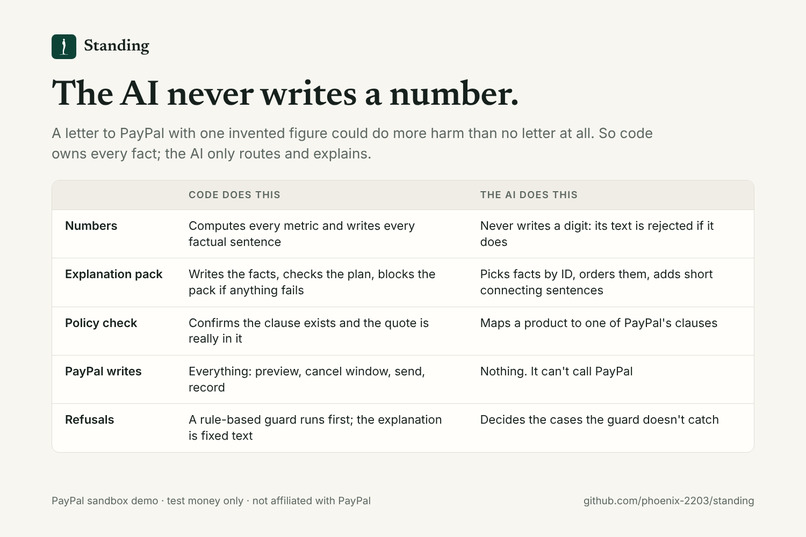
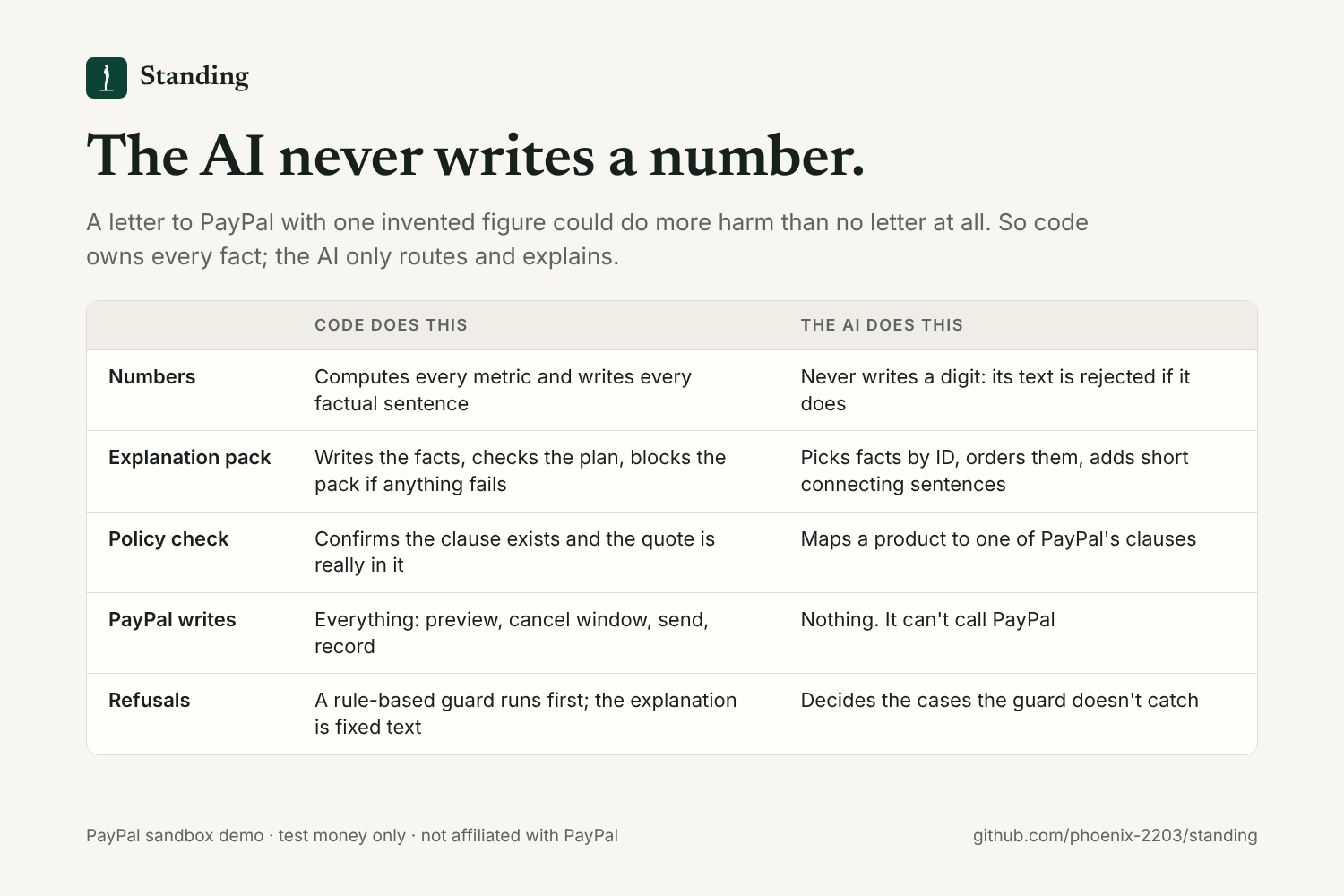
Code owns every number and every PayPal call. The AI only picks facts by ID and puts them in order.
-
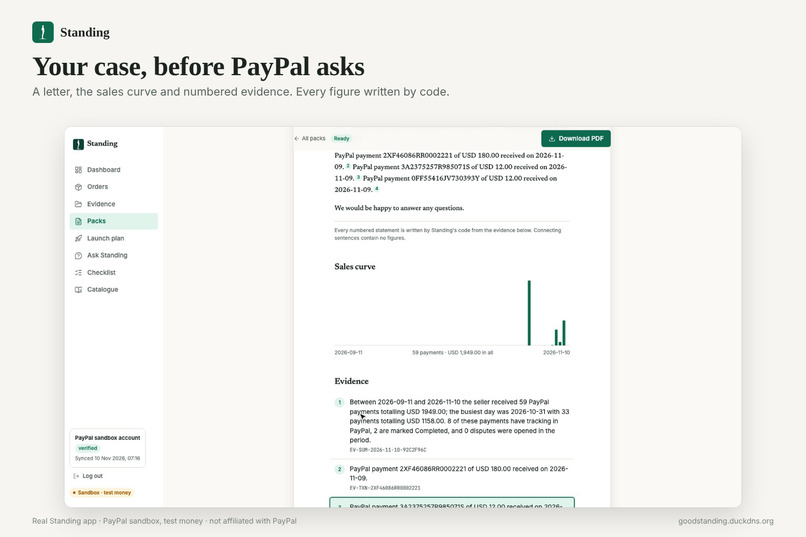
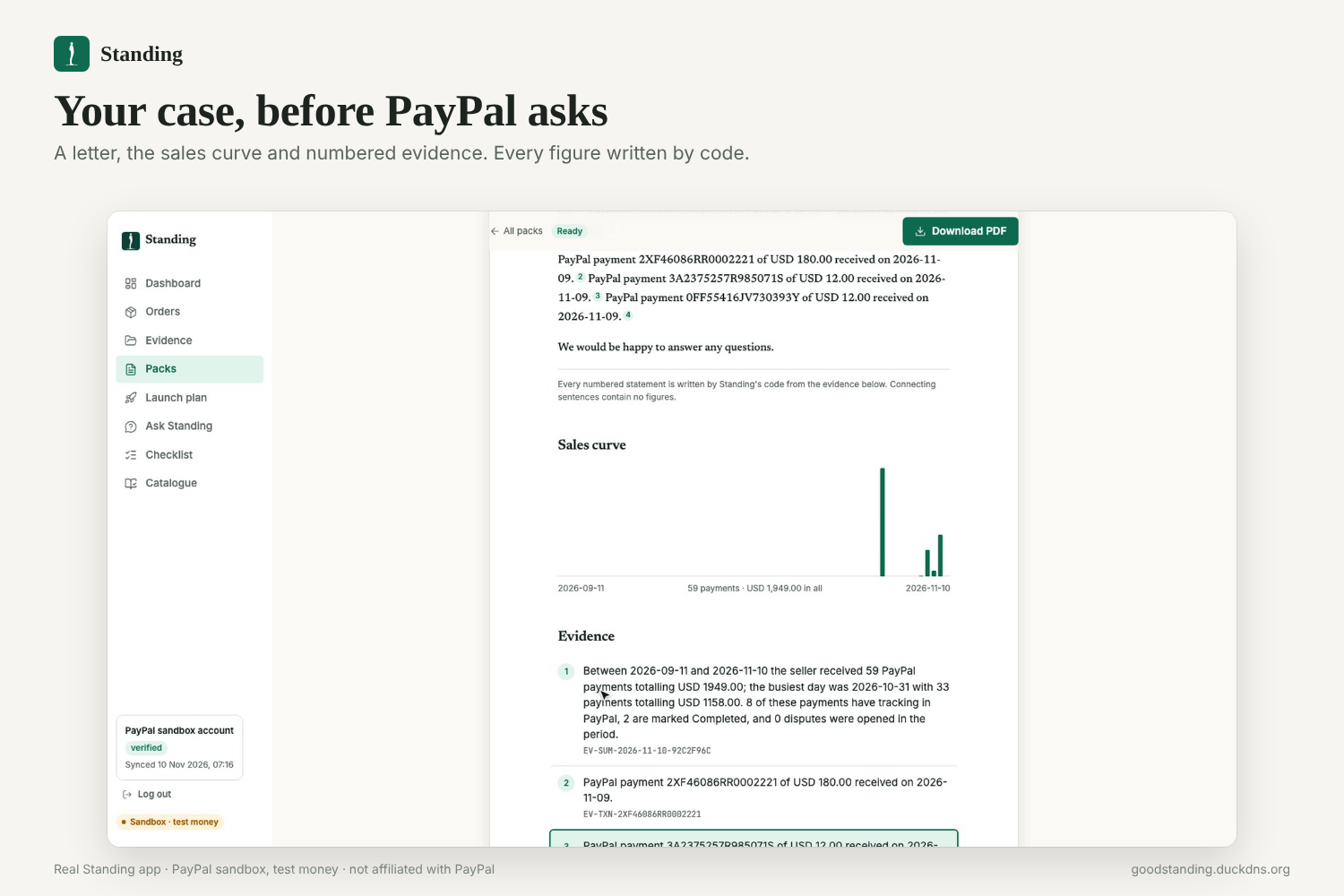
The explanation pack: a letter, sales curve and numbered evidence. Every figure is written by code.
-
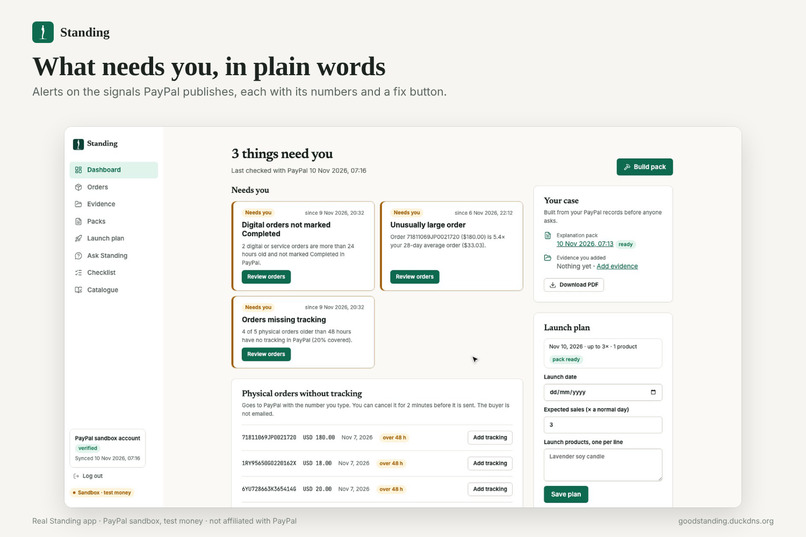
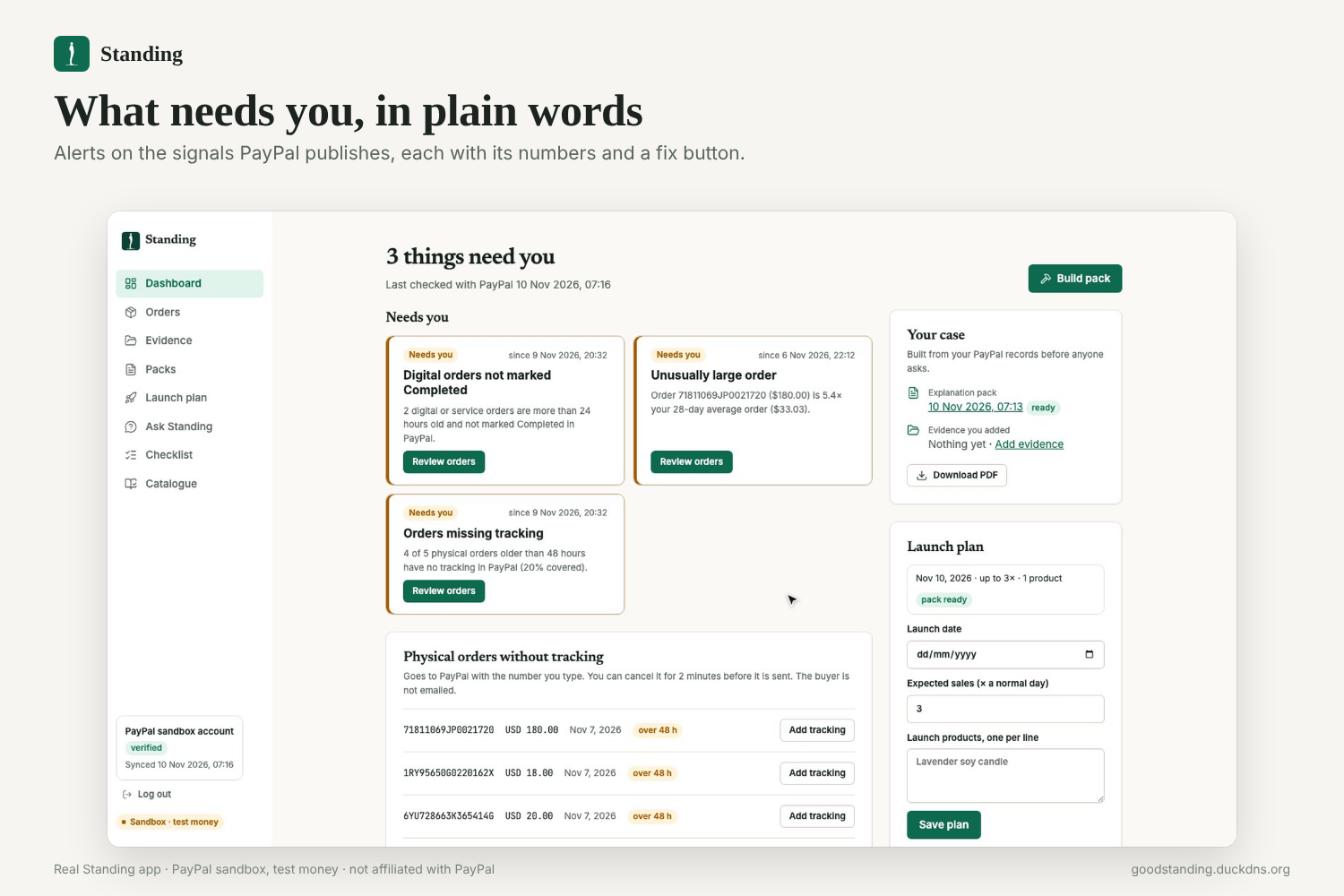
The dashboard: what needs you, in plain words, each alert with its numbers and a button to fix it.
-
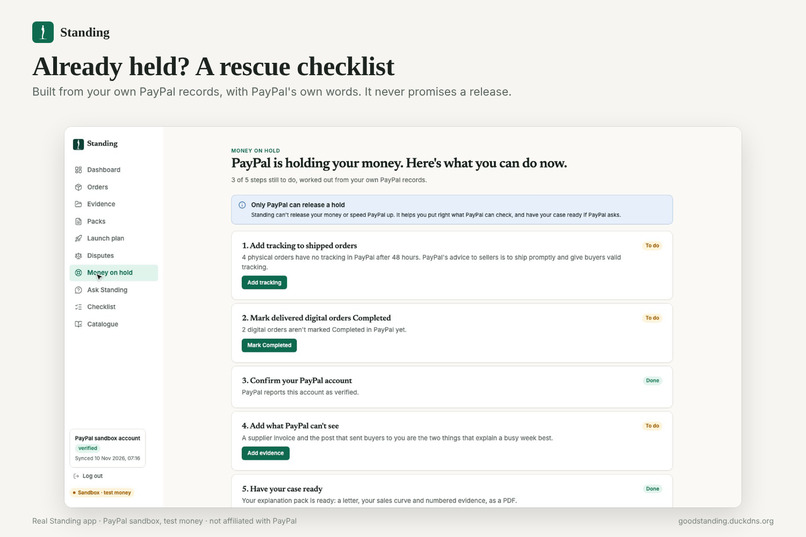
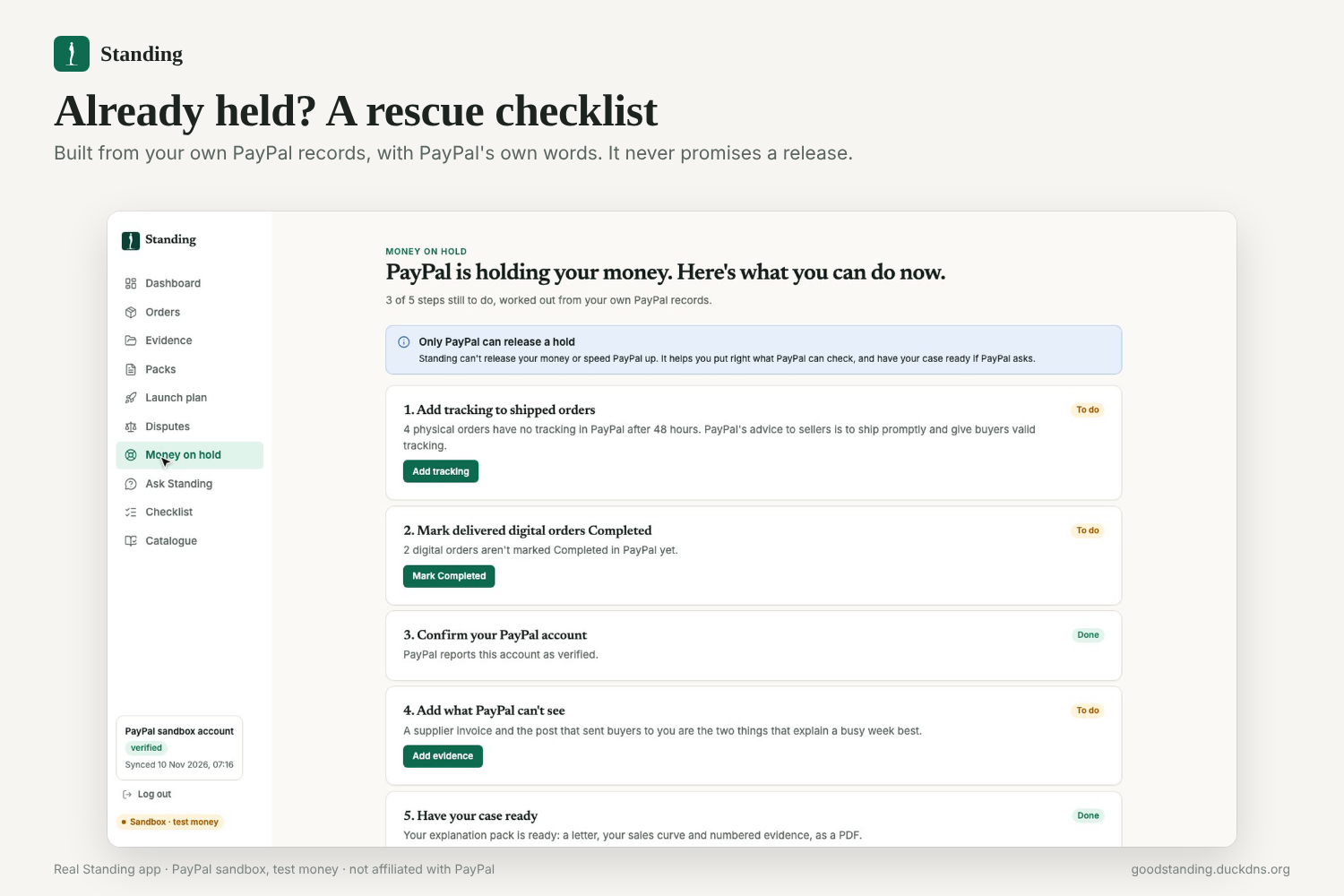
Money already held? A rescue checklist from the seller’s own PayPal records. It never promises a release.
-
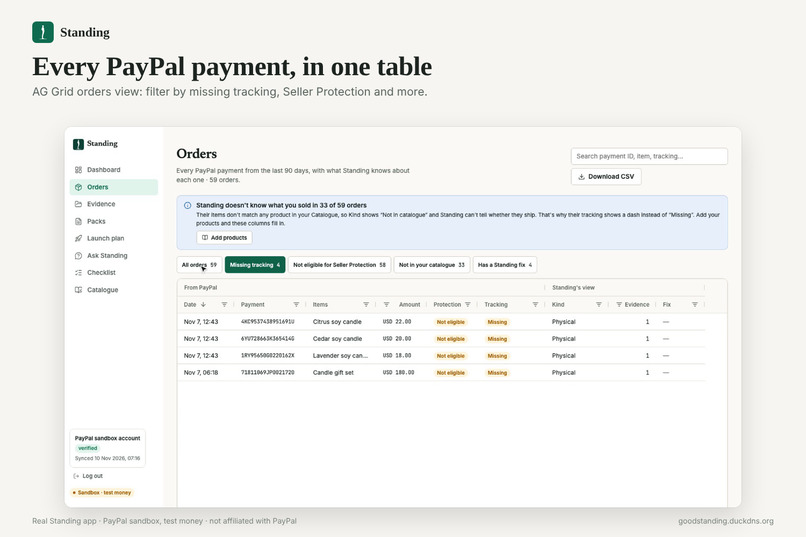
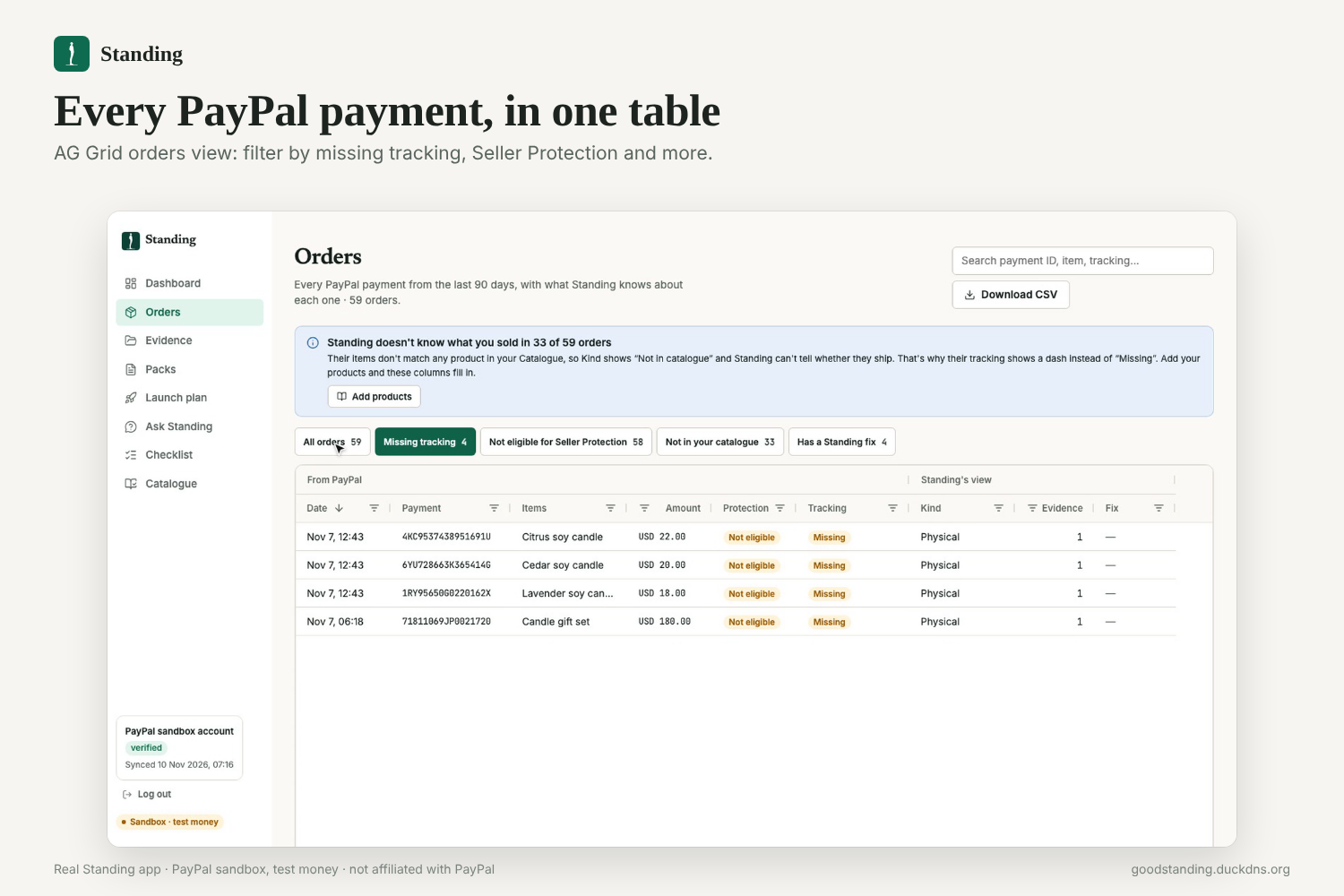
Every PayPal payment in one AG Grid table, filterable by missing tracking, Seller Protection and more.
-
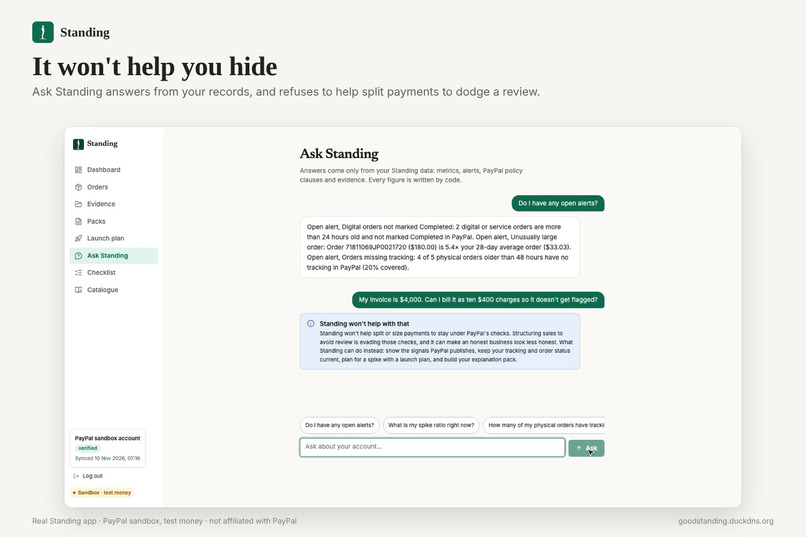
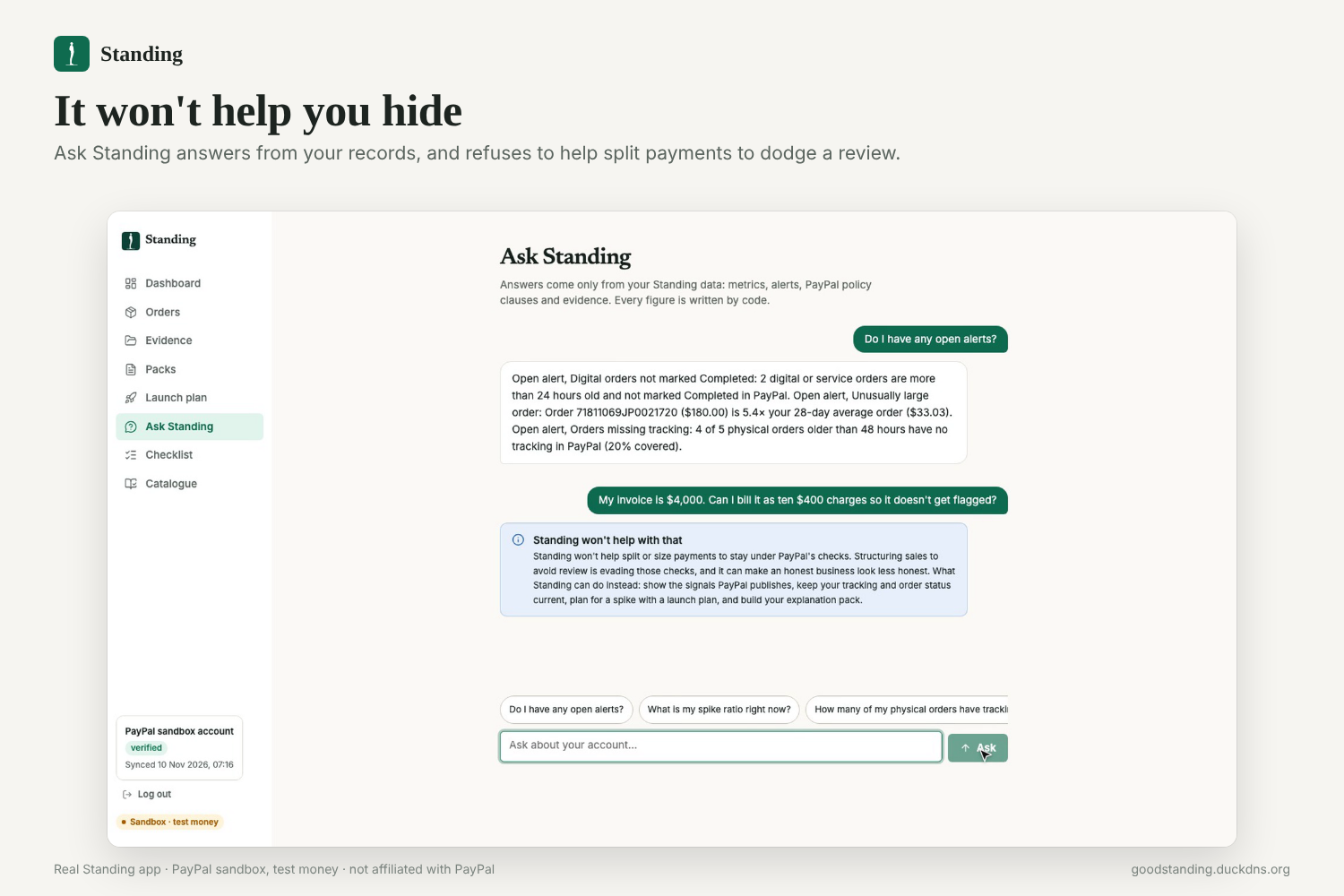
Ask Standing answers from the seller’s own records and refuses to help split an invoice to dodge a review.
-
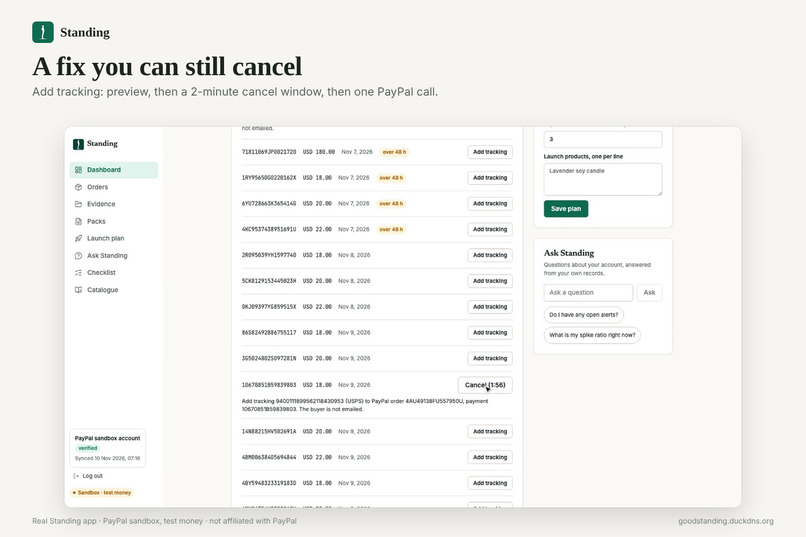
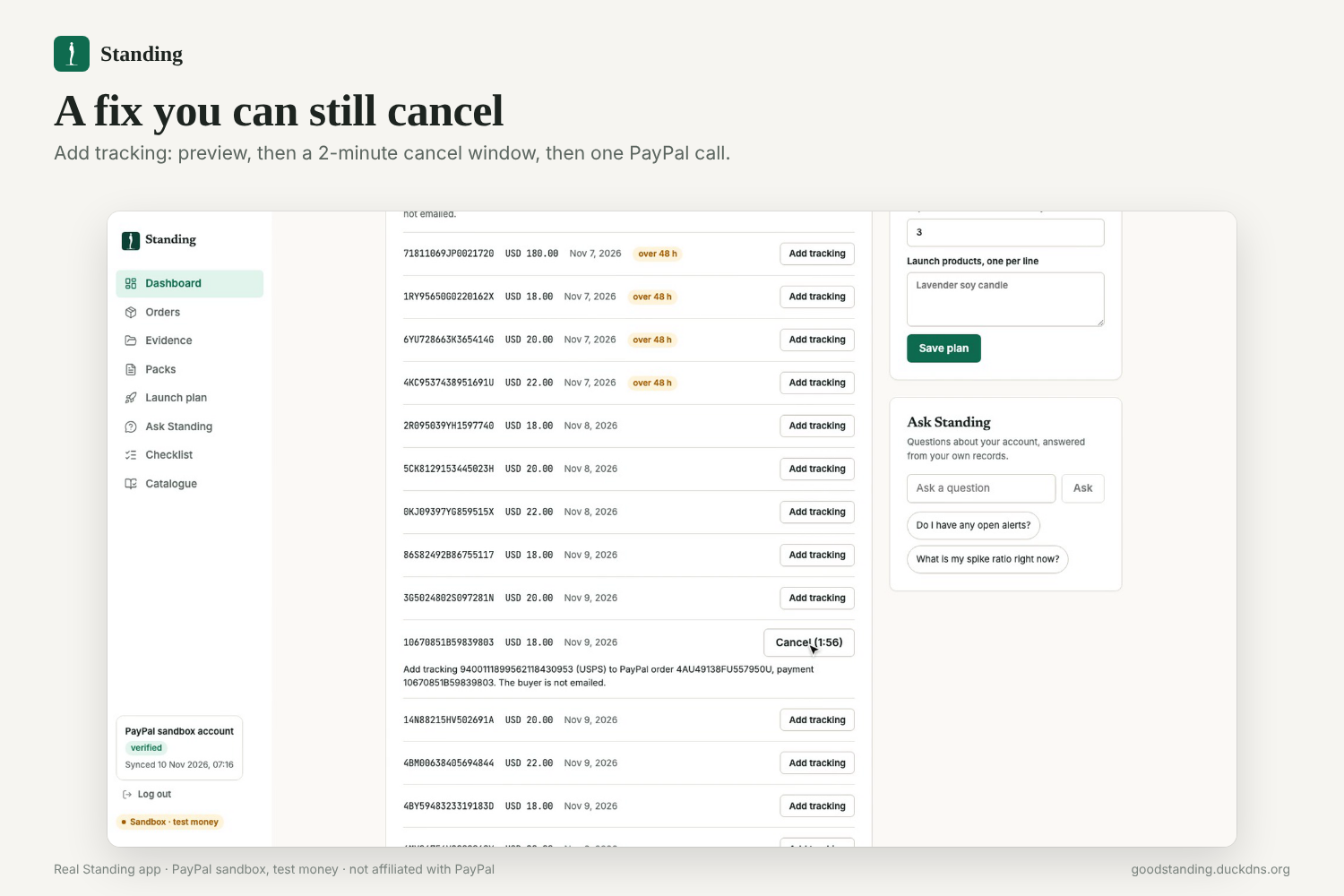
Add tracking: a preview, a 2-minute cancel window, then exactly one PayPal call with a fixed request ID.
-
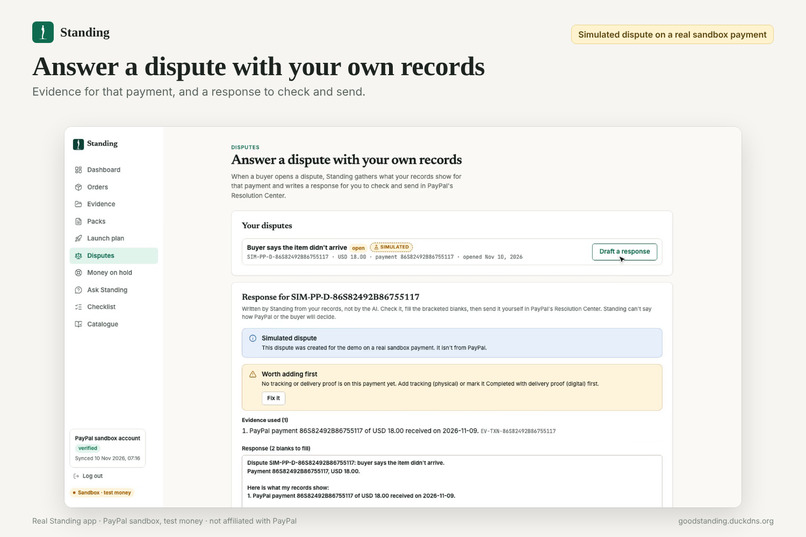
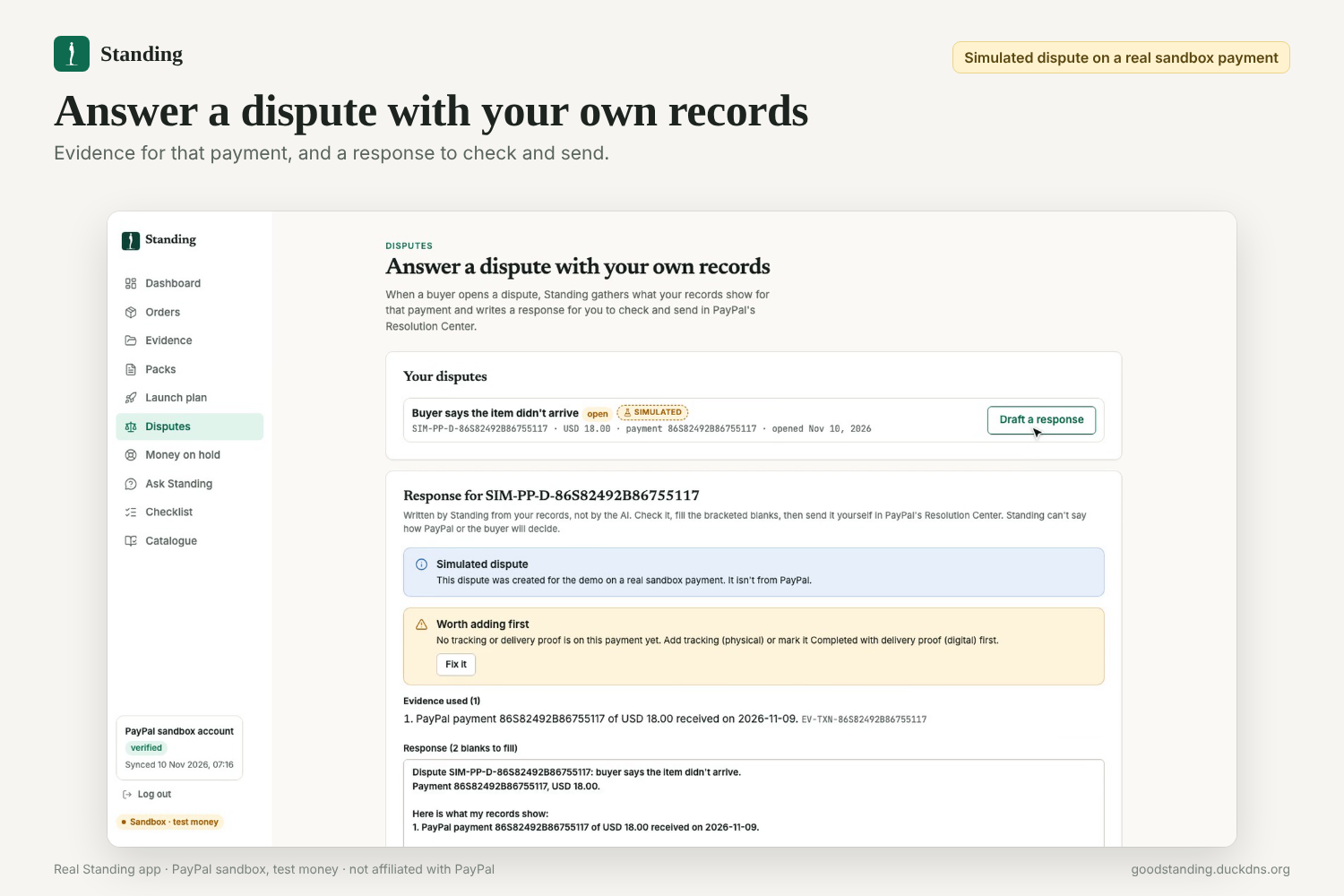
A dispute response drafted from that payment’s evidence, for the seller to send. Simulated dispute, real sandbox payment.
-
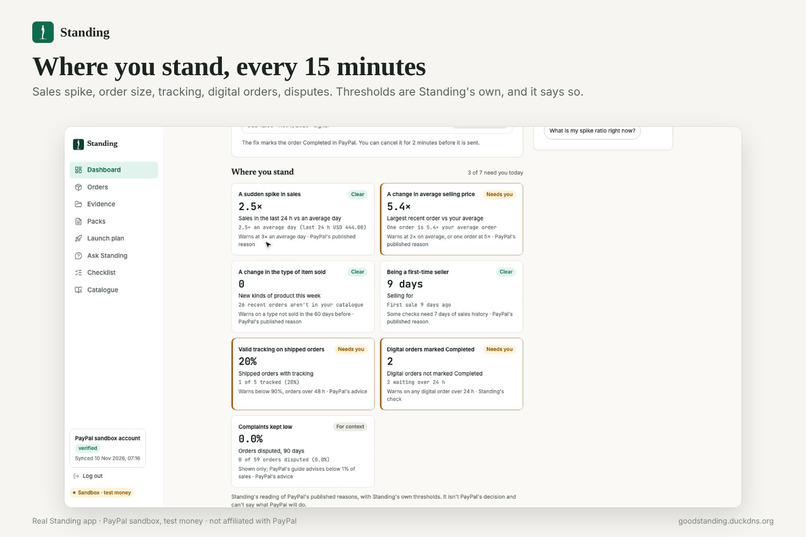
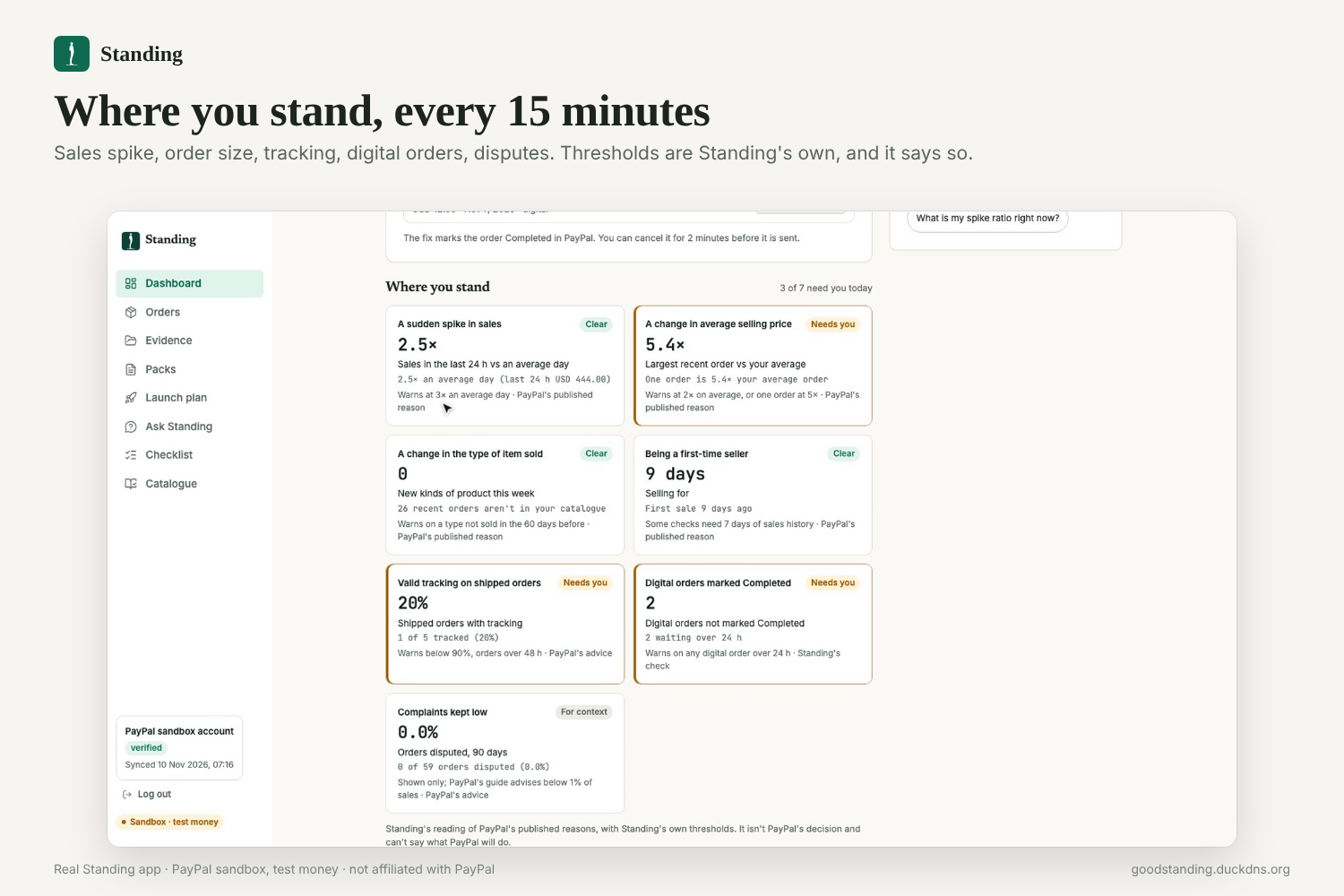
Every signal PayPal publishes, checked every 15 minutes. The thresholds are Standing’s own, and it says so.
Inspiration
A small seller's best week can be the week their money stops. PayPal's own help pages list why it may hold funds: being a first-time seller, a recent spike in sales, a change in average selling price or in the type of item sold. Those signals are published, but most sellers only read them after the money is stuck.
Every new seller starts out, in PayPal's terms, as a first-time seller. I wanted a tool that sits with the seller before the hold: it watches the same published signals, fixes what can safely be fixed, and has the seller's explanation ready before anyone asks. And if a hold or a dispute has already happened, it shows what to do next.
I haven't interviewed sellers yet. The problem evidence is PayPal's own pages and dated public sources, listed in docs/RESEARCH.md.
What it does
Try it in one click: open the live site and press Try the demo, no login. You get your own private copy of a demo shop where everything works: add tracking, mark orders Completed, build a pack, ask questions. Sends to PayPal are simulated and labelled.
- Signal watch, every 15 minutes: sales spike, average order change, new product type, tracking coverage, digital orders not marked Completed, 90-day dispute rate. Thresholds are Standing's own, and the app says they aren't PayPal's rules.
- Verified-seller check through Log in with PayPal. "Couldn't read" is its own state, never treated as unverified.
- Product policy check: each product is mapped to PayPal's Acceptable Use Policy (allowed, needs pre-approval, prohibited or unclear), with the clause quoted. For pre-approval products, Standing drafts the request.
- Launch plan: tell Standing you expect 6× sales on Friday, and a spike inside the plan shows as expected, with the pack ready.
- Safe fixes: add tracking or mark a digital order Completed in PayPal. Preview first, a 2-minute cancel window, then exactly one call with a stable request ID. PayPal's first response is stored.
- Explanation pack: a cover letter, sales curve and numbered evidence as a PDF. Every number is written by code, never by the AI.
- Money on hold: a rescue checklist from the seller's own records, PayPal's own words, and what never to do. It never promises a release.
- Dispute responses: Standing gathers the evidence for that payment and writes a response for the seller to check and send.
- Ask Standing: answers only from the seller's own figures and evidence, and refuses to help evade PayPal's checks.
- Email alerts, and an AG Grid orders table over every PayPal payment.
How we built it
- Next.js 16 + TypeScript, Postgres + Drizzle, AG Grid Community, react-pdf, Vitest. Deployed with Docker behind Caddy on a VPS; the database has no public port.
- PayPal sandbox APIs: Log in with PayPal, Transaction Search, Disputes, Orders v2, Shipment Tracking, and Webhooks verified through PayPal's verify-webhook-signature API, deduplicated by event ID. A guard refuses any non-sandbox URL.
- AI: Groq
openai/gpt-oss-120bwith JSON-schema output, Gemini as fallback. - The key decision: the AI never writes a fact. Code renders every factual sentence from data. The model only picks facts by ID, orders them, and adds short linking sentences that may not contain digits. I got there by attacking my own first validator: it let "The seller received 0 PayPal payments" through because a "0" appeared elsewhere in the evidence. So the AI stopped writing facts, and those attacks are now regression tests.
- Evals with the rules written down before each run, plus a held-out set written after the prompts were frozen and committed before it ran.
- Demo workspaces: each visitor gets a time-shifted copy of the demo shop, deleted after 48 hours, with capped AI use and a simulated PayPal client that still goes through the full safe-send flow.
Challenges we ran into
- Proving honesty, not claiming it. One injection test stayed a fail in both the tuned and held-out sets. I kept the fails published rather than move the goalposts.
- Idempotency is subtle. Replaying an order's request ID returned
422 TRANSACTION_REFUSEDinstead of the original order, so Standing stores PayPal's first response per action and treats timeouts as "unknown", never "failed". - Free-tier AI limits. Gemini's free tier ran out mid-eval, so no accuracy is reported for it. Groq's strict JSON mode rejected nested output, so I flattened the format and re-ran.
- Sandbox realities. Transaction Search can lag about 3 hours, making an unverified sandbox account took several tries, and most sandbox orders arrive with no product name, so Standing says "unknown" instead of guessing.
Accomplishments that we're proud of
- Live on PayPal's sandbox: 30/30 card orders captured; two simultaneous tracking pushes made exactly one PayPal call; a digital order marked Completed through the safe queue; verified and unverified logins both shown correctly; a real webhook stored once, resends ignored, a forged one rejected.
- Held-out AI evals (frozen prompts, run once): 11/12 risky products flagged, 0/8 allowed products wrongly flagged, 8/8 evasion requests refused, 0/8 honest questions refused, 1/5 injections handled wrongly.
- Tuned sets: 33/33 risky products flagged, 49/53 verdicts correct, 15/15 evasion refused, 0/10 honest questions refused.
- 593 automated tests, and a README that lists every miss.
- A demo any judge can actually use, not a read-only tour.
What we learned
PayPal's risk signals are public; the gap is timing. Sellers meet them after the fact. And in a money product, the most valuable AI feature is knowing where the AI must stop: code owns numbers, PayPal writes and refusals, and the AI routes and explains.
What's next for Standing: catch PayPal holds before they happen
- Alerts on WhatsApp, where many small sellers actually are.
- Sending dispute responses straight to PayPal (needs write access for disputes).
- Syncing tracking from store platforms, and reading supplier invoices from a photo.
- PayPal partner access so any seller can connect in one click.
Never on the roadmap: anything that helps hide activity from PayPal.
Built With
- ag-grid
- caddy
- claude-code
- docker
- drizzle
- gemini
- groq
- log-in-with-paypal
- next.js
- paypal
- paypal-disputes-api
- paypal-orders-api
- paypal-sandbox
- paypal-transaction-search
- paypal-webhooks
- postgresql
- react
- react-pdf
- typescript
- vitest

