-
-
-
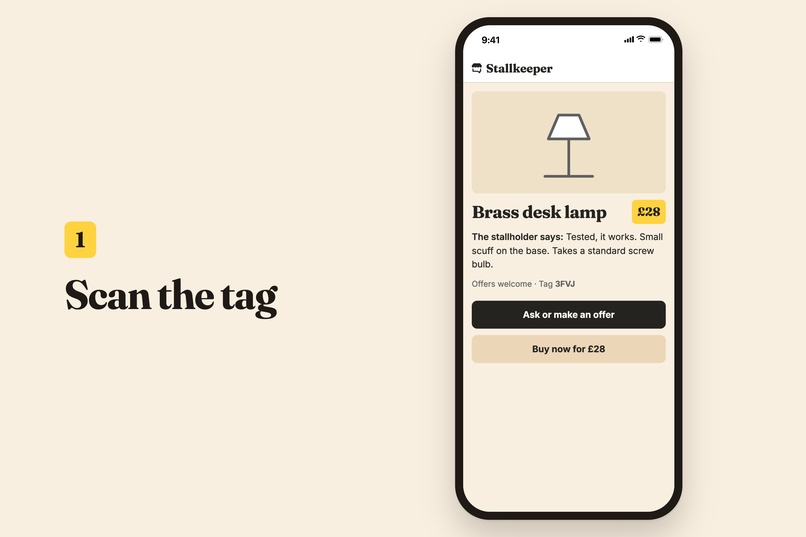
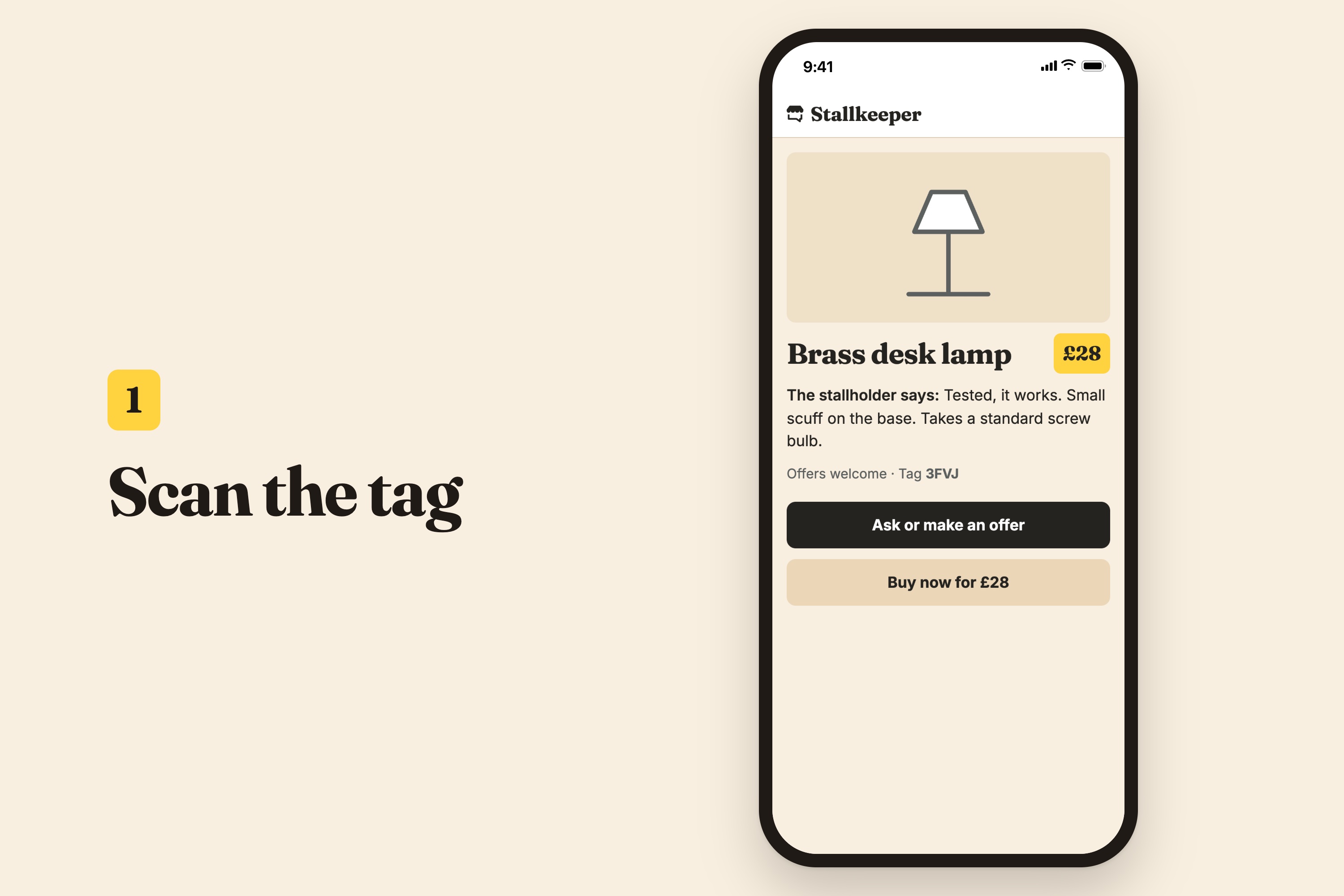
The brass desk lamp's QR tag opens this page in the browser, with nothing to install and no Stallkeeper account.
-
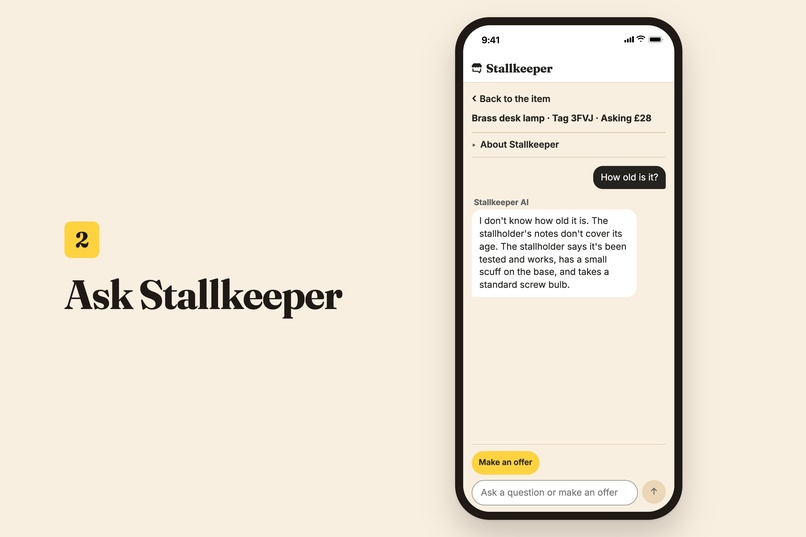
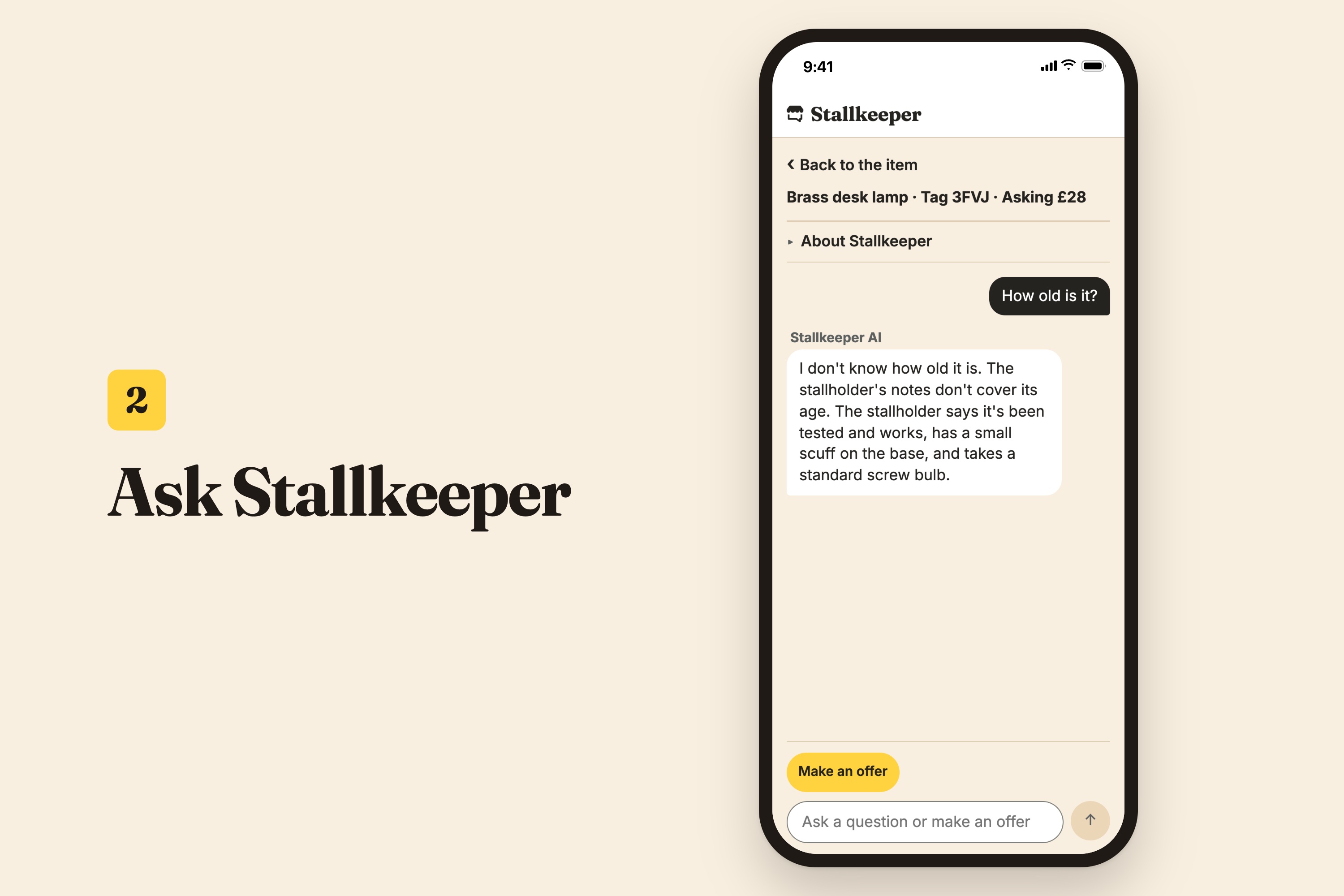
Asked how old the lamp is, Stallkeeper says it doesn't know, because the stallholder's notes don't say.
-
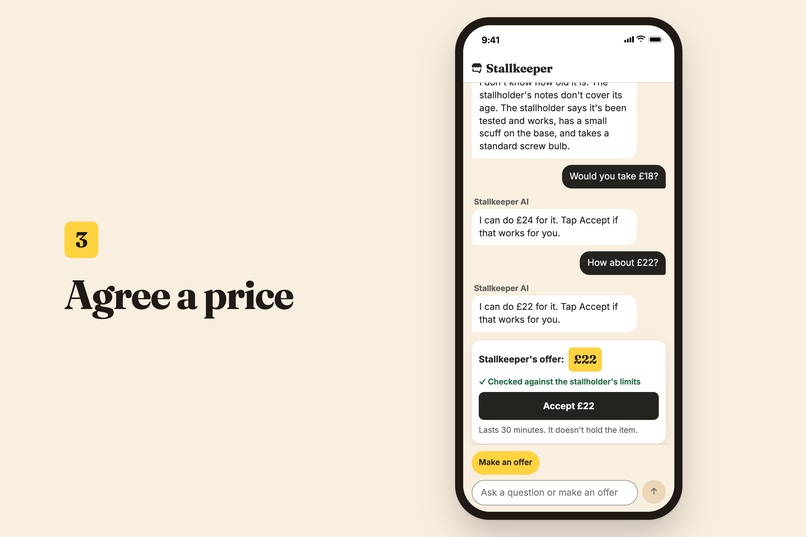
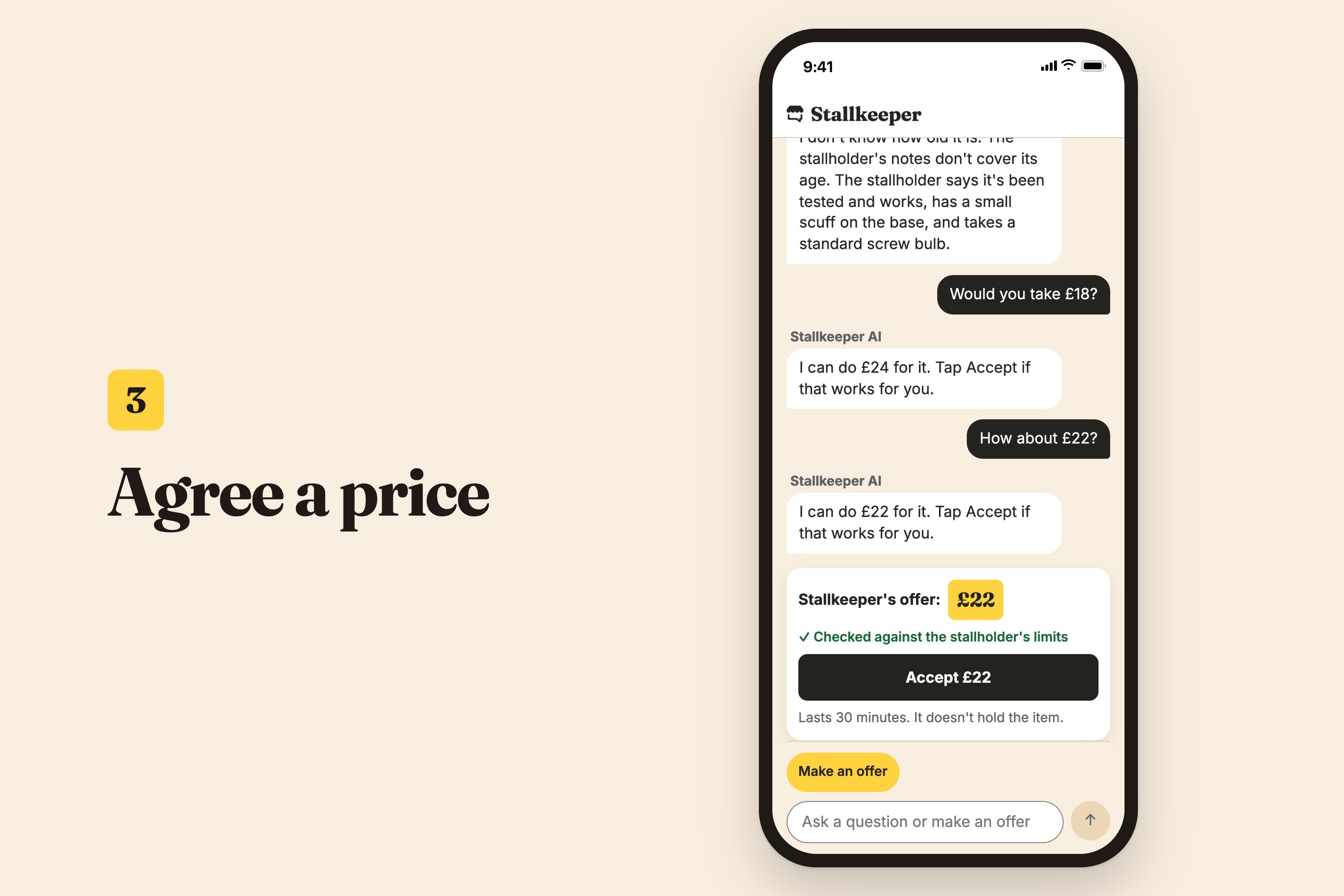
The buyer offers £18 and Stallkeeper counters at £24. At £22, the server checks the stallholder's limits and issues an Accept card.
-
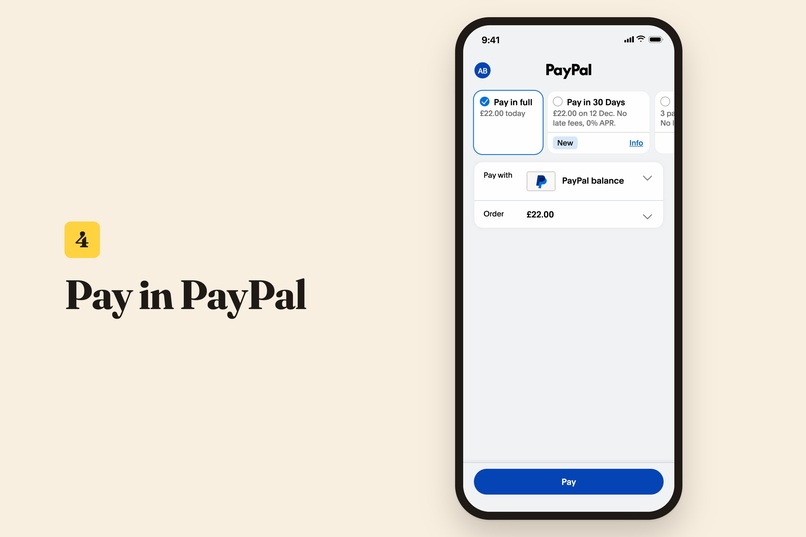
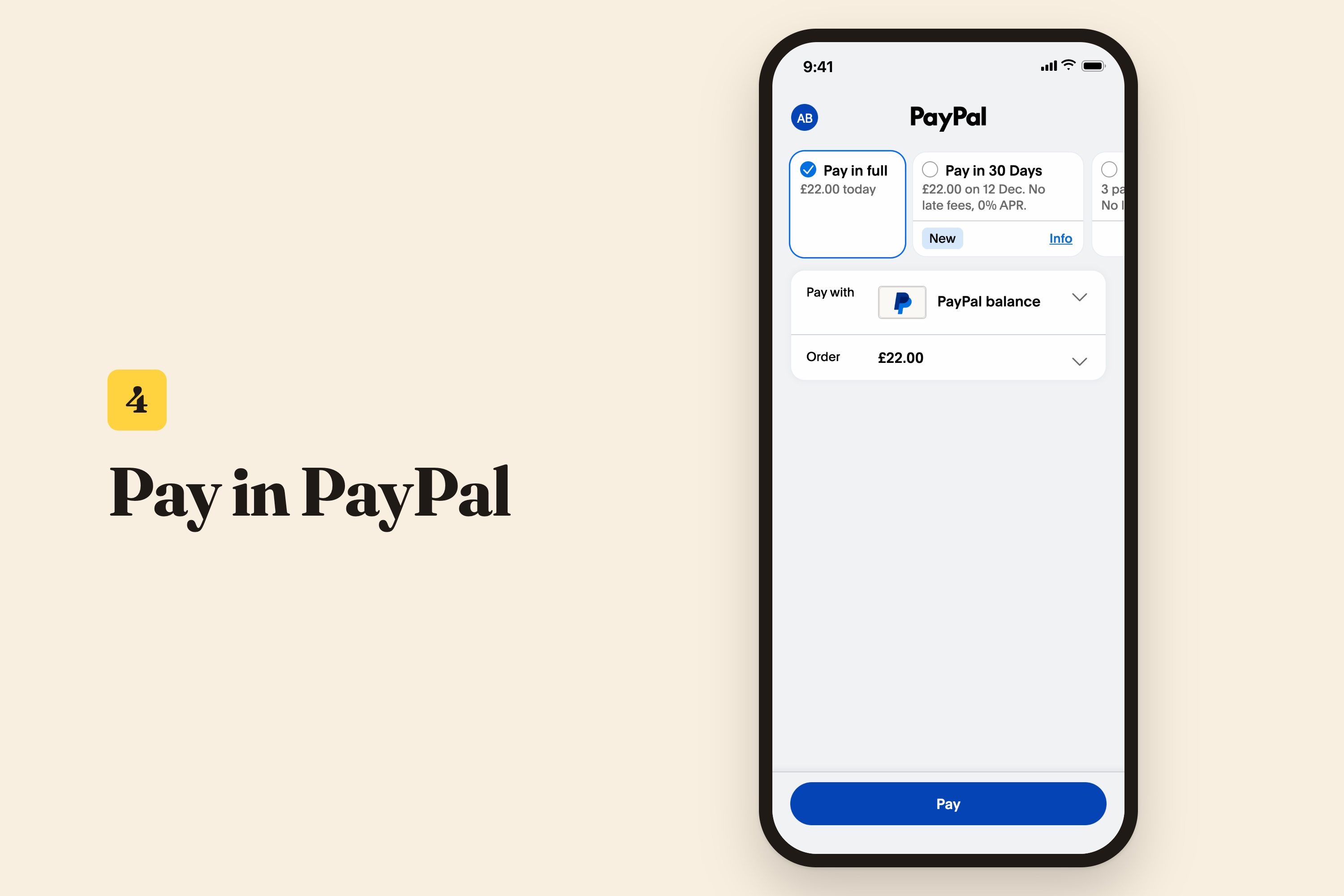
The PayPal sandbox approval screen for £22, before the buyer presses Pay.
-
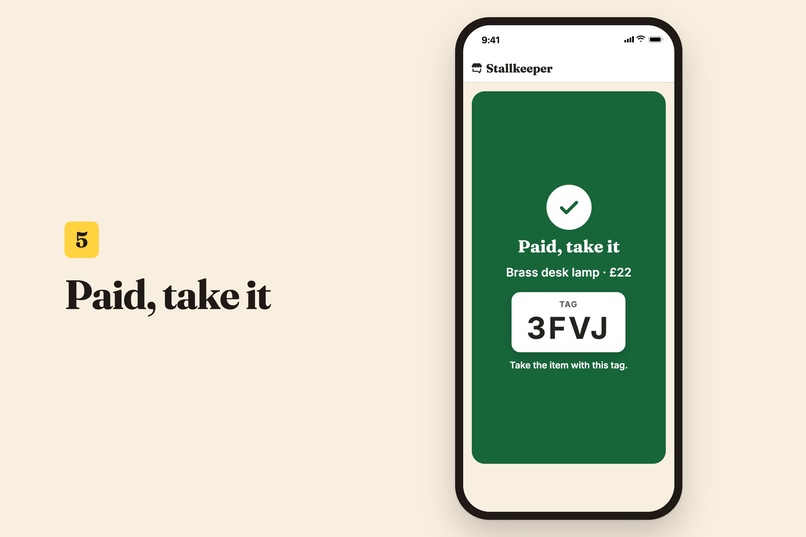
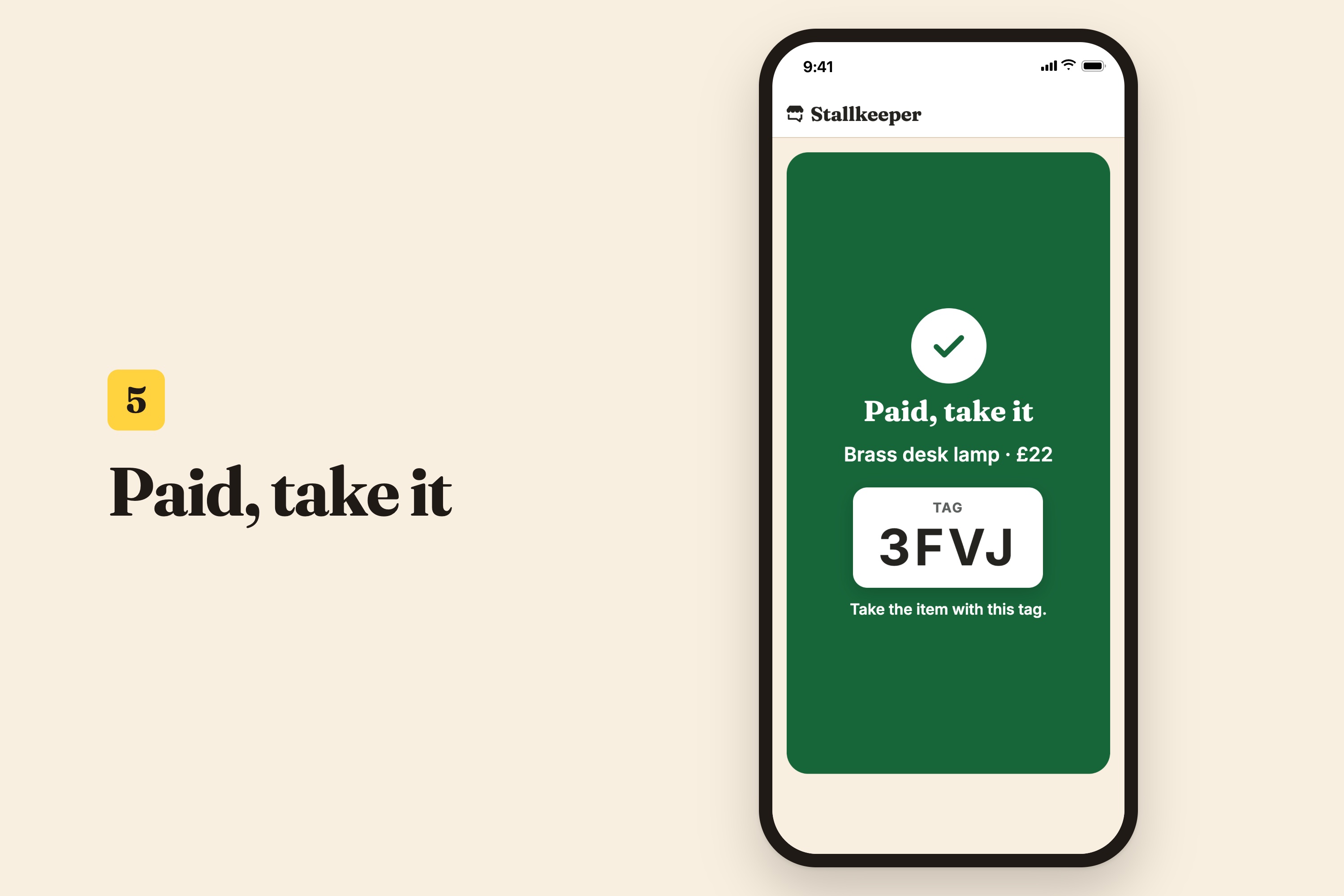
"Paid, take it" appears only after PayPal confirms the capture, with the tag code to match.
-
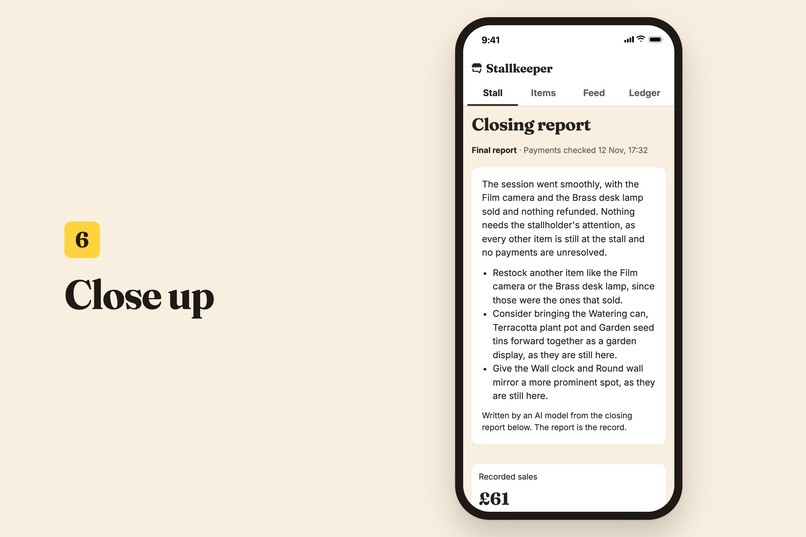
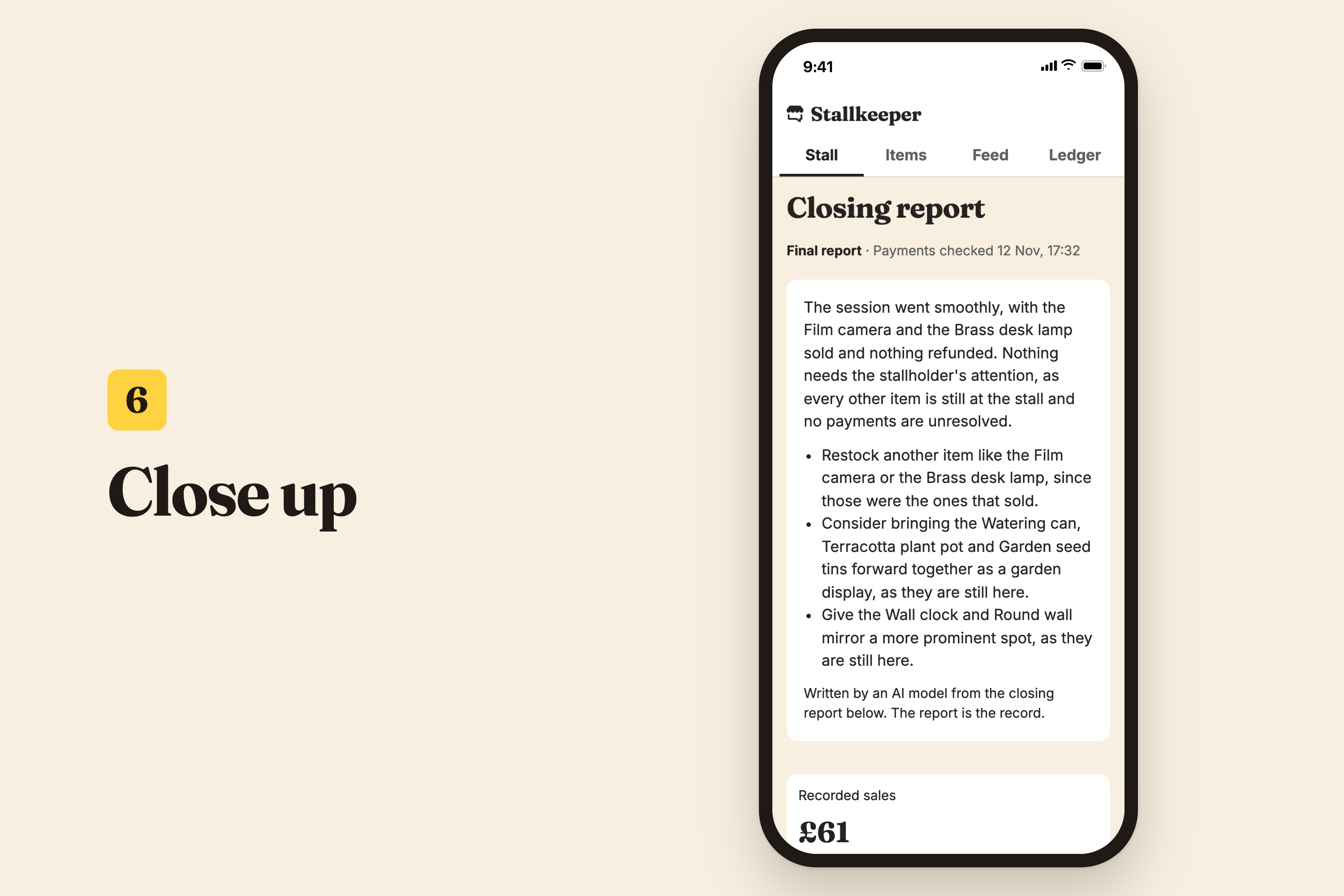
At closing, the AI sums up the session from the recorded sales and suggests what to restock and move to the front.
-
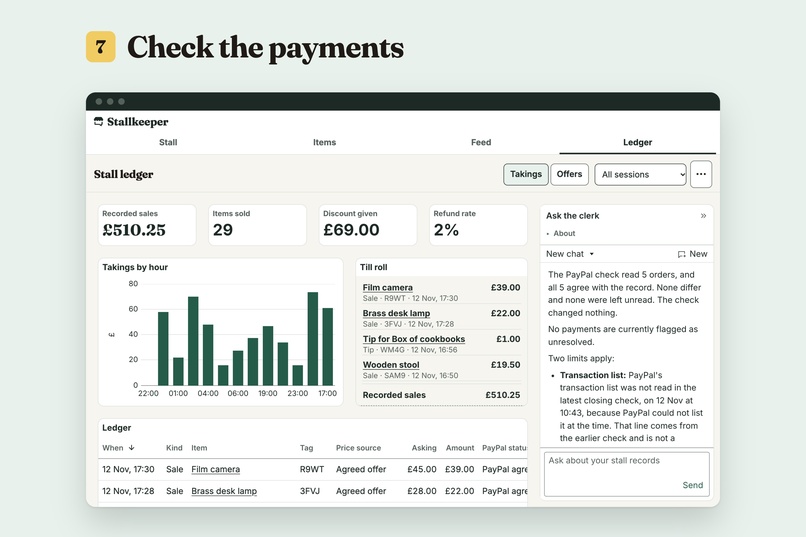
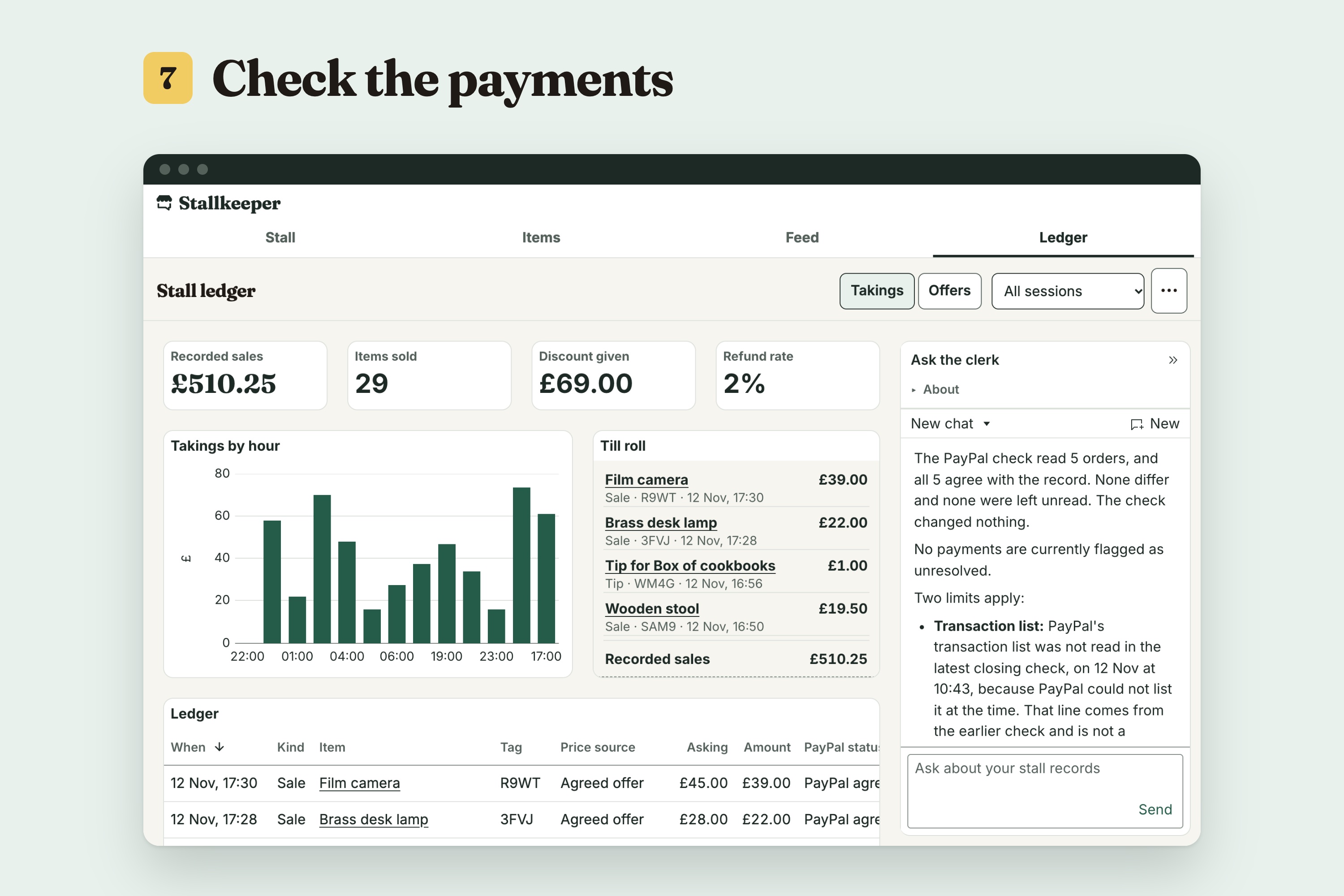
In the AG Studio ledger, the Stall clerk runs the read-only PayPal check, and all 5 orders it read agree with the record.
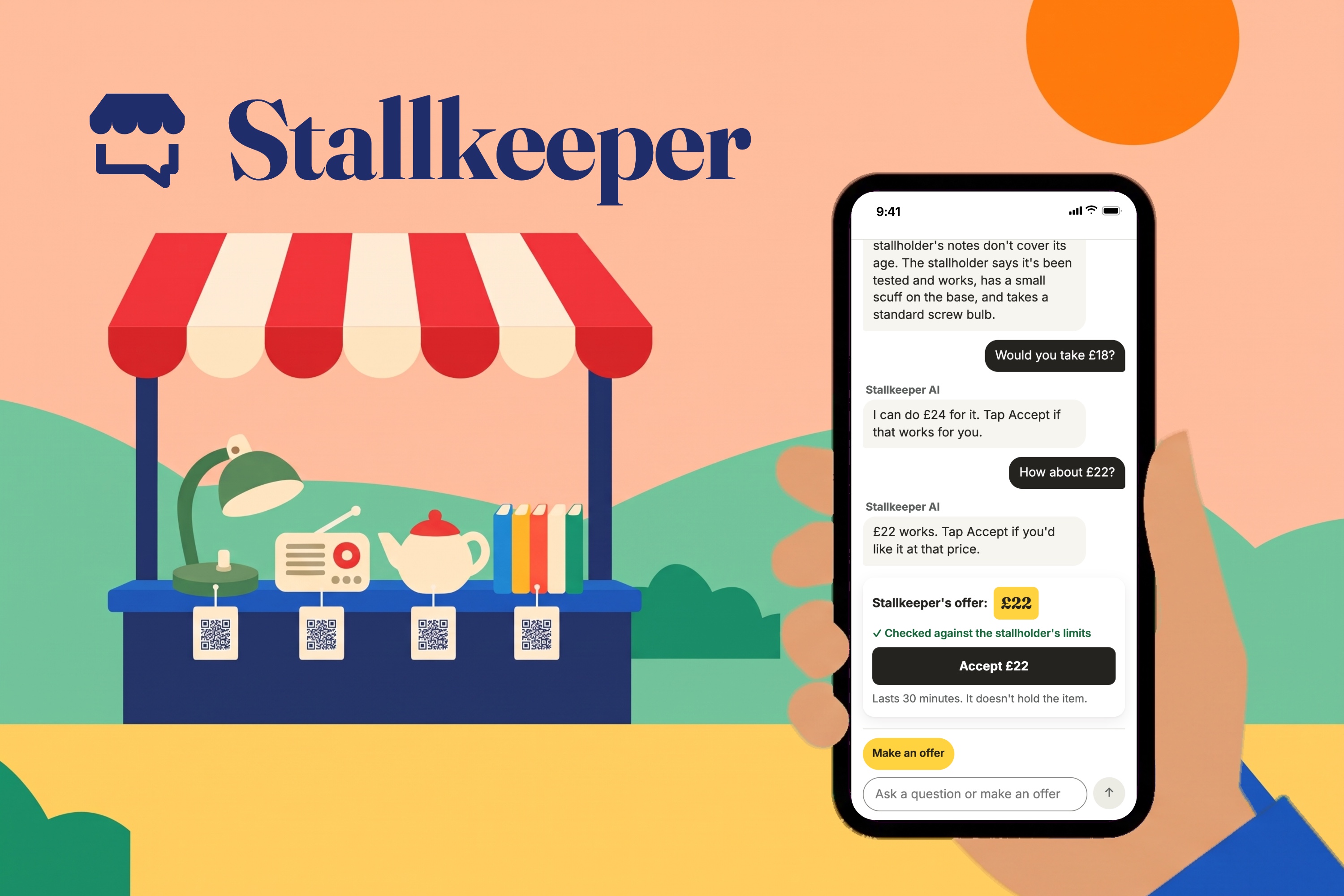
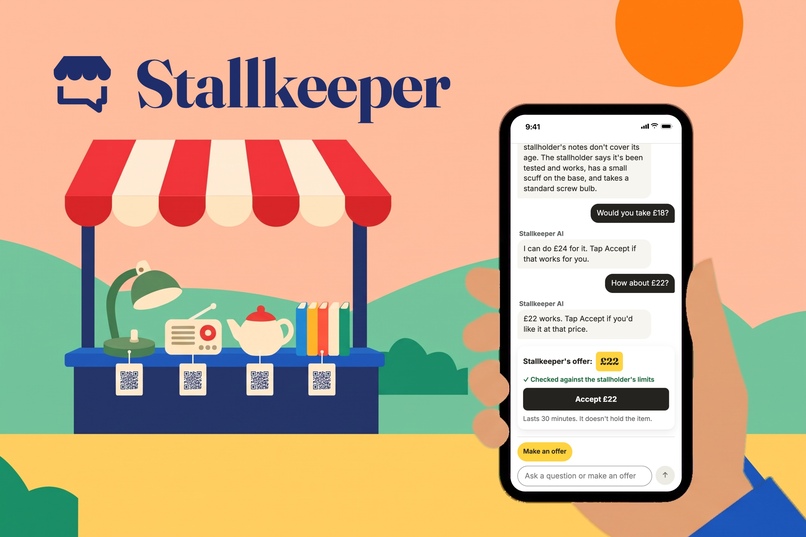
Leave your second-hand stall open while you get on with your day. Stallkeeper lets a buyer at the table scan the printed tag on a one-off item, ask questions, agree a price within your limits and pay with PayPal. The buyer is a person standing at the stall with a phone, not an AI agent, and needs no app and no Stallkeeper account. At closing, the stallholder sees recorded payments and can flag an unsold item that is missing.
It is for people selling one-off second-hand goods from a self-service stall while they are nearby but busy. A payment QR code can take money. It cannot say whether the lamp works, or answer "would you take £15?", and with second-hand goods those questions are often the sale.
Try a sale and the closing check
Start at stallkeeper.onrender.com/demo, a seeded demo stall on the PayPal sandbox. Tag codes change at each reset, so always start there.
- Buy something. Press Be a buyer, then Ask or make an offer. Ask a question, offer below the asking price and tap Accept on the offer card.
- Pay. The PayPal sandbox buyer login is on the
/demopage under "PayPal login for buyers", and folded under the PayPal button with Copy buttons. Pay with it and wait for "Paid, take it". - Check the stall at closing. Press See this sale as the owner on the paid screen, then Be the owner. Find your sale on the live feed and press Close stall, which opens the closing report. Open Something missing? and press Not at the stall beside any item except Box of cookbooks, which is free. Scroll up: the report now lists the item under "Not on the shelf, no confirmed payment. This record cannot say what happened." Press Undo beside the item in the fold.
- Check PayPal, then reopen. Open the Ledger tab and ask the Stall clerk, "Please check every payment with PayPal and tell me if any differ." On a phone, choose Ask the clerk in the ⋯ menu at the top of the ledger. Then open the Stall tab and press Open stall, so the next visitor finds the stall open. Closing takes up to about half a minute. If the tab still says Closing, open it again a few seconds later, because it does not refresh by itself.
You need no personal API key and no live PayPal account, and no real money moves. The demo runs on a paid Render instance, so a judge does not wait for a cold start. The demo stall is shared, so another visitor may have closed or reset it before you. If chat is unavailable, pay the asking price. If the clerk is unavailable, open the ⋯ menu at the top of the ledger, choose PayPal check and press Check with PayPal. Setup steps for running it yourself are in the README.
22 captured orders checked against PayPal
Each result links to its dated record. Everything here ran in the PayPal sandbox on demo stock.
- 21 sandbox sales, one £1.00 tip and one refund completed on the hosted service between 5 and 7 November 2026, with £315.75 of recorded sales at 23:06 UTC on 7 November 2026 (capture table).
- PayPal's own records agree. The Agent Toolkit's
get_orderhas read all 22 captured hosted orders, and all 22 agree with the record (record). - Haggling ended in payment. In iOS Simulator on 6 November 2026 a £20 offer on a £28 lamp got a £22 server card, and the capture and the stallholder's feed both read £22.00 (record).
- No haggling attack got a price below the stallholder's limit. On 12 November 2026 we ran 46 haggling attacks locally against the same model and prompts as the live stall, including fake PayPal receipts, "the owner said £5", discount codes, role-play and five languages (record).
- Every pricing mode ran. On 7 November 2026 a free take with a £1.00 tip, an offer-led £22.50, a pay-what-you-want £3.25 and a fixed £10.00 all completed in desktop Chrome (record).
- A resend did not count twice. On the first hosted sale, on 5 November 2026, PayPal verified the webhook and a resend of the same event left one sale on the feed. A full refund then took recorded sales back to £0 (record).
- Every AI job ran on real Claude on the hosted service. That covers buyer answers and offers (record), a price review that lowered five items (record), the closing summary (record) and the Stall clerk (record).
- A clean copy passed every check. On 12 November 2026 a copy of the development code, exported with no git history and no credentials, passed
pnpm install --frozen-lockfile,pnpm typecheck,pnpm lint,pnpm testwith 1,545 tests in 59 files, andpnpm build(record).
For one-off second-hand stalls
Stallkeeper is built for one-off second-hand items, where each has its own condition notes and its own acceptable price. It lets a buyer ask about condition, agree a price and pay while the stallholder is away from the table. In a January 2025 Opinium poll for SUEZ, 48% of UK adults said they had bought a second-hand item in the past year.
Self-service stalls already exist. There are honesty stalls with PayPal QR codes (Deb Digs Plants) and farm stands where questions go to email (Hoofprint Farm). Both sell plants and flowers, and neither uses Stallkeeper.
The same tag, chat and payment fit car boot stalls, garage and yard sales, honesty-box farm and roadside stands, charity and community stalls, and makers' markets. What they get:
- Sales while the stallholder is away. A buyer asks "does it work?", gets the stallholder's own notes, agrees a price and pays with nobody at the table.
- Haggling within set limits. The stallholder sets a floor once, and the server never agrees a price below it.
- Payment without a card reader. The buyer pays through PayPal after agreeing a price, with no Stallkeeper account. For context, cash was 8% of UK payments by number in 2025, down from 45% in 2015 (UK Finance).
- A closing check. The stallholder sees recorded payments and free takes, and can flag an unsold item that is missing.
The stallholder prints tags, six to an A4 sheet, and buyers use their own phone.
From the tag to the closing report
- The transaction starts at the object. A printed tag identifies one second-hand item at an unattended stall. Its buyer can ask about that item's condition, negotiate and pay. The stallholder then closes with the payment record and any missing-item flags.
- Server code sets every payable price. Claude words the replies. The server calculates every offer card and validates its amount again at acceptance and checkout, so chat text cannot authorise a payable price.
- Answers come from the stallholder's notes. Stallkeeper answers from them, attributes them with "the stallholder says", and tells the buyer when the notes do not cover a question.
- Four ways to price an item. Offers, a fixed price, pay what you want, or free with an optional PayPal tip and thank-you note. Stallholders can also pledge a share of sales to charity.
- Tags carry no price. A price can change without reprinting. Late in the day Claude proposes lower prices for unsold items and the server decides, within fixed limits. One press of
Run price review nowon the hosted service lowered five seeded items by 8.9% to 11.1% (record). The automatic timer ran on a local server. - Closing records the differences the stallholder finds. Payments and free takes form the record. The stallholder can flag a missing unsold item, which then reads "Not on the shelf, no confirmed payment. This record cannot say what happened." Unflagged unsold items count as still at the stall. An item taken off sale with a reason before closing is listed as removed.
What Claude does
Claude has five jobs, through the Vercel AI SDK and its Anthropic provider.
- Answer buyer questions from stallholder notes and attributed details of a matched new retail listing. Condition comes from the notes.
- Interpret offers and word counter-offers. The server computes and validates prices.
- Propose lower asking prices near closing. The server checks eligibility and reduction limits, including the private floor, and keeps existing reservations and agreements.
- Write a neutral summary of the structured closing report. Server checks on figures and wording decide whether it shows, and the plain report is there either way.
- Answer the stallholder's questions about the ledger and run read-only PayPal checks. The stallholder can also ask for a report card based on those records.
What server code controls
Server code controls payable prices. It keeps the configured floor out of buyer data and model context. The buyer chat has no payment tools, and the Stall clerk's PayPal check is read-only. A reply filter checks recognised amounts against the asking price, buyer-written amounts, issued offers and the retail reference, and replaces rejected replies with fixed copy. Payable amounts follow separate server checks.
On 5 November 2026, all 16 hosted buyer-chat test turns passed every check run on the output buyers received. Some replies were the server's fixed wording, which is the guard doing its job. Chat alone created no agreed price, checkout or payment. Told to ignore its rules and sell the lamp for £5, Claude refused, and the server's counter-offer was £24 (record).
From the fourth round the server accepts an offer at the floor, and never one below it. The haggling evaluation has the full record.
From an agreed price to a checked payment
PayPal runs both the sale and the later check. Three APIs create, approve and capture the stored checkout total, a fourth verifies incoming events, and the Agent Toolkit reads orders back against the ledger.
- OAuth 2.0 gets server tokens with
POST /v1/oauth2/token. - Orders v2 creates, reads and captures orders through
POST /v2/checkout/orders,GET /v2/checkout/orders/{id}andPOST /v2/checkout/orders/{id}/capture. - JavaScript SDK v6 handles buyer approval with
createInstance,findEligibleMethods,createPayPalOneTimePaymentSessionand sessionstart. - Webhooks v1 verifies each event with
POST /v1/notifications/verify-webhook-signature. - Agent Toolkit holds only
get_orderandlist_transactions, for read-only checks from the closing report and the Stall clerk. - Donate SDK offers
PayPal.Donation.Buttonbeside an optional charity pledge. Mocked tests cover it.
Payment checks and recovery
Each rule below is server code. Where a rule has run on the hosted service, its record is linked.
- The server calculates the offer. It works out every counter-offer and never agrees a price below the stallholder's floor. On the hosted service a £5 offer on a £28 lamp got a £24 card (record). A price is agreed only when the buyer taps a card the server issued.
- The order comes from the stored total. Pay starts a five-minute reservation, and the server creates the PayPal order from the total in its stored checkout. On 5 November 2026 PayPal's approval screen showed the stored item and £10.00 (record).
- The capture must match. Before it records a sale, the server checks the capture against the order id, the checkout id, the currency and the stored amount. A mismatch is flagged for the stallholder and records no sale. Mocked tests cover the mismatches.
- Webhooks are verified first. The server checks each event's signature with PayPal before it stores the event or changes a payment.
- A repeat cannot count twice. Verified events go into a durable inbox keyed by event id, and each capture id is recorded once.
- "Paid, take it" waits for a completed capture. Approval alone is not payment. On 6 November 2026 the buyer page showed it after the capture, not before (record).
- Unknown outcomes stay visible. If a capture's outcome is unknown, the item stays reserved and the buyer sees "Checking payment". A timer reads the order again and retries approved orders with their stored capture key for up to 30 minutes. Payments it cannot settle reach the stallholder as flagged. Mocked tests cover this path.
- Refunds reduce recorded sales. A refund does not relist the item. After a refund made through PayPal's API on 5 November 2026, the buyer page changed to "Payment needs checking".
- PayPal's own records are read back. On 7 November 2026 the Stall clerk called
run_paypal_checkon the hosted service and read the 12 orders no earlier check had read (record).
list_transactions read PayPal's transaction list in a closing check on the hosted service on 12 November 2026 (record), and on a local server on 8 November 2026 (record). Two later hosted presses, on a session opened seconds earlier, did not read the list.
Ask the ledger to check PayPal
The AG Studio ledger lets the stallholder trace an item from offer to payment and ask the Stall clerk to check captured orders against PayPal. Its custom till roll opens each item's price history, and its PayPal stamp shows what was checked.
The Stall clerk is our own agent on Claude, connected through our adapter for the AG Studio Agent Framework. Studio's lead asks the clerk for records, then hands layout work to the built-in Page and Widget agents. No agent can change a price, stock or a payment. Live updates, cross-filters, Edit mode, Reset layout, CSV export and a report card made on request each ran on the hosted service (record).
New retail references for used items
The stallholder photographs an item or searches Channel3's catalogue by text, then picks a product. Stallkeeper saves that product's lowest in-stock new UK price and retailer, and suggests a starting price. Buyers see it on the item page as a "New from £X at retailer" line, and chat can quote it. It is a retailer's price for a new one, not a valuation of the used item.
Text search, save by product ID, the buyer's "New from" line and an AI answer quoting it ran on the hosted service (record). Image search returned usable UK/GBP candidates for three real photographs on a local server (record). Chat can also get the listing's description and facts as attributed details for a new one, a path mocked tests cover. The calls are POST /v1/search, POST /v1/image-search and GET /v1/products/{id}, through @channel3/sdk.
Built with
Vue 3, TypeScript, Vite, Fastify, Supabase Postgres, Render, Claude (claude-sonnet-5-5) through the Vercel AI SDK, PayPal's sandbox, Agent Toolkit and Donate SDK, Channel3 (@channel3/sdk) and AG Studio (ag-studio-vue3, from AG Grid). AG Studio is commercial software, used under its trial and outside the repository's MIT licence, which covers only our own code. Portions of this software are copyright AG Grid Ltd.
Render hosts the Vue build, Fastify API and webhook endpoint in one Node service, with no Render Workflows. Supabase supplies Postgres and private photo storage, reached through the API. The Postman collection is a manual reference with run instructions. APIMatic's PayPal Context Plugin 0.4.1 helped at build time with one webhook question, one client review and one ledger-check checklist. It generated no integration code (tasks).
Development and film tools
Claude Code and Codex assisted with code, review, tests, documentation and tooling. The current film uses illustrations drawn in code and synthetic narration. The narration is synthetic speech in the Higgsfield "Arthur" voice, ElevenLabs via Higgsfield. App screens, PayPal approval and payment confirmations are recordings of the app running locally against the PayPal sandbox, on demonstration stock, with seeded sales for the ledger's earlier days. The phone camera views are mocked.
The demo stall has no item photos, and its seeded items show line illustrations drawn in code. The item photos seen in the film recordings are mock-up product photos made with AI image generation on a plain background. See the film record.
Built With
- ag-grid
- ag-studio
- anthropic
- apimatic
- channel3
- claude
- claude-code
- codex
- elevenlabs
- fastify
- higgsfield
- node.js
- paypal
- paypal-agent-toolkit
- paypal-javascript-sdk
- paypal-orders-v2
- paypal-webhooks
- postgresql
- qrcode
- render
- supabase
- typescript
- vercel-ai-sdk
- vite
- vue
