StakeStreak
Stake your habits. Lose if you quit. Earn from those who do.
Inspiration
Habit apps don't work. Not because people don't want to change — but because there are no real consequences for failure.
You miss a day on Duolingo and a cartoon owl looks sad. You skip your workout and Habitica deducts some fictional coins. None of it hurts. And if it doesn't hurt, it doesn't stick.
We kept asking: what if missing a day actually cost you something? Not a notification. Not a broken streak counter. Real money — automatically deducted, gone, redistributed to the people who showed up while you didn't.
That question became StakeStreak.
The inspiration came from two worlds colliding: behavioral economics (specifically the concept of loss aversion — people are twice as motivated by potential losses as by equivalent gains) and DeFi staking mechanics, where you lock value as a commitment signal. We combined them into a habit layer where your USDC stake is the accountability mechanism.
What it does
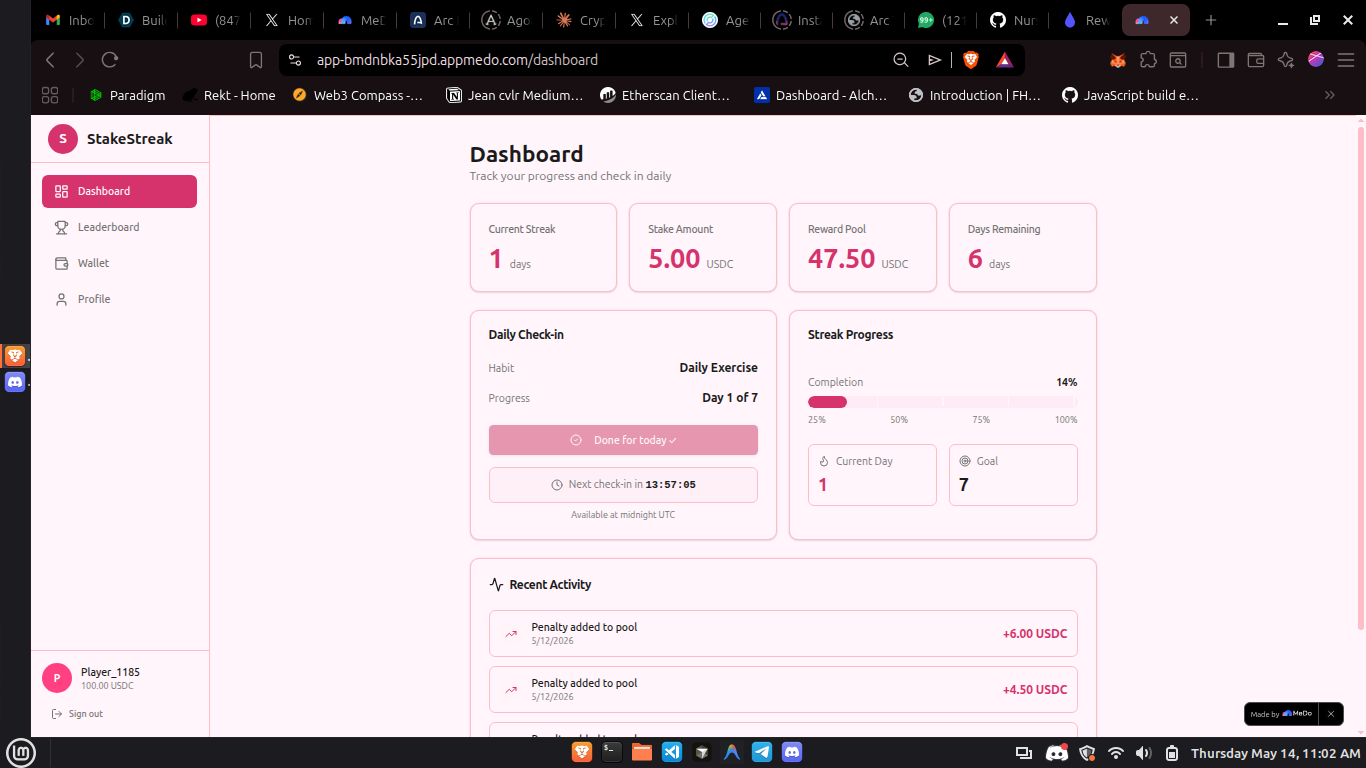
StakeStreak is a habit accountability app where financial consequences replace willpower.
Here's the mechanic:
- Stake your commitment — pick a habit, set a streak goal (7, 21, or 30 days), and lock in a USDC amount
- Check in daily or lose — every day before midnight, you must mark your habit complete. Miss a day and 10% of your stake is automatically deducted and sent to the shared reward pool
- Outlast everyone, earn their losses — complete your full streak and claim a proportional share of the pool, funded entirely by everyone who quit
The reward formula is:
$$\text{your payout} = \text{original stake} + \left(\frac{\text{your stake}}{\sum \text{all stakes}} \times \text{total pool}\right)$$
So if you staked \$20 out of \$100 total staked across all players, and the pool accumulated \$47.50 from people who missed days — you earn \$20 + \$9.50 = \$29.50.
The app includes:
- Live leaderboard showing active streaks, stakes, and projected earnings
- Eliminated tab showing who quit and how much they lost
- Real-time reward pool counter that grows as people fail
- Notification feed with deadline countdowns and penalty alerts
- Guest mode — try it instantly, no sign-up required
How we built it
We built StakeStreak entirely on MeDo, using natural language prompts to generate the full stack — frontend, backend, database, and auth.
Stack generated by MeDo:
- Frontend: React + Vite, mobile-first responsive UI
- Backend: MeDo's agentic full-stack generation with real-time logic
- Database: Supabase (4 tables:
users,streaks,checkins,pool_events) - Auth: Supabase Auth — email/password + guest mode with auto-generated
Player_XXXXidentities - Scheduled logic: daily cron job at 23:50 UTC checks all active streaks, applies penalties, updates pool
The build process:
We used a layered prompting strategy — one master prompt to scaffold the entire app, then focused follow-up prompts for each screen, the database schema, auth, notifications, and final polish. Each prompt was specific about behavior, data relationships, and exact color values (#D6336C, #FF4081, #FFB6C1, #FFF5F8) to maintain design consistency.
The entire app — from first prompt to deployed public URL — was built in under a week.
Challenges we ran into
1. The penalty cron job
The hardest piece was the automated midnight penalty logic. Getting MeDo to generate a reliable scheduled job that queries all active streaks, calculates the 10% deduction, writes to pool_events, updates wallet_balance, and handles edge cases (balance hitting zero, streak elimination) — all atomically — required several iterations and specific prompting about the exact sequence of database operations.
2. Proportional pool distribution Splitting the pool fairly on streak completion sounds simple but has edge cases: what if multiple users complete on the same day? What if someone's stake changes? We settled on a snapshot model — your share is calculated at the moment of completion based on original stake amounts, not dynamic balances.
3. Guest mode UX Making the app immediately useful for someone who hasn't signed up meant pre-populating demo data the moment a guest logs in — a live leaderboard, an existing reward pool, eliminated players, and a pre-created streak. Without this, judges (and new users) land on an empty app and can't understand the value.
4. Design consistency at scale MeDo generates UI fast, but maintaining a coherent design system across 5+ screens required being explicit in every prompt — specifying exact hex values, component behaviors, and typography rules each time rather than assuming MeDo would remember previous context.
Accomplishments that we're proud of
- The mechanic works end-to-end — stake → daily check-in → automatic penalty → pool accumulation → proportional reward distribution is fully functional
- Real behavioral design — the app is grounded in loss aversion theory, not just gamification gimmicks
- Guest mode — a judge can experience the full app in under 60 seconds with zero friction
- A distinctive visual identity — the rose palette (
#D6336Cprimary) makes StakeStreak instantly recognizable in a sea of blue-and-white SaaS apps - Built entirely with MeDo — no hand-written code, demonstrating what's possible with pure natural language app generation
What we learned
Prompting is product thinking. Building with MeDo taught us that the quality of your output is entirely determined by how precisely you can describe behavior, data relationships, and edge cases. Vague prompts produce vague apps. The discipline of writing "at 23:50 UTC, find all active streaks where no checkin exists for today, then..." is the same discipline as writing a good technical spec.
Loss aversion is underused in consumer apps. Every habit app focuses on rewards and streaks. Almost none of them make failure genuinely costly. The behavioral economics literature is clear that losses motivate more than gains — StakeStreak is built entirely on that insight.
Demo data is a feature. An empty app is an invisible app. Pre-populating with realistic demo state (active users, a live pool, eliminated players) was as important as the core mechanic itself.
What's next for StakeStreak
- Real crypto integration — connect to an actual USDC smart contract on a low-fee chain (Base or Polygon) so stakes are real on-chain commitments, not simulated balances
- Social challenges — invite friends into a private streak pool, making the competition personal
- Habit verification — integrate with Apple Health, Strava, or Garmin to auto-verify workouts instead of relying on self-reporting
- Variable penalty rates — let users choose their penalty percentage (5%, 10%, 25%) to calibrate their own risk tolerance
- Corporate wellness — sell to companies as an employee wellness tool where the employer tops up the reward pool as an incentive
Built for the MeDo Hackathon 2026 | #BuiltWithMeDo
Built With
- css
- html
- javascript
- medo
- react
- supabase
- vite


Log in or sign up for Devpost to join the conversation.