-
-
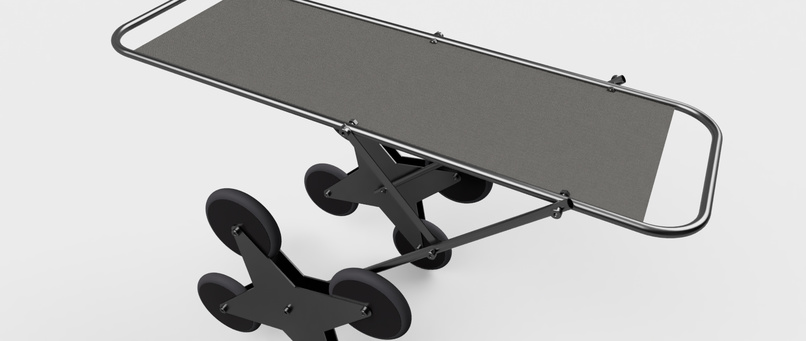
Closer view
-

Stair climbing stretcher
-

Front view
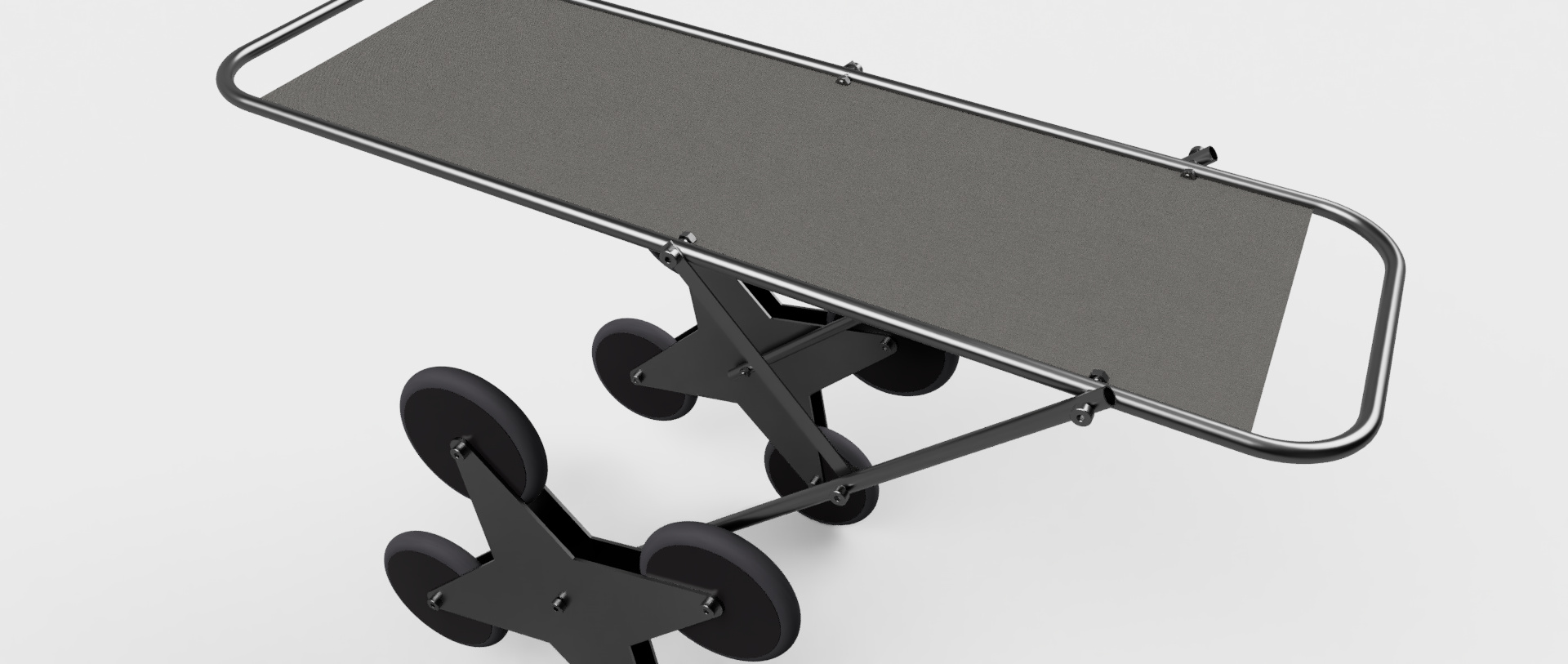


Stair Climbing Stretcher
Problem addressed: Enhancing First Responder Safety in Stairway Patient Transport
Emergency medical services (EMS) personnel frequently encounter situations where patients must be transported up or down stairs, especially in multi-story buildings lacking functional elevators. Traditional stretchers are primarily designed for flat surfaces, necessitating manual lifting and carrying when navigating stairs. This manual handling significantly increases the risk of musculoskeletal injuries among first responders (Patient Handling and Safety Experts). Notably, more than half of EMS workers' compensation claims—approximately 65%—are related to back injuries (McEvoy). Additionally, in 2014, EMS workers reported over 21,000 injuries, with 7,100 attributed to sprains and strains (Medical).
The physical strain associated with carrying patients on stairs not only jeopardizes the health and safety of EMS personnel but also compromises patient safety due to the increased risk of falls. Addressing these challenges is crucial to enhance the efficiency and well-being of first responders during stairway evacuations.
Target Users
The primary users of the stair-climbing stretcher are paramedics and first responders responsible for transporting immobile patients in emergency scenarios. Their key needs include:
Safety: Minimizing the risk of injury during patient transport, particularly when navigating stairs.
Efficiency: Reducing the physical effort and time required to transport patients, allowing for quicker response times and improved patient outcomes.
Versatility: Utilizing equipment adaptable to various environments, including confined spaces and staircases, without compromising stability or patient comfort.
Technical design features
To address these needs, the stair-climbing stretcher incorporates several innovative features:
Star-Wheel Configuration: Each side of the stretcher is equipped with a set of four wheels arranged in a star-shaped pattern. On flat surfaces, two wheels maintain ground contact, ensuring stability. When encountering stairs, the rotating wheel assembly allows seamless transition from one step to the next, facilitating smooth ascent or descent without manual lifting.
Sturdy Steel Frame: The stretcher’s frame is constructed from high-strength steel, offering exceptional durability and structural integrity. Steel provides greater stability under heavy loads and is highly resistant to deformation. Unlike some lighter metals, steel does not melt easily in high-temperature environments, making it a safer choice during fire-related emergencies where heat resistance is critical.
Adjustable Safety Straps: Equipped with multiple quick-release restraint straps, the stretcher secures patients of varying sizes, enhancing safety during transport. Due to restrictions in CAD for modeling semi-rigid objects, the straps could not be modeled. However, they are included in our original plan and are assumed to be part of the stretcher.
Fire-Resistant Fabric: The stretcher bed is made from fire-resistant fabric to ensure maximum safety in high-risk environments such as building fires or chemical accidents. This material resists ignition and helps protect both the patient and the responder during evacuation, adding a crucial layer of protection in hazardous rescue situations.
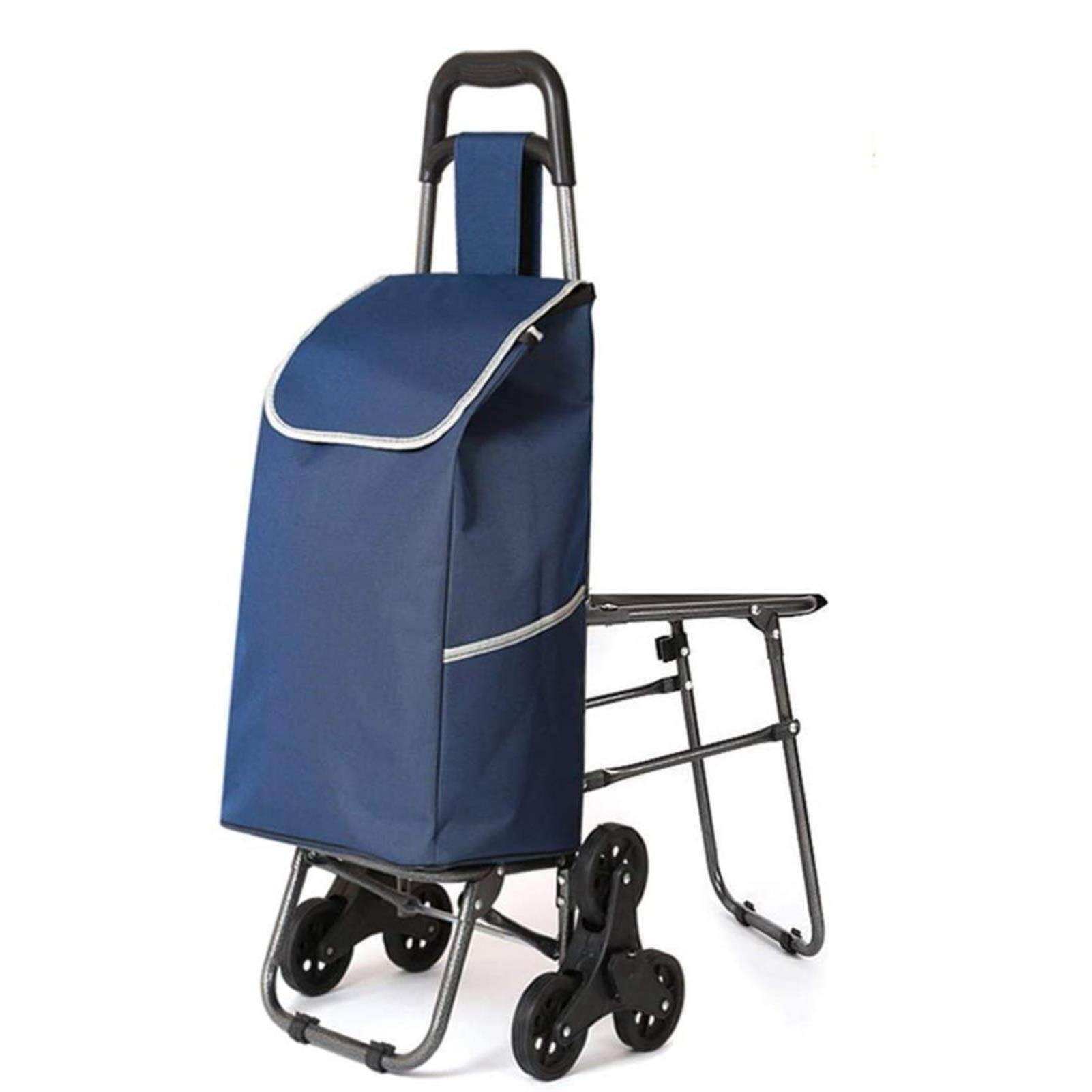
Major iterations and design inspirations
The development process drew inspiration from existing stair-climbing devices, such as the triple-wheel carts used for transporting goods over curbs and stairs. Initial designs featured a three-wheel configuration; however, research showed that a four-wheel arrangement offered superior stability and load distribution. This led to the adoption of the star-wheel design, enhancing both safety and maneuverability on stairs.
Wheel Mechanism
The stretcher features a star-shaped wheel assembly on each side, consisting of four wheels mounted around a central hub. On flat surfaces, two wheels maintain contact with the ground, allowing the stretcher to roll smoothly with enhanced stability. When encountering stairs, the gap between two wheels aligns with the edge of a step, triggering the entire wheel assembly—and a portion of the frame—to rotate approximately 90 degrees. This rotation brings the next wheel into contact with the step above or below, enabling a controlled and continuous climbing or descending motion without lifting the stretcher manually.
User story/walkthrough
Scenario: Emergency Evacuation in a High-Rise Building
During an earthquake in a Chicago skyscraper, a power outage disables the elevators. First responders arrive to find multiple injured individuals on the upper floors. Utilizing the stair-climbing stretcher, they ascend the stairs to reach a patient with a fractured leg. After securing the patient with the adjustable straps, they smoothly descend the staircase. The star-wheel mechanism allows the stretcher to glide over each step, reducing physical strain on the responders and minimizing patient discomfort. This efficient evacuation ensures the patient receives timely medical attention while safeguarding the health of the EMS personnel.
Real-world Feasibility
The stretcher's design is optimized for manufacturability using readily available materials and existing production techniques:
Materials: The use of steel for the frame balances strength and weight considerations, ensuring durability without excessive heaviness.
Production Techniques: Standard manufacturing processes, such as metal fabrication and assembly, are employed, allowing for cost-effective production.
Compliance: The design adheres to medical equipment standards, ensuring safety and reliability in emergency situations.
Future Improvements and Next Steps:
To further enhance the stair-climbing stretcher, future developments may include:
Foldable Stretcher Bed: Implementing a foldable bed design to increase compactness for storage and transport.
Advanced Materials: Exploring the use of composite materials to reduce weight while maintaining structural integrity.
Ergonomic Enhancements: Refining handle placements and cushioning to improve user comfort and control during operation.
By addressing the critical challenges associated with stairway patient transport, the stair-climbing stretcher aims to significantly improve the safety and efficiency of first responders, ultimately enhancing patient care outcomes.
References Cited
McEvoy, Mike. “How Powered Cots and Stair Chairs Can Reduce EMS Back Injuries.” EMS1, 27 Feb. 2014, www.ems1.com/immobilization/articles/how-powered-cots-and-stair-chairs-can-reduce-ems-back-injuries-AdIgTiYRbtnpFFQQ/?utm_source=chatgpt.com. Accessed 30 Mar. 2025. Medical, Graham. “First Responder Safety Obstacles during Patient Transport.” Grahammedical.com, 2017, blog.grahammedical.com/blog/first-responder-safety-obstacles-during-patient-transport?utm_source=chatgpt.com. Accessed 30 Mar. 2025. Overall Dimensions of Gamma Stretcher Frame from a ..., www.researchgate.net/figure/Overall-dimensions-of-Gamma-stretcher-frame-from-a-bottom-view_fig3_38003354. Accessed 30 Mar. 2025. Patient Handling and Safety Experts. “The Power Paradox: The Contradiction of Power Stretchers and Manual Patient Lifting in EMS.” EMS1, 31 May 2024, www.ems1.com/patient-handling/the-power-paradox-the-contradiction-of-power-stretchers-and-manual-patient-lifting-in-ems?utm_source=chatgpt.com. Accessed 30 Mar. 2025. Required Dimensions of the Stair Climbing Cart, www.researchgate.net/figure/Required-dimensions-of-the-stair-climbing-cart_fig1_341656768. Accessed 30 Mar. 2025.

Log in or sign up for Devpost to join the conversation.