In short
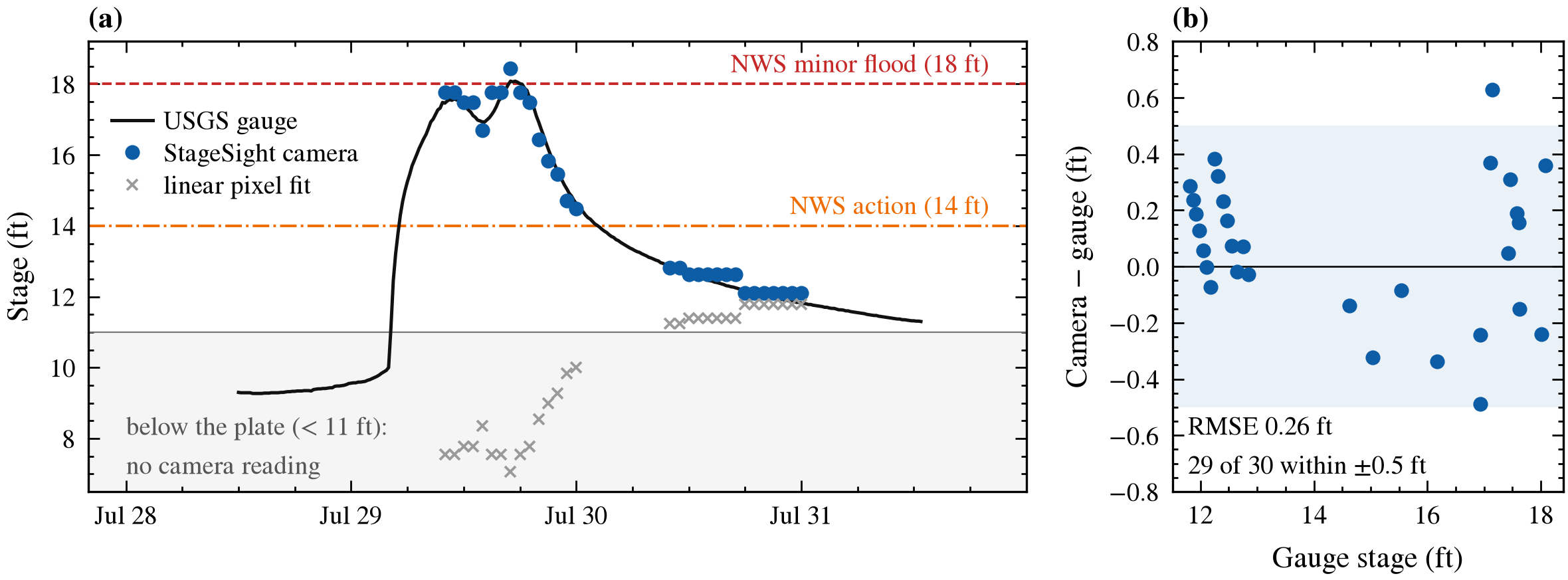
- OpenCV 5 reads river stage off a USGS staff-plate camera with no gauge data: 0.26 ft RMSE through the 29 July 2026 flood (29 of 30 frames within 0.5 ft), where a fitted pixel regression is off by 6.3 ft.
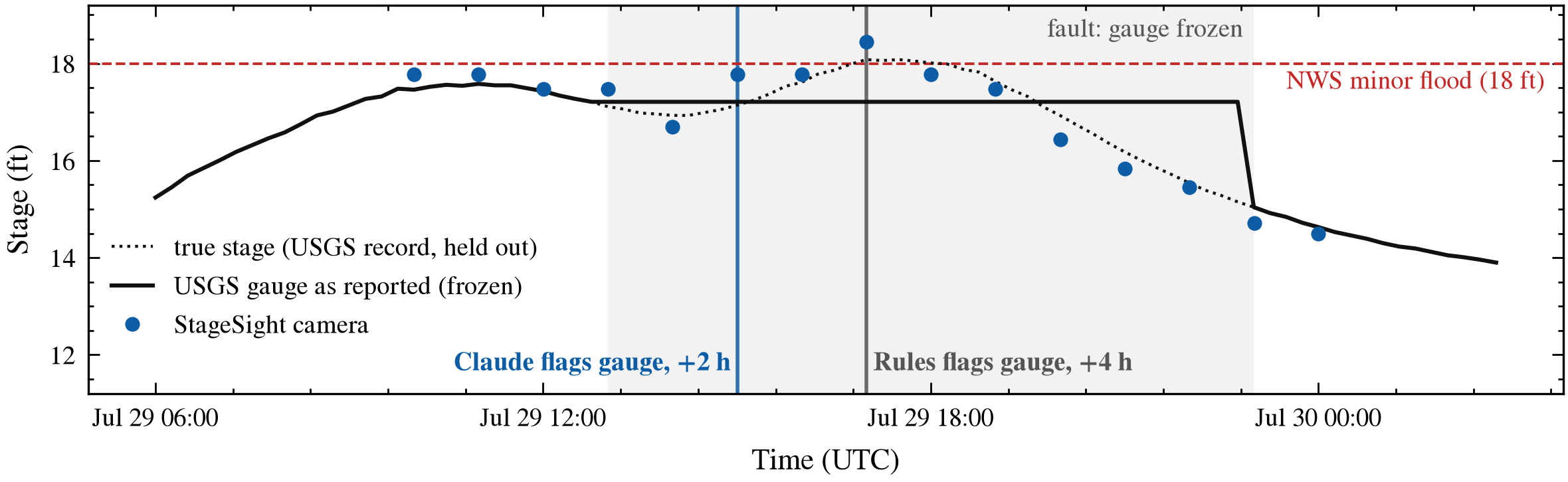
- When camera and gauge disagree, a Claude agent on Amazon Bedrock re-runs the OpenCV reader and decides which instrument is wrong. In both simulated camera faults the fixed rules blamed the healthy gauge; Claude blamed the camera in 3 of 3 runs.
- It runs live on AWS Lambda every 15 minutes, and nothing leaves it until a person approves.
Inspiration
I study floods as a PhD student in civil engineering. A river gauge reports stage from one pressure sensor. When that sensor fouls, freezes or goes silent, often in the storm it exists for, the record shows no sign of it. The USGS already runs cameras at its gauges, many aimed straight at a staff plate, but people look at those images; nobody measures them. I wanted the camera to become a second instrument that can check the first.
What it does
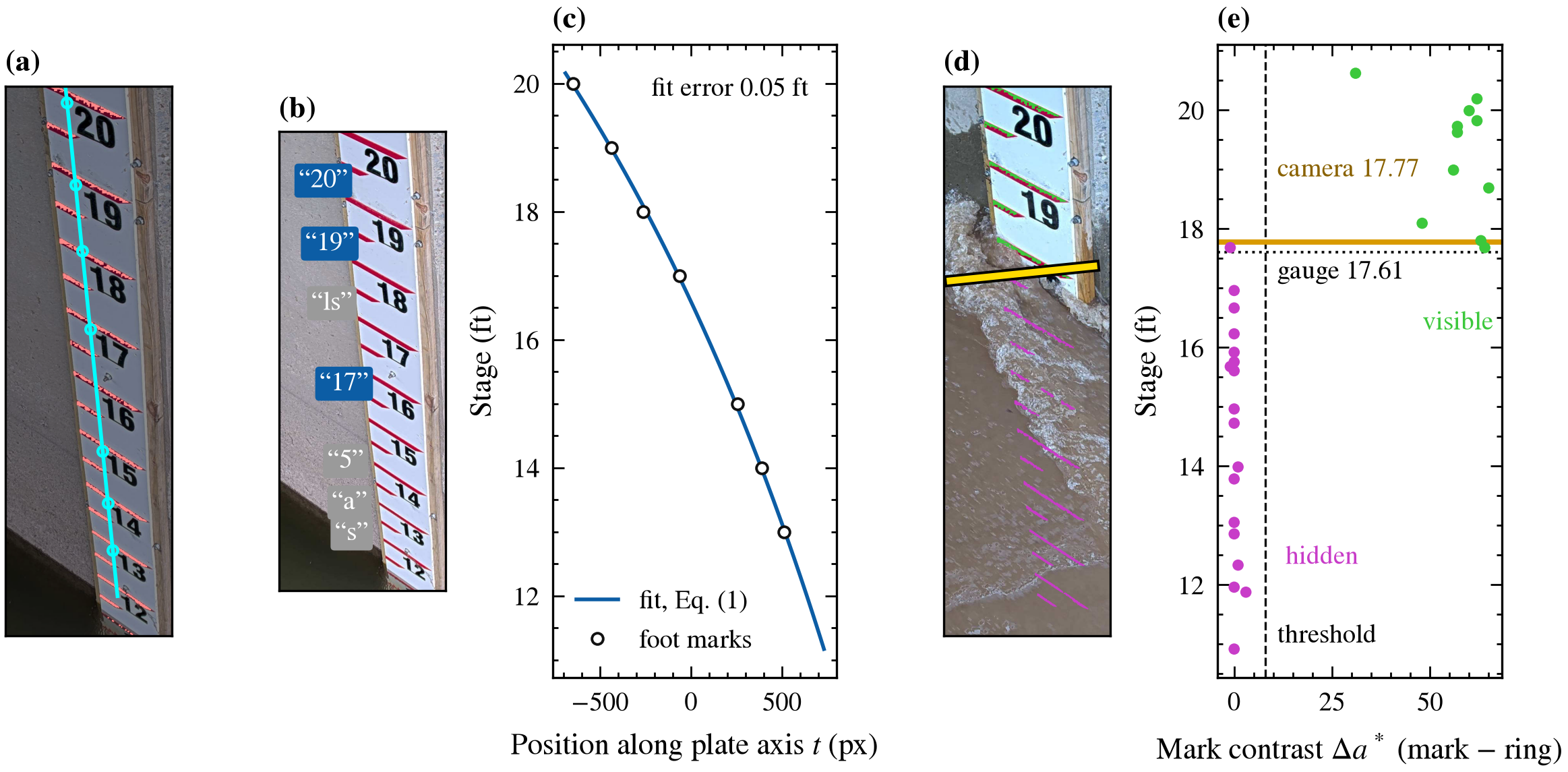
- Every 15 minutes StageSight takes the newest frame from the USGS camera at Hancock, NY, and OpenCV 5 reads the river stage off the staff plate with no gauge data: the plate's marks give the scale and the printed foot numbers, read by OpenCV's DNN text recognizer, give the datum.
- It compares that reading with the USGS gauge. When they disagree, the gauge goes silent or the river reaches an NWS flood level, a Claude agent on Amazon Bedrock gathers evidence (re-reads earlier frames, checks the gauge history and an upstream gauge) and decides which instrument to trust.
- Sensor flags and flood alert drafts go to an approval queue. Nothing is sent without a person.
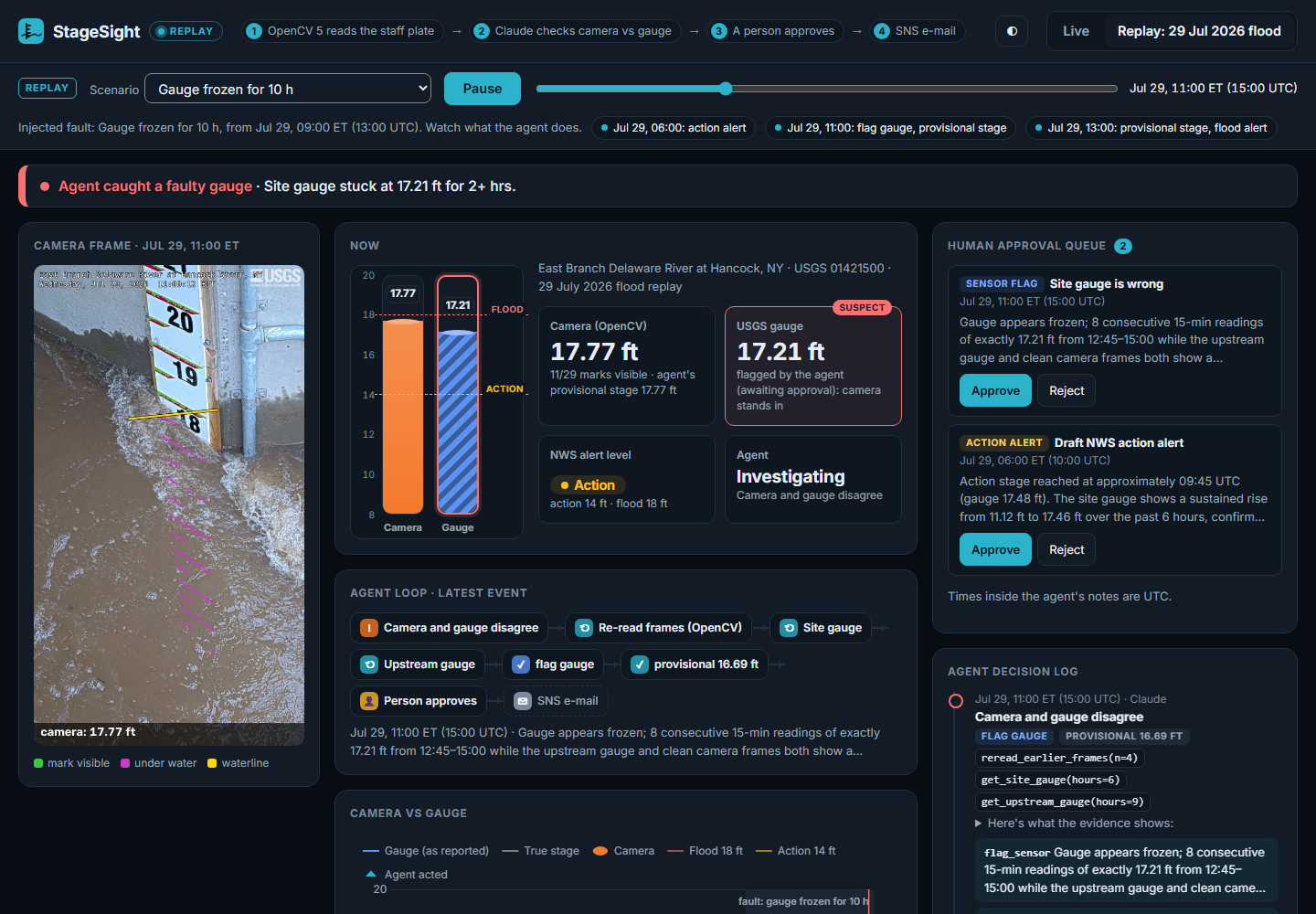
- The live dashboard opens a replay of the 29 July 2026 flood when the river is low or it is night, so you can watch the agent handle a frozen gauge, a drifting gauge, debris on the plate or spray on the lens. You can also upload a frame and get a reading back from Lambda.
How I built it
- OpenCV 5 reader: HSV red mask,
connectedComponentsWithStatsandfitLinefind the plate and its marks; a 1-D projective map turns pixels into feet;phaseCorrelatere-registers the plate every frame; Lab a* contrast decides which marks are under water; the OpenCV Zoo CRNN, run throughcv.dnn.TextRecognitionModel, reads the datum. A quality gate and explicit statuses (below_plate,unreadable,camera_moved) mean it returns a reason instead of a guess. - Agent: code raises events; only events call Claude (Opus 4.6 on Bedrock) in a tool loop with three evidence tools and four actions. The tools run inside Lambda; Bedrock only chooses them. Agent memory, a safety net that always surfaces flood alerts, and a rule fallback on any model error came out of testing.
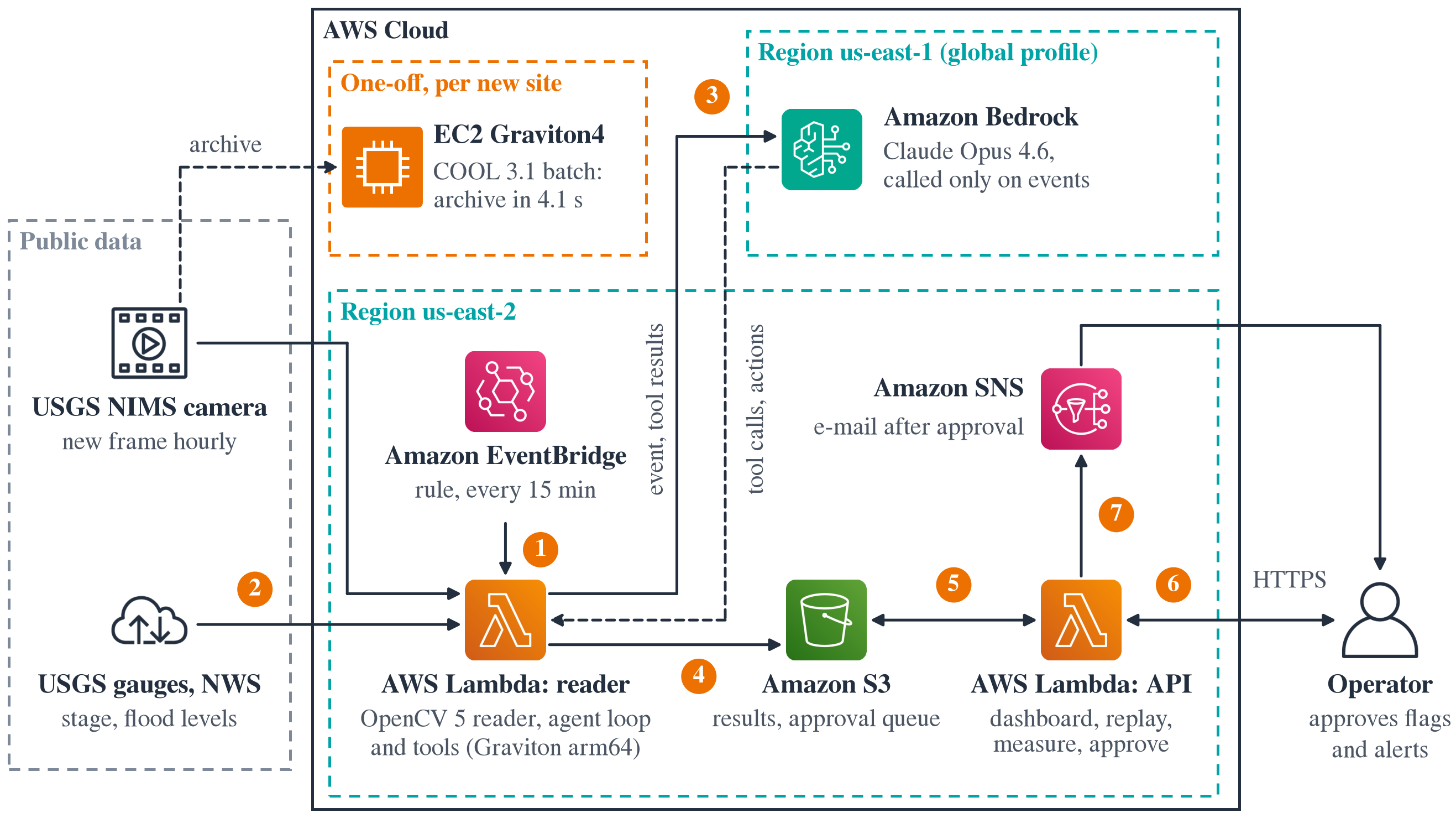
- AWS: two arm64 Lambda functions on Graviton: a reader that also runs the agent, and an API that serves the dashboard, the flood replay and
/measurebehind a Function URL. An EventBridge rule every 15 minutes, a private S3 bucket, Bedrock, and an SNS topic that e-mails approved alerts. The IAM role can write logs, use only that bucket, invoke Anthropic models and publish to that topic. The zip is built without Docker by cross-installing the Linux arm64 OpenCV 5 wheels. A tick takes a median of 6.3 s (n = 23 CloudWatch runs). - EC2 Graviton4 + COOL: a one-off batch re-reads a camera's archive when a site is set up.
- The same code runs on a laptop CPU, with a replay that injects faults into the real flood.
- Tests (pytest) and lint run in GitHub Actions.
Results
- 29 July 2026 flood at Hancock, NY (NWS minor flood, 18.08 ft peak): 0.26 ft RMSE against the USGS gauge, 29 of 30 readings within 0.5 ft, with no gauge data. A linear pixel fit trained on a smaller September high water has 6.3 ft RMSE. The camera follows both flood peaks.
- Second test event, 4–5 Sep 2026 high water (frames the reader never used): 0.34 ft RMSE, 15 of 15 within 0.5 ft. The water stayed inside one gap between two marks, so this is one reading repeated; the archive has no daylight frame spoiled by rain, fog or glare.
- Injected faults, repeated runs (Claude Opus 4.6 and Sonnet 4.6 against a rule baseline): Opus 4.6 caught all four gauge faults in 3 of 3 runs (frozen gauge in 2 h vs 4 h for the rules, drift in 7 h vs 8 h) and blamed the camera in both camera faults in 3 of 3 runs. It is not error-free: during the frozen gauge it also flagged the healthy camera at the second peak in 3 of 3 runs, and there the flood alert came from the safety net. Sonnet 4.6 missed the slow drift in 2 of 3 runs. The report (Table IV) shows all of it.
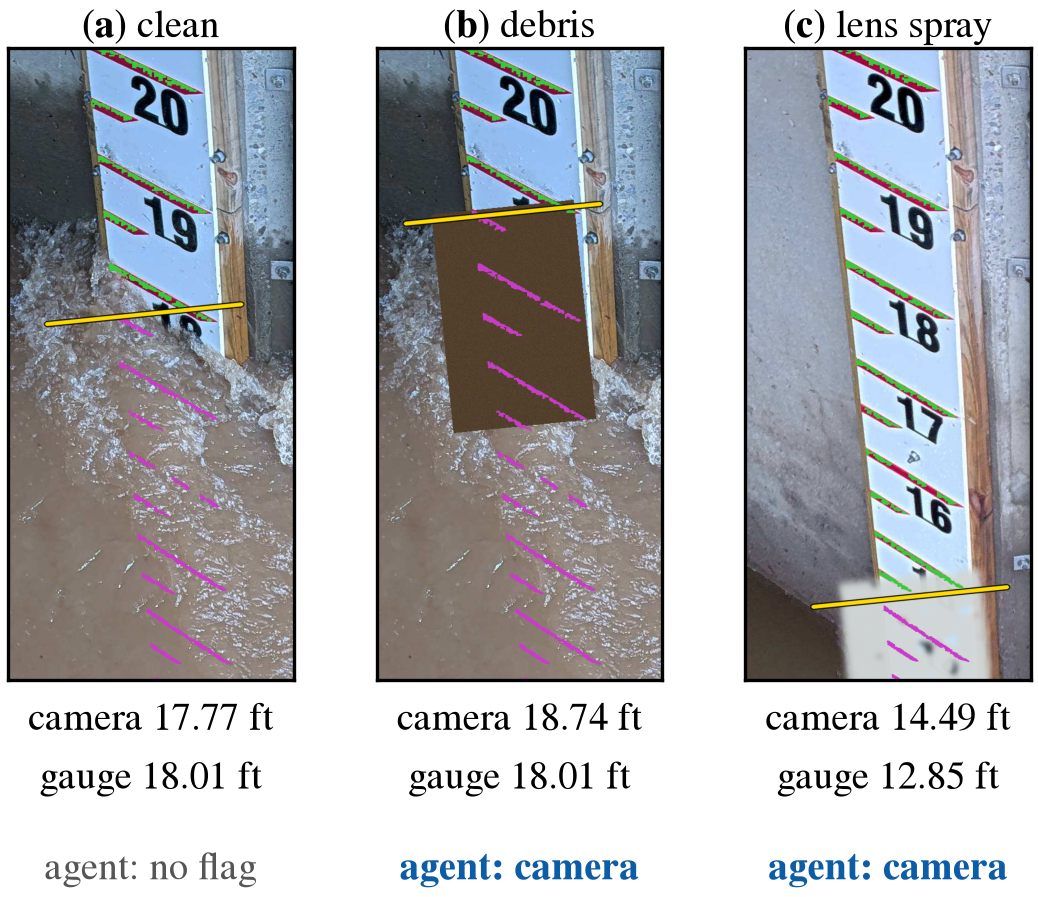
- Camera faults (debris over the plate, spray on the lens) with a healthy gauge: the rule baseline blamed the healthy gauge and published the bad camera stage; Claude blamed the camera. In the debris case it noticed the visible marks drop from 11 to 7 while both gauges said the river was falling.
- 90 days of normal operation (1,863 frames): 0 false sensor flags from the rule planner and 0 from Claude Opus 4.6 (one run, 17k input / 2.9k output tokens); both drafted only the action and flood alerts at the real flood. Only two events reached the planner in those 90 days, so this is a small sample, not a measured false-alarm rate.
- COOL on Graviton4: with 16 worker processes a c8g.4xlarge re-reads the whole 90-day archive (1,869 frames) in 4.1 s, about $0.0008 at on-demand prices, scaling almost linearly from 33 frames/s with one worker. COOL gives the same status and stage as pip OpenCV in every frame; it is 4% faster in one process and 4.9x faster in connectedComponentsWithStats, while the batch is NumPy-bound, so the two builds tie there. COOL's DNN text recognizer aborted on c8g.xlarge and ran on c8g.4xlarge; a minimal reproduction is in the repo (report Sec. VI, Table II).
Challenges I ran into
- My first approach, a self-calibrating waterline detector for any camera, reached 0.29 ft MAE in range on a close wall but failed on far-bank bridge cameras and could not extrapolate to floods. Reading the plate itself solved the flood problem; the far-bank cameras stay in the report as failure cases.
- The OCR dropped the leading "1" of "19"; now only the longest reads in a frame may vote.
- Claude's first run missed the drift, and its second run drafted no flood alert during a real flood because it had forgotten its own gauge flag. I fixed it in code (agent memory and a safety net), not in the prompt. In the third run it flagged the frozen gauge for a partly wrong reason; the report says so.
- A brand-new AWS account had only the 4.6-generation Claude models enabled and low request quotas, so the agent retries patiently and falls back to the rules when Bedrock is unavailable.
Accomplishments that I'm proud of
- An absolute stage reading from an existing public camera, with no survey, no target and no gauge data, that holds through a flood above every frame used in setup.
- In both camera-fault replays the agent blamed the right instrument, where fixed thresholds blamed the healthy gauge.
- Stated limits: the reader returns a reason instead of a number when it cannot see, and the report lists the agent's failures.
What I learned
When the event you care about lies outside the training range, a geometric model of the plate extrapolates and a fitted regression does not. The agent helped where two instruments disagreed; the safety net and human approval covered its mistakes.
What's next for StageSight
Read night infrared frames from the printed numbers, and support more plate designs and the other NIMS plate cameras.
Responsible use
StageSight is a decision aid, not an official warning system. It uses public USGS and NWS data only, sends nothing until a person approves it (then by SNS e-mail; live approvals need an operator token), and labels a camera stage provisional whenever it stands in for the gauge.
Special awards
- Best Use of COOL: the archive batch runs on EC2 Graviton4 with COOL 3.1 (cv2 loaded from /opt/cool, KleidiCV 0.7.0 in the build info), measured against stock OpenCV on the same instances: identical output on 1,869 frames, 454 frames/s with 16 workers, $0.0004 per 1,000 frames, and a DNN crash isolated to one instance size with a minimal reproduction (report Table II,
results/cool/;scripts/cool_run.pylaunches, measures and terminates the instance). - Agentic Vision: the OpenCV reading decides what happens next: code turns it into events, and
reread_earlier_framesre-runs the OpenCV reader and returns mark counts. In the debris case the drop from 11 to 7 visible marks is what made Claude blame the camera instead of the gauge. Evidence: report Sec. V and VII-C, Table IV, Figs. 5 to 7, and the replay on the live site.
How to test
- Open the live dashboard. At night or low water it opens the replay of the 29 July 2026 flood;
?mode=liveshows the latest real camera frame read on AWS Lambda. - In the replay, pick a scenario (for example "Gauge frozen for 10 h" or "Debris covers the plate") and press the chips under the time bar to jump to each agent action. The Agent loop panel shows the tools Claude called; the decision log has its full reasoning.
- Approve or Reject in the replay is local only and sends nothing. Live approvals need the operator token, so judges see the live queue read-only.
- "Try the reader": download the sample flood frame from the same panel, or any full 1080x1920 frame of the Hancock staff camera from USGS NIMS, and upload it; Lambda returns the stage it read.
- Offline:
pytest -qin a fresh clone runs the reader on two real flood frames (README, "Check it in 10 minutes").
Links
- Live dashboard: https://zkdbpwl26gqzom5j3osjaoi4dy0htqoq.lambda-url.us-east-2.on.aws/
- Code: https://github.com/Waqar-msx9t/stagesight
- Technical report (PDF): https://github.com/Waqar-msx9t/stagesight/blob/main/docs/StageSight_report.pdf
- Demo video: https://youtu.be/YnP3MDY5Bgs
Built With
- amazon-bedrock
- amazon-ec2
- amazon-eventbridge
- amazon-sns
- amazon-web-services
- aws-graviton
- aws-lambda
- chart.js
- claude
- github-actions
- numpy
- opencv
- python

Log in or sign up for Devpost to join the conversation.