-
-
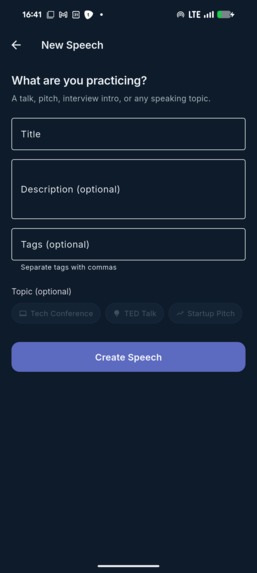
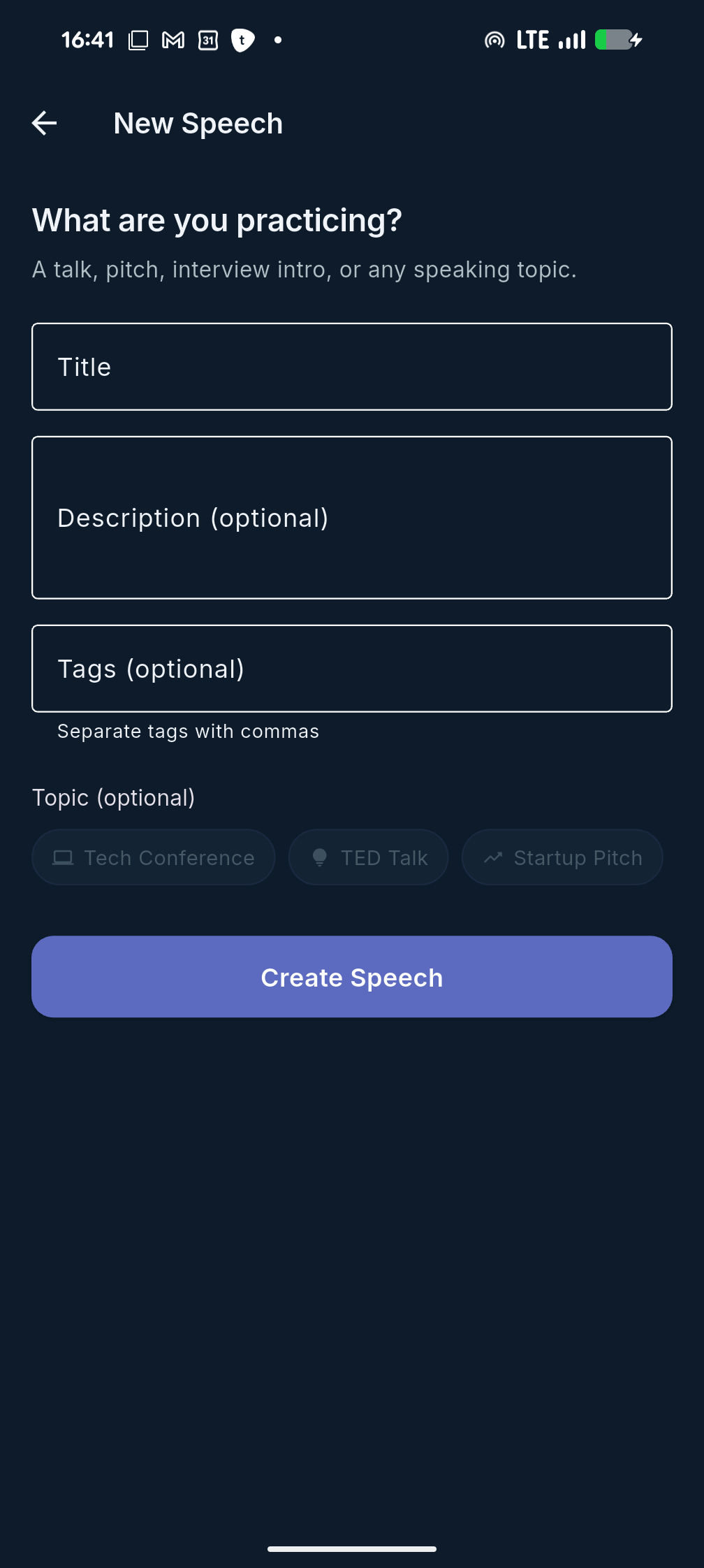
Additing session
-
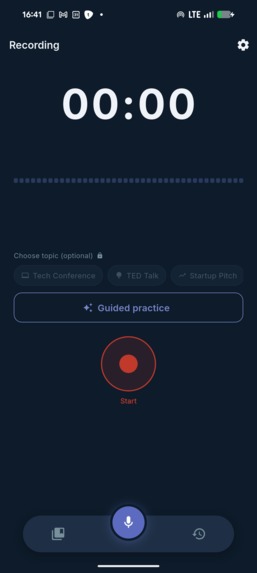
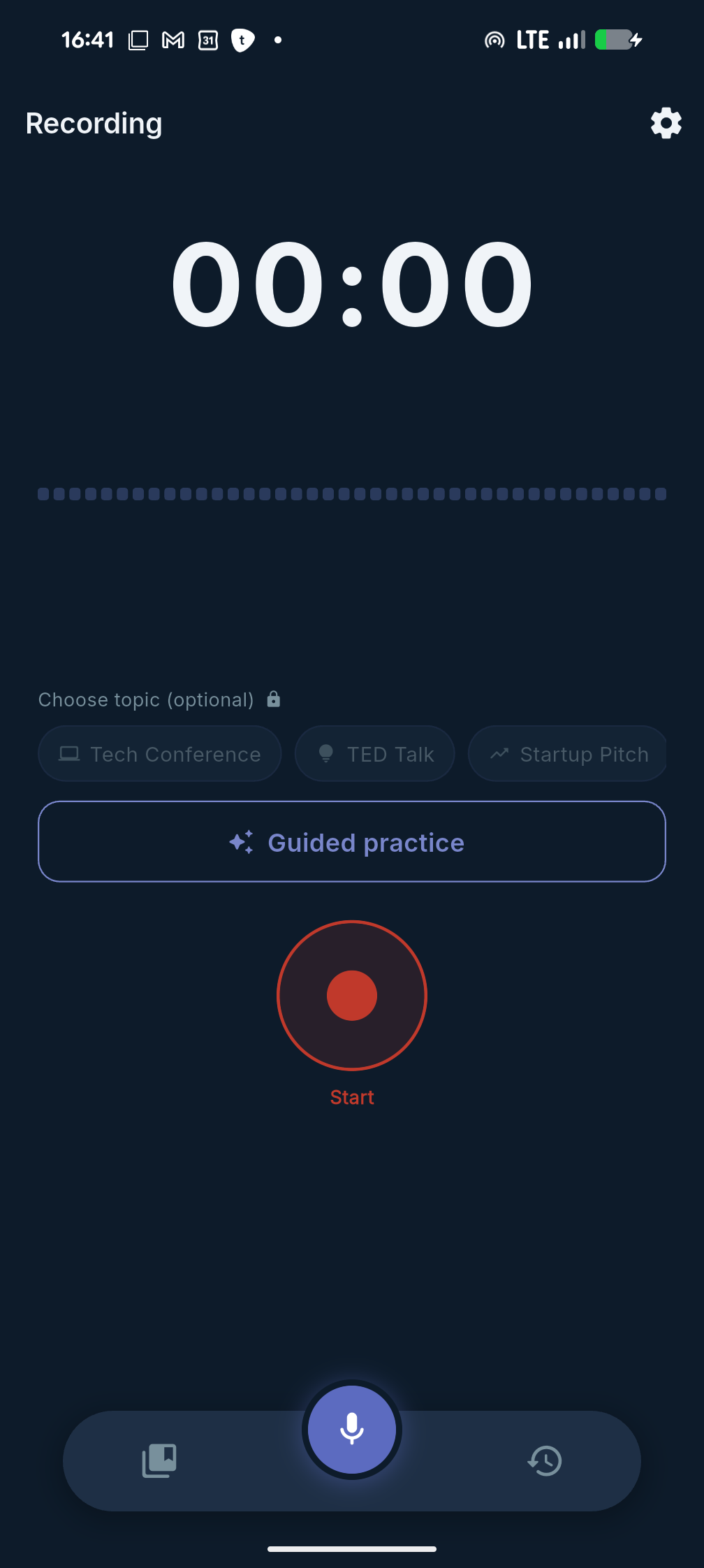
Main screen
-
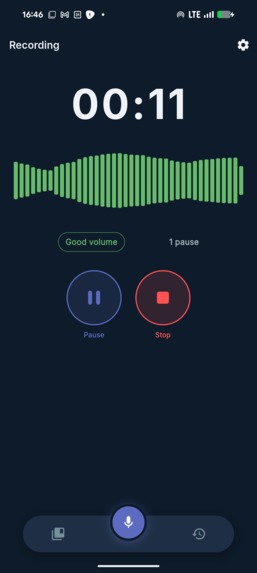
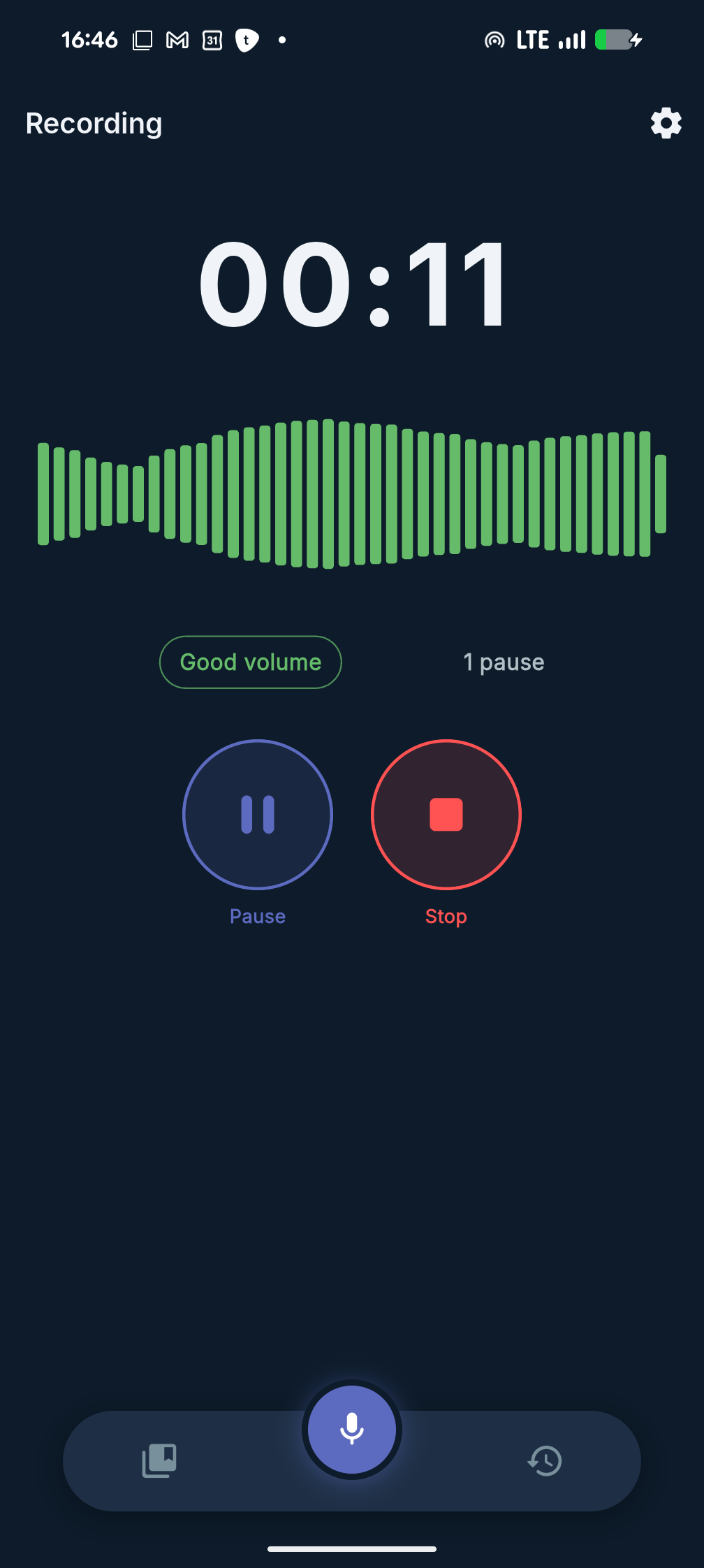
Recording
-
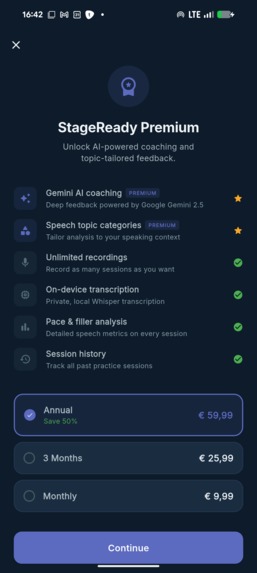
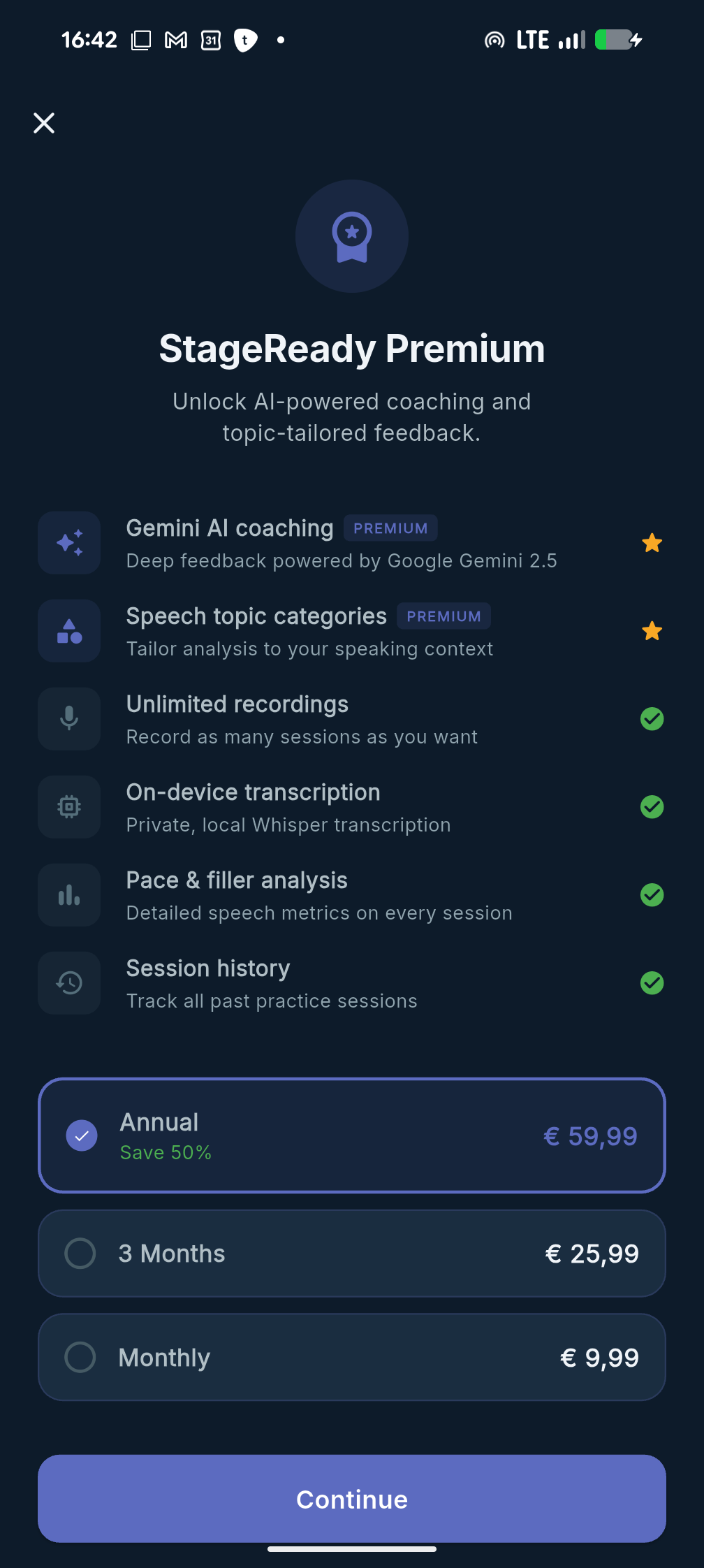
Paywall
Inspiration
I speak at tech conferences regularly, and one thing never really changes: a talk gets better by practicing it again and again.
But it is surprisingly difficult to measure that improvement. I can record myself, listen back, and have a feeling that the second attempt was better — but was it actually better? Did I speak more clearly? Did I slow down? Did I use fewer filler words?
That was the idea behind Stage Ready.
I wanted to build the tool I would personally use before my next conference talk: something I can open, press record, practice, and immediately understand what I should improve.
What it does
Stage Ready is a mobile public speaking coach.
You record a practice session and Stage Ready analyzes your delivery: speaking pace, pauses, filler words, duration, transcript, and other speaking metrics.
But a single analysis isn't the main idea.
You can create a Speech — for example, "My FlutterCon Talk" — and practice it multiple times. Stage Ready compares those sessions and shows whether you're actually improving over time.
You can also make quick standalone practice sessions without creating a Speech.
The goal is simple: practice your talk, track your progress, and be ready when you step on stage.
How we built it
Stage Ready is built with Flutter and designed as a mobile-first experience.
Speech is captured directly from the practice flow. Live speech recognition makes recording interactive, while the analysis produces metrics such as pace, pauses, filler words, duration, and other speaking statistics.
Sessions can optionally belong to a Speech. This allows Stage Ready to compare multiple rehearsals and show progress instead of treating every recording as an isolated attempt.
AI handles qualitative coaching, while measurable statistics are calculated separately. This keeps the feedback grounded in what actually happened during the session.
For monetization, we integrated RevenueCat to manage subscriptions, entitlements, and access to premium coaching features. Instead of spreading purchase logic throughout the app, Stage Ready can simply ask whether a user has access to a feature and let RevenueCat handle the subscription state behind it.
This is especially important for Stage Ready because AI features have a real usage cost. RevenueCat gives us a foundation for separating the free practice experience from more advanced AI coaching while keeping the purchasing experience simple.
Challenges we ran into
Speech is messy.
Real people pause, restart sentences, repeat themselves, change their speaking speed, and use filler words in ways that aren't always obvious from a transcript.
Another challenge was deciding what should happen live and what should happen after recording. Immediate feedback makes the app feel responsive, but the final analysis needs to be reliable.
We also had to think carefully about the difference between a Session and a Speech. A Session tells you how you performed today. A Speech needs to tell you whether you're getting better after five or ten rehearsals.
Monetization introduced another interesting product decision: what should always be free, and what belongs in Stage Ready Pro? RevenueCat allowed us to build that boundary around entitlements instead of coupling the product architecture directly to Google Play billing.
Accomplishments that we're proud of
Stage Ready went from an idea based on a real problem I have as a conference speaker to a working Android application.
I'm particularly happy that it doesn't stop at giving someone an AI-generated score.
It keeps the history of the actual practice process and makes improvement visible.
I'm also proud that the app supports both structured rehearsal and quick practice. You can spend weeks preparing one important talk, or simply open Stage Ready and practice speaking for a minute.
What we learned
One of the biggest lessons was that AI itself isn't the product.
A user can already ask a general-purpose AI to analyze a transcript. The interesting part is everything around it: capturing the practice session, measuring it consistently, remembering previous attempts, comparing them, and turning feedback into a repeatable improvement loop.
We also learned that public speaking improvement is much more interesting as a trend than as a single score.
"Your score is 78" isn't nearly as motivating as "you started at 62, and after five rehearsals you're at 78."
On the business side, RevenueCat made us think about monetization as part of the product architecture from the beginning. Entitlements give us a clean way to experiment with what belongs in Pro without rebuilding the purchasing layer every time the product changes.
What's next for Stage Ready
The next step is to make Stage Ready feel less like an analyzer and more like a real rehearsal partner.
We want to expand the coaching system, improve long-term progress tracking, and introduce specialized practice modes for conference talks, interviews, pitches, and other speaking situations.
RevenueCat will also let us experiment with the premium model as Stage Ready evolves — including advanced AI coaching, deeper speech analytics, and potentially usage-based access to more computationally expensive features.
One particularly exciting direction is an AI audience that can listen to a presentation and then ask questions — including technical, beginner, skeptical, or unexpected questions.
Ultimately, Stage Ready should answer one question before an important presentation:
Am I ready to step on stage?
Built With
- dart
- flutter
- revenuecat
- whisper

Log in or sign up for Devpost to join the conversation.