Inspiration
Small businesses are now fully dependent on SaaS tools — email, payroll, payments, file sharing — yet nearly half of cyberattacks target small businesses, and most don’t have a formal incident response plan.
Existing cybersecurity tools are built for enterprise IT teams, not 5–25 person companies without dedicated security staff.
We were inspired to build something that translates cyber risk into simple, actionable steps small teams can actually execute — before a single stolen login shuts them down.
What it does
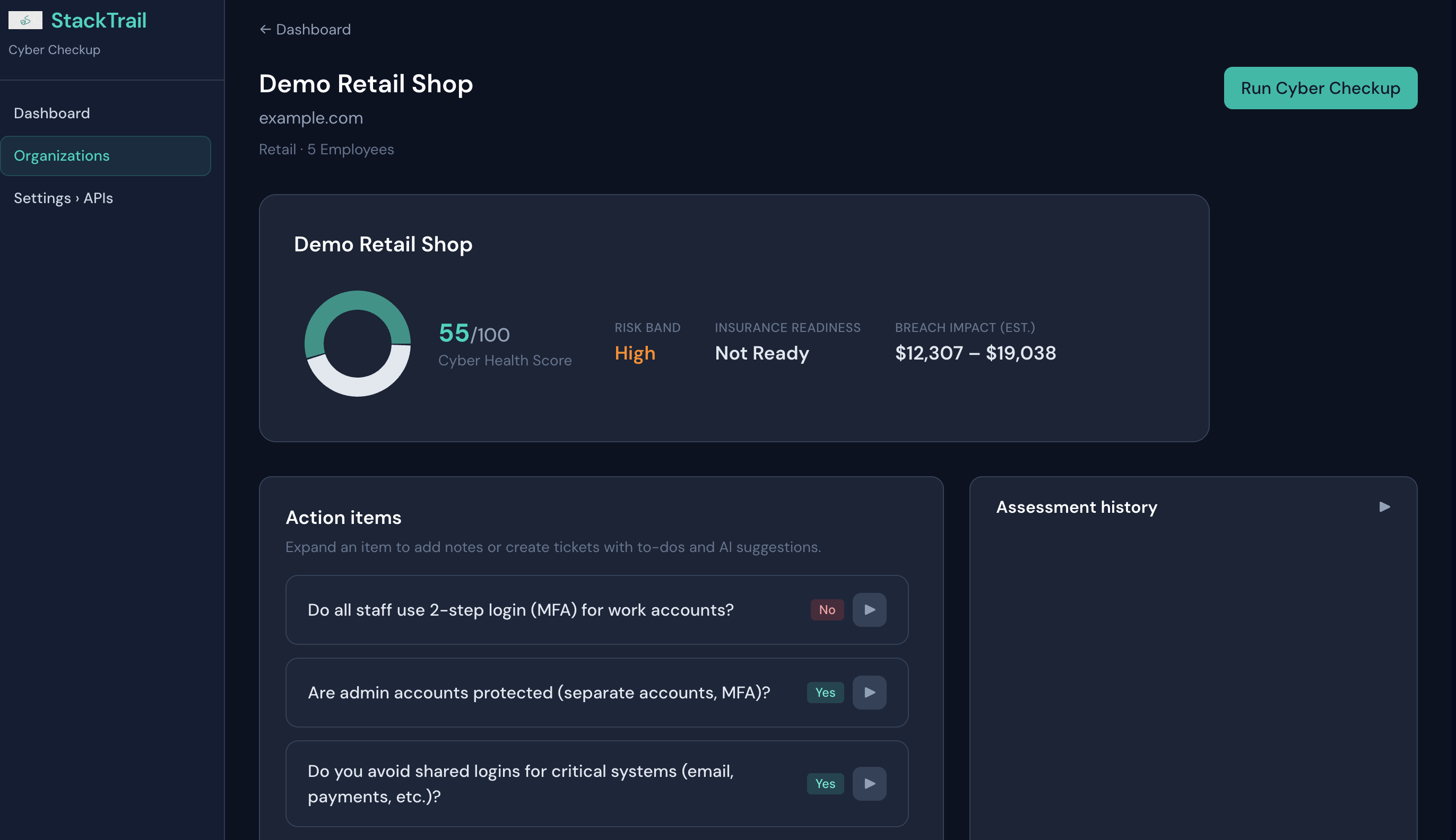
StackTrail evaluates a small business’s SaaS security posture and external domain health, then turns that risk into prioritized, actionable tasks.
It:
Runs a short SaaS-focused security assessment
Scans domain email and TLS configurations (SPF, DMARC, certificate health)
Generates a clear cyber health score
Estimates downtime and financial impact
Identifies the top 3 highest-impact fixes
Automatically creates tasks in workflow tools like Trello
StackTrail makes cybersecurity operational instead of theoretical.
How we built it
We built StackTrail as a full-stack web application:
Backend: Django + Django REST Framework
Frontend: React + TypeScript (Vite)
Database: PostgreSQL
We implemented:
A rules-based scoring engine to calculate risk and insurance readiness
A domain and email scanning module (DNS + TLS checks)
A reporting system that generates structured monthly-style summaries
Workflow integration to convert risk findings into actionable tasks
The system is modular, allowing future integrations with SaaS APIs and monitoring systems.
Challenges we ran into
One major challenge was scope control.
It’s easy to expand into full enterprise SaaS security posture management, but we intentionally narrowed our focus to small businesses and high-impact controls like MFA, email authentication, and access management.
Another challenge was balancing technical depth with clarity — we had to translate complex security concepts into plain language without oversimplifying.
Designing a scoring model that felt realistic but understandable was also a key technical and product challenge.
Accomplishments that we're proud of
Building a working SaaS-level security assessment platform in a short timeframe
Implementing real domain scanning functionality
Designing a clear risk scoring and prioritization engine
Turning findings into workflow tasks instead of static reports
Creating a product that feels practical and immediately usable
We’re especially proud that StackTrail doesn’t just detect risk — it operationalizes it.
What we learned
We learned that cybersecurity for small businesses isn’t primarily a technical problem — it’s a clarity and prioritization problem.
Small teams don’t need more dashboards. They need to know:
What matters most
What to fix first
How to do it
We also learned the importance of narrowing the problem space to deliver something usable rather than trying to solve everything.
What's next for StackTrail
Next, we plan to:
Add OAuth-based integrations with Google Workspace and Microsoft 365 for automated posture checks
Expand workflow integrations beyond Trello
Implement scheduled monthly scanning and reporting
Add industry benchmarking for small businesses
Develop a subscription model for continuous monitoring
Long term, StackTrail aims to become the SaaS security operating layer for small teams.
Built With
- backend:
- database:
- django
- framework
- frontend:
- react
- rest
- typescript


Log in or sign up for Devpost to join the conversation.