-
-
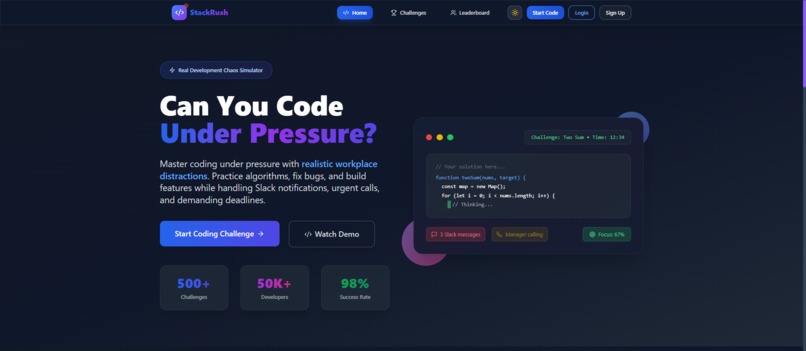
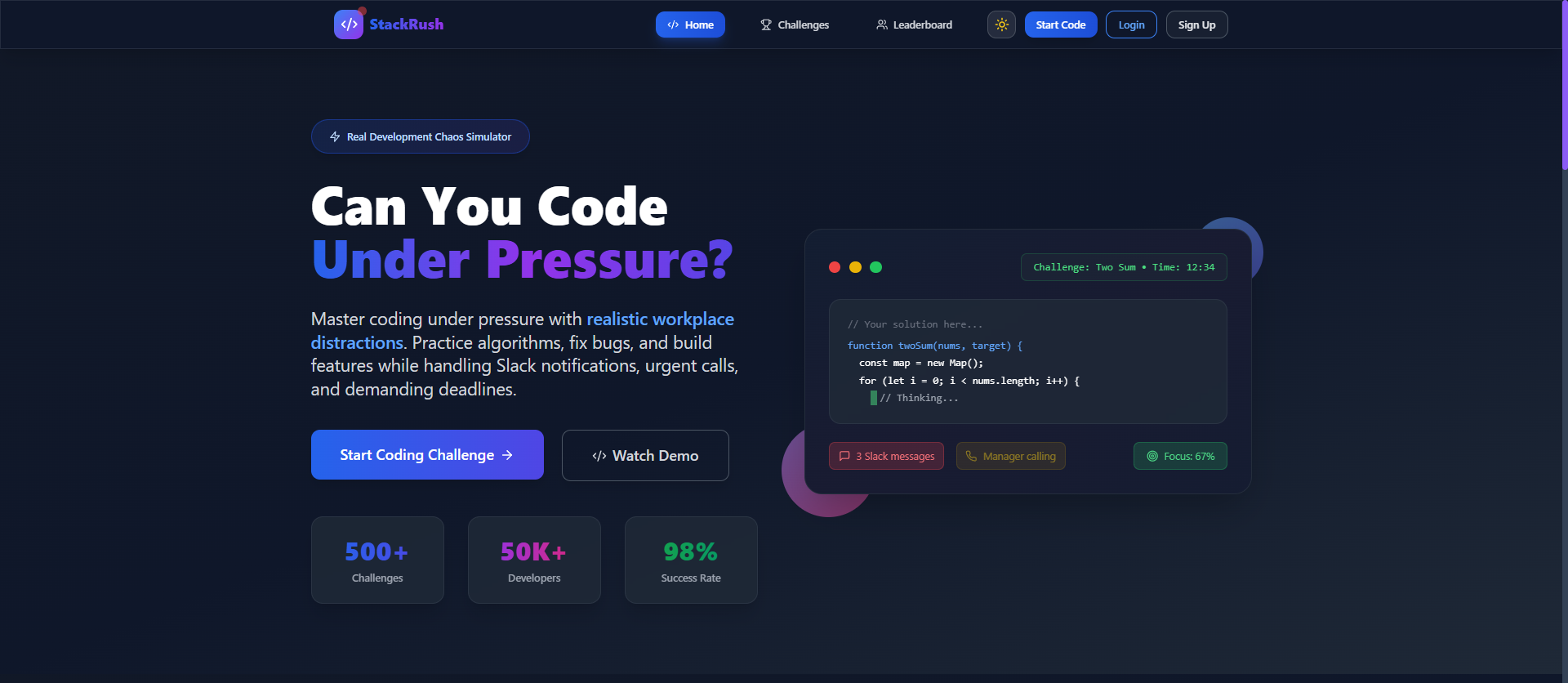
Stack rush Landing page
My journey in tech didn't start in a university classroom. It started with a 10th-grade education and a burning desire to build things. Like millions of self-taught developers, I dove into the world of online tutorials and courses. I spent countless hours learning, accumulating knowledge, and collecting certificates. But when I applied for jobs, I hit a wall. All employers saw was a resume with no degree and no real-world projects. I was trapped in tutorial hell—I had the knowledge, but no way to prove I had the skills.
The inspiration for Stack Rush came from two of my passions: gaming and aviation. I love simulation games, where you learn by managing complex, realistic systems. I was always fascinated by how pilots spend hundreds of hours in flight simulators, safely practicing for engine failures and storms before ever flying a real plane.
A thought struck me: Why don't we have this for coding?
Why isn't there a safe, realistic environment where aspiring developers can practice on messy, real-world codebases, fix actual bugs, and build features, all while creating a verifiable record of their abilities?
I wanted to build the tool I wish I had. A platform that values demonstrable skill over credentials. A launchpad for everyone who has the talent but lacks the traditional opportunity. That's how Stack Rush was born.
What I Learned: More Than Just Code This hackathon was an incredible learning experience that went far beyond technical implementation.
Product Vision: I learned how to distill a personal frustration into a clear product vision. The challenge wasn't just to build a "coding platform," but to craft an experience that builds a user's confidence and career. Balancing realism with guided learning was a key lesson in product design.
Community is Everything: By committing to an open-source model from day one, I realized the product's future doesn't just lie in my hands. The plan to allow community-submitted challenges will turn Stack Rush into a living, breathing ecosystem that grows with its users.
The Power of AI-Assisted Development: My biggest technical takeaway was learning how to partner with an AI like Kiro. It's a new way of thinking—shifting from writing every line of code to clearly defining requirements, specs, and tasks. I learned to be a better architect, guiding the AI to execute my vision at a speed I never thought possible.
How I Built It: A Story of Vision and Velocity Building a project of this complexity during a hackathon would have been impossible without a modern, AI-powered workflow.
My process began with Bolt, where I quickly scaffolded the basic mockup and foundational structure for Stack Rush. This gave me a solid, tangible starting point.
But the project truly came to life when I imported that scaffold into Kiro. The magic was in Kiro's automated, structured workflow. All I had to do was give it a high-level prompt or task, and it would instantly do the planning for me. It would automatically generate the:
Requirements File: Defining what needed to be done.
Design Spec: Laying out the UI/UX and system architecture.
Task List: Breaking the entire project into manageable steps.
Kiro created the entire plan and then began executing it, step-by-step. This made the development process unbelievably smooth. I could give it complex prompts like, "Integrate a web container for live code previews and upgrade the entire design," and watch it happen.
The results were staggering. Kiro seamlessly integrated these advanced features and ended up generating over 85% of the new backend code. The speed and accuracy were insane, allowing me to focus on the core vision and user experience, not the boilerplate.
Challenges I Faced: The Real-World Simulation Fittingly, building a simulation of real-world coding came with its own real-world challenges.
Technical Complexity: Creating a sandboxed environment in the browser that can safely run code, manage dependencies, and provide real-time feedback is non-trivial. Integrating the web container was a significant hurdle that required careful architecture.
Balancing Realism and Guidance: The biggest conceptual challenge was designing the "distractions." How do you make a bug-fixing task feel realistically messy and chaotic without making it frustratingly impossible for a learner? It was a constant balancing act between creating a real challenge and providing a positive educational experience.
What's Next: The Journey is Just Beginning This hackathon is not the end of Stack Rush; it is the public beginning. My commitment to this project is long-term. My immediate roadmap includes expanding the challenge library and, most importantly, building the feature that will allow the community to contribute their own challenges.
My mission is to build a world where your skills—not your certificates—define your future. Stack Rush is my first, most important step on that journey, and I am dedicated to helping as many people as I can with it.

Log in or sign up for Devpost to join the conversation.