-
-
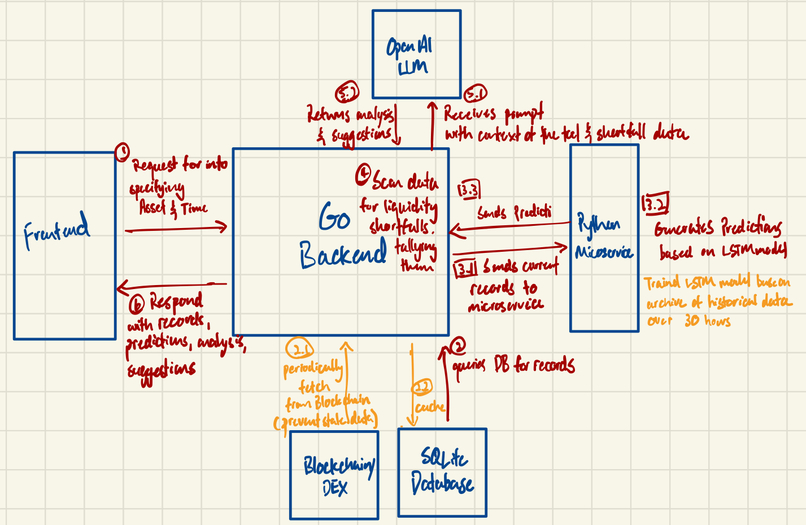
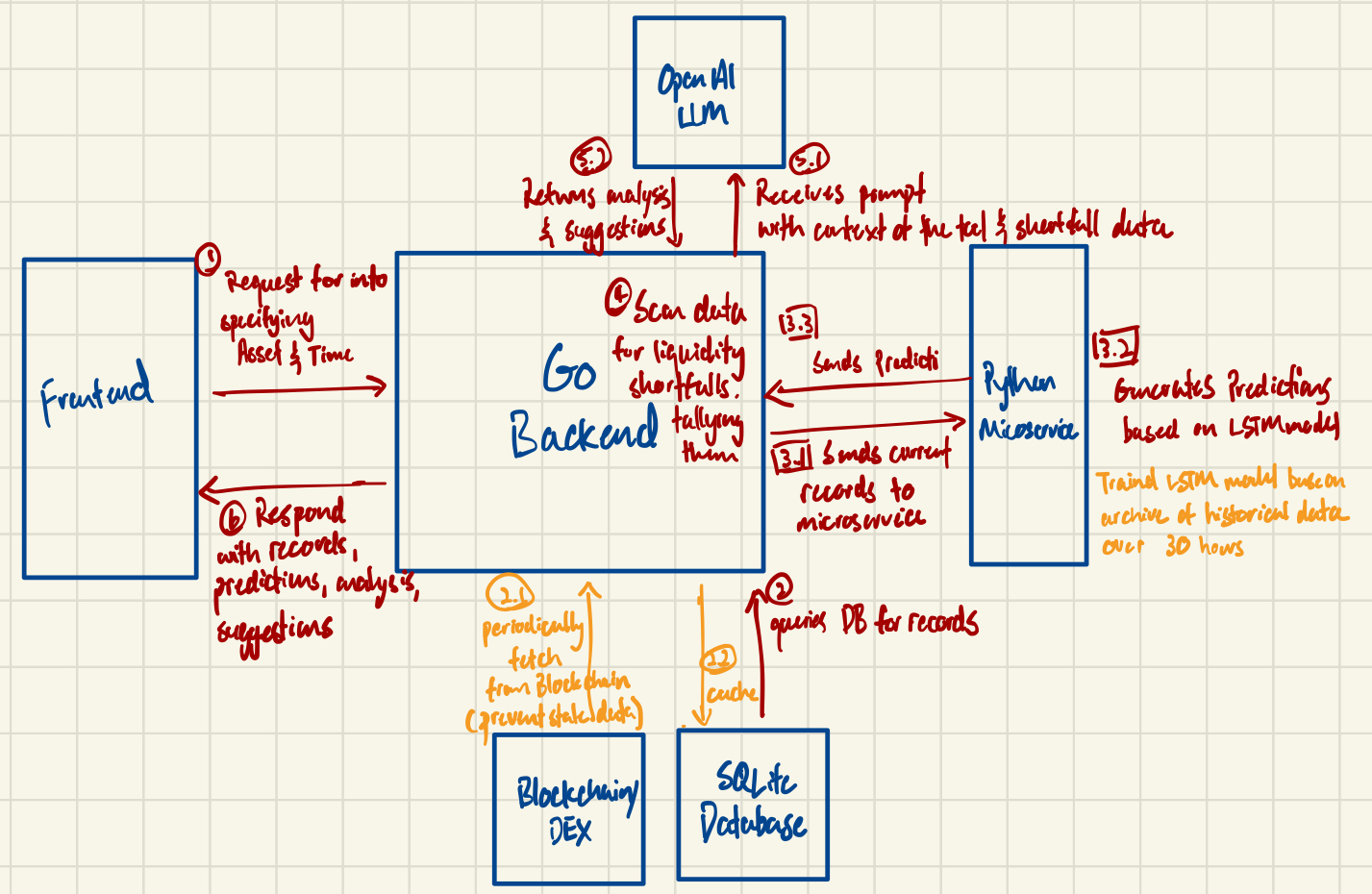
Application Pipeline Diagram
StableTide API: Liquidity Management for Tokenized Assets
1. Problem Statement and Motivation
Problem Statement
Liquidity management in tokenized assets is a pressing challenge for financial institutions. As traditional financial markets transition to blockchain-based systems, managing liquidity risks becomes critical due to several factors:
- Decentralized trading environments with fragmented data: Blockchain networks operate independently, creating isolated pockets of data that make it challenging to form a comprehensive view of liquidity.
- High volatility and unpredictable trading patterns in tokenized assets: Tokenized assets experience rapid price fluctuations, making them inherently risky without proper monitoring tools.
- Limited tools for proactive risk management in decentralized finance (DeFi): Current financial risk management tools are not designed to handle the unique challenges posed by DeFi systems.
Motivation
Tokenized assets are rapidly being adopted by financial institutions for several reasons:
- Expand market accessibility: Tokenization opens markets to a broader range of investors by lowering barriers to entry.
- Provide liquidity for traditionally illiquid assets: Tokenization allows fractional ownership of assets such as real estate or art, increasing their liquidity.
- Leverage blockchain transparency: Blockchain systems ensure that transactions are immutable and publicly verifiable.
However, without robust liquidity management tools, financial institutions face significant risks:
- Liquidity shortfalls leading to asset devaluation.
- Systemic risks from interconnected tokenized ecosystems.
- Difficulty in complying with regulatory standards.
2. Proposed Solution
StableTide API
StableTide API is a blockchain-focused liquidity tracker designed specifically for financial institutions to manage liquidity risks in tokenized assets. Key features include:
Liquidity Risk Monitoring
Tracks trading volume, bid-ask spread, and transaction frequency in real-time, providing up-to-date insights on liquidity conditions.
Predictive Analytics
Utilizes machine learning (ML) models to forecast liquidity shortfalls based on historical data trends, enabling institutions to act before problems arise.
Corrective Actions
Leverages large language models (LLMs) to offer suggestions for managing tokenized assets and preventing liquidity shortfalls.
Value Proposition
- 24/7 Monitoring: Helps institutions identify and address liquidity risks without requiring active monitoring.
- Seamless Integration: Combines data fetching, prediction generation, and analysis into one simple click.
- Operational Efficiency: Reduces the number of man-hours needed to monitor tokenized assets.
TAM/SAM/SOM Analysis
- Total Addressable Market (TAM): The tokenized asset market is expected to reach $16 trillion by 2030.
- Serviceable Addressable Market (SAM): Financial institutions investing in blockchain are projected to manage assets worth $2 trillion by 2030.
- Serviceable Obtainable Market (SOM): Early adopters of predictive liquidity tools represent a $500 billion market opportunity.
3. Technical Implementation
Architecture
- The Frontend sends a request specifying the time window and the asset to be queried to the Backend.
- The Backend then fetches the latest records from the SQLite database, which is periodically updated with the latest data from the Blockchain/DEX.
- The Server then sends the asset data to the Python Microservice hosting the LSTM model. The LSTM model has been trained with historical data using models from Tensorflow to generate predictions.
- The Server scans the existing asset data and the predictions for liquidity shortfalls, recording and tallying them up.
- The Server sends the recorded and tallied shortfalls in a prompt with context and instructions to OpenAI’s 4o Large Language Model. It returns analysis and suggestions for mitigating liquidity risk based on the severity and frequency of shortfalls.
- The Server sends back a response with the records, predictions, analysis, and suggestions.
4. Explanation of Blockchain/ML in the API
Blockchain Integration
- Etherscan API: Ensures transparency and data integrity by fetching transaction data.
- Smart Contract Data: Tracks tokenized asset transfers and liquidity pool interactions.
- On-Chain Metrics:
- Trading Volume: Aggregated from transaction value fields.
- Bid-Ask Spread: Derived from decentralized exchange (DEX) liquidity pool reserves.
Machine Learning
- Why LSTM?:
- Ideal for time-series data analysis.
- Captures sequential dependencies in data for forecasting trading volumes and identifying liquidity risks.
- OpenAI Integration:
- Analyzes forecasted data.
- Provides actionable insights to financial institutions.
5. Projected Roadmap of Development
Phase 1: Prototype (Hackathon Submission)
- Develop the backend for fetching and aggregating blockchain data.
- Build an LSTM-based microservice for liquidity predictions.
Phase 2: Feature Expansion
- Add multi-blockchain support (e.g., Binance Smart Chain, Solana).
- Implement real-time alerts via webhooks for liquidity risks.
Phase 3: Commercialization
- Integrate enterprise-grade security and compliance features.
- Offer advanced visualization and analytics tailored to institutional clients.
- Scale the solution using TAM/SAM/SOM analysis to target both DeFi and traditional finance markets.
Challenges and Mitigation
- Data Fragmentation: Aggregates data from various DEX APIs and implements cross-chain integrations.
- ML Accuracy: Continuously retrains LSTM models with live data to improve prediction accuracy.
Built With
- etherscan
- go
- javascript
- lstm
- python
- sqlite

Log in or sign up for Devpost to join the conversation.