-
-
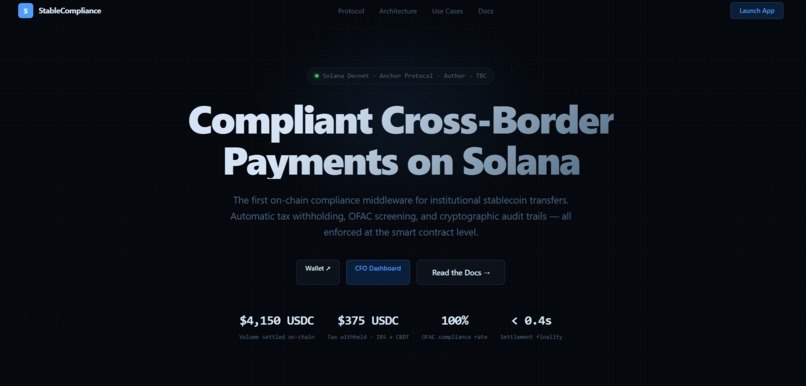
StableCompliance
-
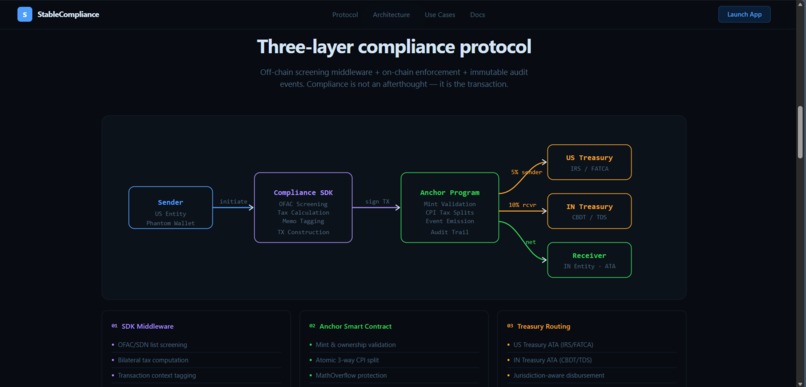
Architecture
-
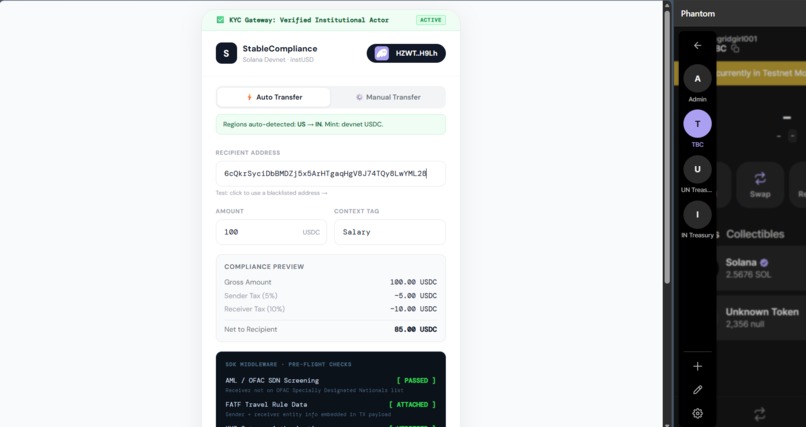
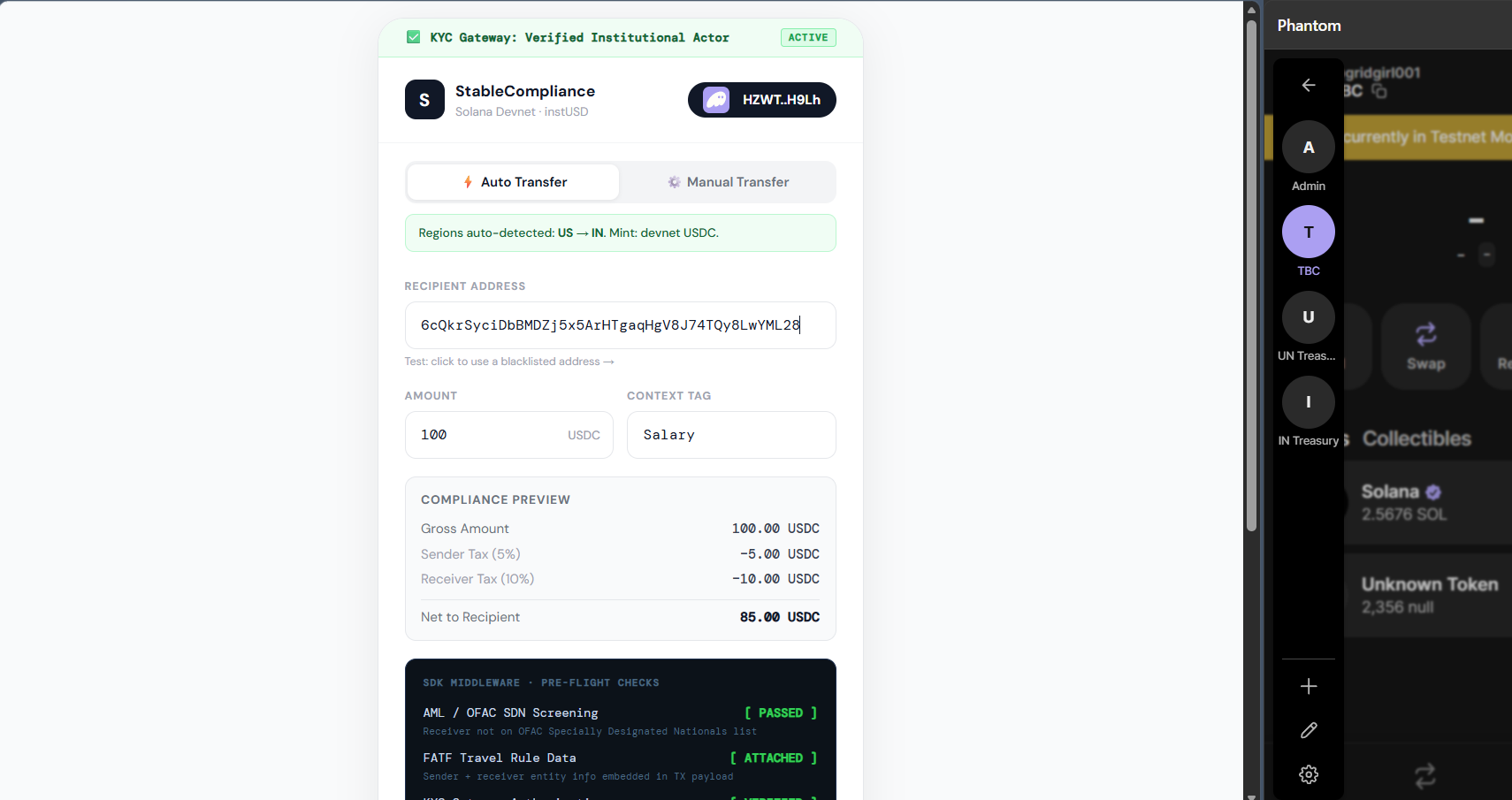
Get funded with faucet and try making transaction live on wallet
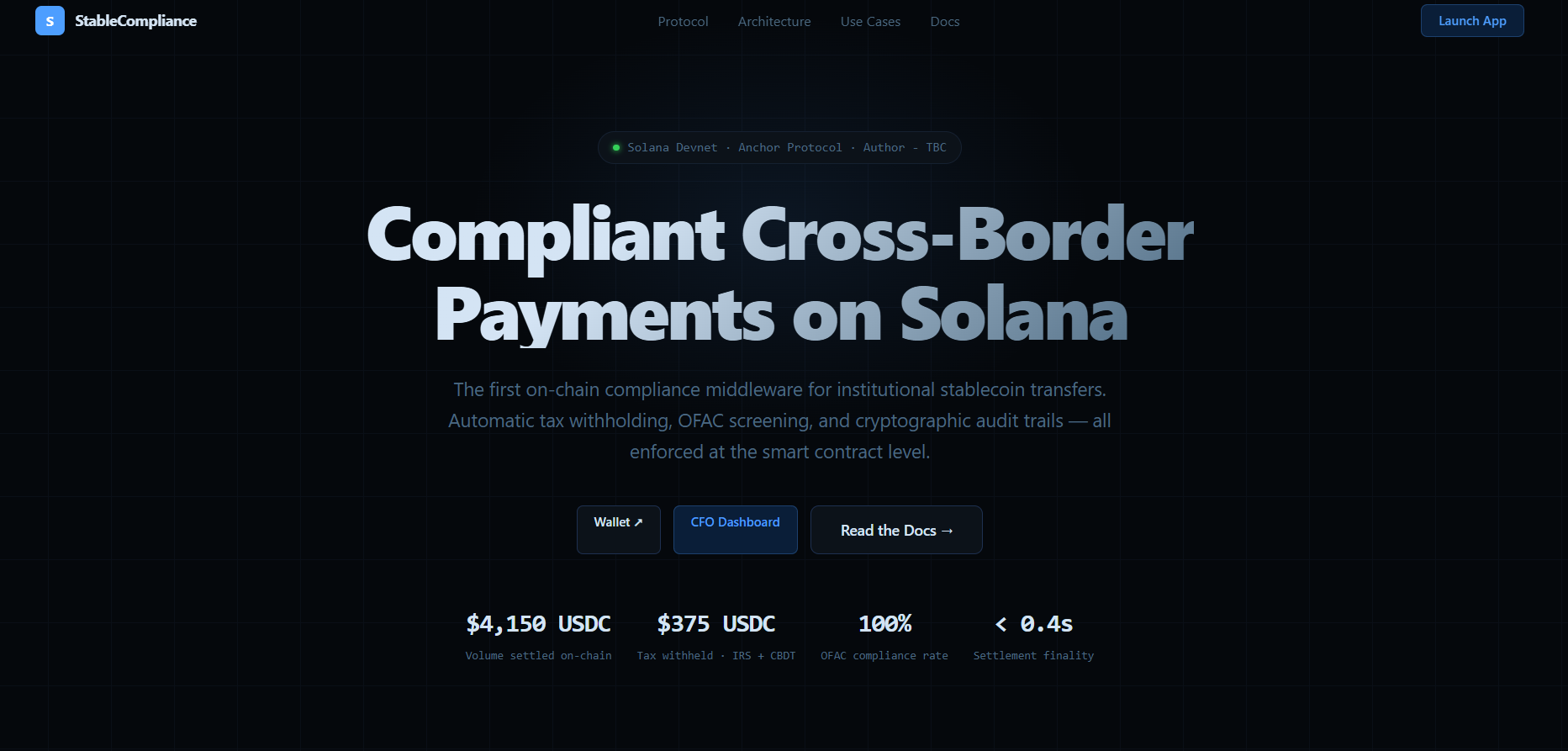
Inspiration
Stablecoins settle trillions globally, yet traditional finance often avoids them, fearing they can't regulate fast, borderless money. I believe blockchain is undeniable and wanted to prove it can follow the rules. My goal was to replace the manual, multi-day nightmare of tax reconciliation with automated, millisecond precision—building a definitive bridge between decentralized technology and strict, real-world compliance.
What it does
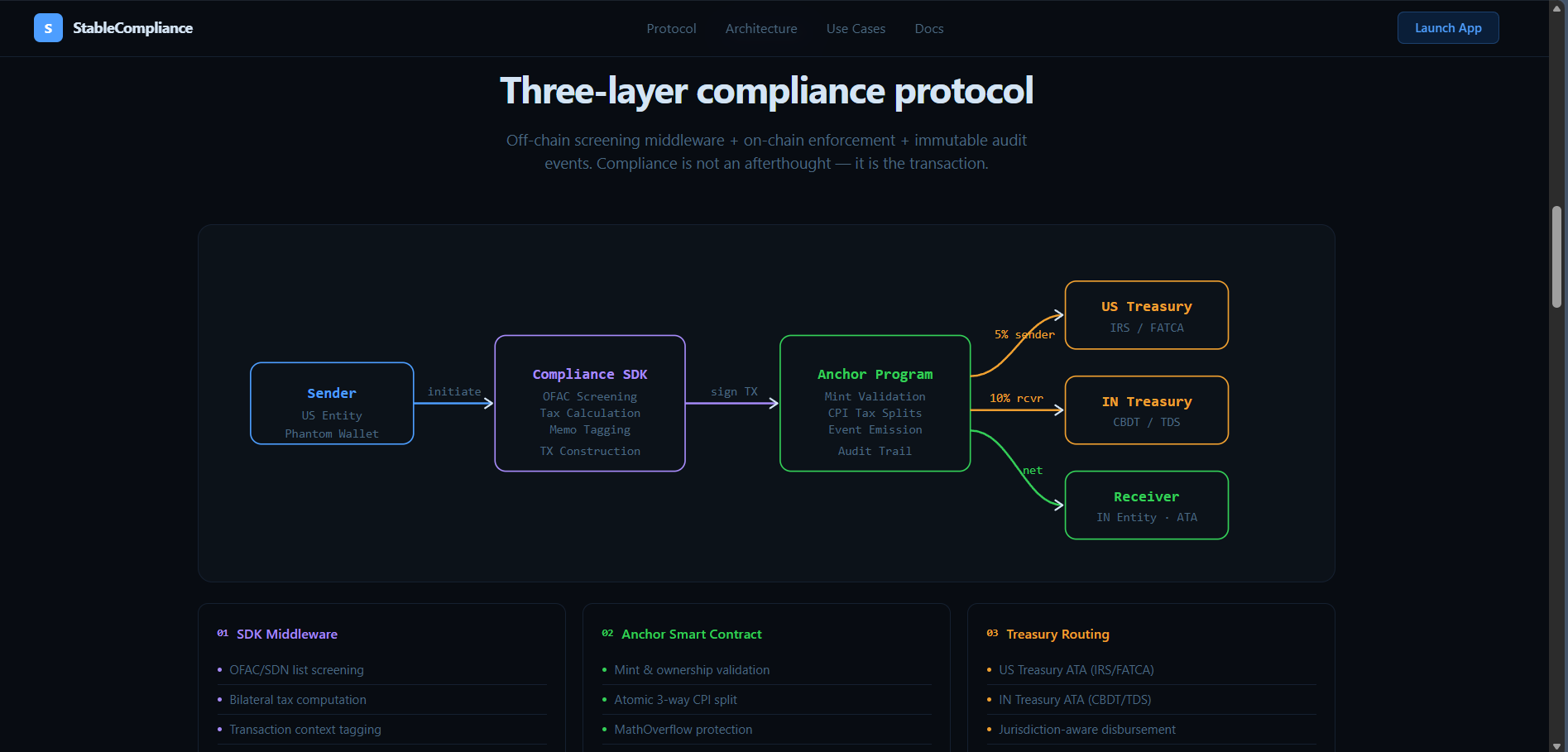
It is a real-time compliance and tax routing engine. The exact millisecond a stablecoin transaction settles, the protocol instantly verifies wallet addresses against KYC registries and AML blacklists. It then calculates the required tax, splits the funds, and routes the exact obligation directly to a government or corporate treasury—all within a single atomic transaction. Zero manual audits. Full regulatory compliance.
How we built it
We wrote the core logic in Rust and deployed it using the Anchor framework on Solana to get the low-latency execution needed for high-speed finance. We embedded the compliance logic directly into the transaction lifecycle.
Mathematically, the protocol executes an atomic split. For a given transaction volume \( V \) and jurisdictional tax rate \( \tau \), the smart contract ensures the state update is atomic. The settlement logic guarantees:
$$V_{receiver} = V(1-\tau)$$
$$V_{treasury} = V\tau$$
This routes the exact fraction of funds to the receiver and the designated treasury simultaneously in a single transaction block.
Challenges we ran into
The biggest challenge was translating slow, traditional tax laws into fast, immutable code. We had to ensure that enforcing these strict rules didn't bottleneck the network. Handling fractional math in Rust to guarantee precise treasury splits—while keeping the execution under a few milliseconds—took a lot of reverse-engineering and architectural tweaking.
Accomplishments that we're proud of
We proved that complex regulatory compliance doesn't have to ruin the user experience. We successfully executed atomic tax routing, meaning we are enforcing real-world financial laws at the protocol level without sacrificing the speed of decentralized tech.
What we learned
I realized just how desperately traditional corporate treasuries need automated reconciliation tools. I learned that the hesitation around crypto isn't about the tech itself; it's about the fear of losing control. When you show regulators and traditional corporate treasuries that smart contracts can actually enforce compliance faster and more accurately than human auditors, the conversation completely shifts.
What's next: Commercialization & Business Model
The immediate next step is packaging this protocol into a "Compliance-as-a-Service" (CaaS) API and SDK. While the core smart contracts are open-source, traditional Web2 finance companies don't want to manage blockchain infrastructure—they just want a clean API endpoint to call.
Our business model is a hybrid: a micro-transaction fee (e.g., 0.05%) on the tax routed, alongside enterprise licensing for high-volume integrators. The target buyers are not Web3 native startups. The buyers are global payment gateways, cross-border remittance platforms, and multinational corporate treasuries. These institutions desperately want to use stablecoin rails to save billions on global settlement costs, but are paralyzed by compliance fears. By abstracting the blockchain complexity into a standard API, we are selling them the exact regulatory safety net they need to adopt this undeniable technology.
Built With
- anchor
- node.js
- rust
- solana
- token-2022
- typescript


Log in or sign up for Devpost to join the conversation.