Inspiration
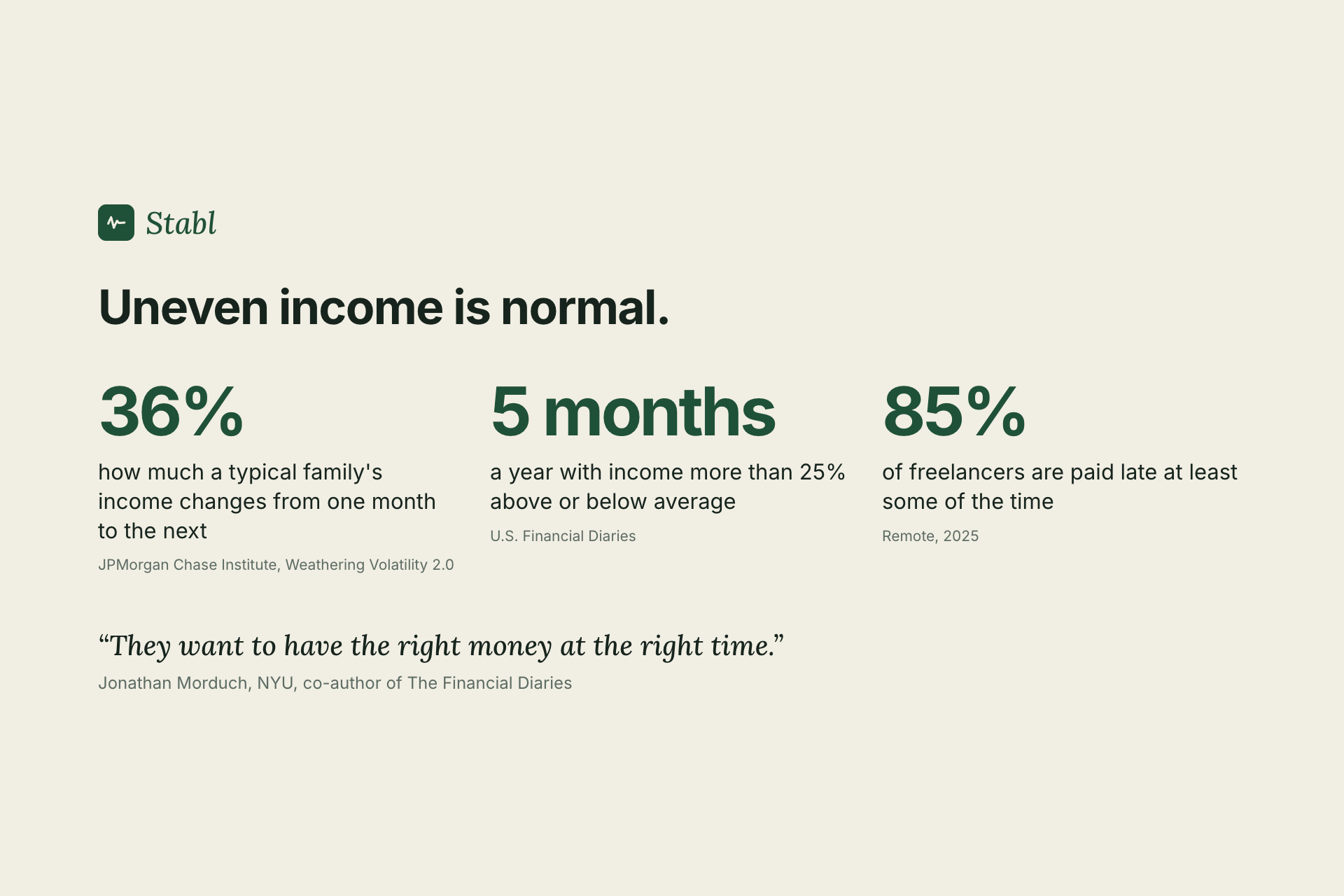
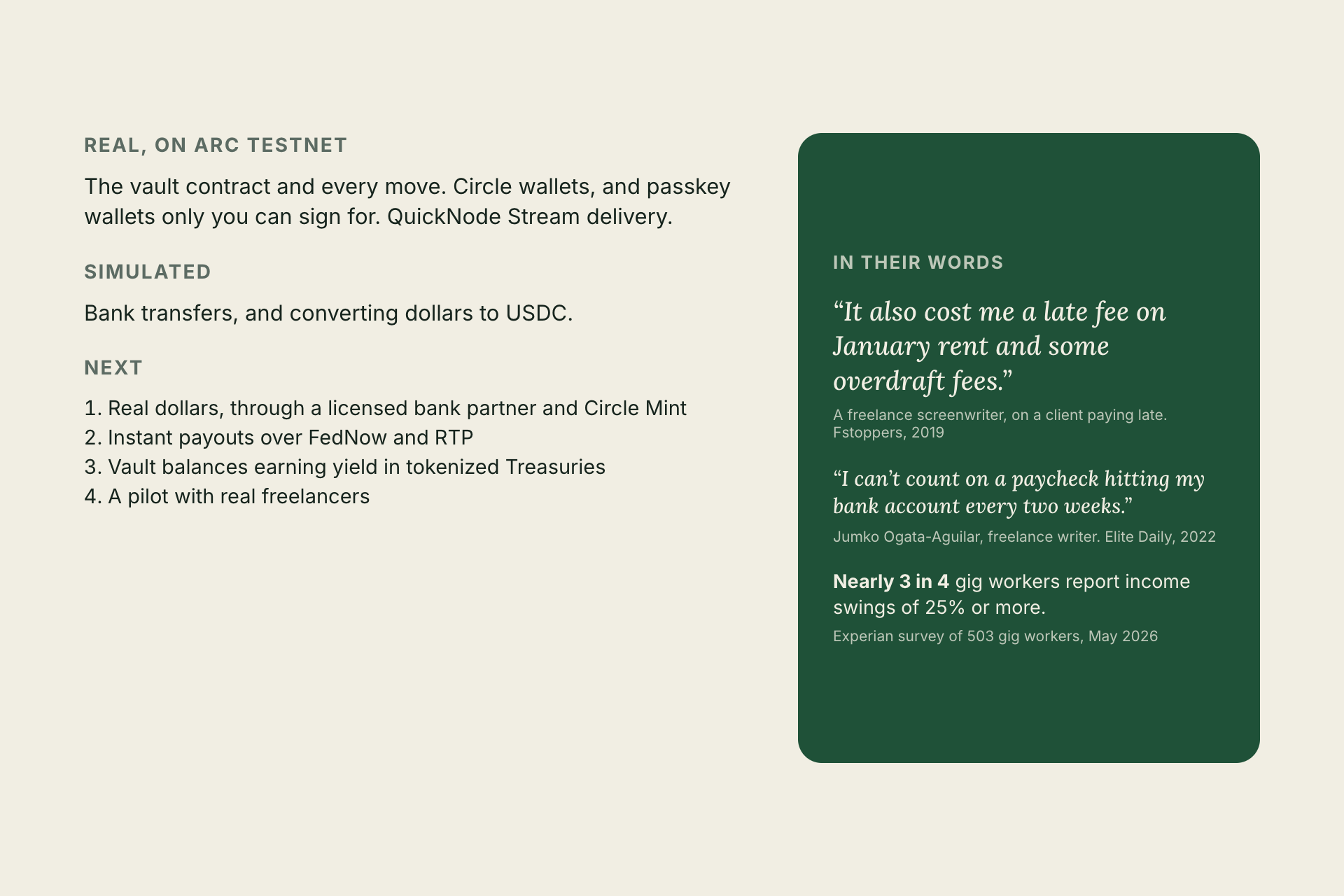
Uneven income is normal. The JPMorgan Chase Institute found a typical family's income changes by about 36% from one month to the next. In Experian's May 2026 survey of 503 gig workers, nearly 3 in 4 reported income swings of 25% or more. And freelancers say it themselves:
"It also cost me a late fee on January rent and some overdraft fees." (a freelance screenwriter, on a client paying late, Fstoppers)
"I can't count on a paycheck hitting my bank account every two weeks." (Jumko Ogata-Aguilar, freelance writer, Elite Daily)
As researcher Jonathan Morduch put it, families "want to have the right money at the right time." A good month gets spent, and a slow month means overdrafts or payday loans. Budgeting apps tell you what went wrong after the fact. We wanted something that does the smoothing for you.
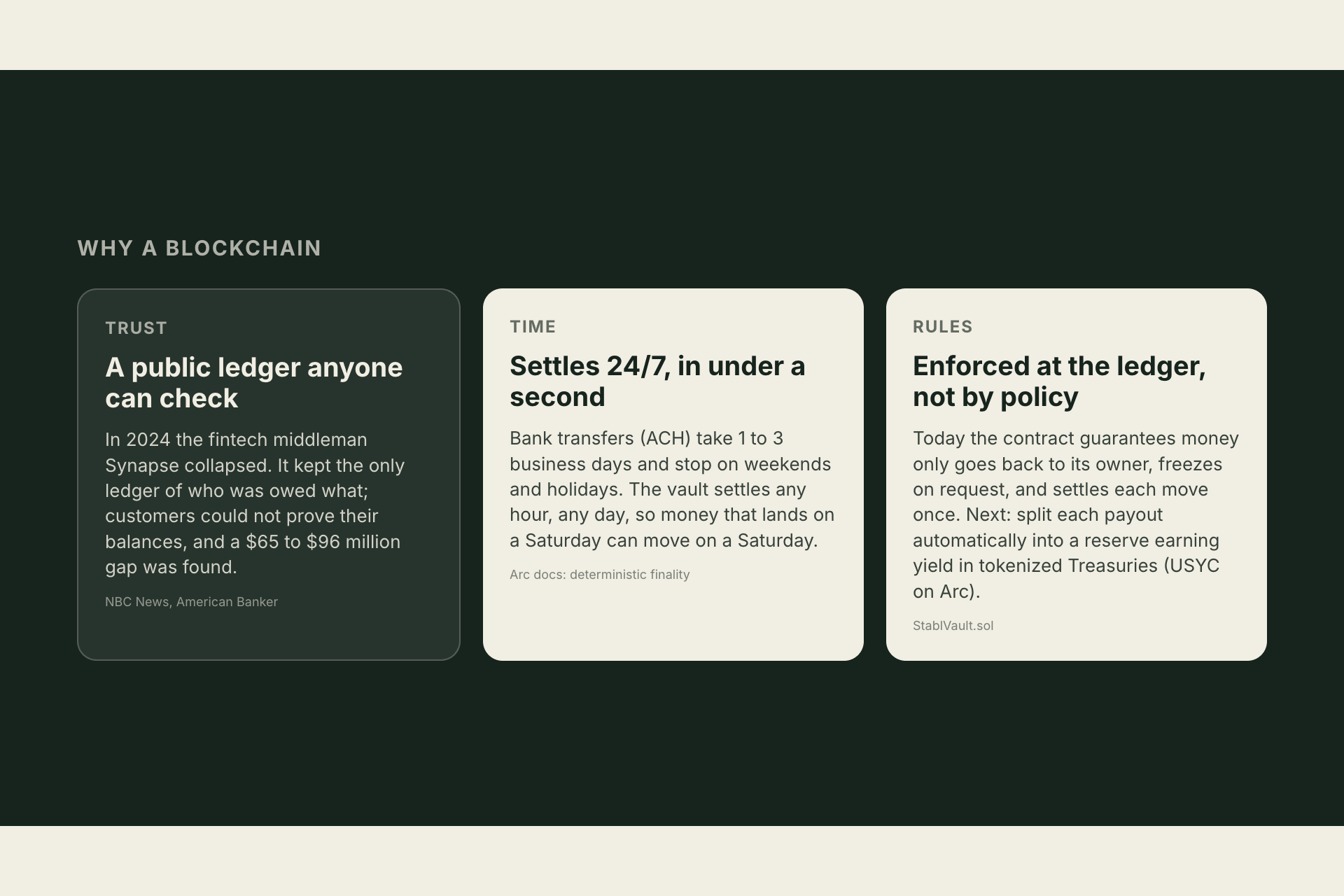
That means software moving your money on its own, which raises one question: what stops it from moving your money somewhere else? For most apps the answer is "trust us," and that has failed before. In 2024 the fintech middleman Synapse collapsed; it kept the ledger of who was owed what, customers couldn't prove their balances, and a bankruptcy trustee found a gap of tens of millions of dollars.
What we built
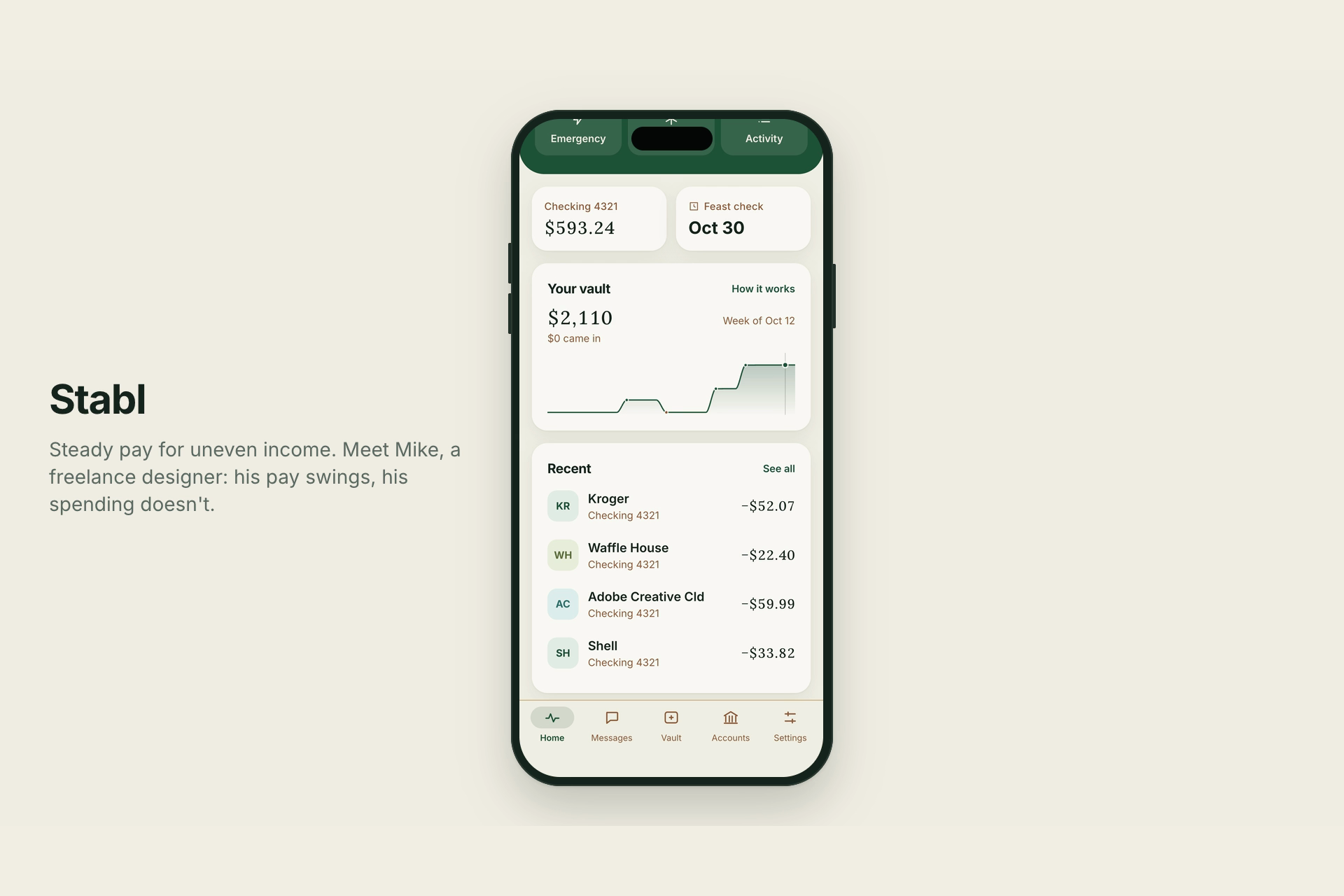
Stabl is a consumer app for freelancers with uneven pay.
- It connects to your bank through Plaid and learns your income, your bills and your normal spending.
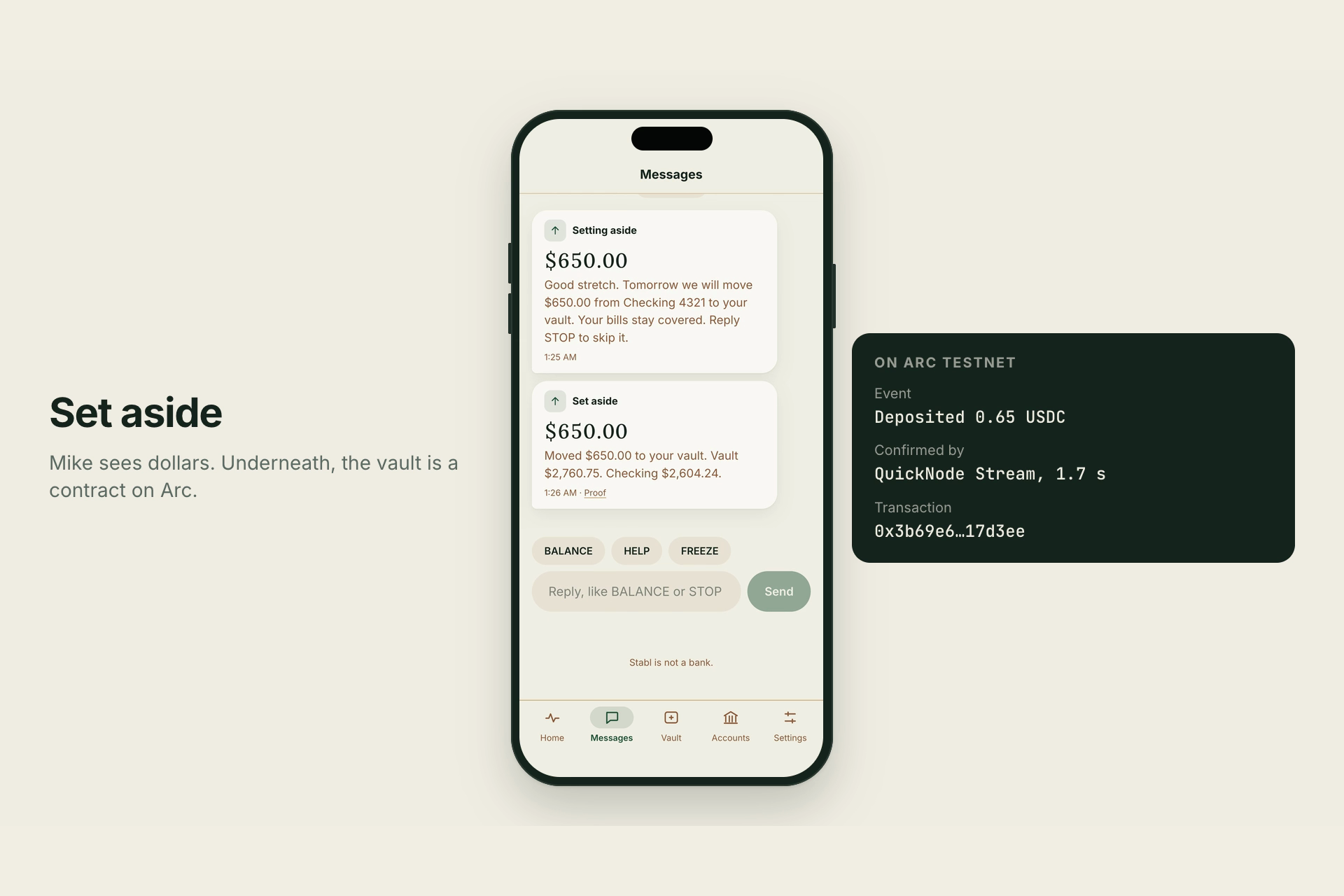
- In a good stretch, it tells you a day ahead, then moves the extra into a locked vault. Reply STOP and it doesn't.
- In a slow week, it sends money back to checking right away.
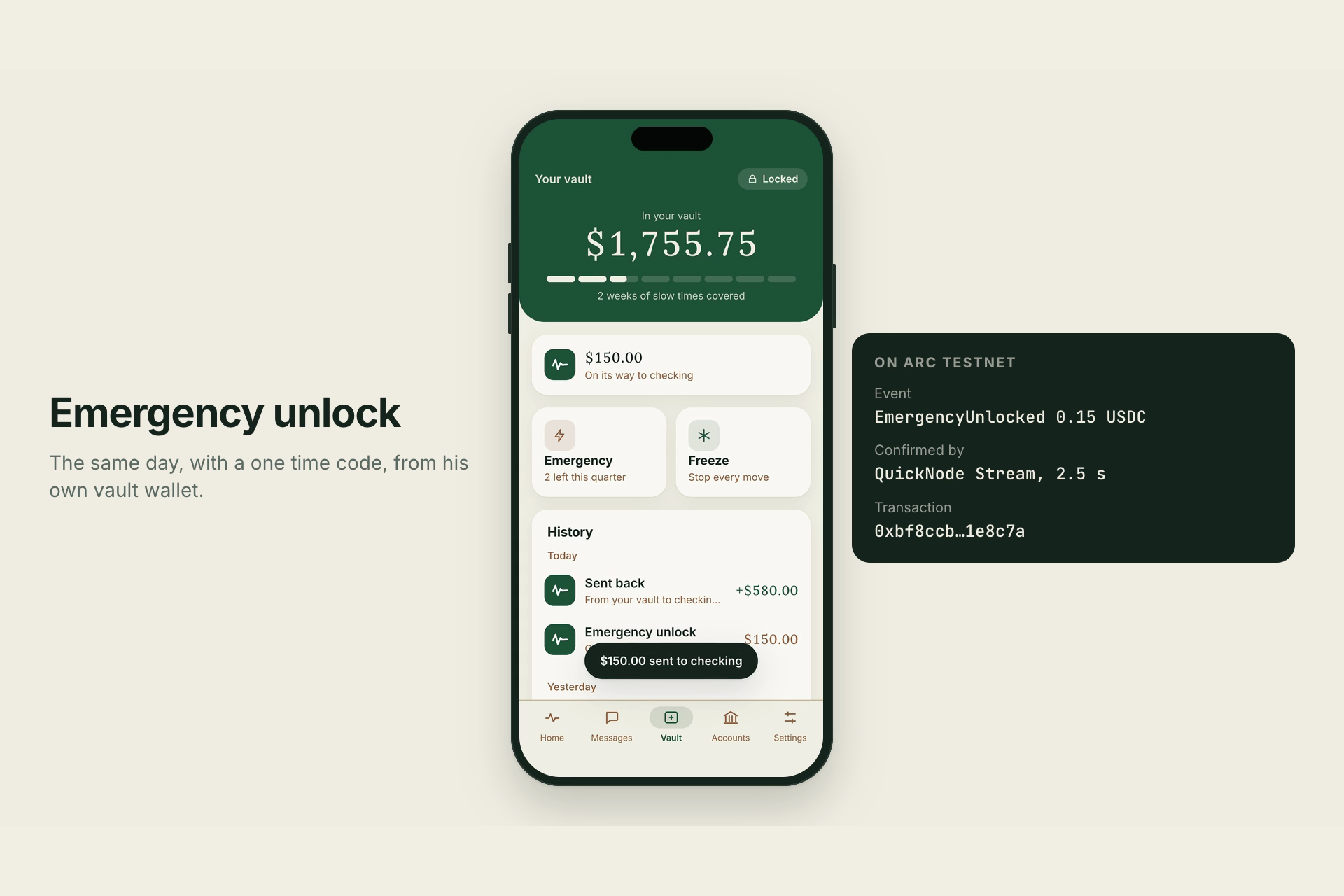
- Any time, you can freeze everything, or unlock money the same day with a one-time code.
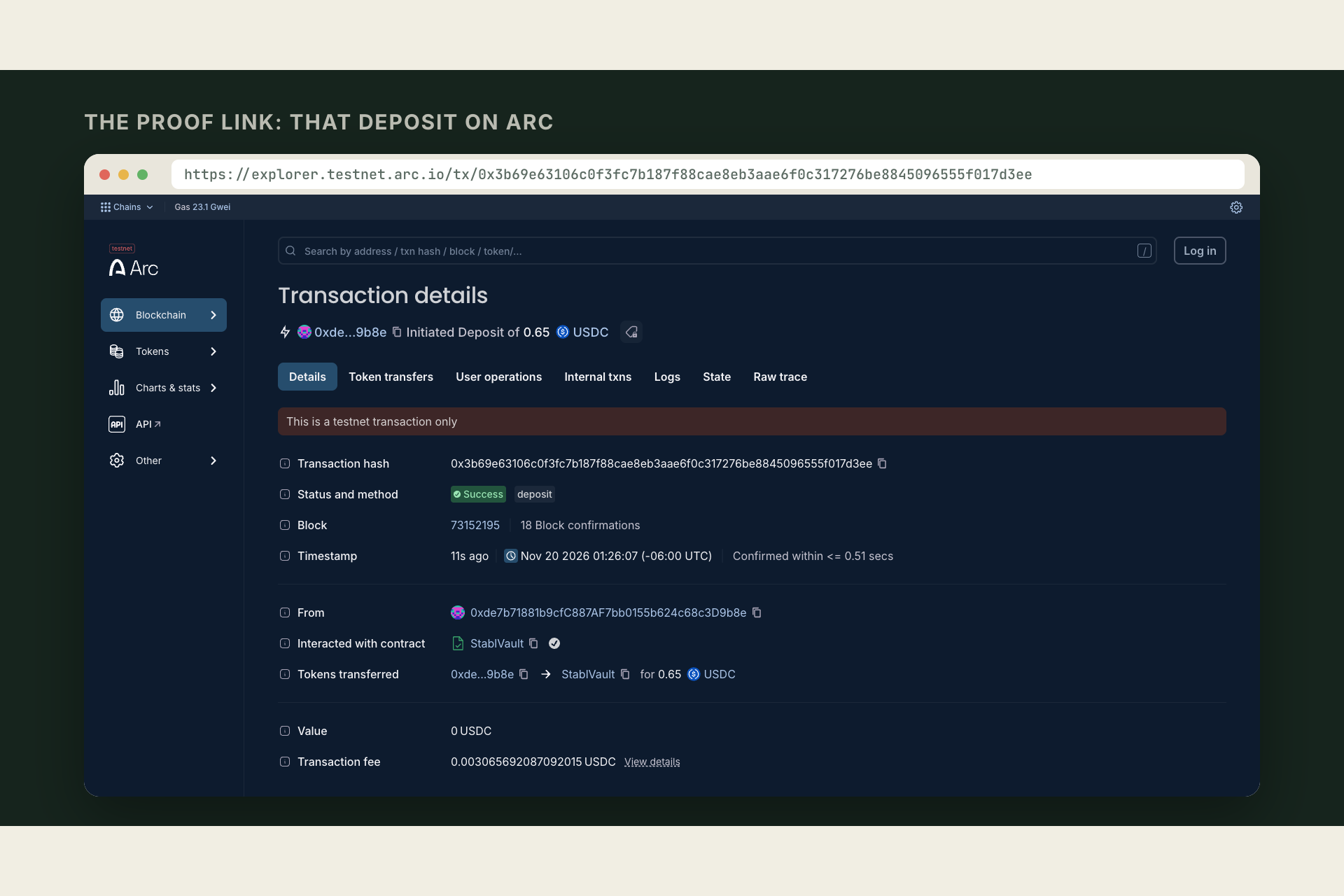
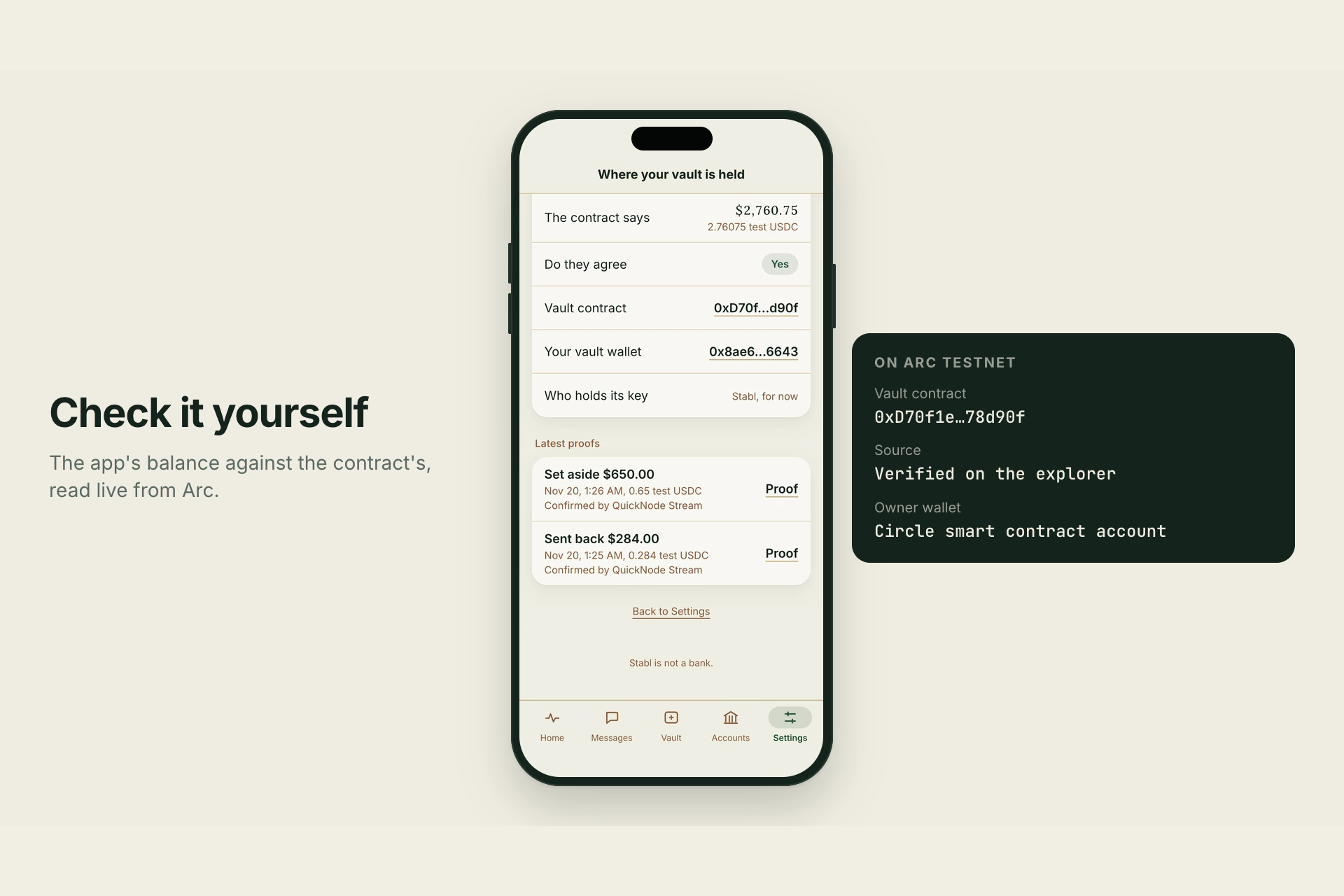
- Every move gets a plain message, and every receipt has a Proof link to the transaction on Arc.
You only ever see dollars. Underneath, the vault is StablVault, a smart contract on Arc holding USDC. Every person gets a hidden Circle wallet, with fees paid by Circle's Gas Station, so nobody installs a wallet, writes down a seed phrase or buys crypto. And with one tap you can hold your own vault key: a passkey (Face ID or fingerprint) on your phone, through a Circle modular wallet. Then only you can unfreeze the vault or unlock money from it.
What problem it solves
Freelancers often earn enough over a year and still come up short, because clients pay whenever they pay and rent is due on the first either way. Stabl moves money across time so the good weeks cover the slow ones, and it does it inside a vault whose rules even Stabl can't break.
How it works
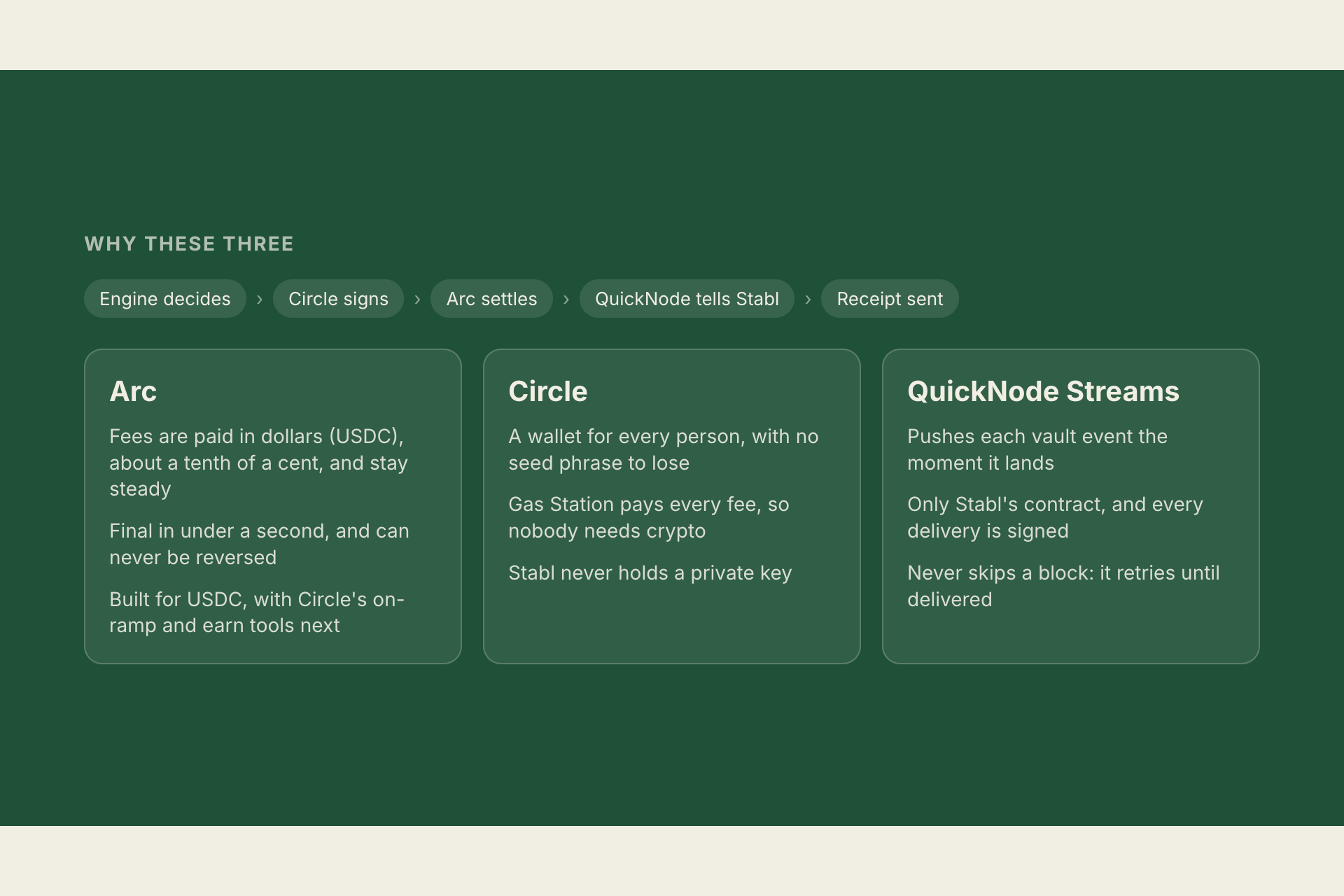
- The engine decides. It reads bank data, keeps three weeks of needs in checking, and never takes money upcoming bills need.
- Circle signs. Set-asides and releases come from Stabl's operator wallet with Gas Station paying the fee and an idempotency key on every request. An unfreeze or emergency unlock comes from the owner's wallet; with a passkey, it is signed in the browser and sent through Circle's bundler with the paymaster paying the fee.
- Arc settles. StablVault enforces the rules: money leaving a vault only goes to its owner, Stabl's operator can't redirect or sweep it, a frozen vault moves nothing, and each move settles once. Arc finalizes in under a second, any day, and fees are paid in USDC.
- QuickNode tells Stabl. A Stream on
arc-testnet(logs dataset) runs a filter that passes only StablVault's logs to a signed webhook. Stabl stores each event once under its transaction and log index, writes the ledger entry, then sends the receipt. A backfill Stream replays the vault's whole history to fill any gap. - You see it. "Moved $650.00 to your vault," with a Proof link. Settings shows Stabl's balance next to the contract's, read live from Arc, and who holds your vault's key.
The vault moves are real transactions on Arc Testnet. The bank side and the conversion between dollars and USDC are simulated.
Why a blockchain
- Trust: balances sit on a public ledger anyone can check, not a private ledger one company controls.
- Time: ACH transfers take 1 to 3 business days and stop on weekends; the vault settles in under a second, any hour, any day.
- Rules: the contract enforces Stabl's rules at the ledger itself, and with a passkey the owner alone controls unfreezing and unlocking.
What makes it unique
- The crypto is invisible, and the guarantee is not. Income-smoothing apps have existed (Even, in 2015). Stabl's difference is a vault contract whose rules Stabl can't break, with a public proof for every move.
- Automatic, but yours. Stabl moves money for you, yet with a passkey only you can unfreeze or unlock the vault, with no seed phrase.
- Settled only when the chain says so. Receipts come from the contract's own events, delivered by QuickNode, never from the app's request.
- Honest about its limits. One Settings page says what's real and what's simulated, and the README lists the trade-offs.
How we built it
- Smart contract: Solidity, Hardhat 3 and forge-std. 22 tests, two of them fuzz tests that check money leaving a vault only ever reaches its owner. Deployed through Arc's CREATE2 factory from a fee-sponsored Circle wallet, and source-verified on the explorer.
- Wallets: Circle developer-controlled smart accounts with Gas Station, and Circle modular wallets with passkeys and the paymaster (ERC-4337).
- Events: QuickNode Streams, a live Stream and a backfill Stream, into a signed webhook; a fallback reads receipts from Arc directly.
- App: Next.js and TypeScript on Vercel, PostgreSQL (Neon) with Drizzle, Plaid, viem, and a smoothing engine written as pure functions.
Challenges we ran into
- Arc is not Ethereum. USDC has 18 decimals natively and 6 through ERC-20, there is a 20 Gwei fee floor, and value transfers can revert where Ethereum's would not. The contract stays on the ERC-20 interface only.
- Exactly once, end to end. A webhook can arrive twice, late or never. Settlement is idempotent, each follow-up step is recorded as it finishes and retried if it fails, and a backfill can replay history.
- A frozen serverless function holding a lock. A timed-out function kept a database lock for minutes; we moved to transaction-scoped locks that Postgres releases on its own.
- Invisible crypto without dishonesty. One page states plainly what is a test network and what is simulated.
Accomplishments that we're proud of
- Real set-asides, releases, freezes and emergency unlocks on Arc, each confirmed by the QuickNode Stream within seconds (1.7 to 2.5 seconds in the demo recording), with the app and the contract agreeing to the cent.
- A real passkey unfreezing a vault through Circle's bundler and paymaster, on the live site.
- In a simulation of 200 synthetic freelancers through the same engine, Stabl never caused an overdraft.
What we learned
- Settlement driven by events is the right model for consumer money: tell the user money moved when the ledger of record says so, not when a server asked.
- The honest answer to "why a blockchain" is trust and time, not hype: rules anyone can read, a record anyone can check, and settlement that doesn't wait for Monday.
Judges trying the app
Sign in with any email. In Plaid's window, use username user_good and password pass_good.
Built With
- arc
- circle
- circle-modular-wallets
- circle-wallets
- drizzle
- erc-4337
- gas-station
- hardhat
- neon
- next.js
- node.js
- passkeys
- plaid
- postgresql
- quicknode
- quicknode-streams
- react
- smart-contracts
- solidity
- tailwindcss
- typescript
- usdc
- vercel
- viem
- webauthn
