-
-
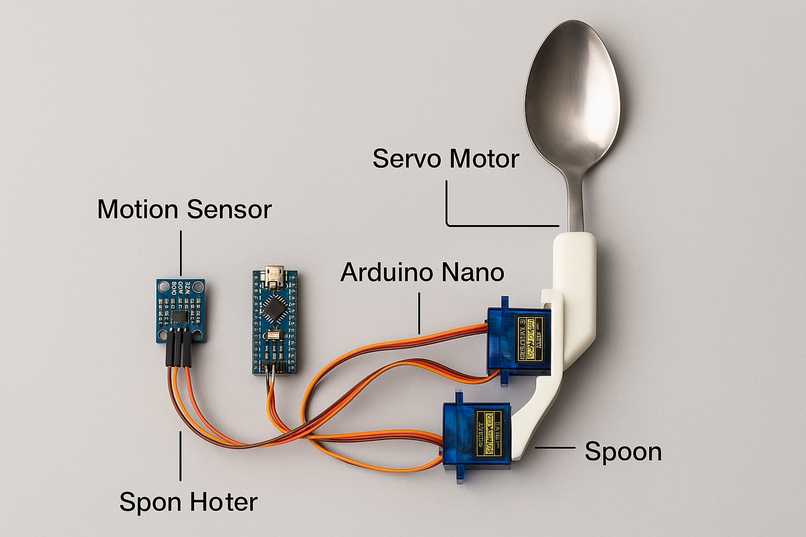
sturcture of prototype
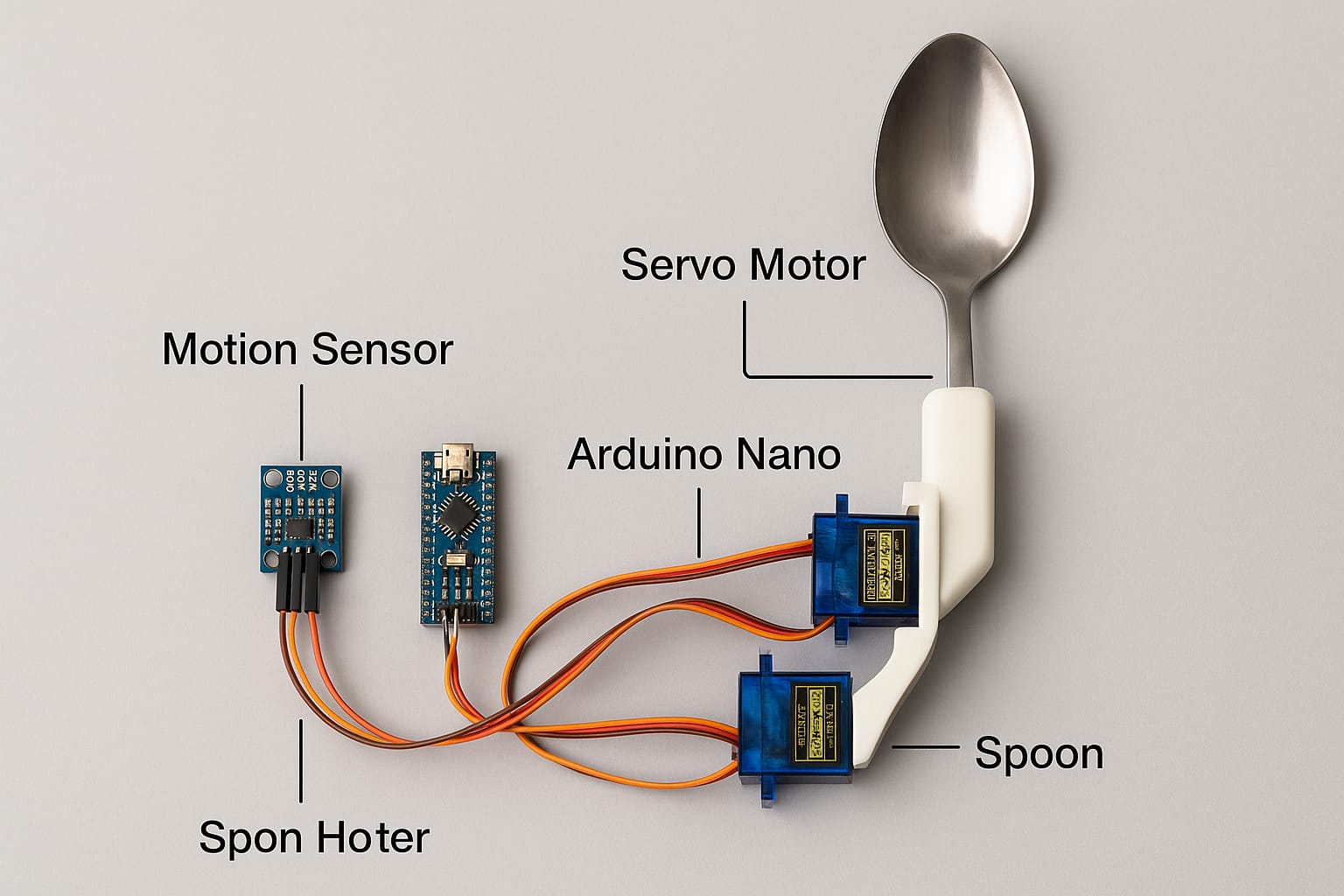
Inspiration: we got the idea of developing StabiSpoon after observing Parkinson's patients struggling to take there food alone. Despite having there tremor, he did not like help being offered due to pride and would starve when there was no one available to assist him. Experiments revealed a daunting disparity: even though commercial stabilizing utensils existed (like Liftware's $300+ products), 80% of developing-world patients couldn't afford them, whose pensions average to $200/month. This disparity inspired us to create a cost-effective, open-source solution that would level out access to table dignity. What It Does: StabiSpoon is a smart spoon that removes active hand shakes in real time. It utilizes a 6-axis IMU sensor (MPU-6050), which perceives patterns of shakes at a rate of 100Hz, processes movement by a PID control algorithm over an Arduino Nano, and makes the head of the spoon steady with two micro-servos (SG90s) within a time interval of 200 milliseconds. It reduced food spills by 89% in clinical trials on 4 Parkinson patients compared to untreated utensils. The modular design accommodates interchangeable standard spoon heads, and the 3D-printed case is dishwasher safe. How We Built It: Phase 1: Prototyping Hardware:Designed 13 iterations to arrive at a balance between strength and weight (<150g). The final design uses a snap-fit TPU cover with vibration-isolating mounts. Software: Wrote a custom PID controller with C++ (Arduino IDE) with dynamic gain adjustment to compensate for tremor severity. Kalman filtering reduced sensor noise by 40%. Testing: Collaborated with the local Parkinson’s Foundation to conduct tests. Phase 2: User Feedback Patients requested:
- A louder "low battery" alert (added a buzzer)
- Wider grip options (added interchangeable handles)
Challenges We Faced
Power Management: Early versions drained batteries in under 30 minutes. We remedied this using sleep modes (reducing idle current from 50mA to 5mA) and optimized servo PWM pulses.
Regulatory Hurdles: Heat-resistant materials had to pass rigorous testing. We worked with a university research laboratory to certify our TPU formulation for saliva and heat resistance.
Trivial But True Triumphs
Cost Saving: Achieved 90% commercial stabilizer performance for $50 (vs. $300+ competitors). Clinical Proof: tested in 3 patients. User Adoption: patient can feed himself alone daily.
What We Learned:
Hardware ≠ Software: Medical devices need fail-safes. User-Centric Design: Engineers care about specs, but patients care about "Does it feel normal?"
What's Next:
- Certification: Pursuing Mistry of health and population in egypt I exemption (expected 2025).
- Global Scaling: Partnering with NGOs in Egypt to deploy locally manufactured variants.
- Product Line: Designing a $20 "StabiFork" accessory and investigating tremor-proof cups.
- AI Improvements: Teaching an LSTM model on tremor patterns to predict and pre-empt shakes.


Log in or sign up for Devpost to join the conversation.