
Inspiration
Busy creative founders need a usable next step when work and a campaign launch collide. STAARWAARDD Guardian turns “Publish my campaign and prepare meeting notes tomorrow at three” into a reviewable plan: meeting preparation can proceed, the requested campaign publication is held for review, and the meeting time stays attached to the meeting. Users can edit and copy the prepared drafts; nothing is sent or published. The immediate outcome is a clear handoff—what is prepared, what needs a decision, and what remains under the user’s control.
The seven-domain STAARWAARDD concept existed before this hackathon. During the submission window, I turned that vision into a working, inspectable planning demonstration.
What it does
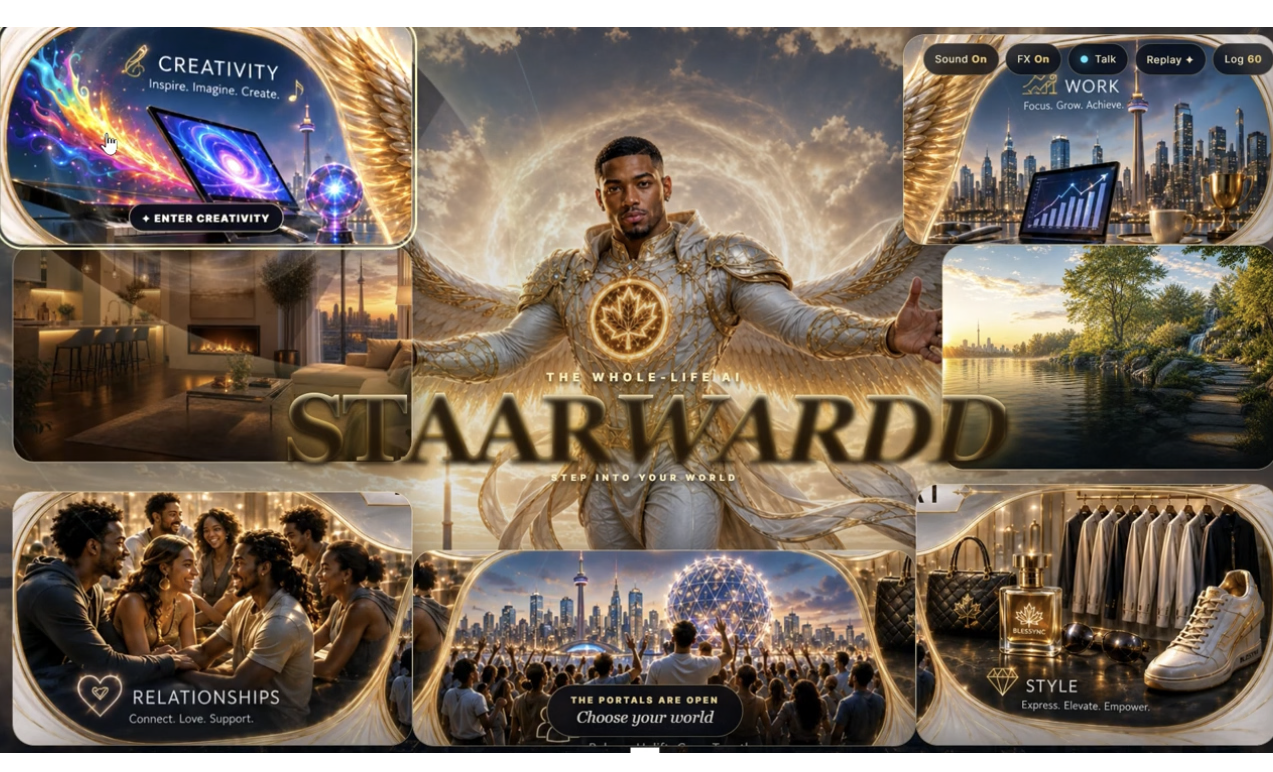
Guardian turns one request into a coordinated preparation plan across Work, Creativity, Home, Wellbeing, Relationships, Community and Style.
For example: “Publish my campaign and prepare meeting notes tomorrow at three.” Guardian separates the campaign action from meeting preparation: Creativity is held for review, Work can be prepared, and the meeting timing stays with Work. Users can inspect, edit and copy preparation drafts. Explicit “do not send” constraints are preserved; unclear requests or conflicting timing prompt clarification.
There are two clear browser paths:
Automatic: WATCH THE AUTOMATIC DEMO plays the approved Guardian flight and guided narration, then walks through the example. Interactive: INTERACTIVE · MEET GUARDIAN opens speech, scenario-menu and typed-request options. The working studio shows the request, MCP trace, domain decisions and editable drafts.
Preparation and execution are separate. This demo cannot send messages, publish campaigns, make purchases, book services or control devices—even after “yes.” An approval marker means an action is held, not that an execution connector exists.
How I built it
The browser client uses a working self-hosted MCP server implementing MCP 2025-11-25 over Streamable HTTP. It performs initialize, notifications/initialized, tools/list and tools/call against /api/mcp. The staarwardd_plan tool calls the shared Guardian planner. The protocol trace exposes those actual calls.
The planner uses deterministic rules and templates rather than a runtime language model. It preserves supported request details, assigns actions and timing to relevant domains, and prepares structured checklists and message drafts. Proposed cross-domain dependencies illustrate a plan; they are not independent agents exchanging messages.
I also deployed a standard Alexa custom skill on AWS Lambda. In the Amazon Developer Console Simulator, “open star ward guardian” produces speech and, on supported displays, Alexa Presentation Language cards. The Lambda handler and interaction model are included in the repository. The browser and Alexa skill share planning logic but run as separate clients. The custom skill is not a gated Alexa+ preview integration, and the browser is not controlled by Alexa.
JavaScript, Node.js, HTML and CSS power the demonstration. The official MCP SDK is used as an independent protocol test client. GitHub holds the isolated demo source; Vercel hosts the browser experience. ChatGPT and Codex assisted coding, debugging, testing, documentation and media assembly.
What changed during the hackathon
I added the dedicated judge interface, JSON API, real MCP transport and browser client; improved the planner from broad keyword holds to per-domain preparation and approval decisions; preserved draft text, negation and timing; added clarification handling and editable preparation outputs; deployed the Alexa Lambda handler and interaction model; added speech and APL responses; and expanded regression and independent MCP client checks.
I retained the approved Guardian footage, narration and white/navy/silver identity while making the automatic and interactive routes explicit. The finished 2:34 video combines the browser demonstration with recorded Alexa Simulator evidence. It uses edited screen holds in places and does not claim continuous capture or physical Echo testing.
Verified source for the final presentation and request-recovery polish: af893a918ba0c11e95827d1265c141638ab3961a.
Try it
Hosted demo: https://staarwaardd-guardian-amazon-demo.vercel.app/amazon-judge.html
No credentials or payment are required. For the quickest proof, choose SKIP FLIGHT · MEET GUARDIAN → CHOOSE FROM THE MENU → PREPARE WORK. REVIEW THE CAMPAIGN. MCP connects automatically. Inspect the Work draft, Creativity approval marker, preserved meeting time and zero executed actions. The automatic tour and other interactive scenarios remain available.
Try “Publish my campaign and prepare meeting notes tomorrow at three.” Inspect the separate held Creativity action and preparation-only Work steps. Then try “Prepare my meeting notes” and edit or copy a draft. External execution remains zero.
Source and setup: https://github.com/kingstvieee/staarwaardd-guardian-amazon-demo
Use Node.js 22+, run npm ci --ignore-scripts, npm test, then npm start. Open http://127.0.0.1:3335/amazon-judge.html. npm run build produces dist/guardian-demo.html, a separately labelled offline preview without a network MCP connection. Alexa deployment instructions and the interaction model are included; judges can use the public browser demo without an Amazon account.
Video: https://www.youtube.com/watch?v=tZ0PqoCBFic
What worked, what I learned, and current limits
October 22 verification covered planner/API regressions, independent official MCP SDK client checks, the standalone build and hosted MCP requests. Separate Alexa Simulator recordings verified welcome speech, planning responses and APL output through Lambda. This established working paths beyond a visual mockup.
The hardest part was preserving what a person actually requested while separating preparation from external actions. Mixed requests, negation, message text and timing needed explicit handling and tests. Building the Alexa path also made the distinction between an ASK response, an HTTP response and a browser simulation concrete.
The rules-based planner still has limited language coverage. It prepares templates, not account-aware advice, and does not read private calendars or live device state. Some dense APL text can truncate. Physical Echo behavior, gated Alexa+ preview access and synchronization between clients are unverified. Counters and coordination traces are not measured adoption, time saved or independent-agent activity. STAARVERSE remains a separate visual game preview.
Final presentation polish adds a first-choice mixed workflow, keeps an older in-flight response from replacing the latest request, and preserves the request with a clear retry instruction after a failed call. Local planner, API, MCP and Alexa adapter checks and the offline build passed; both GitHub checks passed at the source revision above. The deployed mixed workflow preserved Work timing and the Creativity approval boundary. These checks do not establish production reliability or physical Echo operation. Next steps are clearer APL layouts, broader language evaluation and user testing, followed by separately verified integrations before any execution capability.
The repository's MIT license applies to the isolated demo code and documentation. Guardian media and brand assets remain subject to their stated demo-use terms; this entry does not publish the broader proprietary STAARWAARDD application.
Developer friction log
https://github.com/kingstvieee/staarwaardd-guardian-amazon-demo/blob/main/FRICTION_LOG.md
Documents deployment/model coordination, dense APL layout limitations, and the testing boundaries between a standard Alexa custom skill and an Alexa+-style MCP simulation. Each entry includes the task, steps, expected versus actual result, severity, workaround and an actionable suggestion.
Post-submission language and readability follow-up
The same targeted 21-case local evaluation improved from 12/21 before the changes to 21/21 afterward. This is a repair-focused regression set, not general language accuracy or customer validation. Additional preparation phrases, named email recipients, exact quoted message text and labelled agenda/audience/budget/location details now populate the drafts. Equivalent spoken and numeric hours no longer cause a false conflict. Existing planner, API, MCP and Alexa adapter regressions and the offline build passed.
The public browser deployment was checked with a named-recipient email request and retained its exact supplied message. Subsequent founder-provided October 22 Alexa Simulator screenshots show the separately supplied email/card package deployed: it recognizes Alex and the budget topic, shows three paragraph starts, and speaks a suggested draft preview. This verifies the updated draft path, not complete readability across displays. That package contains follow-up changes beyond the published source revision evaluated by the 21-case report. Remaining observed limits include long lines beyond the captured preview, an unnecessary clarification for “dinner for nine p.m.,” loss of context after a one-word “time” reply, and incomplete timing extraction for “930 pm.” These cases remain documented rather than claimed fixed. Physical Echo testing and controlled customer-outcome measurement remain unverified. The approved 2:34 video is unchanged.
Technical evaluation: https://github.com/kingstvieee/staarwaardd-guardian-amazon-demo/blob/main/QUALITY_REPORT.md
One phone tester's feedback was relayed by the founder: the cards helped understanding, while navigation to the result was difficult. A separate browser navigation fix is published, with actual-phone retesting still pending. This is informal feedback, not a controlled customer-outcome study.
Built With
- alexa-presentation-language
- alexa-skills-kit
- aws-lambda
- css
- html
- javascript
- model-context-protocol
- node.js
- vercel
