
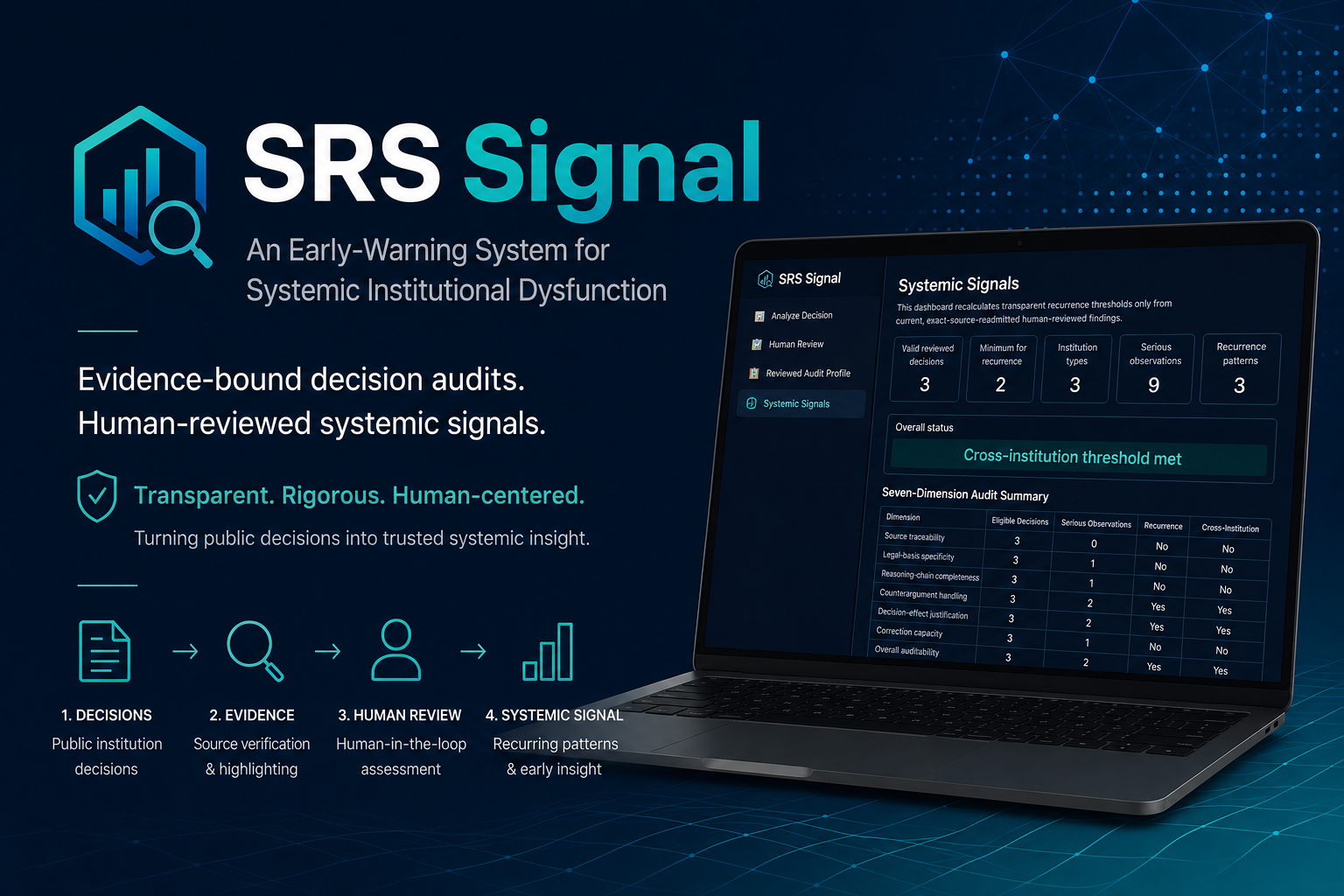
SRS Signal
An Early-Warning System for Systemic Institutional Dysfunction
SRS Signal audits institutional decisions to identify recurring accountability weaknesses and surface transparent early-warning signals of potential systemic dysfunction across different types of public institutions.
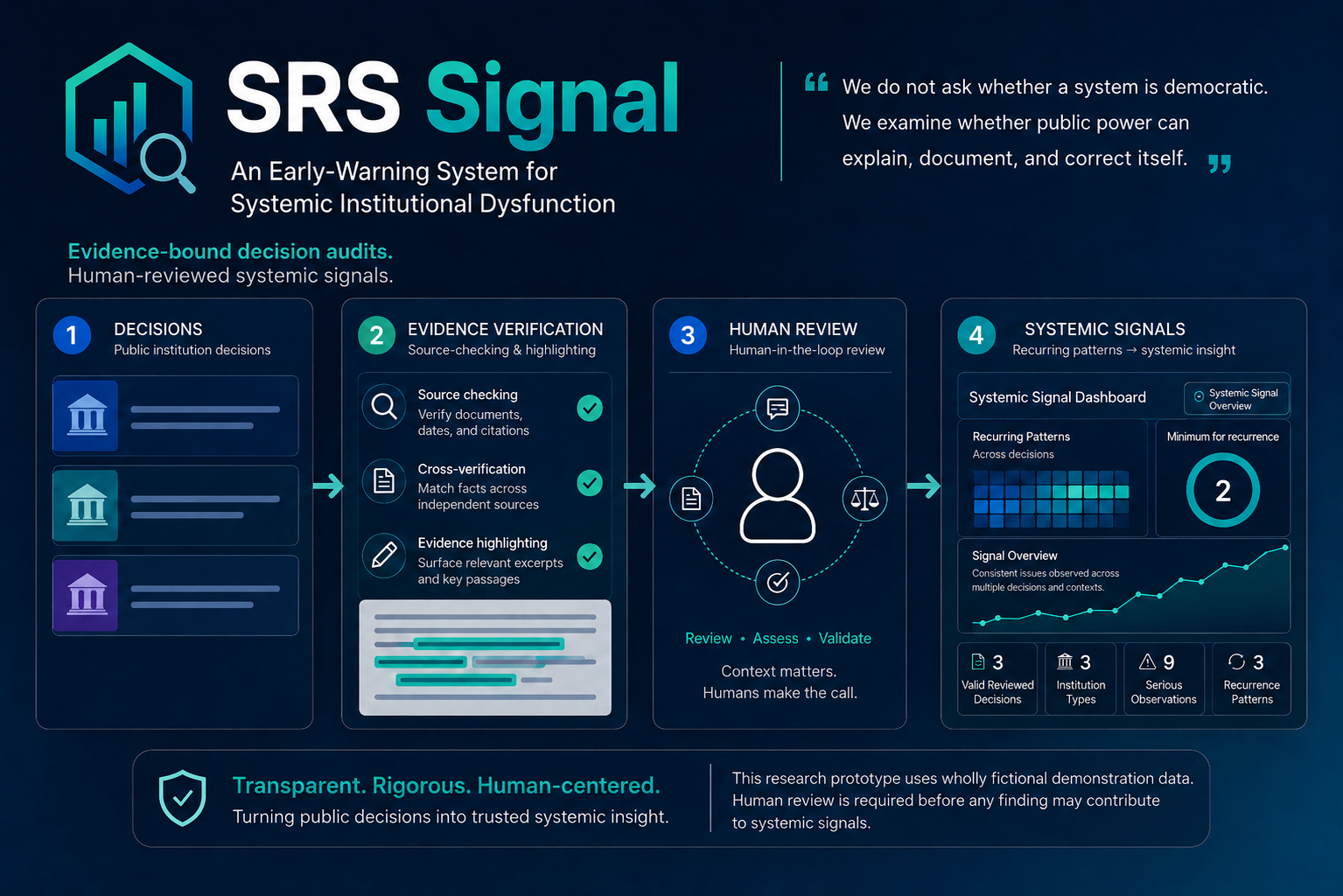
We do not ask whether a system is democratic. We examine whether public power can explain, document, and correct itself.
Inspiration
Public institutions make decisions that affect people every day. Courts, administrative authorities, registries, supervisory bodies, and review forums often rely on information produced elsewhere in the institutional system.
Yet there is rarely a common method for examining whether a decision can be reconstructed from the material available to an external reviewer:
- What facts or data were used?
- Where did they come from?
- Was the legal basis specific?
- Can the reasoning chain be followed?
- Were counterarguments addressed?
- Is the effect of the decision justified?
- Could an identified error be corrected?
SRS Signal grew out of the Self-Reflective Society Research Programme and the methodology of the TV Project, which study how institutional representations, records, and decisions shape social reality.
The project begins from a simple proposition:
A public institution should not only exercise power. It should also be able to explain, document, and correct how that power was exercised.
What it does
The SRS methodology demonstrated here is a representative component of an ongoing AI-assisted research programme in Hungary. As part of that programme, research findings are not confined to academic interpretation. They are fed directly into the systematic examination of real institutional records, decisions, and procedures.
Through this continuing case-based process, relevant institutional practices are placed under an independent, evidence-based societal audit conducted outside the institutions’ own official audit structures.
Over the past year, this integrated research-and-audit process has been used across cases and institutions to examine whether public power can explain, document, and correct its own operation.
In these workflows, AI supports the identification, organisation, comparison, and structuring of relevant material. Human verification and final methodological judgement remain mandatory.
The submitted Build Week application is a purpose-built, deterministic demonstration layer based on three wholly fictional institutional decisions. It exposes the methodological core of the broader AI-supported workflow in a reproducible form that judges can inspect without credentials, external model variability, or confidential institutional material.
The application provides four connected pages:
- Analyze Decision
- Human Review
- Reviewed Audit Profile
- Systemic Signals
Each decision is assessed across seven dimensions:
- Source traceability
- Legal-basis specificity
- Reasoning-chain completeness
- Counterargument handling
- Decision-effect justification
- Correction capacity
- Overall auditability
The application verifies every material evidence quotation against the exact source text supplied for the decision. Every finding must receive an explicit human-review decision. Only findings that are accepted, or edited and then confirmed, can contribute to the final result.
Reviewed results can then be aggregated using transparent recurrence rules. A reviewed dimension becomes a serious observation when its confirmed final score is 0 or 1. Recurrence requires the same dimension to appear in at least two reviewed decisions. A cross-institution signal additionally requires at least two institution types.
The application does not produce a hidden democracy score. It does not determine whether a decision is legally correct, unlawful, democratic, or invalid. It measures whether the reasoning and evidence visible in the supplied document are reconstructable and auditable.
How I built it
I translated an existing institutional-audit methodology into a typed software domain model, a deterministic analysis workflow, an explicit human-review process, and a transparent aggregation layer.
The broader research workflow already uses AI-assisted document analysis and structured data processing. For Build Week, I implemented a deterministic public demonstration that reproduces the complete audit, review, and aggregation process using bundled fictional cases.
The MVP was built with:
- Python
- Streamlit
- Pydantic v2
- Pytest
- GitHub
- deterministic bundled demonstration data
OpenAI Codex and GPT-5.6 supported implementation, architecture review, domain-model refinement, test design, debugging, trust-boundary hardening, and submission preparation.
The submitted application itself does not make a live OpenAI API call and requires no API key. This was a deliberate Build Week design decision: it makes the complete workflow reproducible, reviewable, and safe to demonstrate without exposing real institutional material.
The deterministic demonstration does not replace the broader AI-supported research workflow. It provides a controlled and inspectable implementation of its methodological rules.
The public repository is a minimal runnable submission repository with a clean, auditable history. The wider private research archive and full development history are not included.
Challenges I ran into
1. Turning a qualitative methodology into enforceable software rules
Concepts such as reconstructability, missing evidence, partial identifiability, and overall auditability had to become explicit data contracts rather than informal guidance.
2. Separating AI-supported processing from the public demonstration
The underlying research methodology already operates with AI assistance, but the public Build Week application needed to remain reproducible, inspectable, and safe to test without credentials or confidential source material.
This required separating the broader AI-supported workflow from a deterministic demonstration layer without misrepresenting either one.
3. Preventing unsupported evidence
A quotation is not accepted merely because it resembles the source. Evidence must be revalidated against the exact source text before it can support a reviewed finding.
4. Preserving human responsibility
The software had to prevent provisional output from silently becoming a final conclusion. Every dimension therefore requires an explicit human-review decision.
5. Aggregating without overstating
Repeated weaknesses across a tiny sample do not prove systemic dysfunction. The aggregation layer therefore exposes the thresholds, sample size, contributing institution types, and methodological limits.
6. Protecting real-world material
The demonstration had to remain fully functional without publishing confidential case files, personal data, or the complete private research archive. This led to a deliberately bounded three-case fictional dataset and a clean public repository with fresh history.
Accomplishments that I'm proud of
- A complete end-to-end workflow from source text to reviewed systemic signal
- A reproducible public demonstration of an existing AI-assisted research methodology
- Exact-source evidence verification
- Mandatory dimension-by-dimension human review
- An independent seventh dimension for overall auditability
- Transparent recurrence and cross-institution thresholds
- Three fictional cases representing different institution types
- A public Streamlit deployment that requires no API key
- A minimal public Git repository with a clean, auditable history
- Automated application tests on Python 3.12 and Python 3.13
- Clear separation between AI-assisted research, development-time AI support, and deterministic runtime behaviour
What I learned
The most important lesson was that AI assistance is most valuable when it helps convert methodological assumptions into explicit, testable constraints while leaving responsibility for verification and interpretation with humans.
A qualitative research framework becomes more credible when the software forces it to answer precise questions:
- What counts as evidence?
- When is a finding admissible?
- Who is responsible for confirmation?
- What may be aggregated?
- What threshold produces a signal?
- What does the signal not prove?
I also learned that a deterministic demonstration can make the trust boundaries of a broader AI-supported workflow easier to inspect. Reproducibility does not require denying the role of AI; it requires making clear where AI contributes, where human judgement remains mandatory, and which parts of the workflow are being demonstrated.
Codex and GPT-5.6 were particularly useful for identifying hidden assumptions in the domain model, designing adversarial tests, and hardening the boundary between provisional analysis and confirmed human-reviewed findings.
What's next for SRS Signal
Future development may include:
- integration of controlled live model-assisted analysis into the application through a separately governed provider layer;
- larger and more representative datasets;
- institution-specific audit modules;
- multilingual decision analysis;
- inter-institutional decision-chain mapping;
- longitudinal comparisons;
- reviewer-agreement measurement;
- calibrated uncertainty reporting;
- research validation;
- public and institutional dashboards.
Any operational model-assisted implementation will preserve:
- exact-source evidence validation;
- explicit human review;
- transparent scoring and aggregation rules;
- traceable methodological provenance;
- separation between provisional analysis and confirmed findings.
The long-term goal is not to automate political judgement.
It is to help society observe whether its institutions are capable of explaining, documenting, and correcting their own operation.

Log in or sign up for Devpost to join the conversation.