-
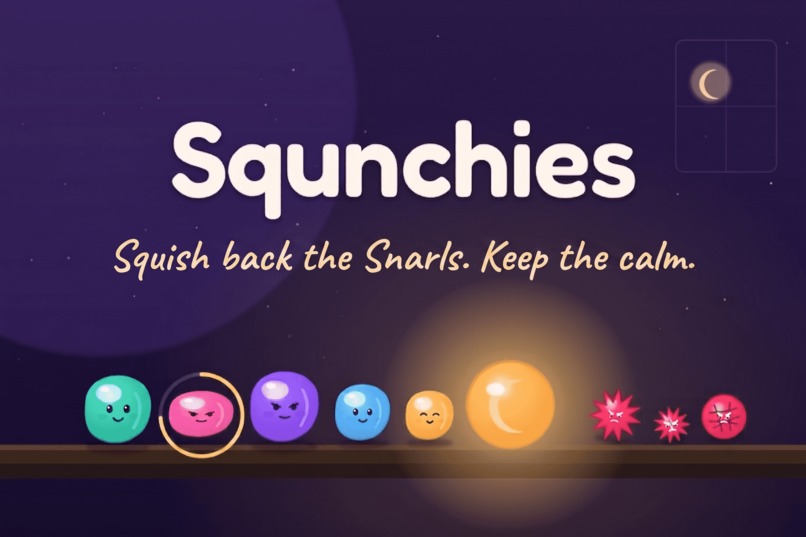
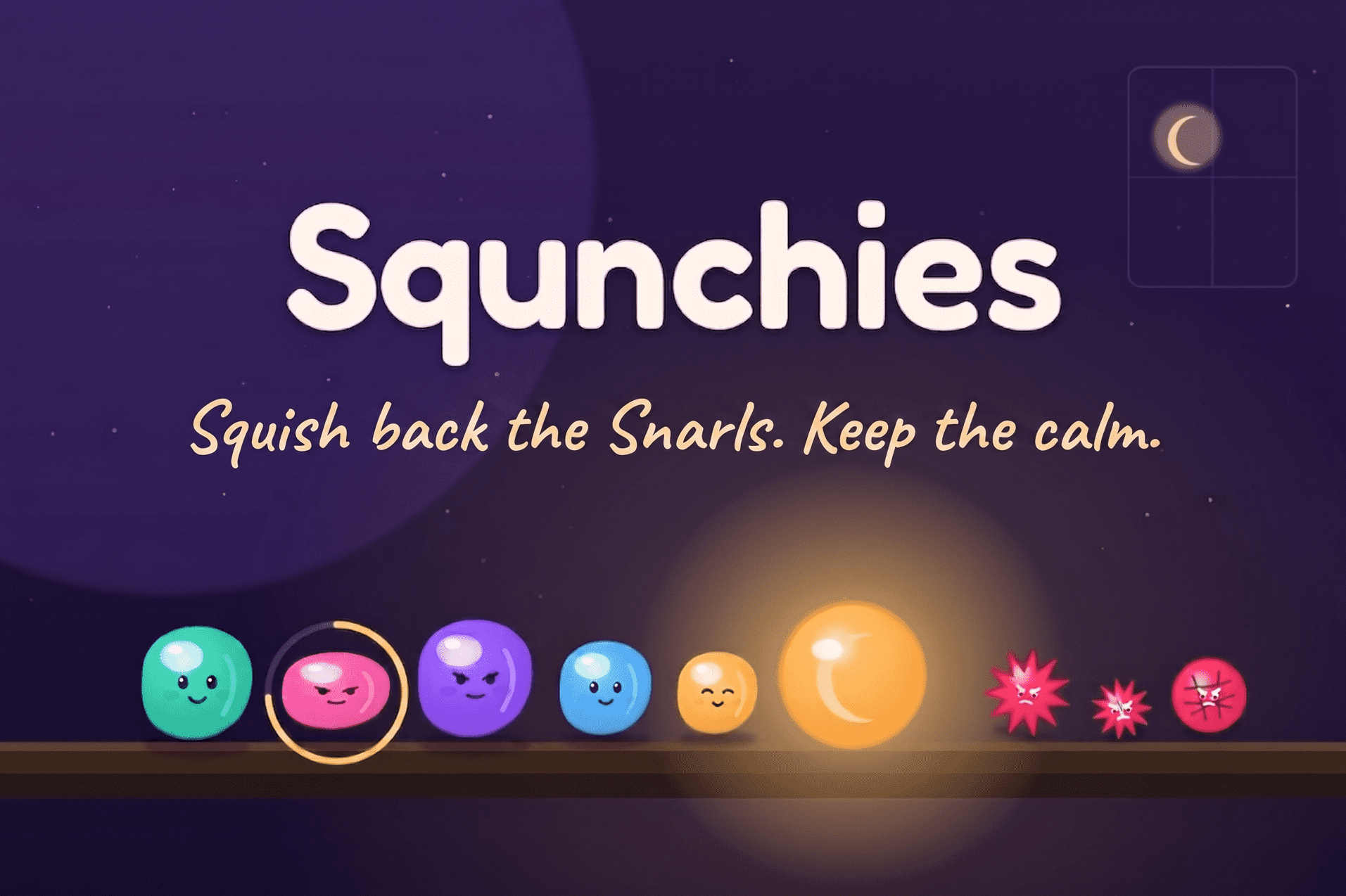
Squnchies!
About
Squnchies is a cozy, hands-on tower defense and strategy game for mobile. This submission is the full pre-production package: a game design document, a player journey map, a visual concept package, and a production plan, for a game that is ready to be built.
Here is the pitch. When the lights go out, a child's squishy stress toys (the Squnchies) wake up on the bedroom shelf to defend the Hush Light, the warm nightlight that holds the room's calm, from the Snarls: jittery little gremlins of stress that creep in along the shelf each night. You place your Squnchies along the lane, and they squish, splat, bounce, and stretch to stop the advance.
The twist that makes it its own thing is that your towers are fidget toys, and you fidget with them. Tap and hold any Squnchie to squeeze it. It deforms under your finger with haptics and a soft sound as a charge ring fills, then you release to unleash a charged attack. Time the release on the peak of the wobble for a "perfect squish" and a bigger payoff. So the game runs on two layers at once: the calm, automatic rhythm of a tower defense board, and the hands-on pleasure of squeezing a stress toy exactly when it counts. You are not just watching your defenses work, you are squeezing the stress out of the night.
Inspiration
I wanted to design a game for an audience that mobile games mostly overlook: the people who reach for something to squeeze to take the edge off the day. Squishy toys, fidget gadgets, kinetic sand, slime videos. It is an evergreen niche with a huge, loyal following, and right now it is having a real moment thanks to the exploding popularity of NeeDoh and the squishy stress-toy craze around it. But most of that world is something you watch or hold, not something you play. I wanted to bridge that gap: to take the genuinely satisfying, tactile feeling of squeezing a stress toy and build an actual game around it, with goals, strategy, and progression. Tower defense felt like the perfect frame. It already has that set-up-then-pay-off rhythm, and pairing its planning layer with a hands-on squeeze mechanic turns a calming fidget into something you can actually win. To keep it original and trademark-safe, the Squnchies, the Snarls, and the whole bedtime world are my own characters, inspired by the trend rather than borrowed from it.
How I designed it
I started from the feeling and built outward. Before any systems, I locked the core fantasy (turning creeping stress into calm, one squish at a time) and the one mechanic everything would hang on: tap and hold a toy to squeeze it, release to attack, time the wobble for a perfect squish. Everything else had to serve that.
From there I designed the systems so they interlock rather than just sit side by side. The Snarls are not just "more enemies": each type asks a different question, so a tanky Knot wants a charged squish while a fast Spark wants range or knockback, and the wave mix is what makes placement decisions matter. The Squish economy creates a real upgrade-versus-buy-versus-save tension every round, and a Calm meter rewards clean play with a board-wide Hush Pulse. The Rooms then escalate the difficulty and the world together, from the Bedroom Shelf to the Dream.
Then I translated all of it into the four-artifact package: a game design document that explains the reasoning behind every choice, a player journey map that walks the first 15 minutes beat by beat, a visual concept package with an original cozy-nightlight art identity and gameplay mockups, and a production plan that scopes the smallest version that proves the idea. I built the whole visual direction (the candy-gel Squnchies, the spiky Snarls, the warm Hush Light) from scratch, so the look would feel intentional and entirely my own.
Challenges I ran into
The hardest design problem was marrying a tactile, in-the-moment mechanic with a genre that is all about planning. A squeeze is reflex; tower defense is strategy. Lean too far into the squeeze and it becomes a fidget toy with a thin game bolted on; lean too far the other way and it loses the thing that makes it special. A lot of the design went into making sure placement and the economy genuinely matter, so the squeeze is the heart but not the whole game.
Keeping it calming while still being a game was its own balance. A tower defense needs stakes and escalating pressure, but the entire point of this one is to lower your shoulders, not raise your heart rate. The answer was real tension with a soft landing: you do not die, the light just dims and you try the night again, which keeps it in the pleasant-challenge zone instead of the white-knuckle one.
A more practical challenge was conveying a feeling. Haptics, give, the satisfying pop of a squeeze: none of that lives naturally in a static document. That pushed me to show the mechanic frame by frame and let the visuals carry what words could not.
Accomplishments I'm proud of
I am proudest that the four artifacts tell one coherent story. The game in the design document is the same game in the journey map, the visual package, and the production plan. The systems connect, and the vision holds together from the first impression to the long-term collection.
I am also proud of the central idea itself. Making your towers fidget toys that you physically squeeze is a genuine twist on a very familiar genre, and the two-layer loop (a calm board that runs itself, plus a hands-on squeeze when it counts) gives the game a feel I have not seen elsewhere. On top of that, the cozy-nightlight visual identity feels deliberate and ownable rather than generic, which is exactly what I was reaching for.
What I learned
This was my first real attempt at game design, and going from "I have a fun idea" to a complete, buildable design package taught me far more than I expected. The biggest shift was learning to design with reasons, not just features. Early on I would write things like "the player squeezes the toy," but the interesting part is the why: why squeezing, why a perfect-timing window, why a warm nightlight as the thing you protect. Pushing every mechanic to justify its place made the whole design sharper.
I also learned that a core mechanic has to feel good before it is strategic. The single most important thing I scoped to test first was just squeezing a toy with nothing at stake, because if that does not feel satisfying on its own, no amount of strategy stacked on top will save it.
Making the player journey map was also new to me, and it ended up teaching me the most. Mapping the first 15 minutes moment by moment, when the game teaches, when it tests, when it rewards, and how it should feel at each beat, made me realize that pacing and emotion are design decisions, not afterthoughts. The same went for scoping: deciding what the minimum version really needs, and being honest about what to cut, turned out to be just as important as deciding what to put in.
What's next for Squnchies
The first real step is to build the MVP and run the make-or-break test: does squeezing a single toy feel good enough that people keep doing it with nothing at stake? Everything depends on that, so it gets prototyped first, before any economy or content.
Once the core feel is proven, the game grows outward while keeping the squeeze at its center: co-op calm, where two players defend one shelf together; Squnchie fusion, combining textures into hybrid toys; Shelf decoration for the cozy-collector crowd; Squish puzzles for players who do want a tougher tactical challenge; and an adaptive, no-fail mode that meets you wherever your stress level is. Add the full set of Rooms beyond the Bedroom Shelf, and the long-term goal is a cozy, collectible little world you keep on your phone to take the edge off the day! :)
Built With
- claude


Log in or sign up for Devpost to join the conversation.