-
-
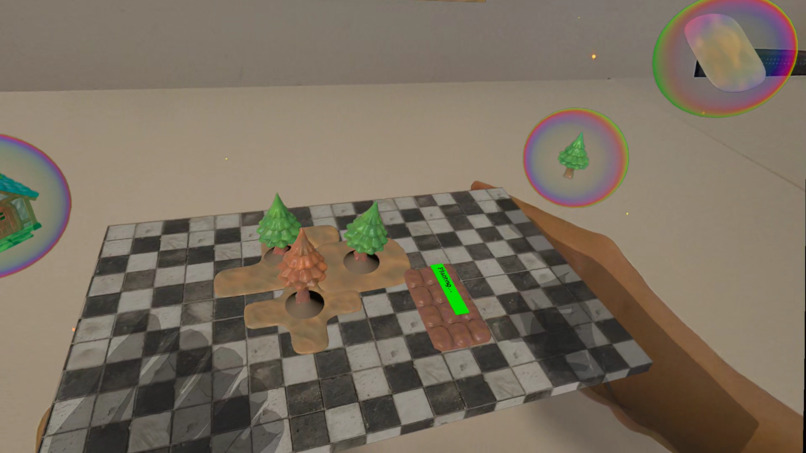
Grow Your Farm
-
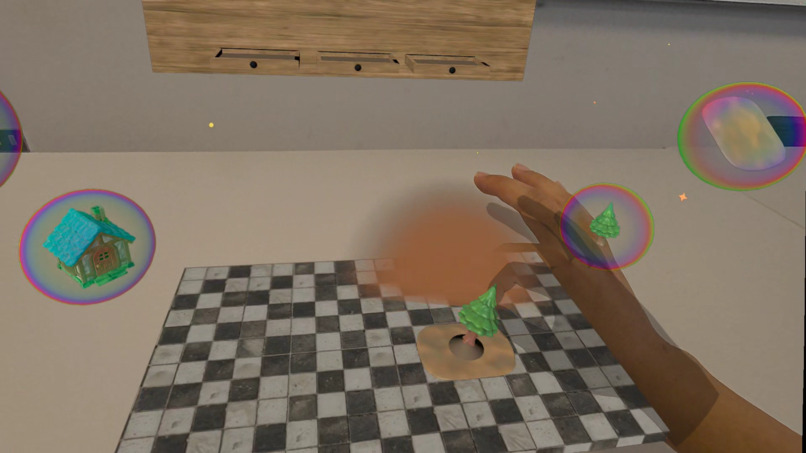
Plant Trees
-
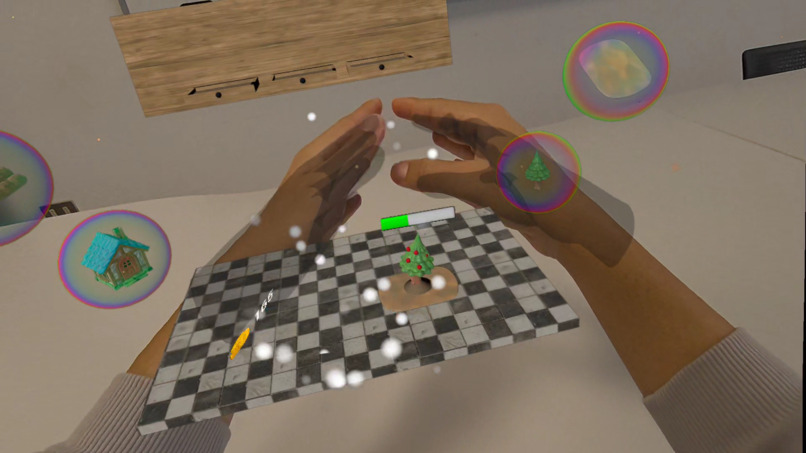
Make It Snow
-
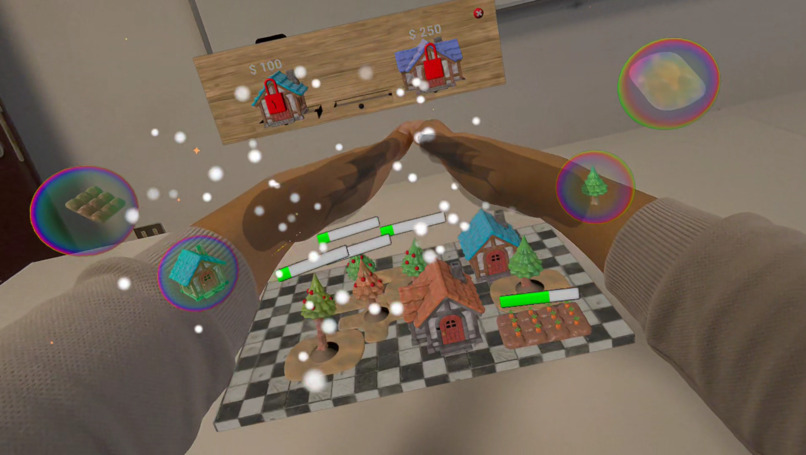
More Snow! More Fun!
Inspiration
There is something deeply human about wanting to create a place of your own, a little world that reflects your imagination, your choices, and your sense of beauty. With Sproutscape, we wanted to bring that feeling within reach, placing an entire living world right at your fingertips.
Inspired by the peaceful charm of miniature gardens, the tactile satisfaction of wooden board games, and the creative freedom of diorama building, we imagined a mixed-reality experience where technology feels natural, playful, and deeply personal.
Rather than relying on complex controller interactions, button combinations, or time pressure, we wanted to make the player's hands the heart of the experience. What if a simple gesture could change the weather? What if the movement of your hands could summon snowfall, awaken blossoming trees, or breathe life into an entire village?
This vision became Sproutscape! A world where imagination meets interaction, where nature responds to your touch, and where building is not about winning or completing tasks, but about slowing down, experimenting, and enjoying the beauty of creation. A miniature world, shaped entirely by you, waiting to grow in the space around you.
What it does
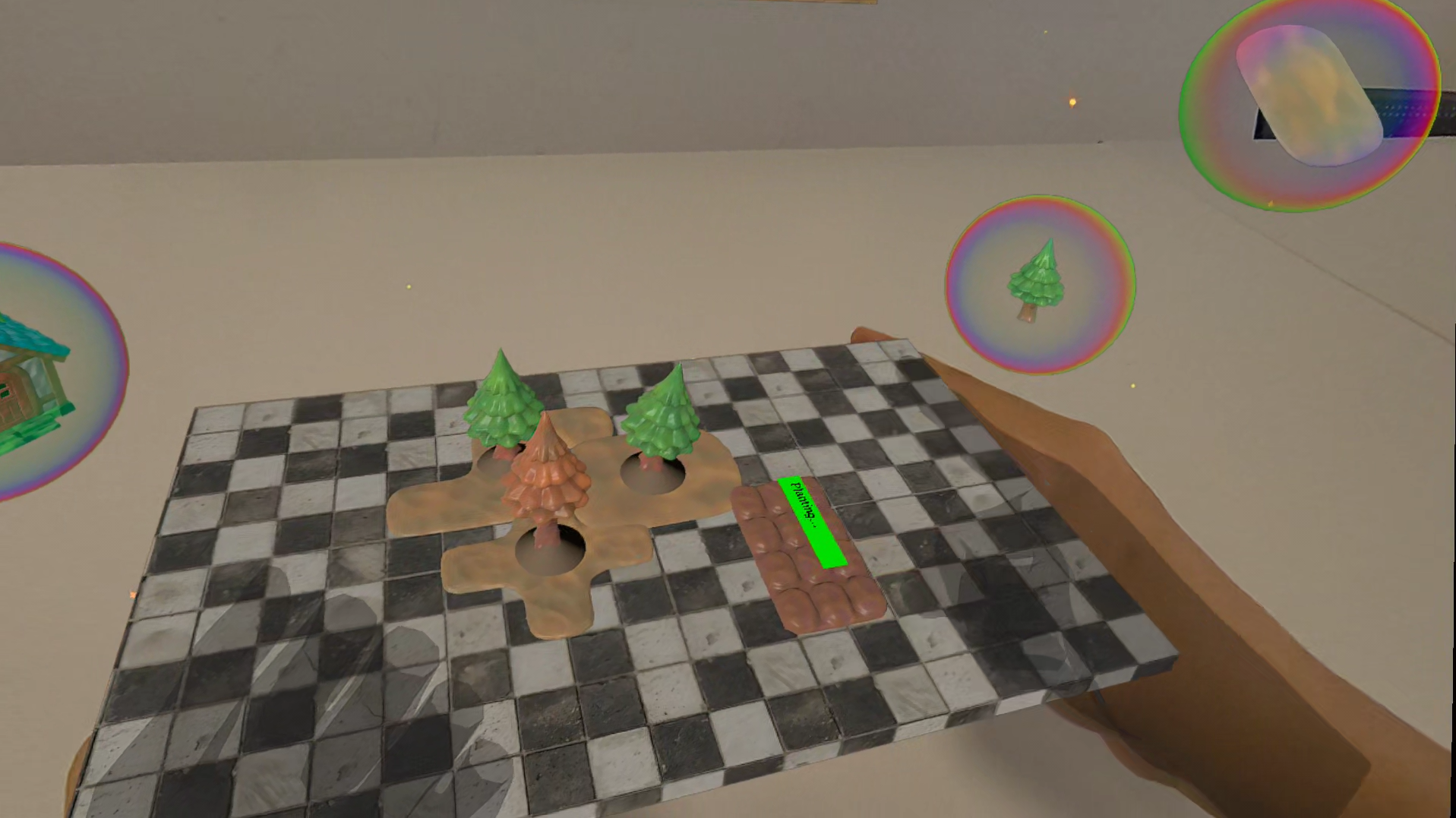
Sproutscape transforms the space in front of you into a living miniature world, where you can design, nurture, and expand your own village using nothing but your hands. Standing over an 18×11 tabletop grid, you become both the architect and the caretaker of a growing settlement, shaping its landscape through intuitive gestures and playful interactions.
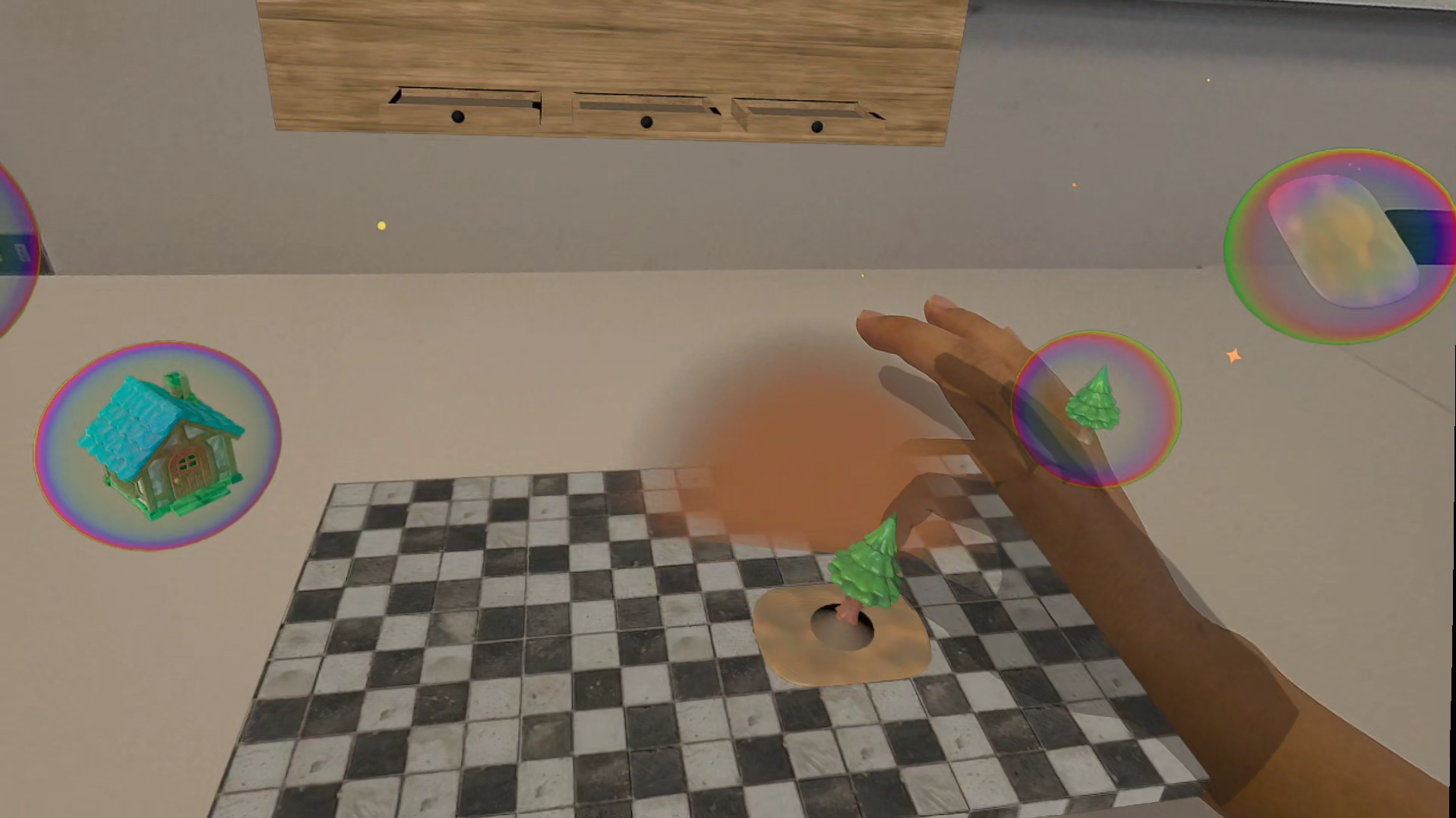
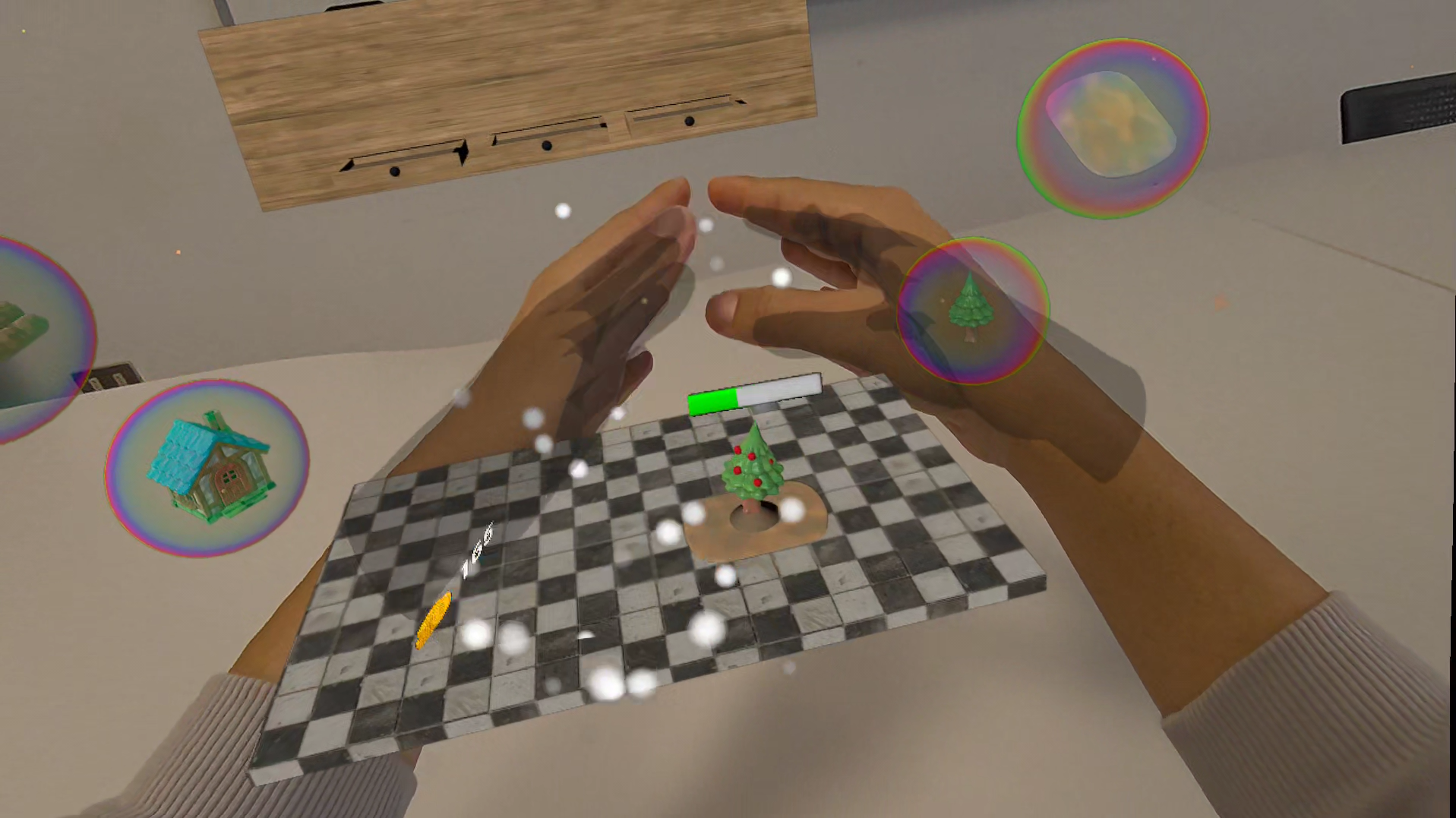
With a simple movement of your hands, you can summon localized snowfall over young saplings, nurture their growth, and bring your orchards and farms to life. As trees mature and produce fruit, you can physically reach out, pick the harvest, and earn gold to reinvest in your little world. Your progress is reflected through a wrist-mounted spatial interface, keeping everything within easy reach.
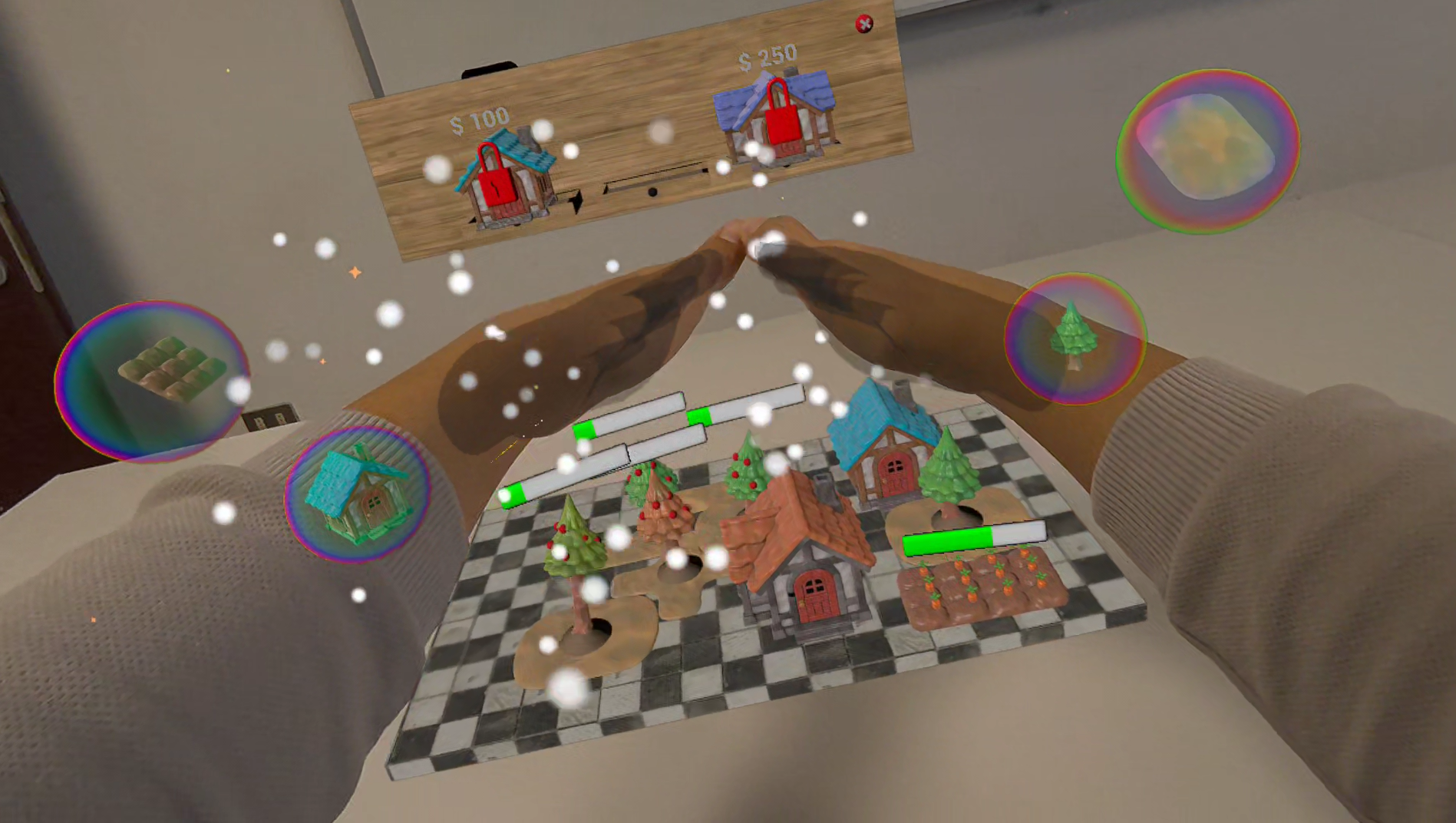
As your resources grow, new possibilities unfold. Unlock charming cottages and miniature pathways, pick them up with your hands, and build your Sproutscape, connecting each piece to gradually create a village of your own. Every gesture brings something new to life, turning the simple act of building into a relaxing, tactile, and rewarding experience.
How we built it
We built Sproutscape in Unreal Engine 5, targeting standalone Meta Quest hardware with full Meta Interaction SDK (ISDK) hand-tracking integration:
Modular Grid Architecture (BP_GridBoard & BP_GridItemBase): We engineered a decoupled, data-driven grid system from scratch. BP_GridBoard converts real-world 3D hand positions into local 2D grid coordinates (WorldToGrid), validates multi-tile footprints (CanPlaceShape), and locks structures cleanly onto the board (SnapAndOccupy).
Inheritance-Driven Structure System: All placeable structures inherit from a unified BP_GridItemBase parent class, automatically generating rectangular or custom multi-cell footprints (FootprintCells) in the Construction Script while allowing child classes (BP_Path, BP_Home) to override grab events for custom behaviors like purchase validation (WBP_PriceTag) and tree-planting zones.
Interactive Weather & Growth Mechanics: We paired Meta ISDK hand-pose recognition with custom Unreal Blueprint timers and Niagara snowfall emitters so trees respond dynamically to player care.
Challenges we ran into
Bringing Sproutscape to life meant finding the right balance between intuitive interaction and technical precision. One of our biggest challenges was making every interaction feel as natural as playing with physical miniature objects, while maintaining the accuracy required in a mixed-reality environment.
Working with a compact tabletop grid, where each cell measures just 2 cm, made object grabbing particularly challenging. The default VR interaction settings sometimes allowed players to accidentally grab objects from a distance or interact with multiple pieces at once. We refined the collision system by isolating interaction channels, making object selection more controlled and predictable. We are still exploring ways to make this system even more efficient before the final release.
Another challenge was achieving precise object placement. Larger structures, such as 3×4 pathways and 6×4 farms, needed to align perfectly with the tabletop grid without floating, tilting, or overlapping. We addressed this by standardizing object pivot points around a bottom-left anchor, introducing dedicated SnapSensorBox components to track placement positions, and restricting rotations to keep every object perfectly aligned with the board.
Hand interaction brought another layer of complexity. Meta's Interaction SDK for Unreal Engine provided us with a powerful and flexible foundation, but translating different hand gestures into distinct gameplay events required additional development. We experimented with collider-based event detection to recognize specific interactions and trigger the appropriate responses. This allowed us to build a more responsive system where players could interact with the miniature world through natural hand movements.
Ultimately, these challenges pushed us to rethink how small-scale interactions should work in mixed reality. Each technical obstacle became an opportunity to make the experience feel more seamless, intuitive, and closer to interacting with a real tabletop world.
Accomplishments that we're proud of
One of the things we are most proud of is creating an experience where technology almost disappears, allowing the joy of interaction to take center stage. Sproutscape was designed around the idea that players should be able to shape and nurture their world as naturally as they would interact with objects on a real tabletop. From summoning snowfall and harvesting fruit to purchasing houses and placing pathways, the entire experience can be enjoyed without ever touching a controller. Everything happens through natural hand gestures, making the interaction feel intuitive and immediate.
We are also proud of the scalable system we built behind the experience. Our modular Blueprint architecture, supported by a parent-child grid structure, allows us to introduce new building types, different footprints, and interactive elements without having to rebuild the underlying placement logic. This gives Sproutscape room to grow and makes expanding the miniature world much easier.
Another achievement is the way we integrated feedback into the world itself. Instead of relying on traditional menus that interrupt the experience, we developed spatial interfaces that feel like part of the environment. Players can check their gold through a wrist-mounted display, while floating price tags appear naturally above purchasable objects and respond dynamically to their progress. We wanted every piece of information to feel connected to the world rather than layered on top of it.
Above all, we are proud that we turned a simple idea into a living, interactive miniature world, where every small gesture can make something grow, change, or come to life.
What we learned
Developing Sproutscape taught us that creating a natural mixed-reality experience is not just about making interactions possible, but about making them feel enjoyful. We discovered how important scale calibration and collision management become when working with hand tracking at a miniature tabletop scale. Interactions that feel forgiving in a room-sized environment suddenly require millimeter-level precision when working with tiny objects on a compact grid.
We also learned the importance of separating the underlying logic from the visual experience. By keeping our grid calculations independent from the actual 3D models and using a simple 2D coordinate system to manage object positions, occupancy, and orientation, we made the development process much more flexible and debugging significantly easier.
Perhaps our biggest takeaway was understanding how much small details matter in mixed reality. A slightly misplaced object, an unexpected grab, or an unnatural hand interaction can break the feeling of immersion. Building Sproutscape taught us to pay closer attention to these details and reminded us that the best interactions are often the ones players don't even have to think about.
What's next for Sproutscape
We see Sproutscape as a little world with endless room to grow. What we have built so far is just the beginning, and our next goal is to give players even more freedom to shape their own miniature landscapes. We want to expand the marketplace with new architectural elements, decorative stones, and a wider variety of fruits and crops, each bringing its own character and growth cycle to the experience.
We also imagine a world that can grow beyond its original boundaries. Players will be able to spend their earned gold to unlock additional tabletop grid extensions, gradually transforming their small settlement into a much larger landscape. With improved building tools, including 90-degree object rotation and more flexible placement options, players will have greater creative freedom to arrange their homes, pathways, orchards, and decorations exactly as they envision them.
But we don't want Sproutscape to be just a collection of buildings and gardens. We want it to feel like a living diorama. Our vision includes tiny villagers wandering along the pathways, seasonal changes, spring rain, autumn breezes, and new weather effects that players can trigger with their hands.
Ultimately, we want every player's Sproutscape to become a little world of its own, constantly evolving through imagination, creativity, and the simple pleasure of making things grow.
Built With
- epicgames
- fab
- freesound
- unreal-engine


