-
-
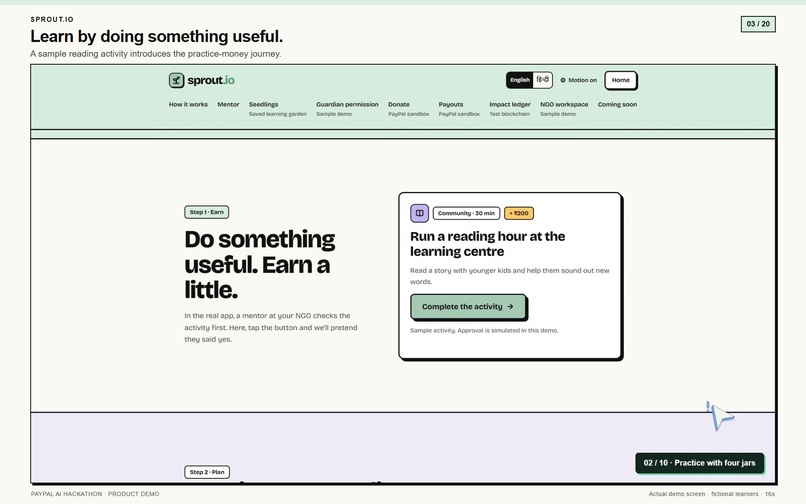
Complete activities using practice money.
-
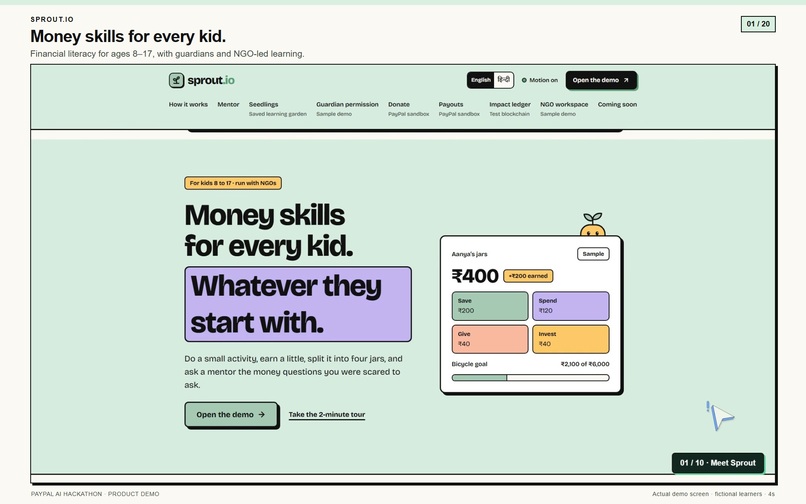
Sprout: financial literacy for children.
-
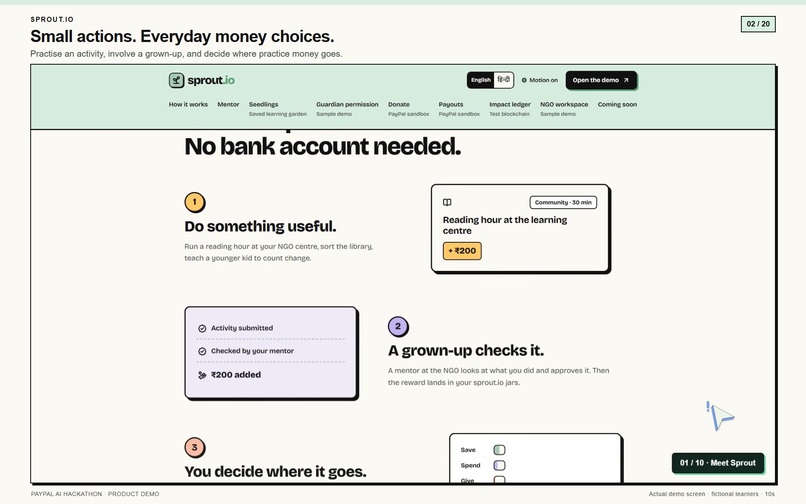
Simple steps for learning money skills.
-
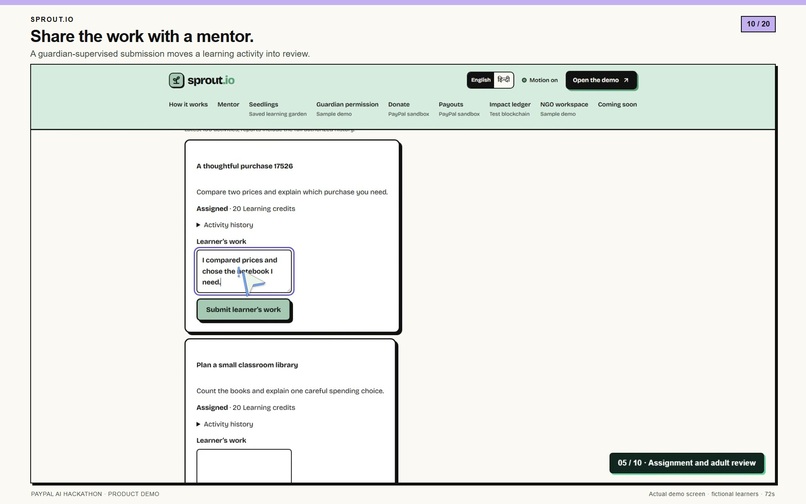
Submit activities with guardian supervision.
-
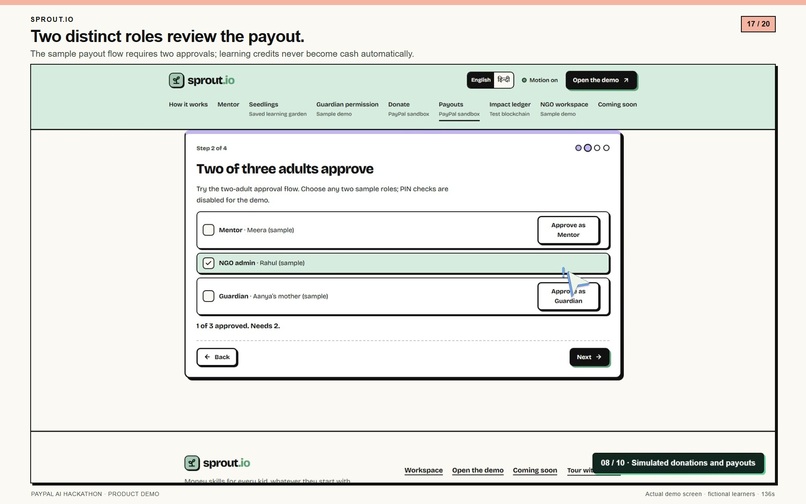
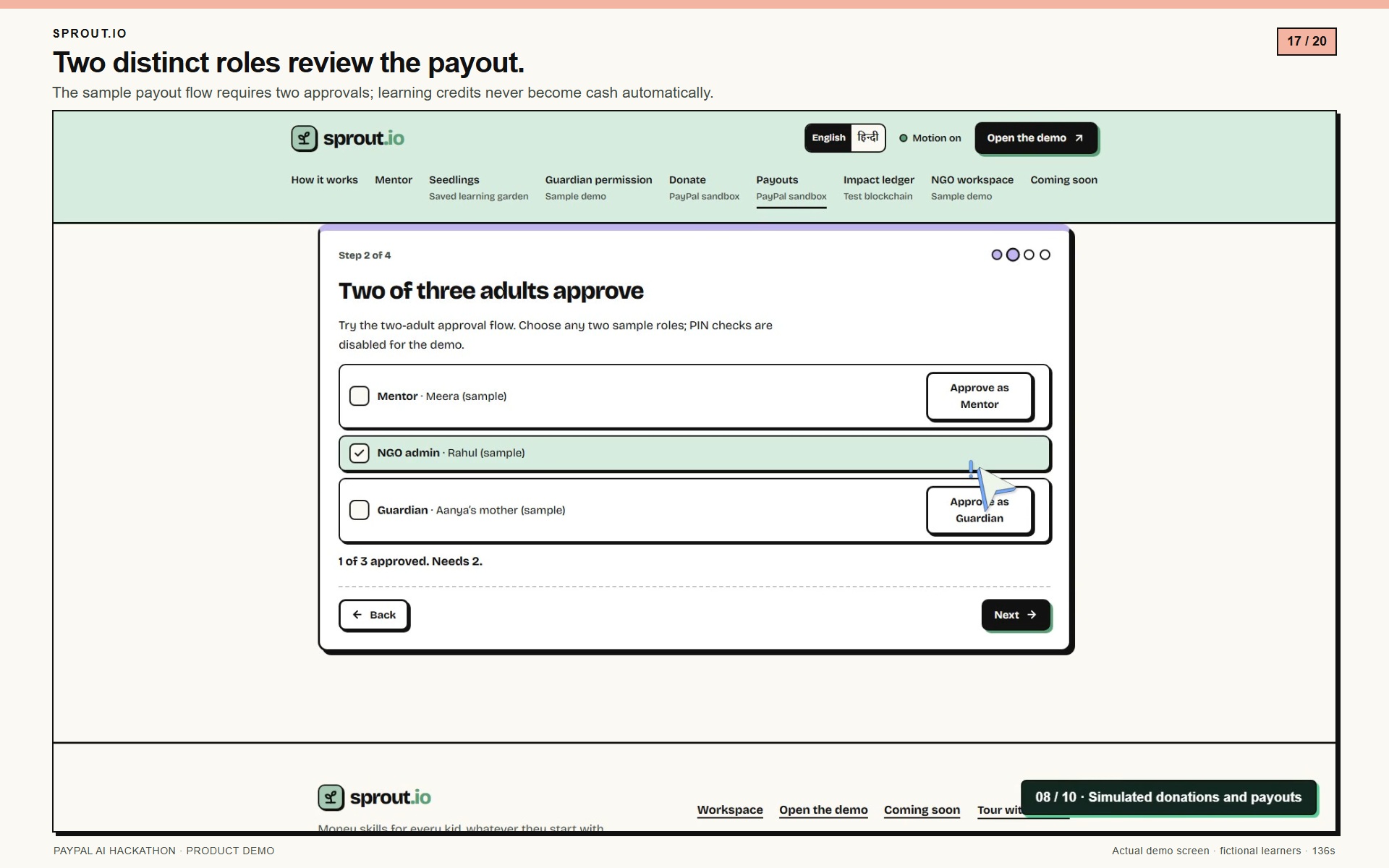
Two-role payout approval
-
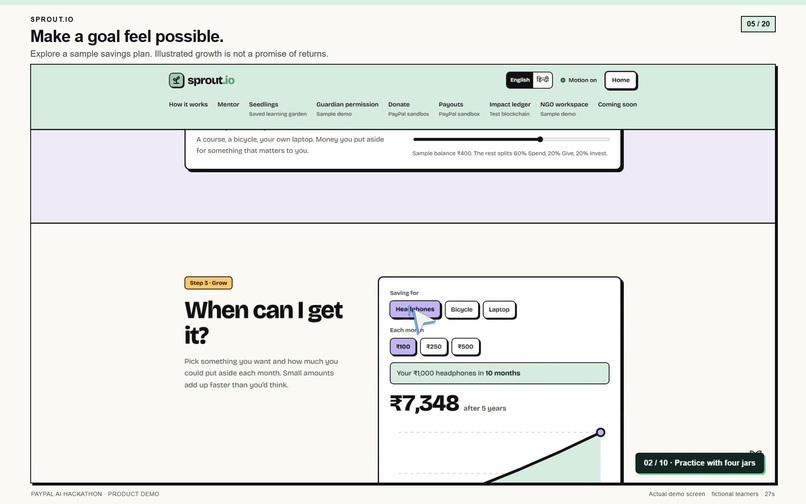
Plan and track savings goals.
-
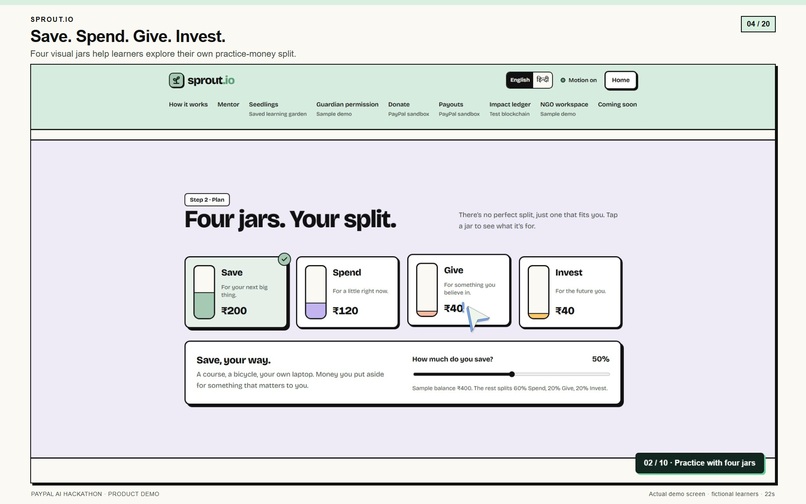
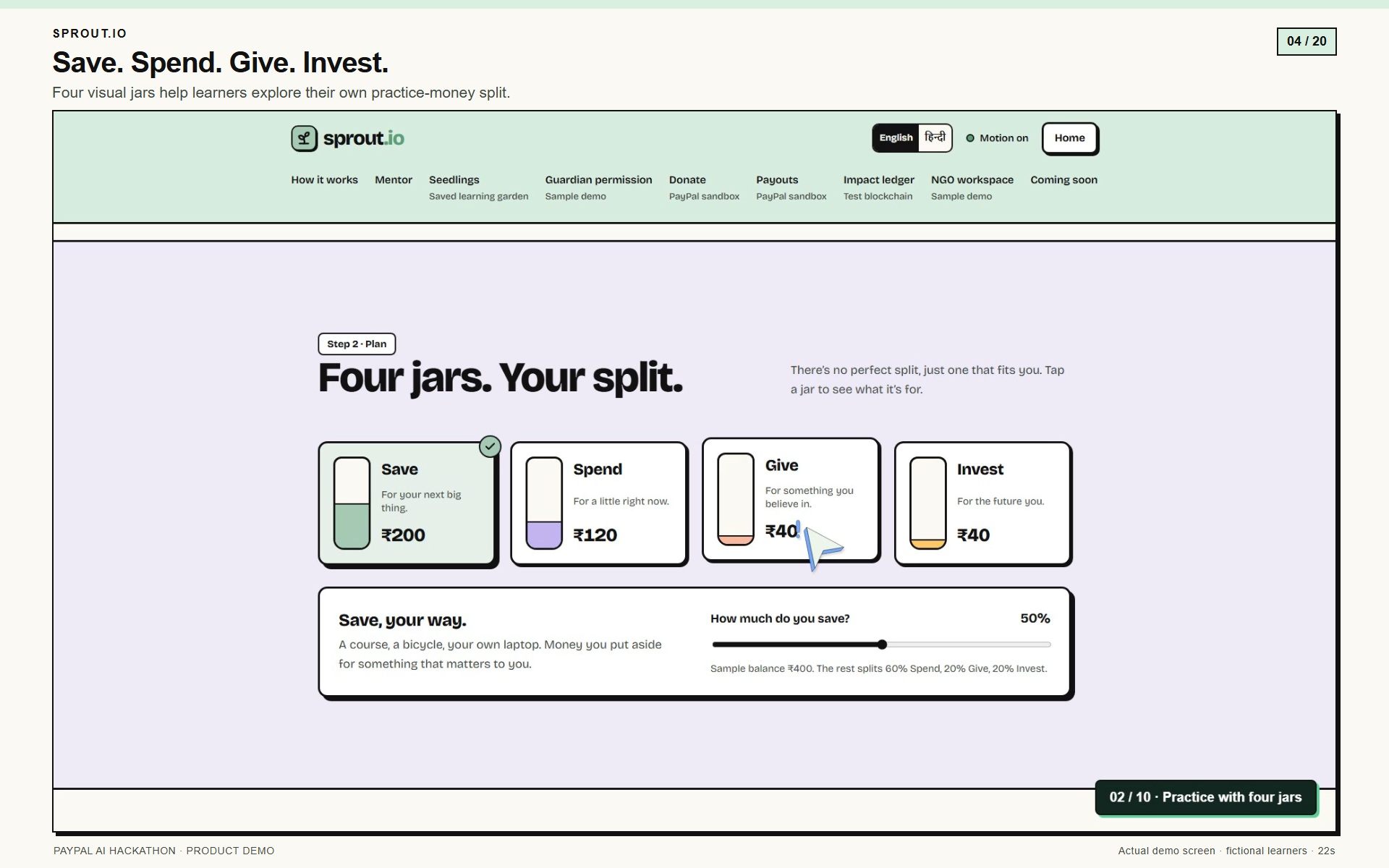
Explore Save, Spend, Give, Invest.
-
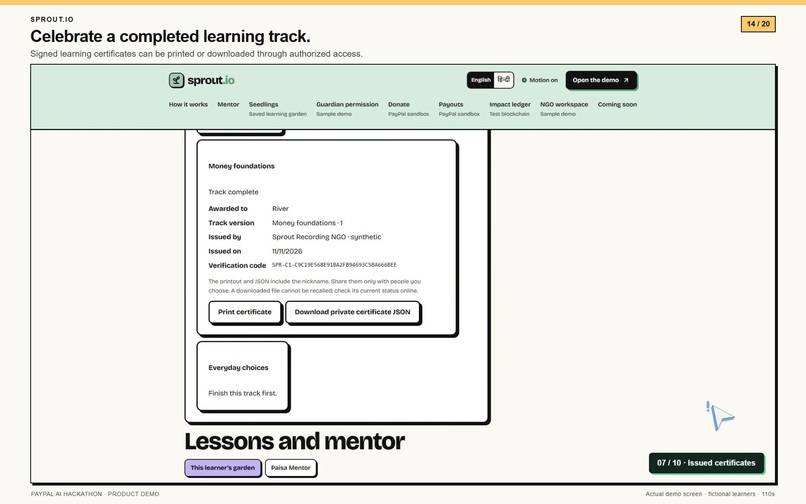
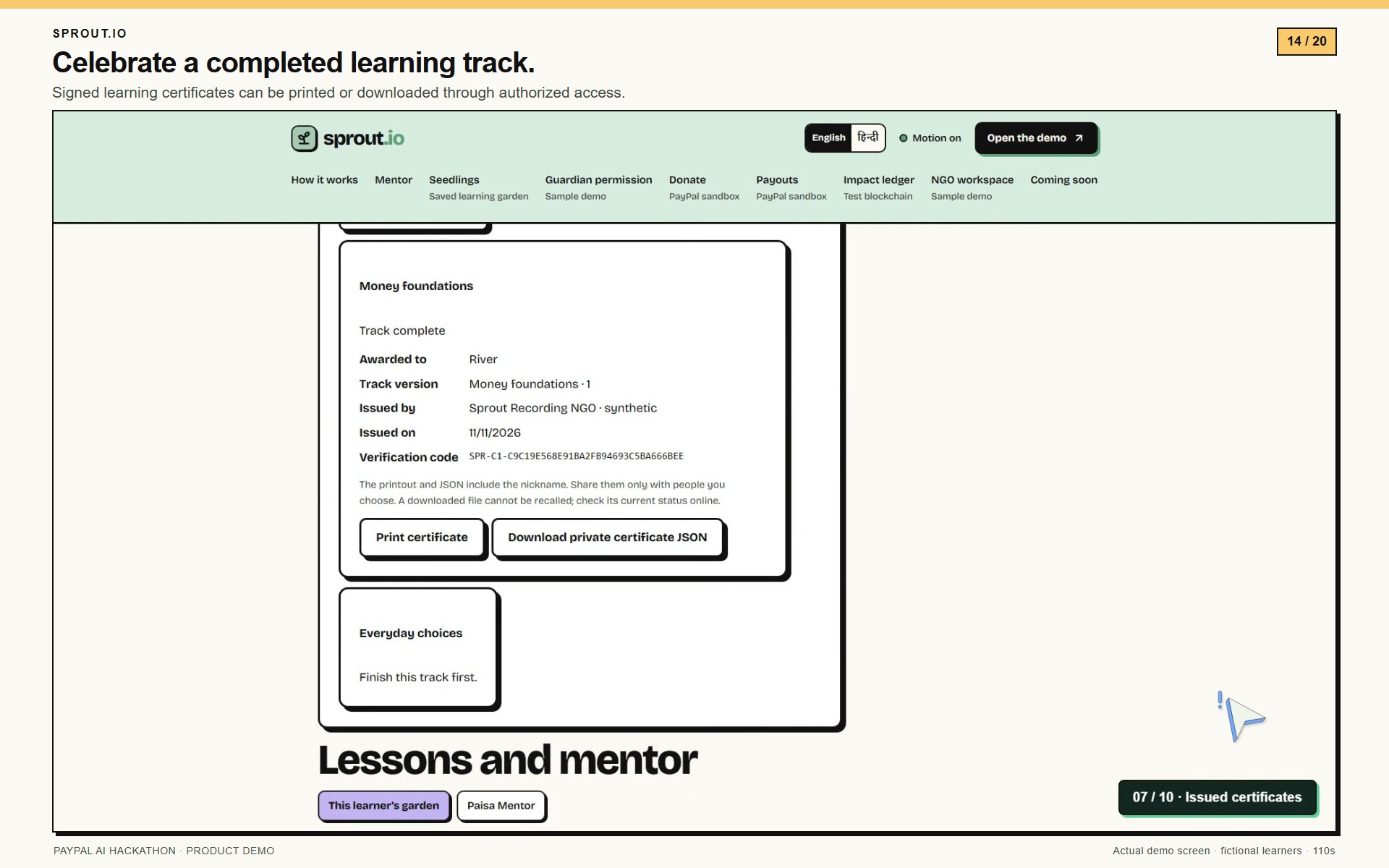
Celebrate progress with signed certificates.
-
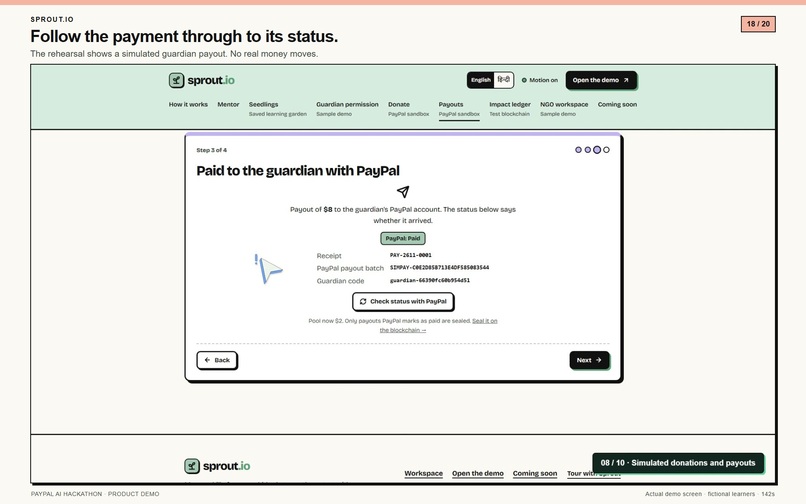
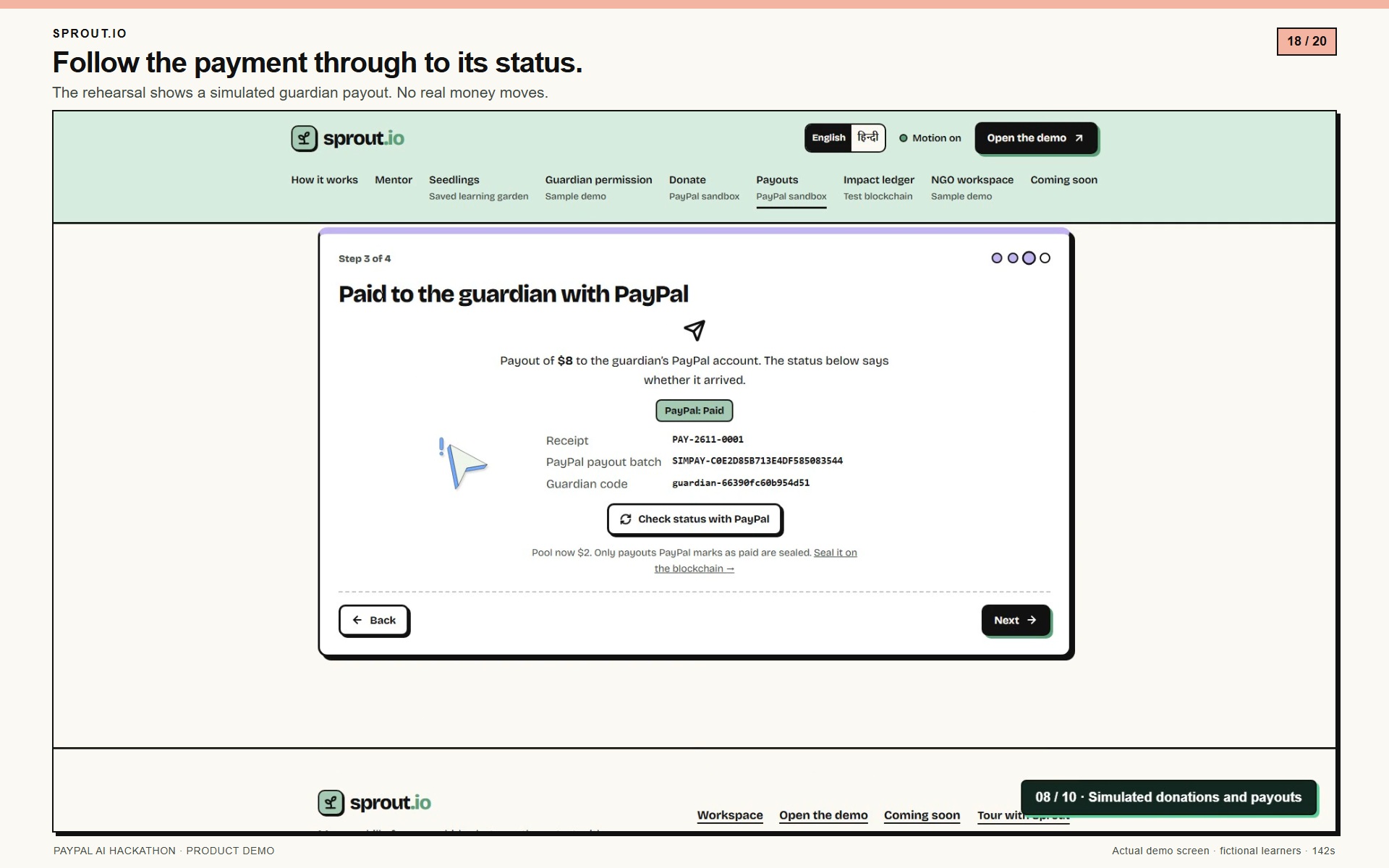
Simulated guardian payouts.
-
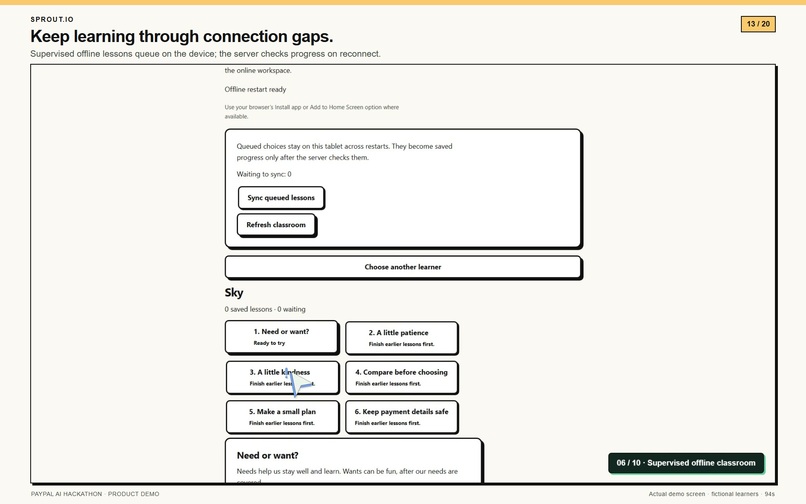
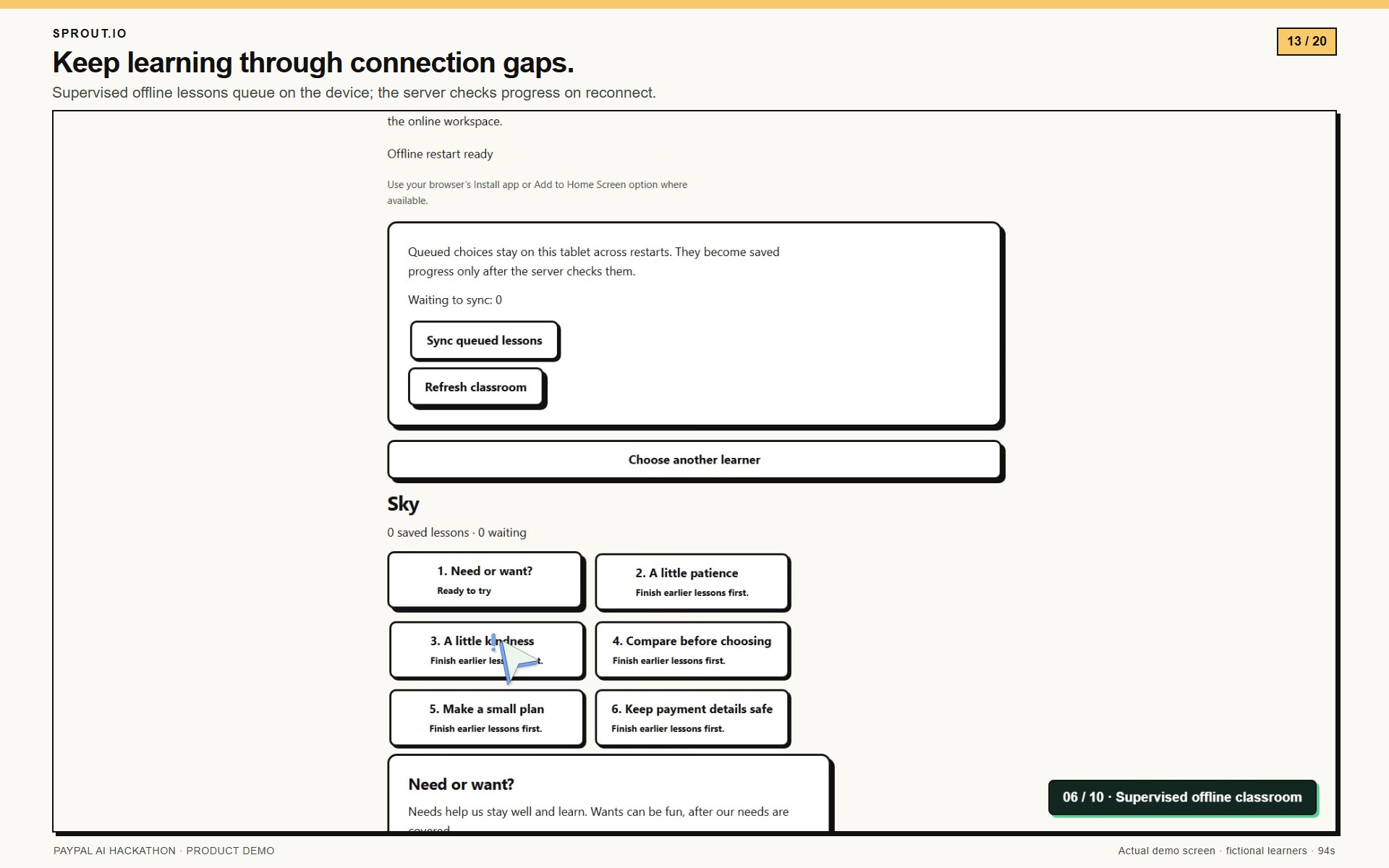
Supervised offline learning with reconnect checks.
-
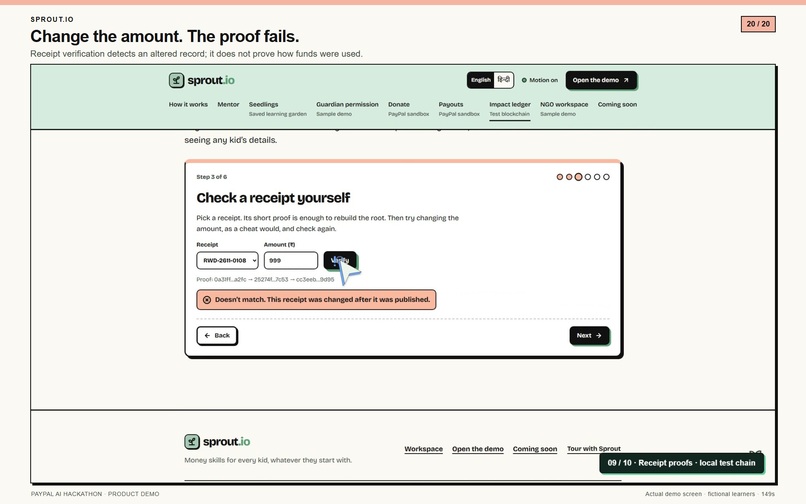
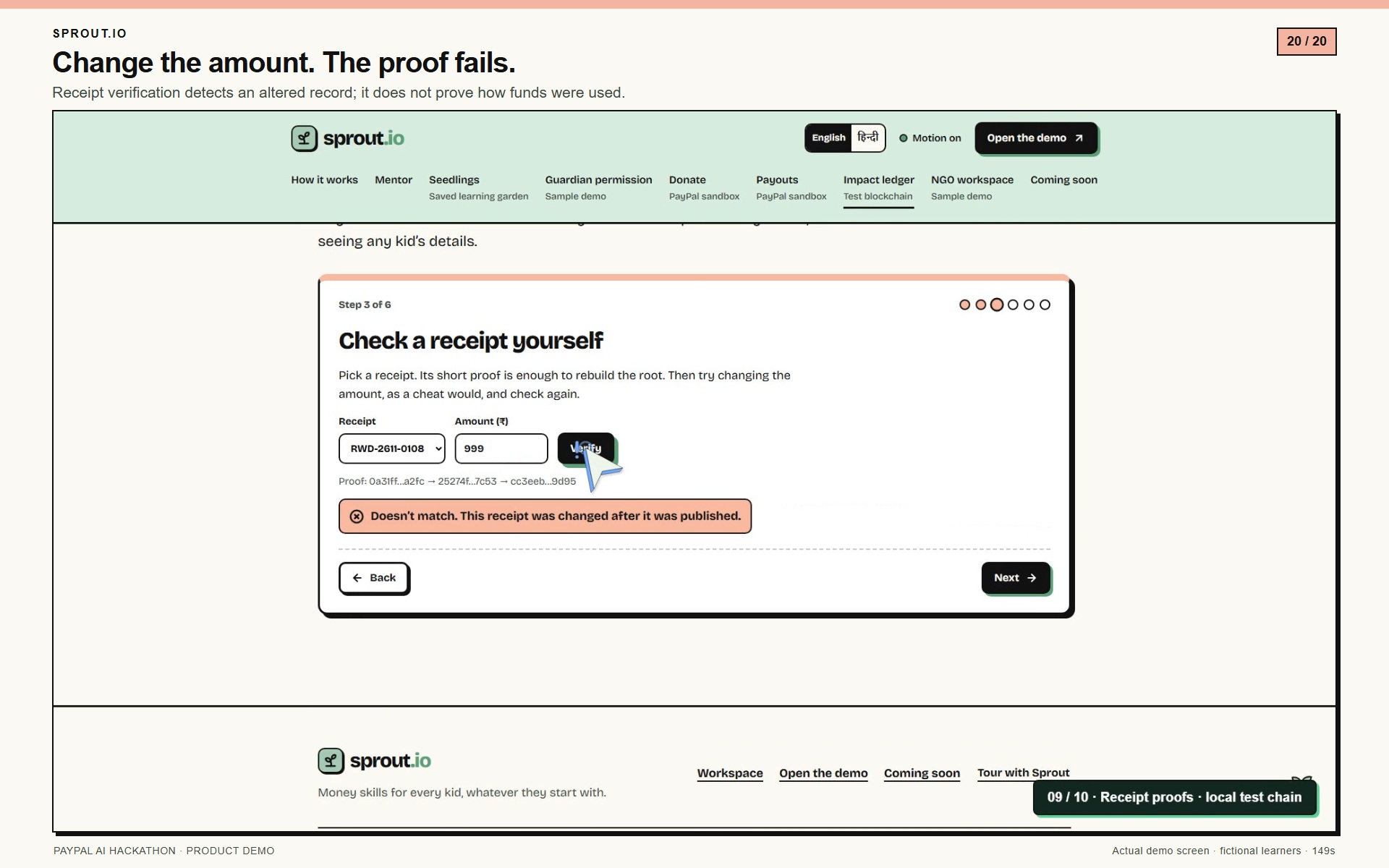
Detect altered receipt amounts.
-
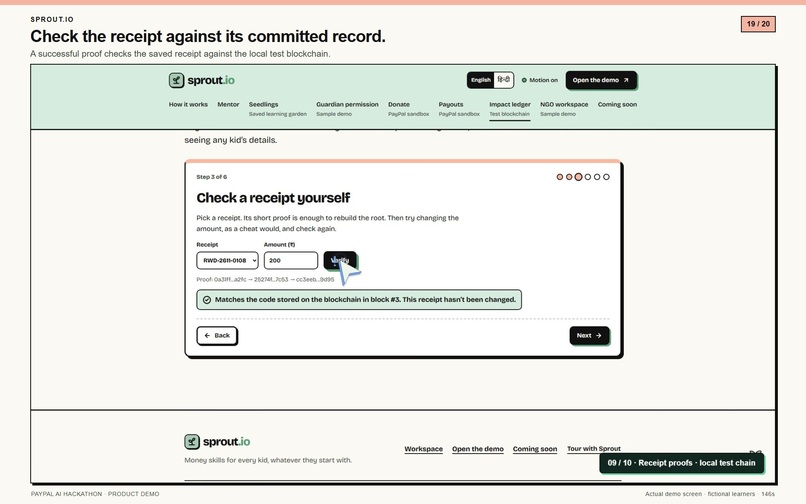
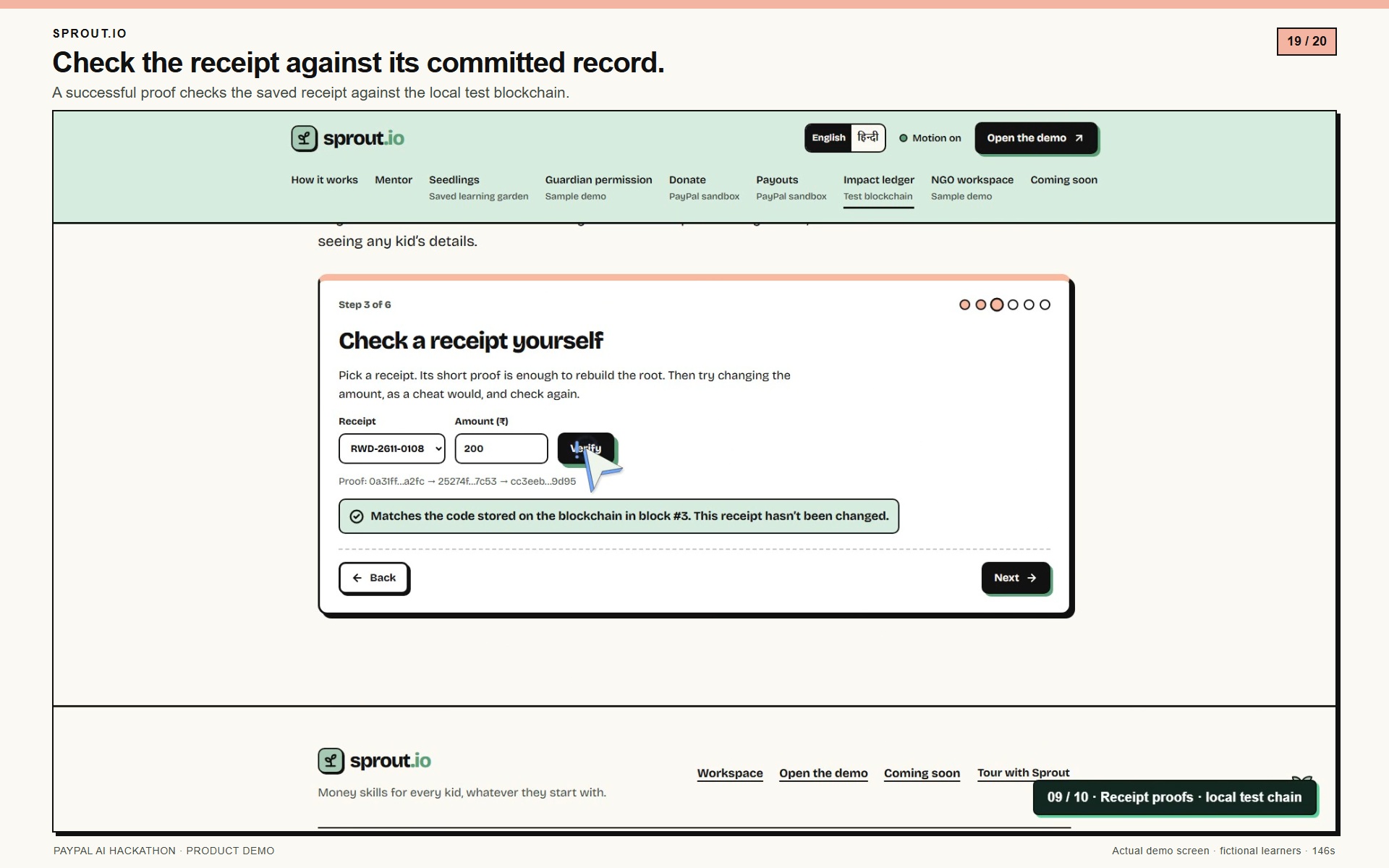
Verify local-blockchain receipt proofs.
-
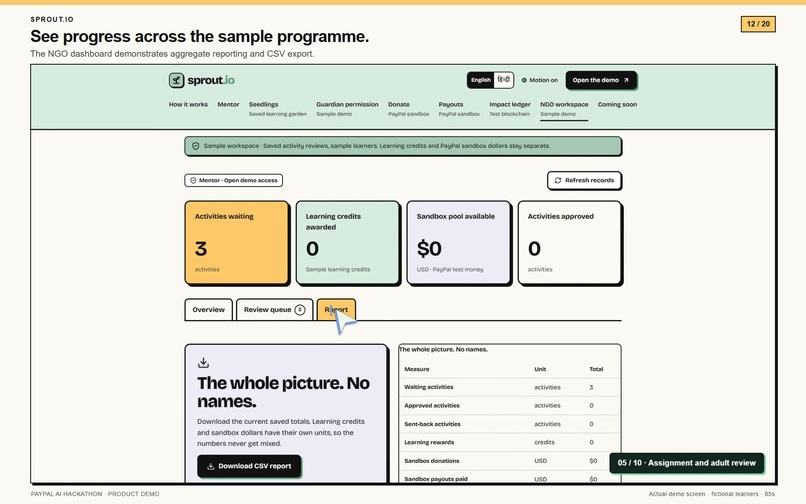
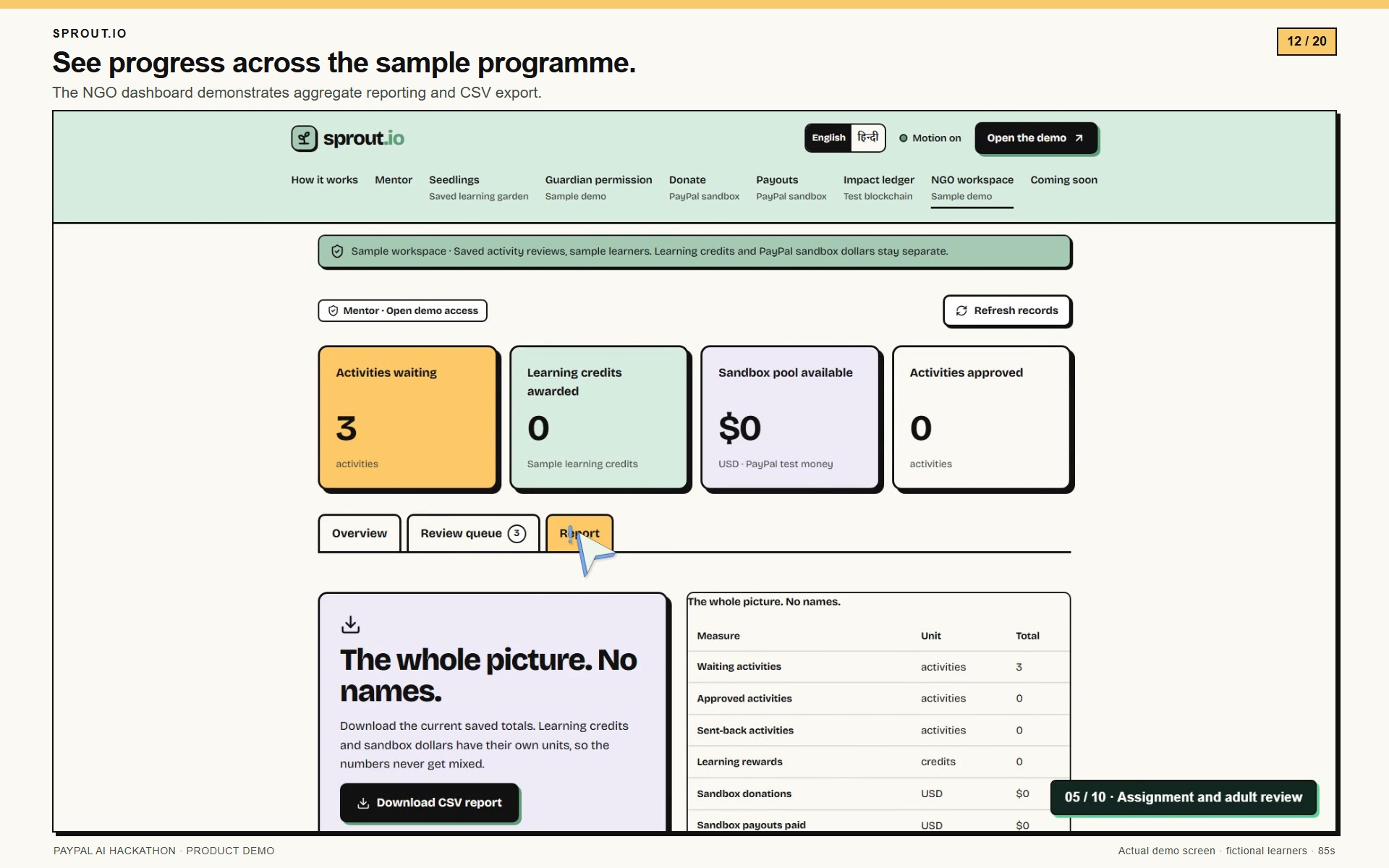
NGOs monitor progress and export reports.
-
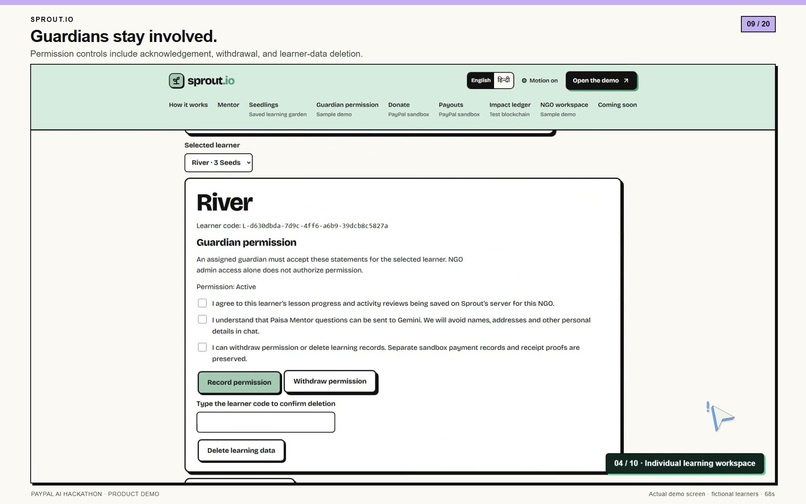
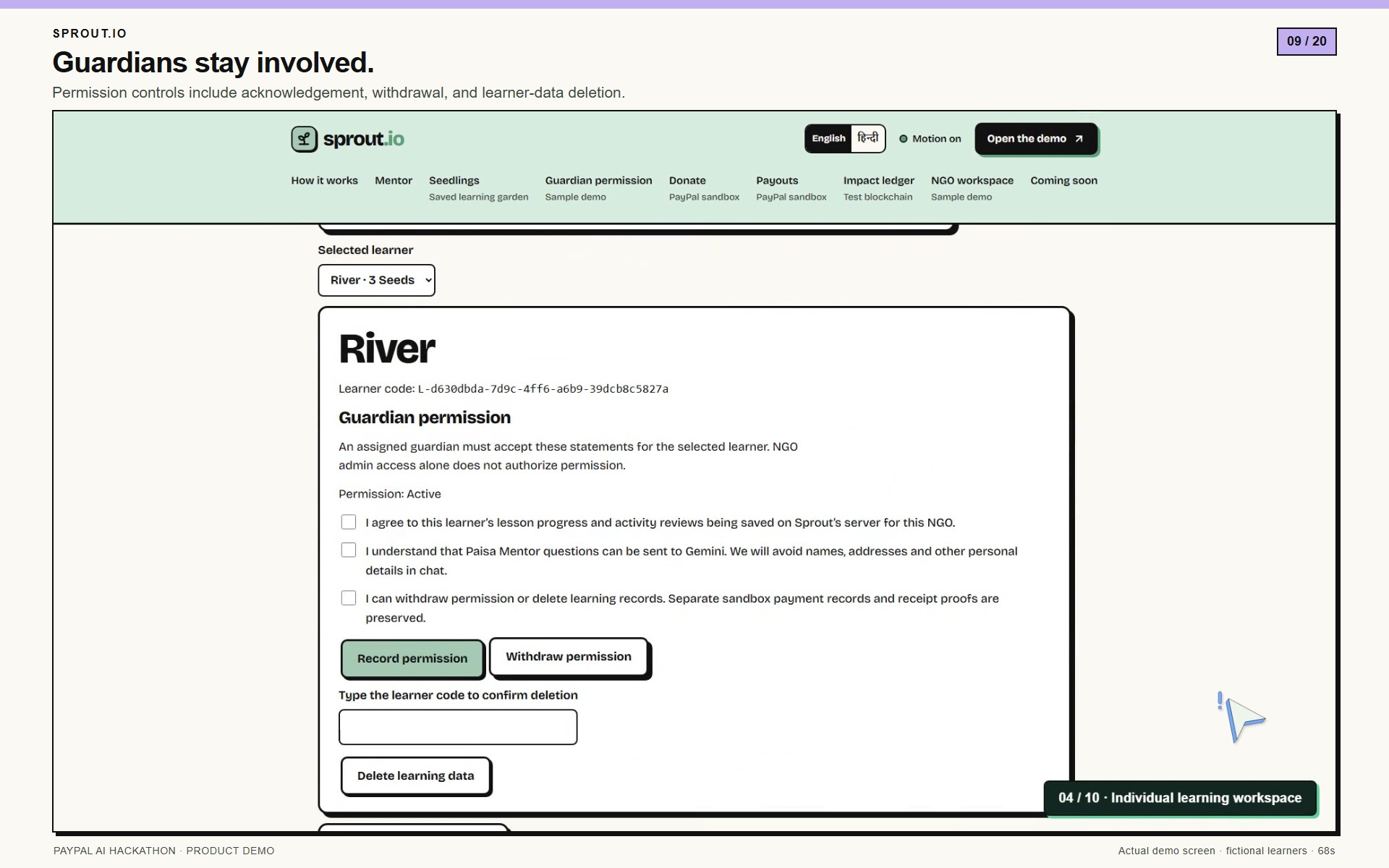
Guardians manage learning permissions.
-
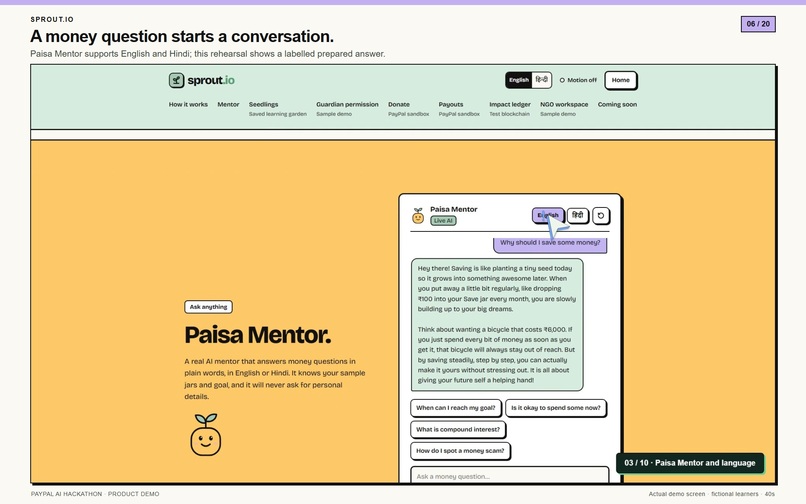
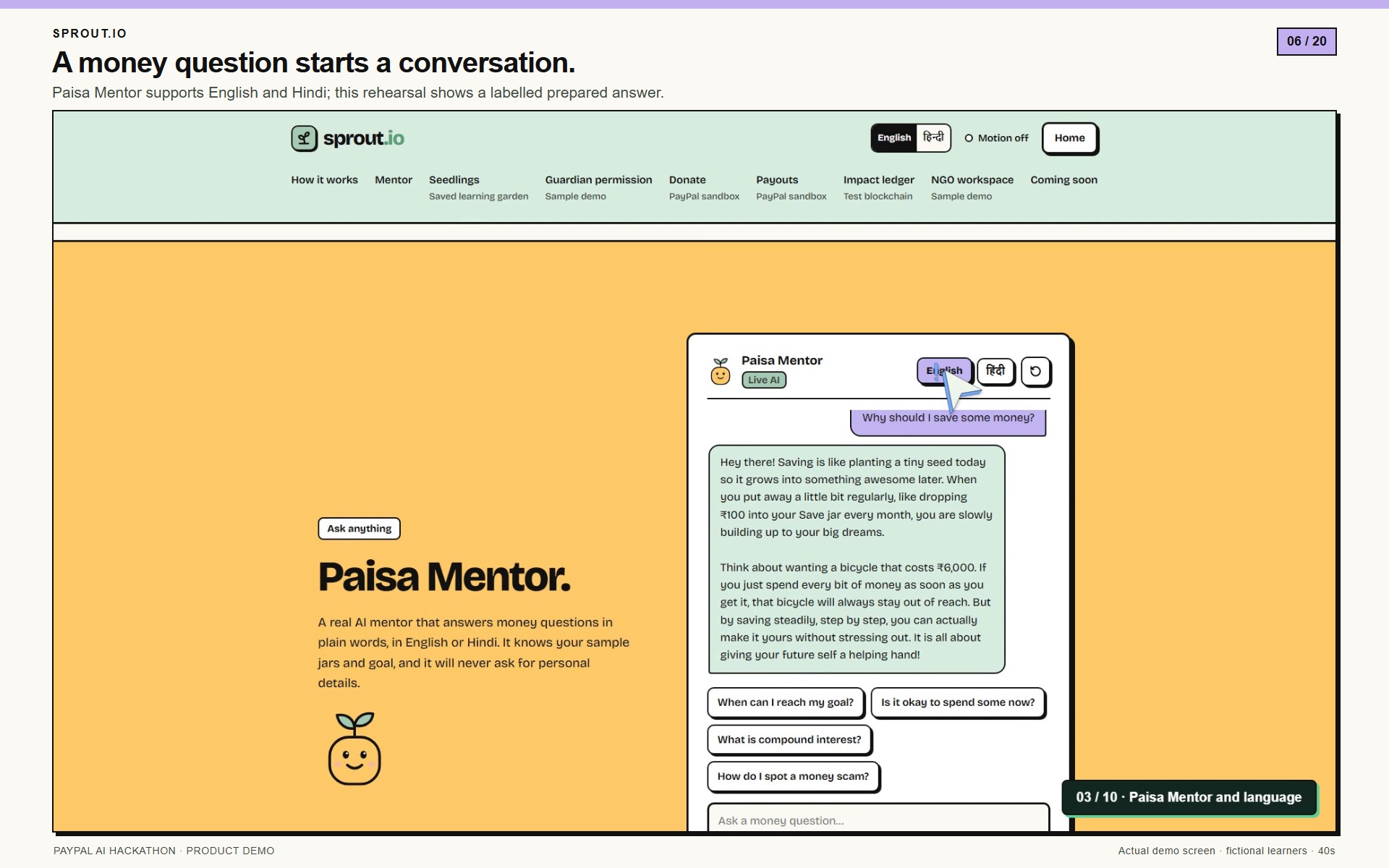
English/Hindi mentor; prepared demo answers.
-
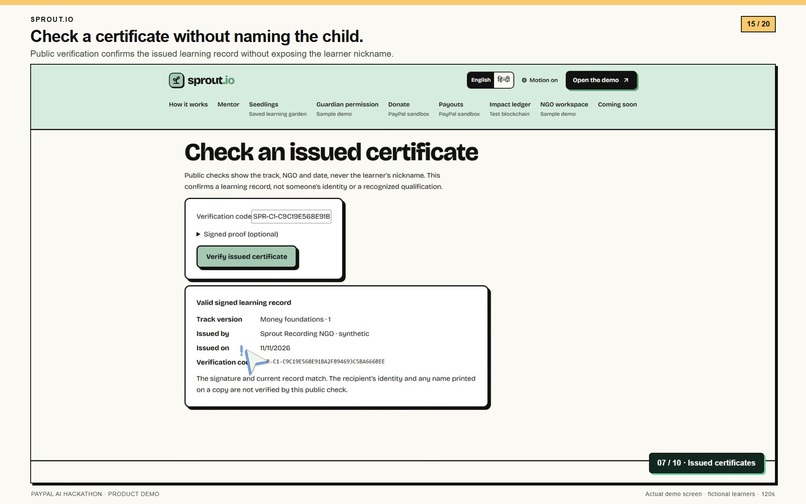
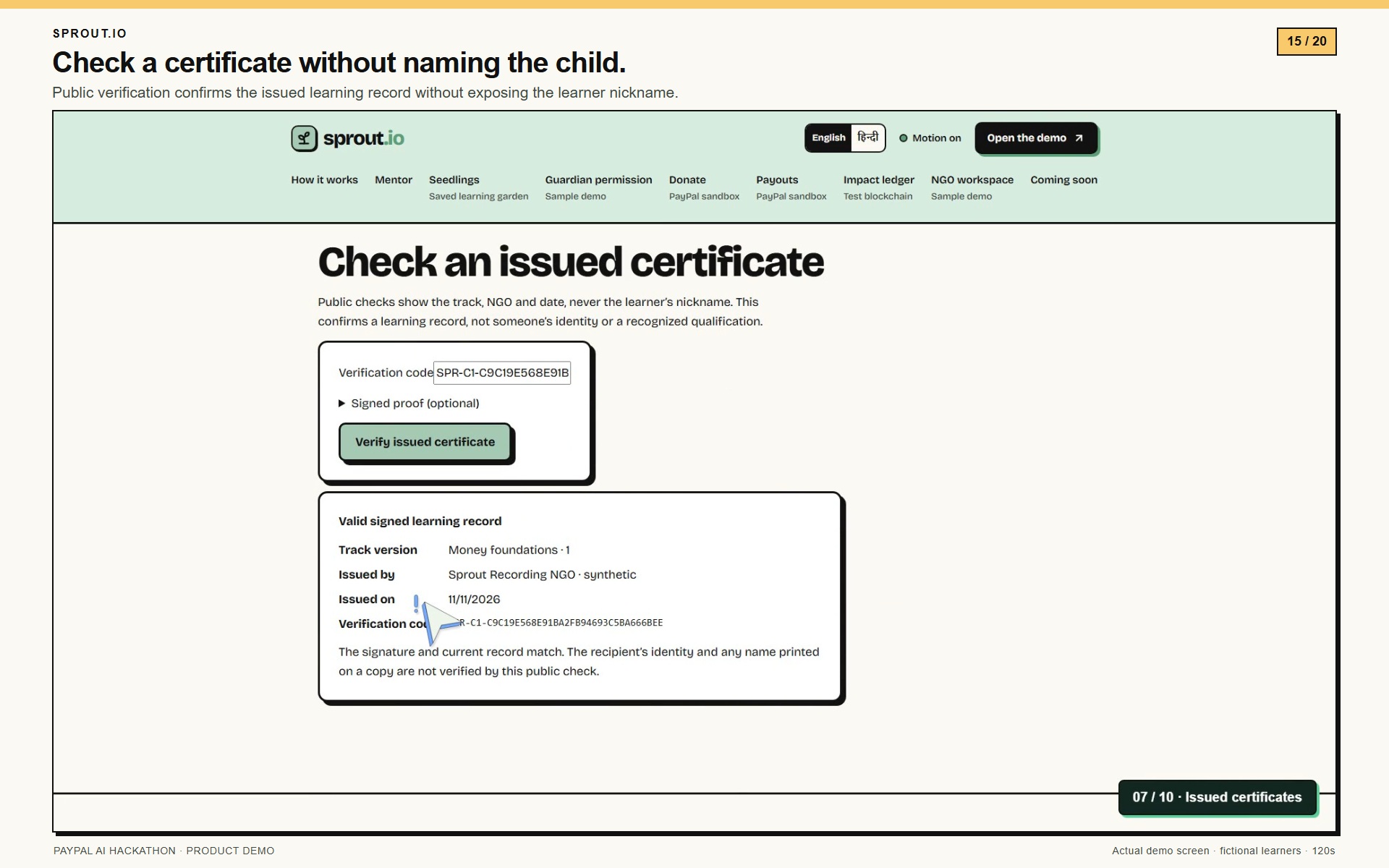
Verify certificates without revealing nicknames.
-
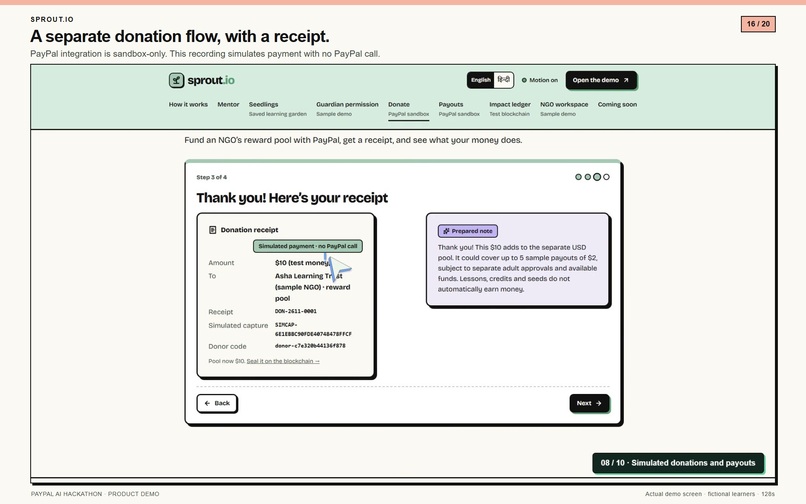
Simulated donation receipts.
-
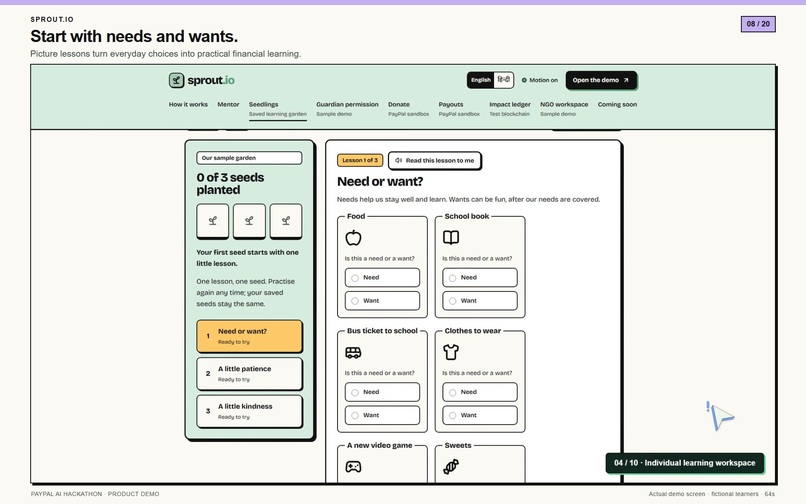
Learn through picture-based lessons.
-
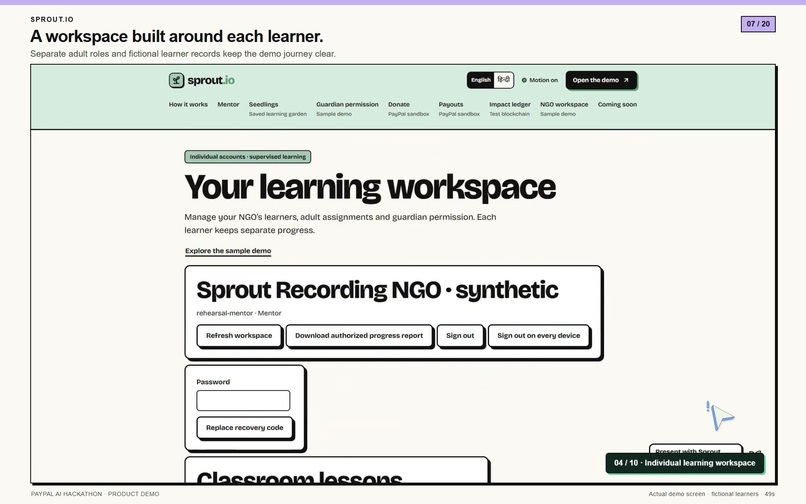
Individual workspaces with adult roles.
-
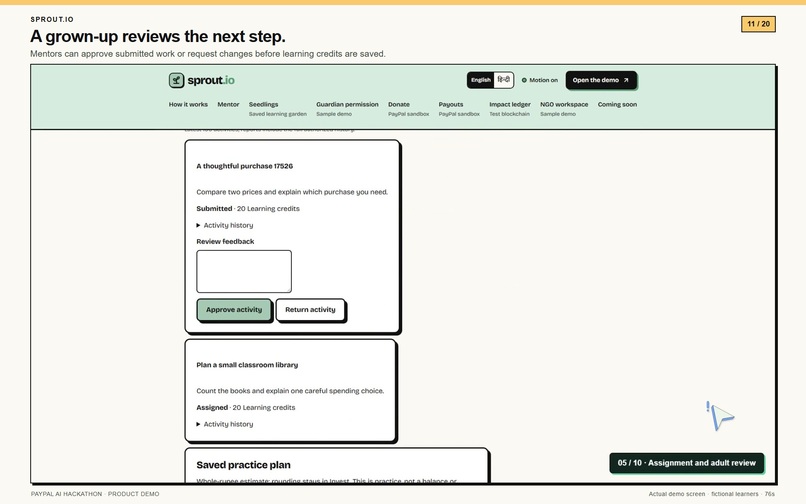
Mentors review and approve work.
Inspiration Sprout started with a simple question: how can children practise making money decisions before those decisions become expensive mistakes?
I wanted to build something children could explore with a guardian or an NGO mentor. Comparing prices, choosing between a need and a want, or saving towards a bicycle gives a money lesson something concrete to work with.
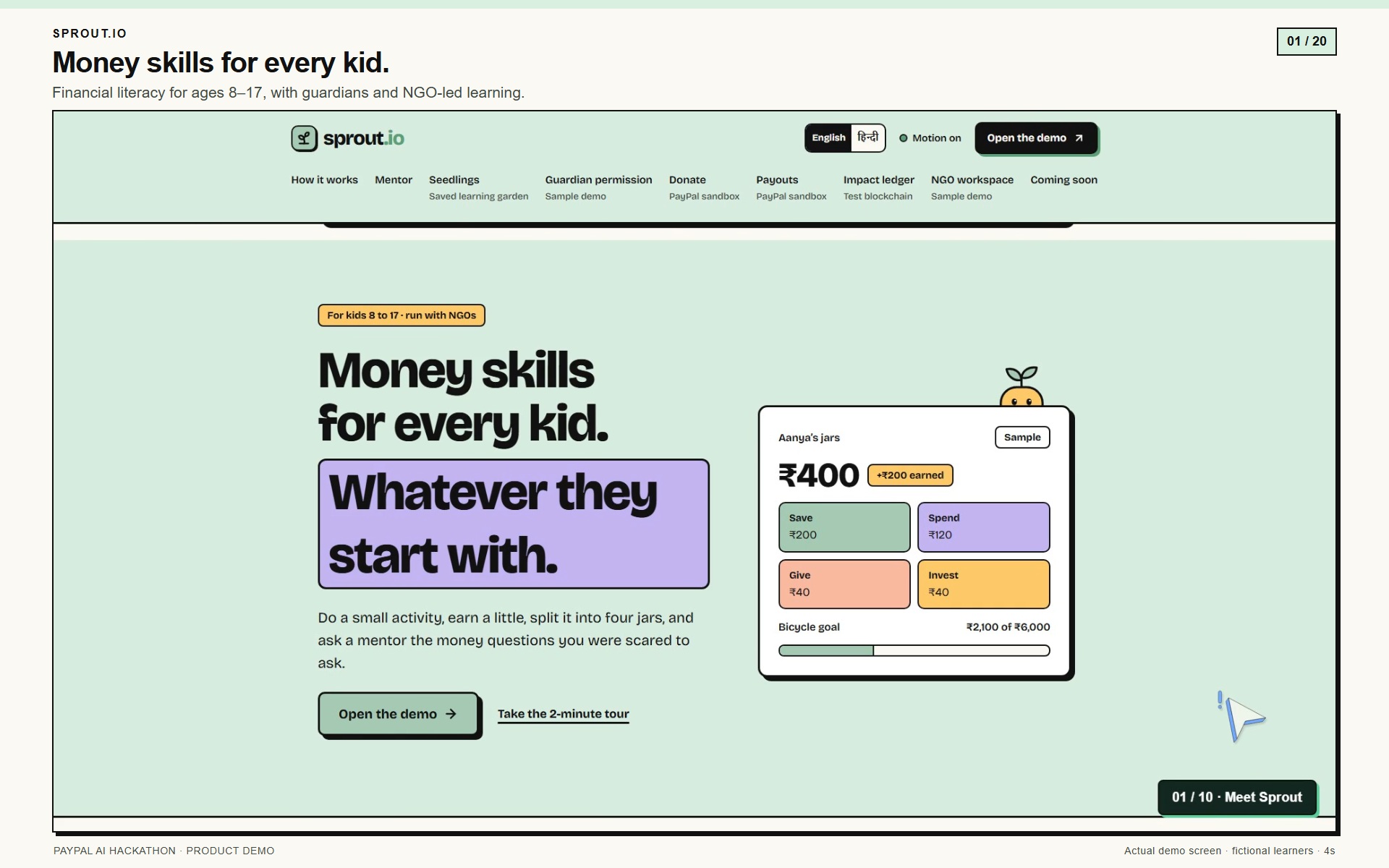
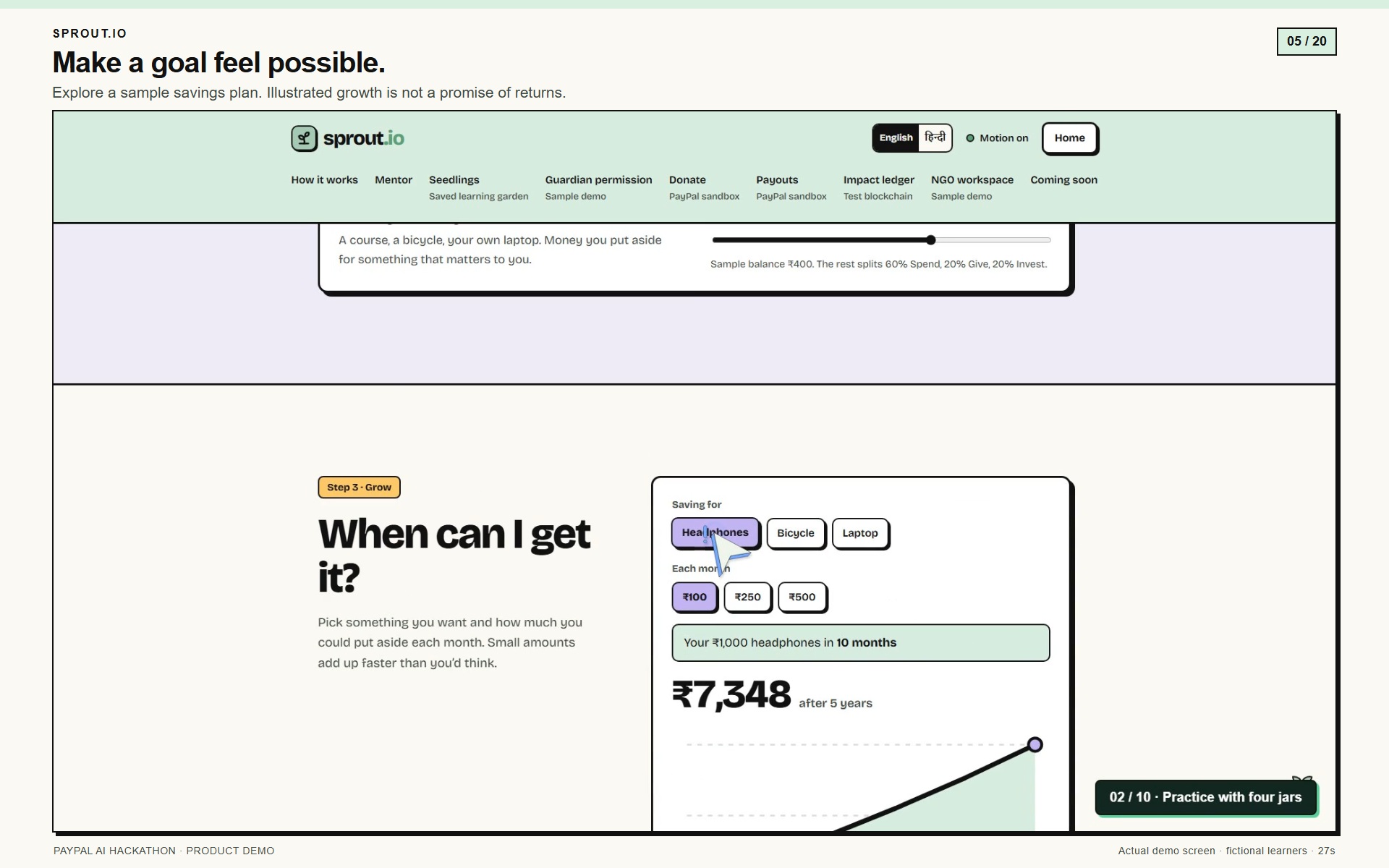
The four jars—Save, Spend, Give, and Invest—became the centre of the experience. Moving a practice balance between them makes the trade-offs visible. What it does Sprout is a financial literacy website designed for children aged 8–17, with learning tools and adult supervision built into the same project.
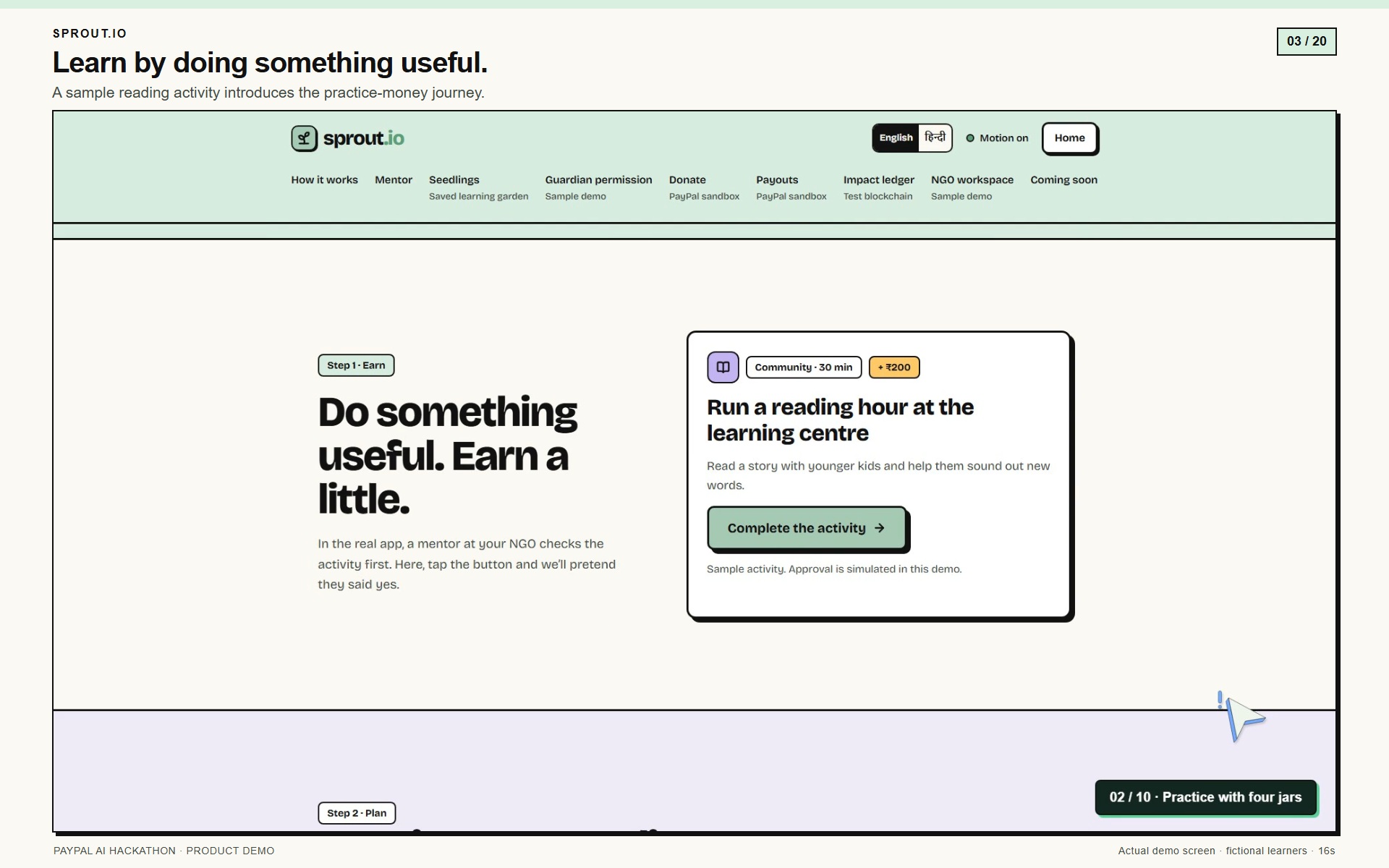
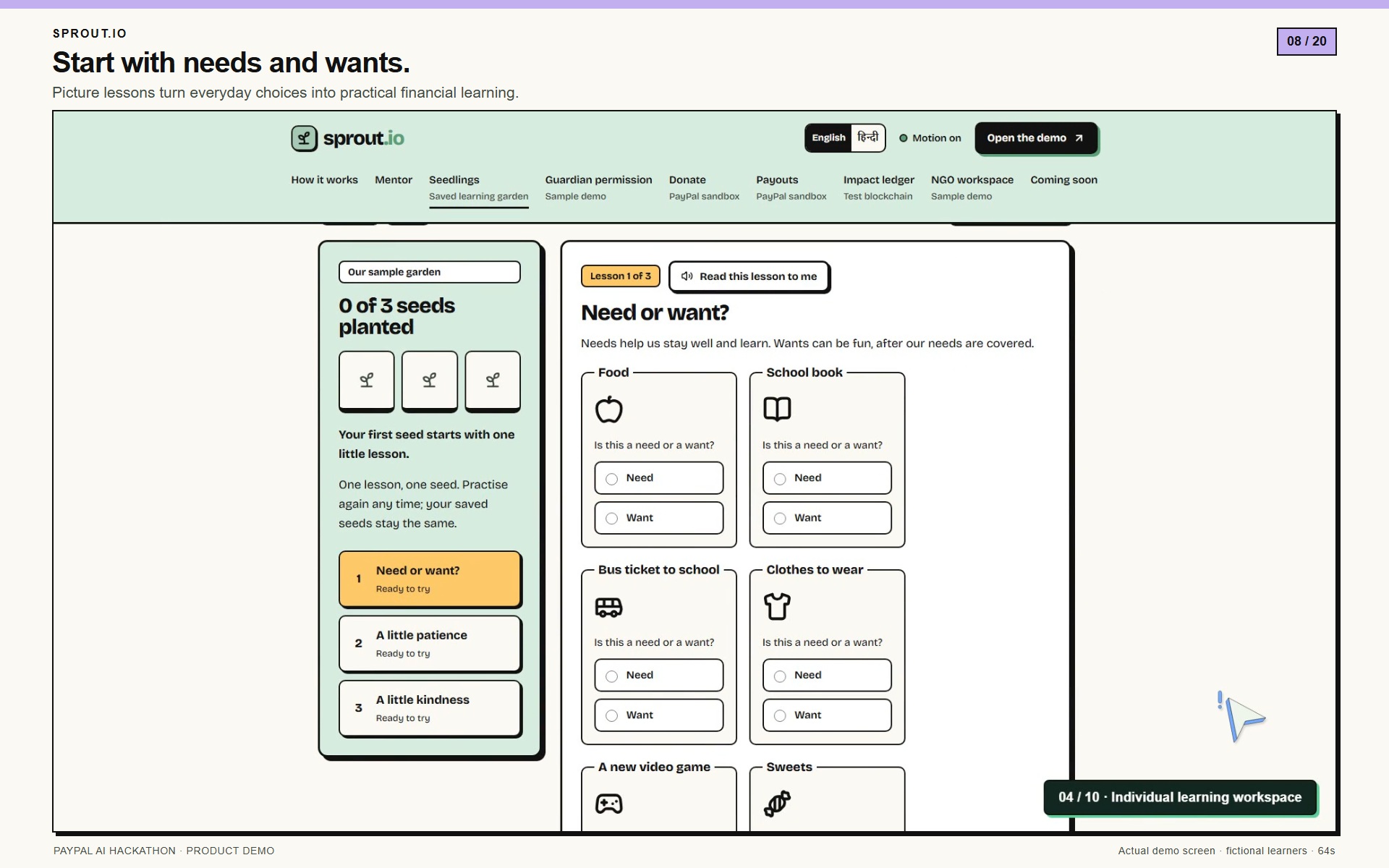
Children can complete picture lessons, divide practice rupees between four jars, and explore savings goals. Paisa Mentor, powered by Gemini, explains money questions in English and Hindi. Responses are checked before display, with labelled prepared answers available when needed.
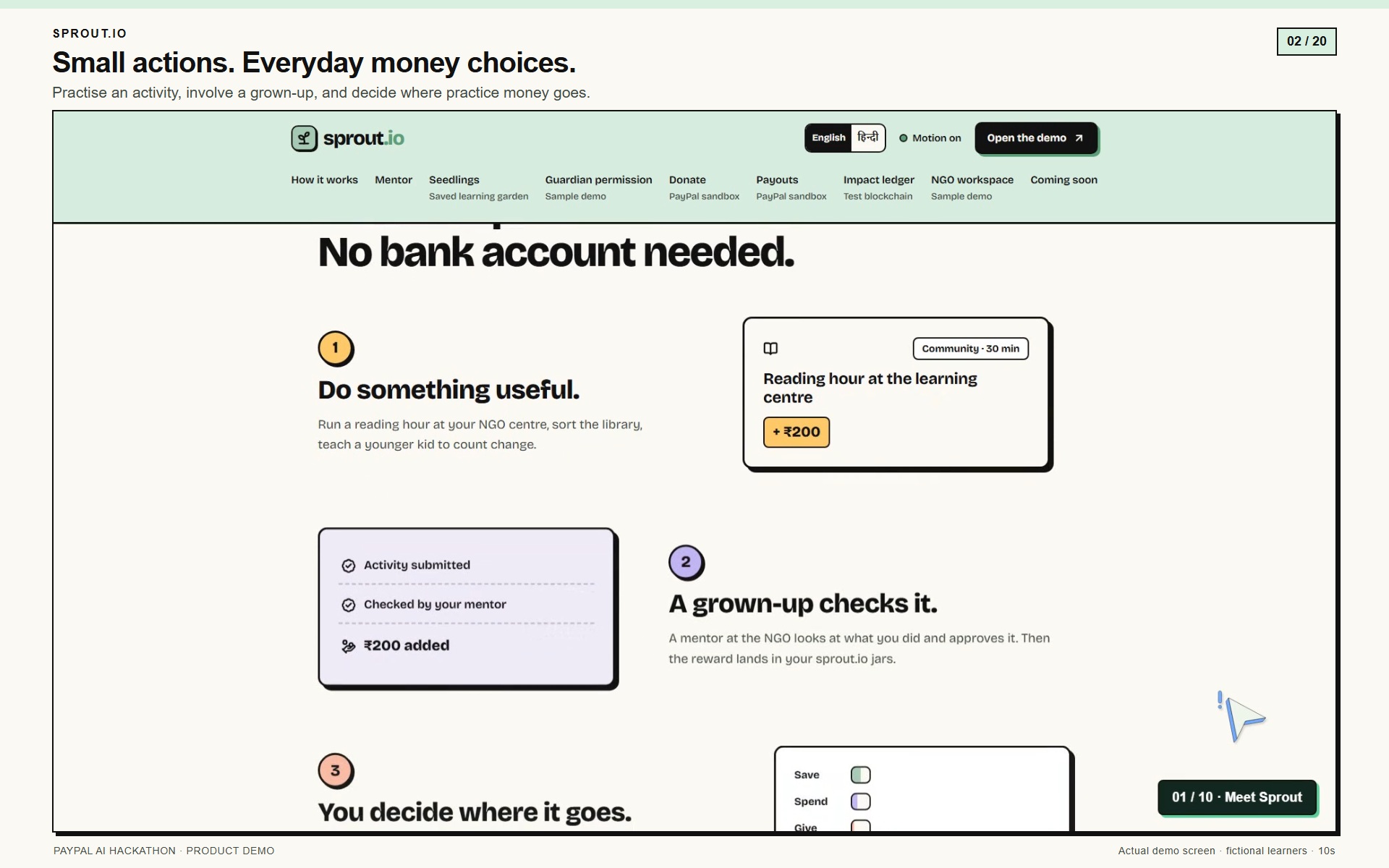
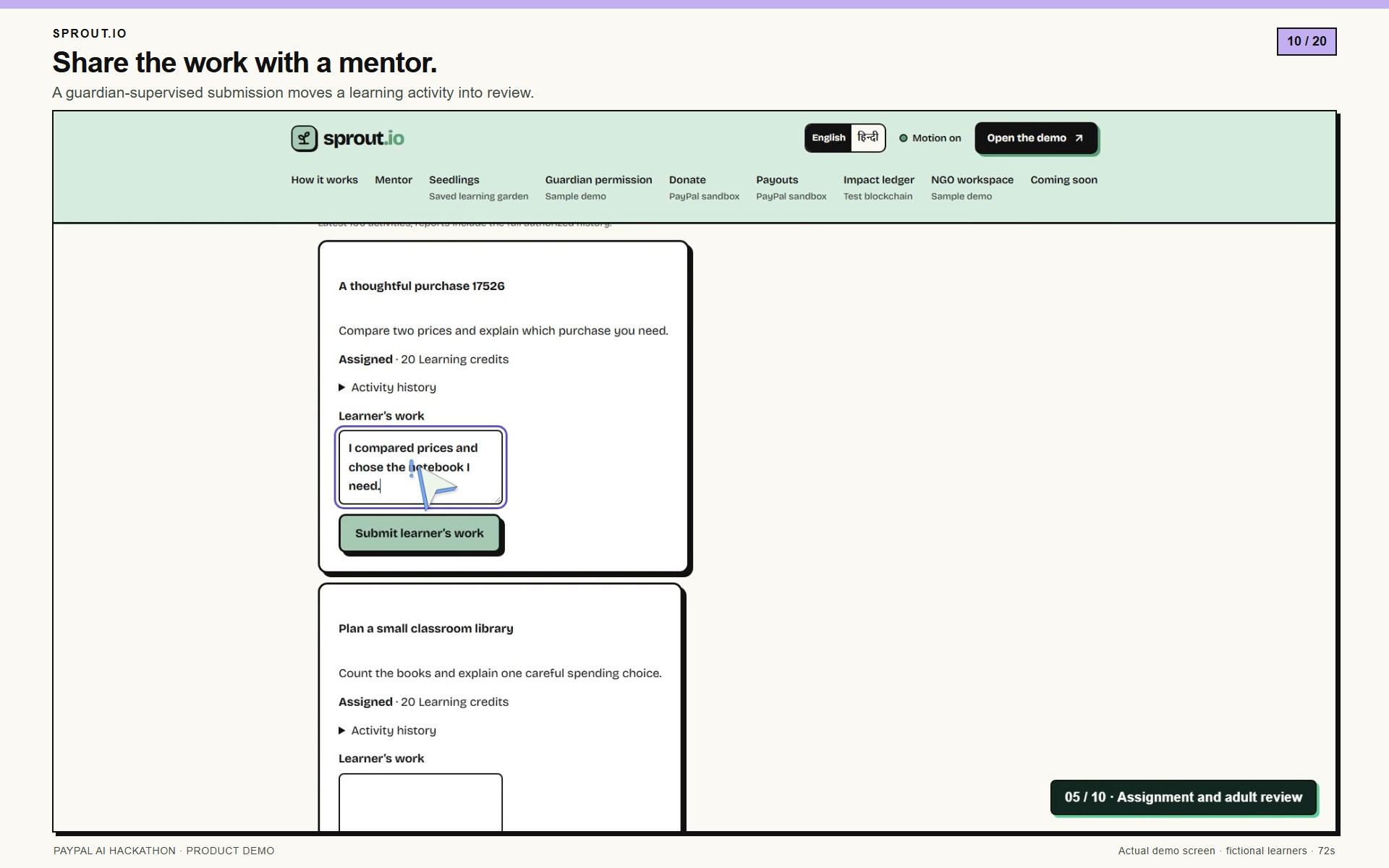
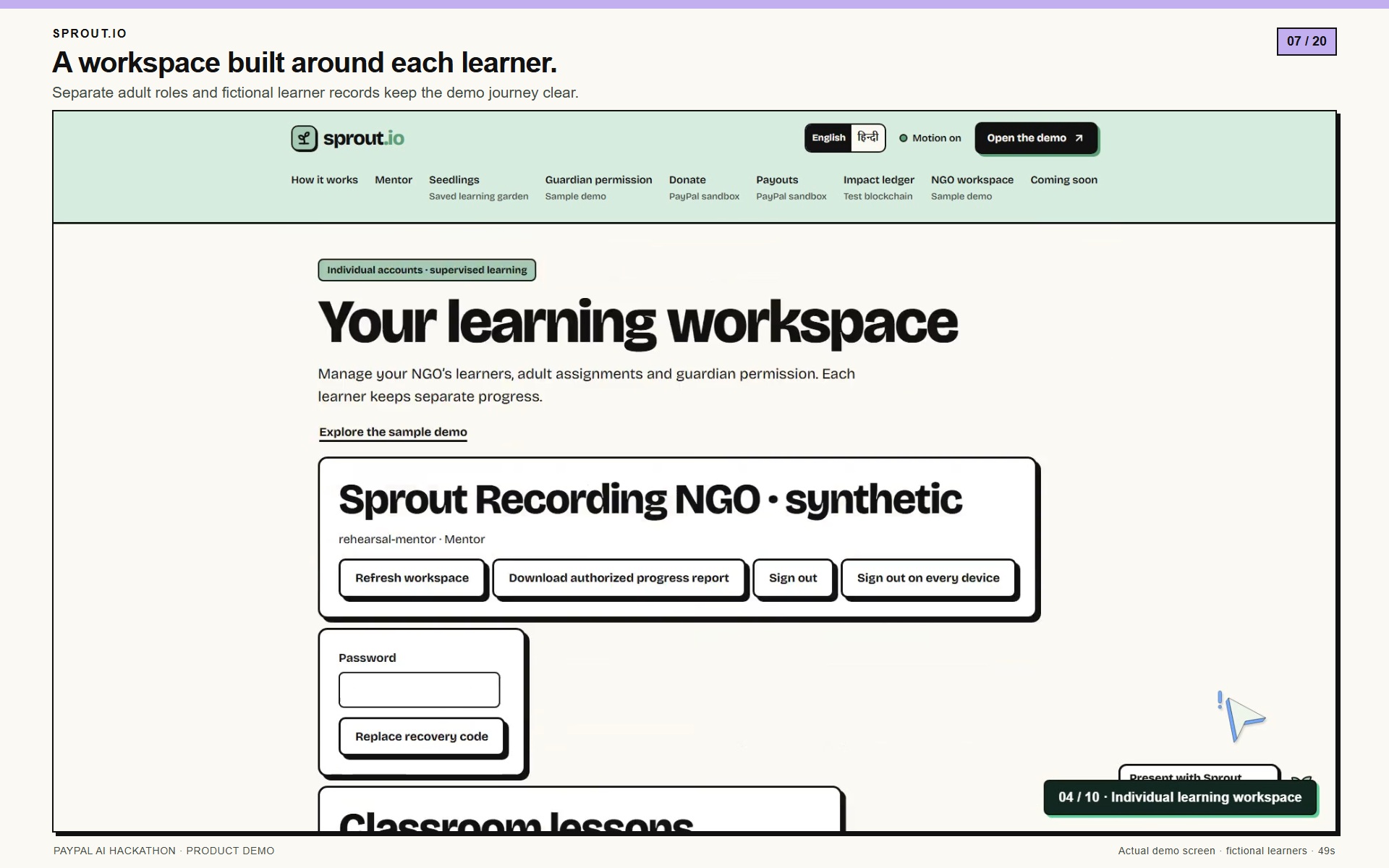
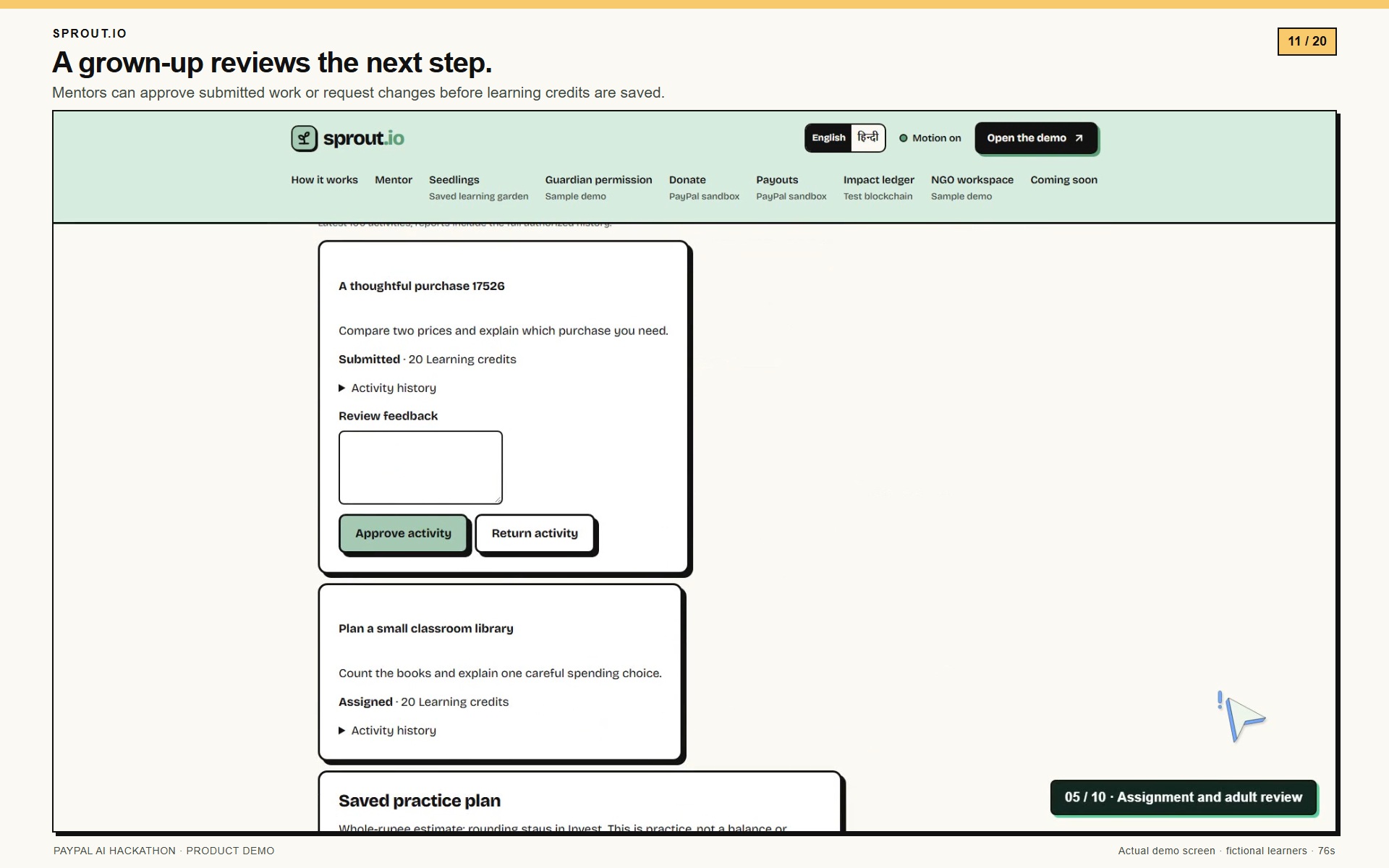
The individual workspace connects learners, guardians, and mentors. Mentors assign activities, guardians submit the learner’s work, and mentors approve it or request changes. Progress and learning credits are saved separately for each learner.
For classrooms with unreliable internet, an approved device can download lessons and queue answers offline. When it reconnects, the server checks permission and answers before awarding progress. Completed tracks can also receive signed learning certificates, with public verification that keeps the learner’s nickname private.
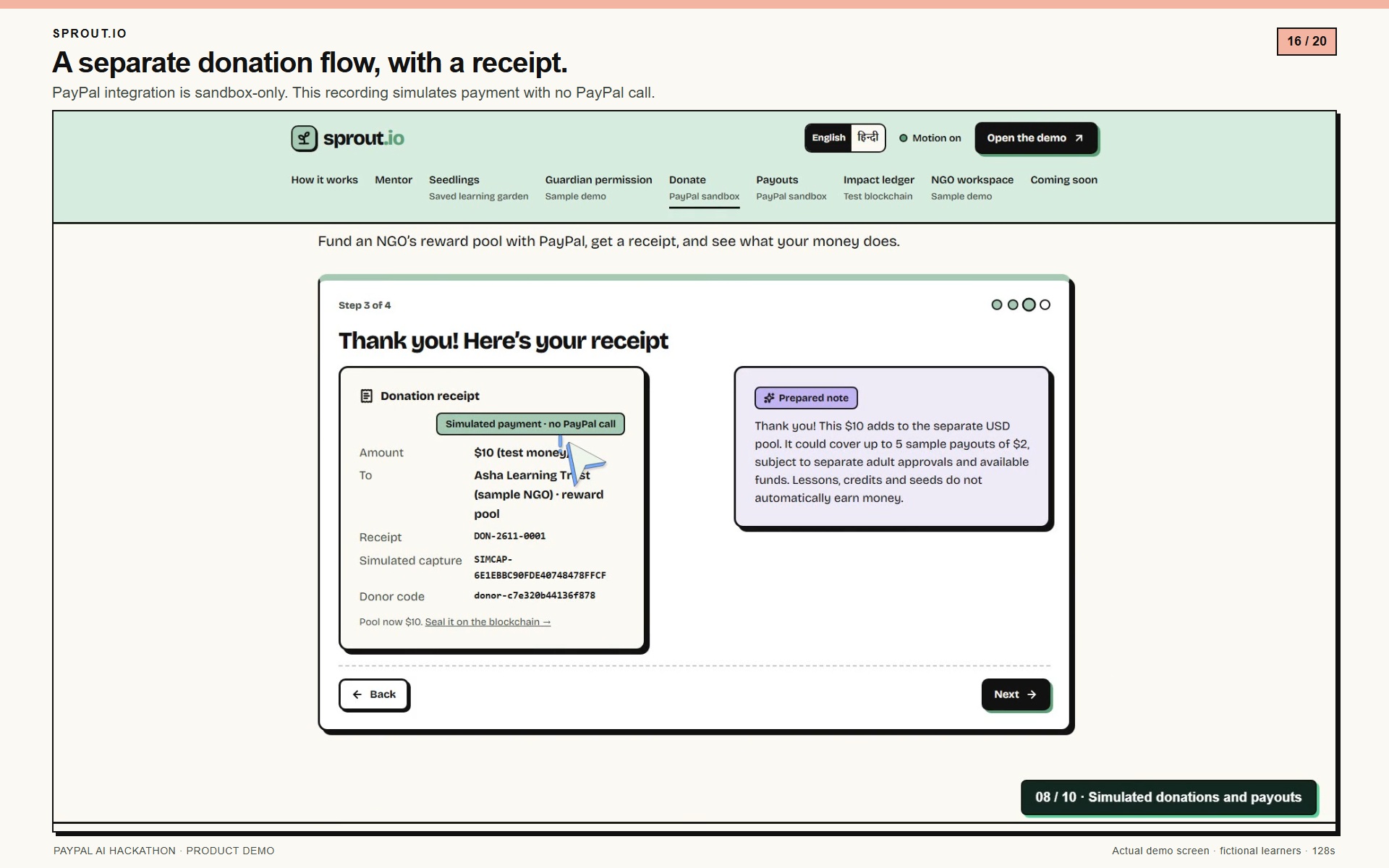
A separate payment demonstration integrates PayPal sandbox donations and payouts. Learning credits, seeds, and practice rupees have no cash value and never automatically become payouts. Receipt proofs demonstrate how a changed record can be detected using a local test blockchain. How I built it I built the frontend with React and Vite, using large controls, illustrated lessons, and a shared English/Hindi language setting.
The backend uses Fastify and TypeScript, with PostgreSQL supporting saved accounts, learning records, and transactional payment records. Gemini runs through the backend so its credentials stay out of the browser.
The payment integration uses PayPal Orders v2 for donations and PayPal Payouts for the separate guardian payout demonstration. The sample payout flow requires two different approval roles.
For receipt verification, I used Solidity and Hardhat. Receipts are hashed into a Merkle tree, allowing a receipt to be checked against a published batch root.
I also built an isolated recording mode with fictional learners and clearly labelled simulated payments. That made it possible to demonstrate the workflows without involving real children’s records or moving money. Challenges I ran into Keeping learning rewards and money separate took careful work. The interface needed to explain which numbers represented practice rupees, learning credits, or sandbox dollars.
Offline learning introduced another problem: permission can change while a device is disconnected. Queued answers therefore need fresh checks when they reach the server. Otherwise, syncing could restore progress that should no longer be accepted.
Payments required similar care around uncertainty. A timeout does not necessarily mean a payment failed. I worked on stable operation IDs, fund reservations, and saved history so retries preserve what happened.
AI responses also needed more than a friendly prompt. I added privacy rules, response checks, and prepared fallbacks, while recognising that those checks still have limits. Accomplishments I’m proud of I’m proud of connecting the learning experience to a working adult review process. Activities have submissions, feedback, saved progress, and a history that can be checked later.
Getting supervised offline lessons to reconnect successfully was another milestone. The certificate workflow and receipt checks also gave the project visible ways to demonstrate verification.
Automated tests helped check access boundaries and recovery behaviour alongside the screens shown in the demo. What I learned I learned to pay closer attention to the states between clicking a button and getting a confirmed result. Waiting to sync, waiting for review, and an uncertain payment outcome each need different behaviour.
I also learned to be precise about what verification means. A signed certificate confirms a learning record. A blockchain proof checks a committed receipt. Neither establishes everything about the person or transaction behind it. What’s next for Sprout The next technical work is payment webhook handling, broader reconciliation, and organisation-scoped payout authorisation. The current demo runs locally, and the submitted recording uses simulated payments.
I’d also like to test the lessons and instructions with NGO facilitators and guardians, especially on shared devices, to find out where the experience needs to be simpler.
Built With
- css
- fastify
- git
- google-gemini-api
- hardhat
- javascript
- lenis
- lucide-react
- motion
- node.js
- npm
- paypal-rest-apis-(orders-and-payouts)
- playwright
- postgresql
- react
- solidity
- typescript
- viem
- vite
- zod
