-
-
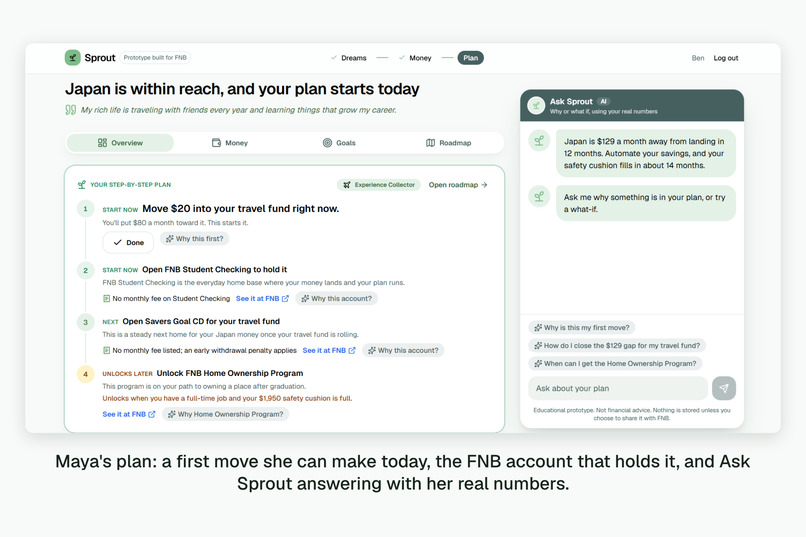
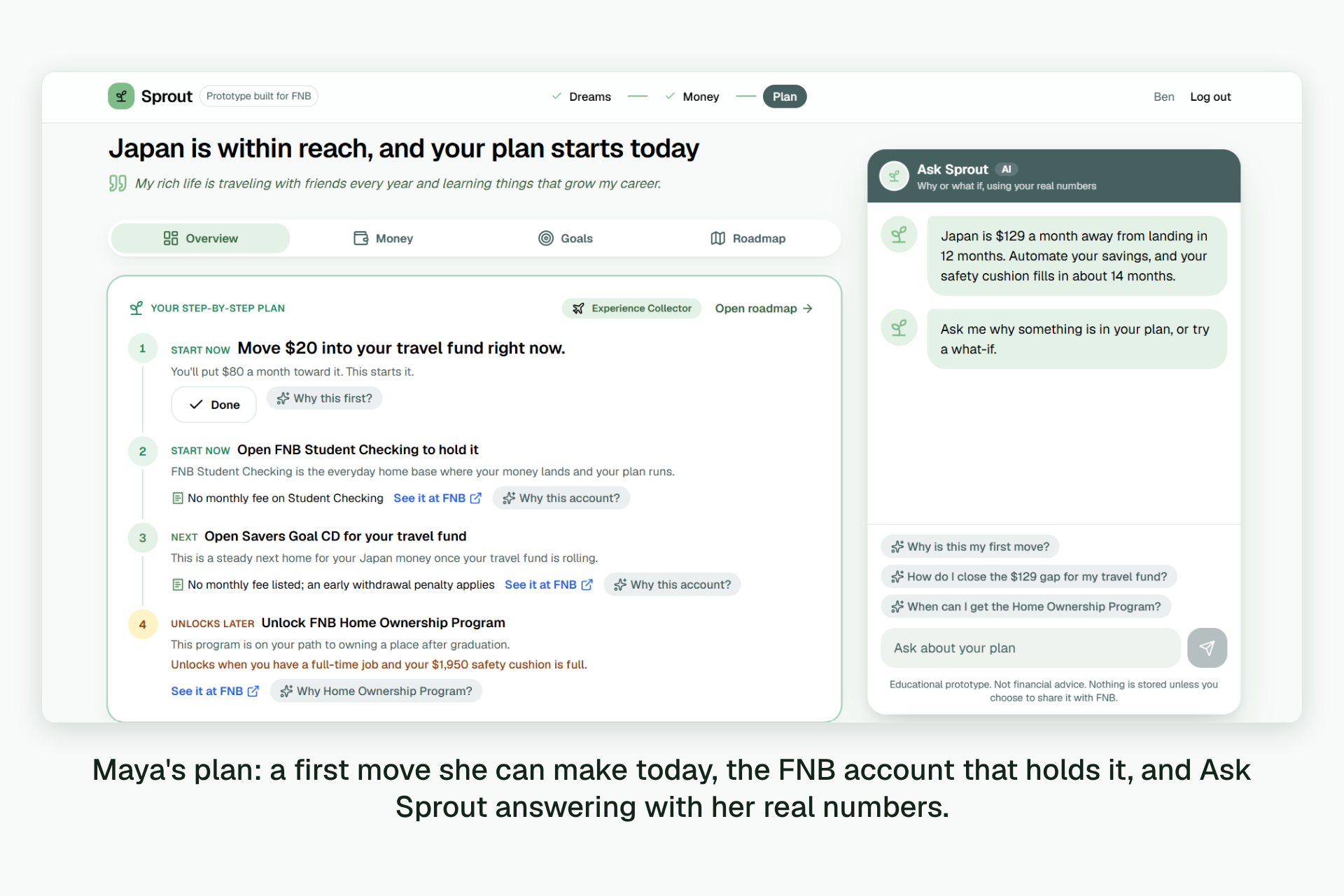
Maya’s plan: a first move she can make today, the FNB account that holds it, and Ask Sprout answering with her real numbers.
-
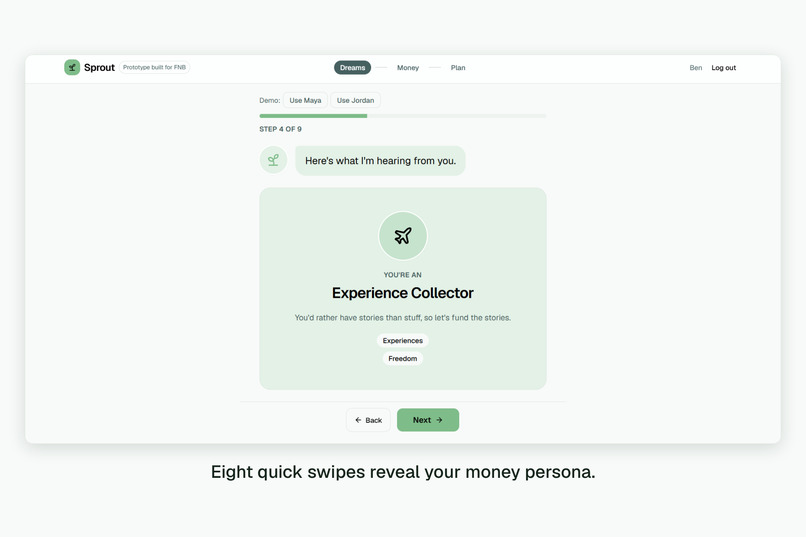
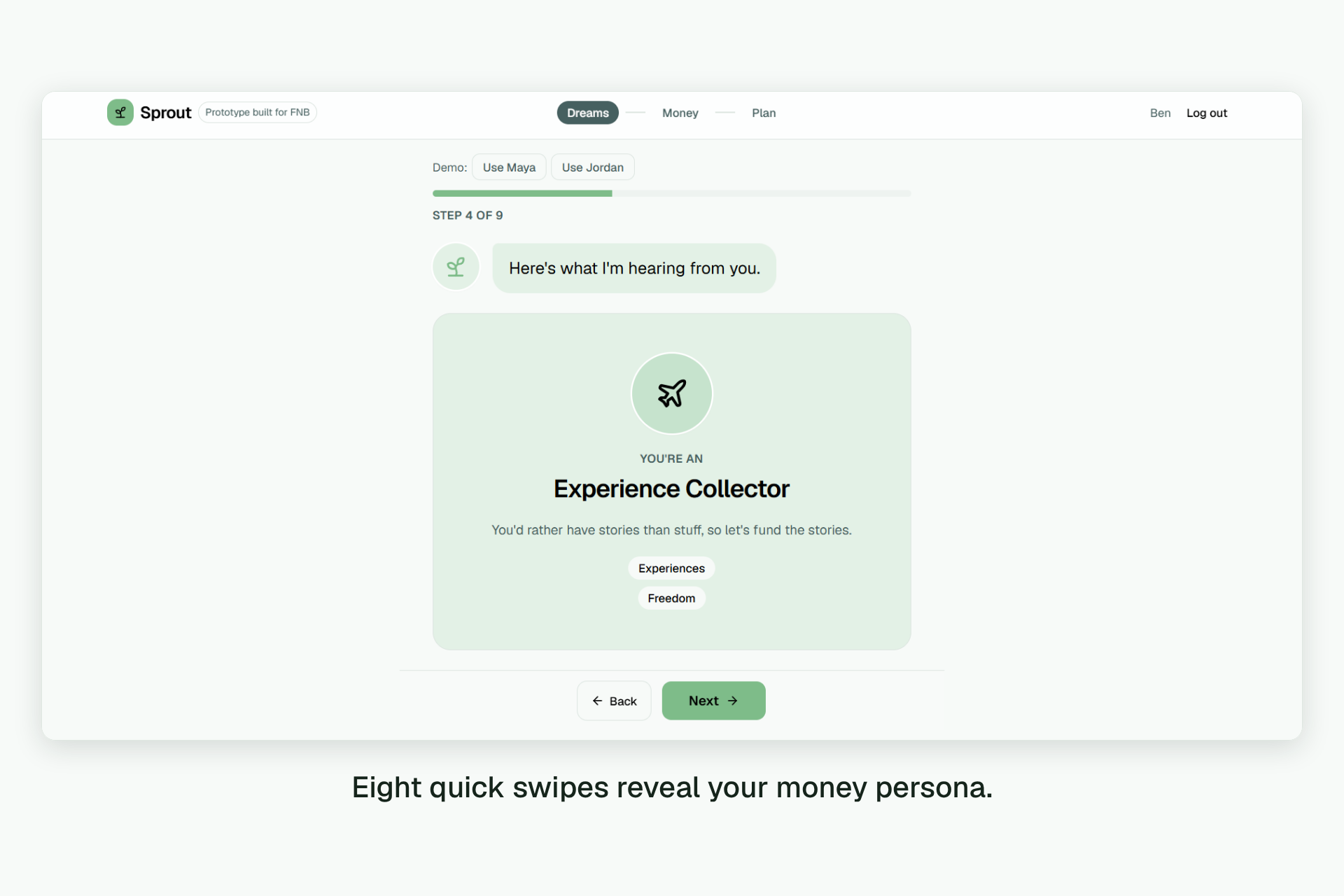
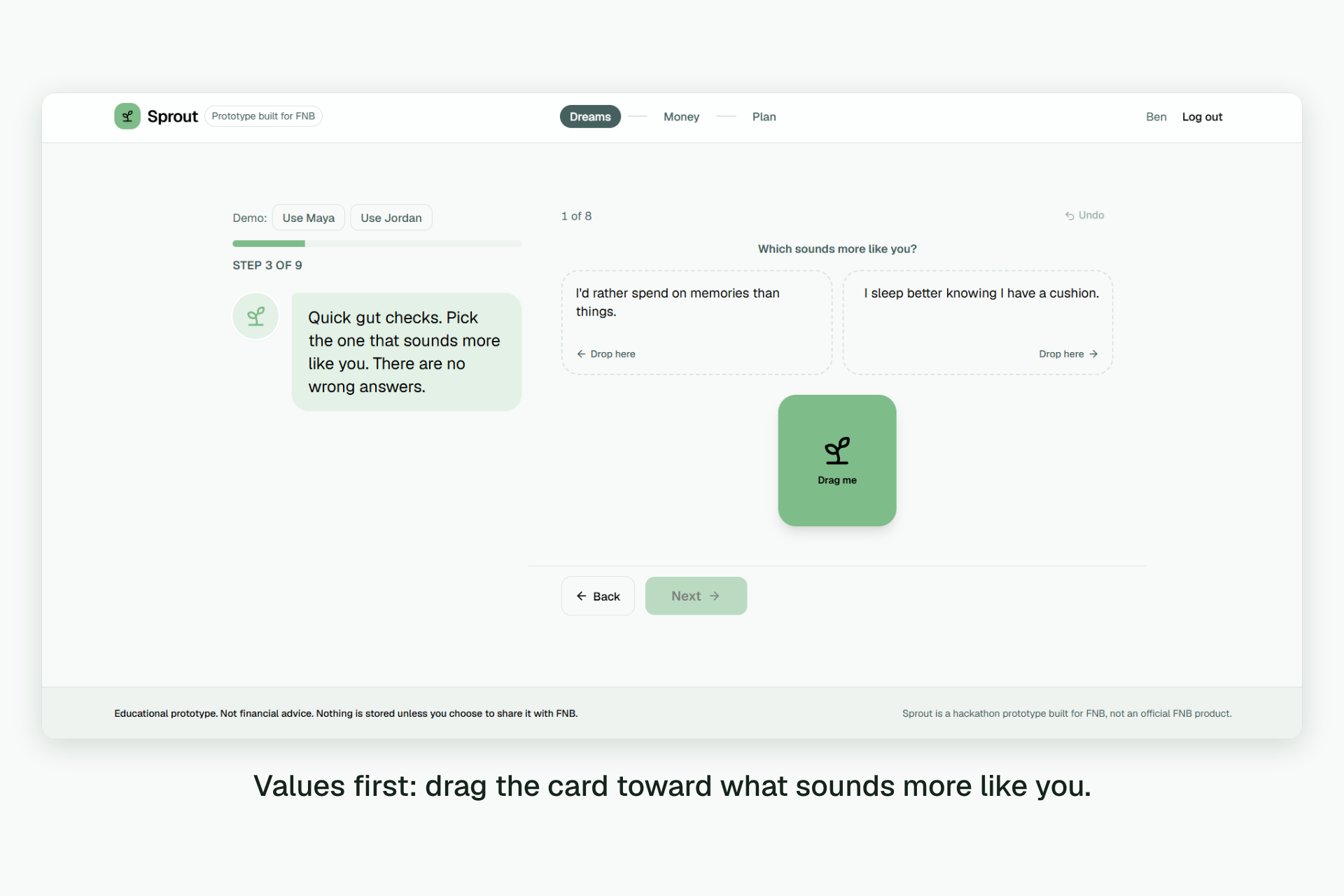
Eight quick swipes reveal your money persona, like Experience Collector.
-
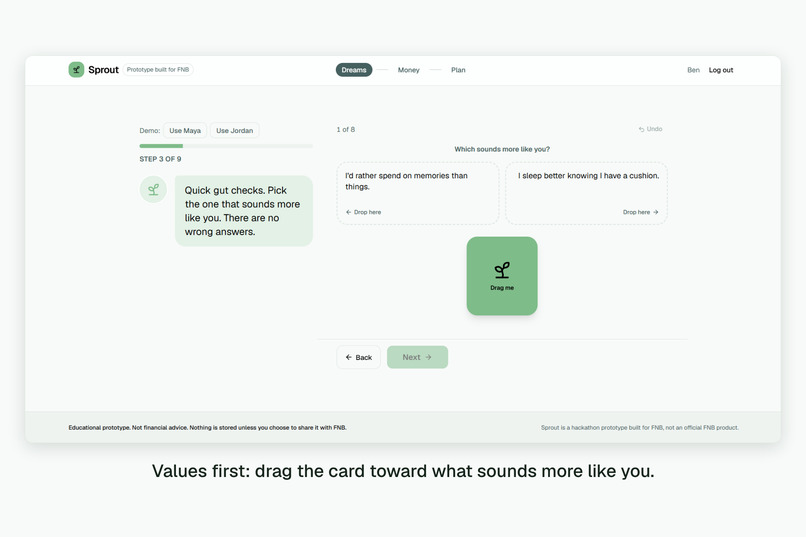
Values first: drag the card toward what sounds more like you.
-
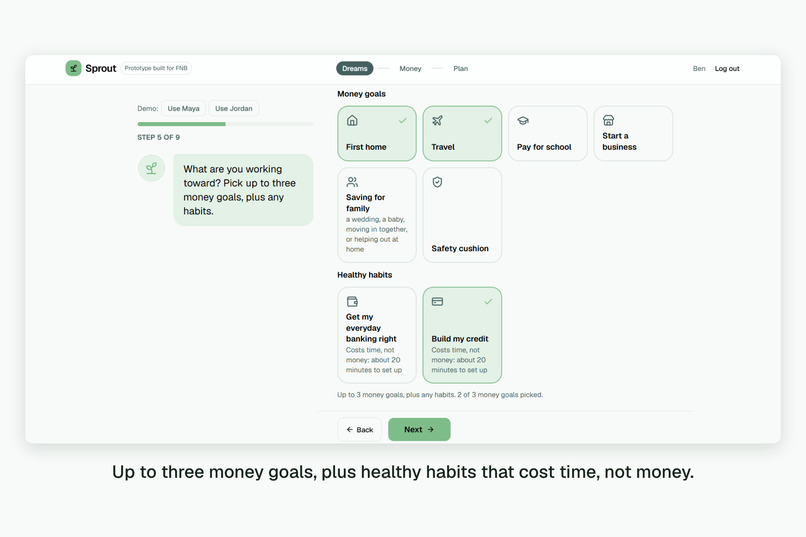
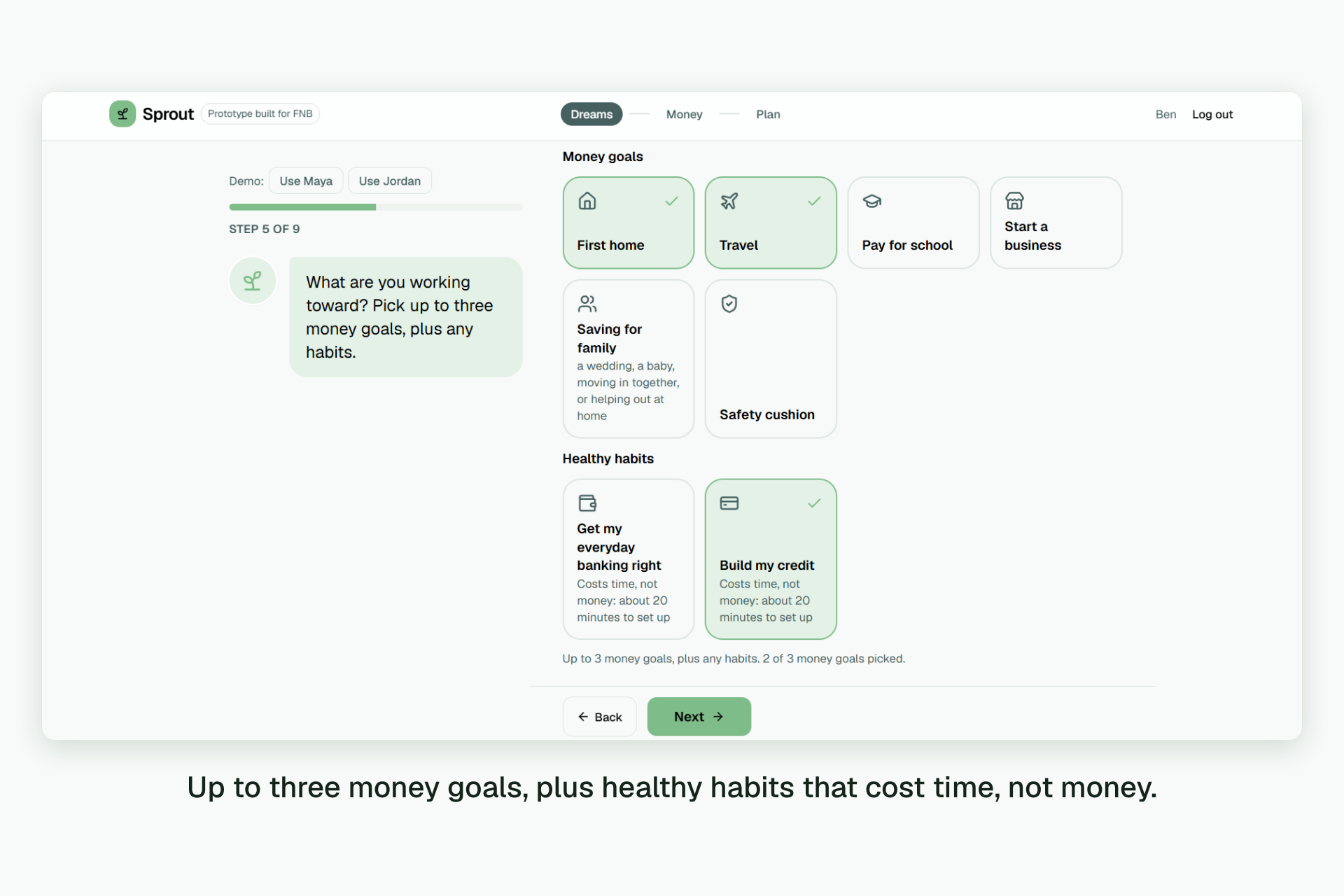
Pick up to three money goals, plus healthy habits that cost time, not money.
-
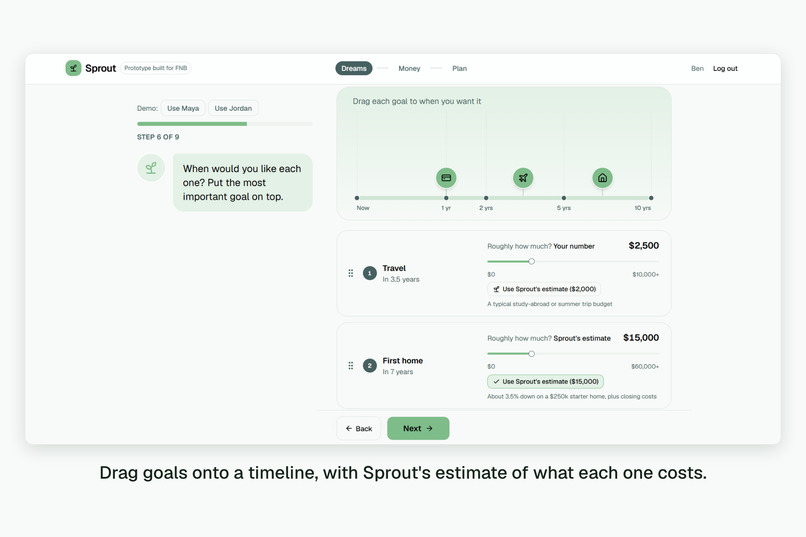
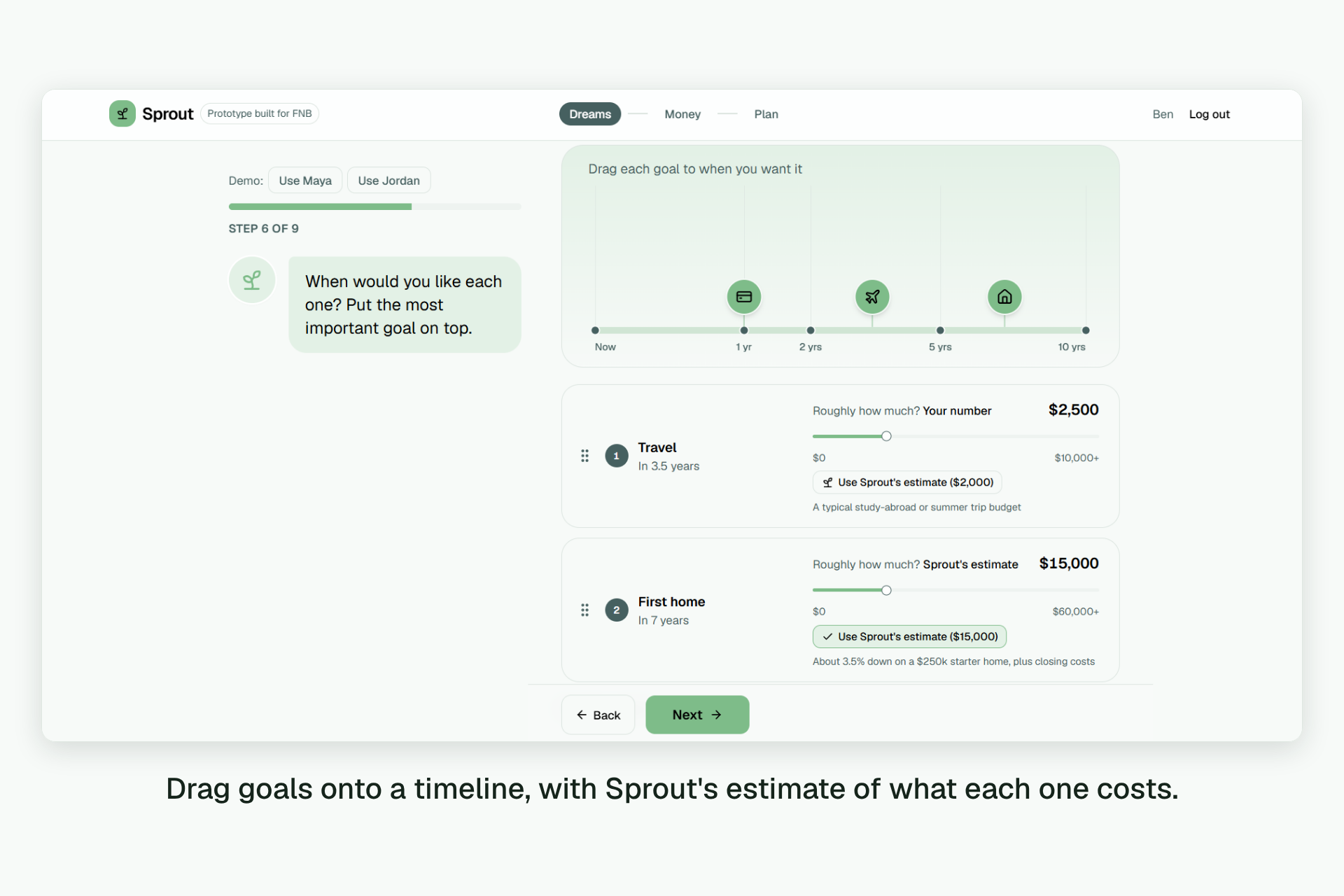
Drag each goal onto a timeline, with Sprout’s estimate of what it costs.
-
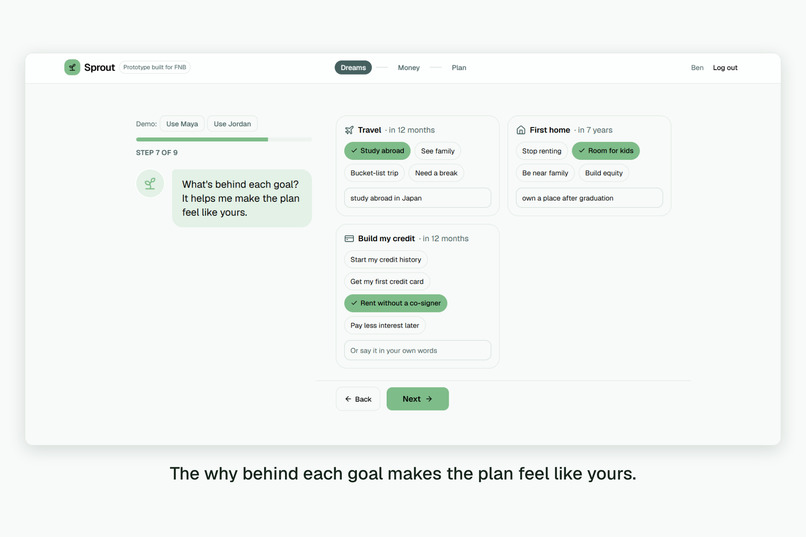
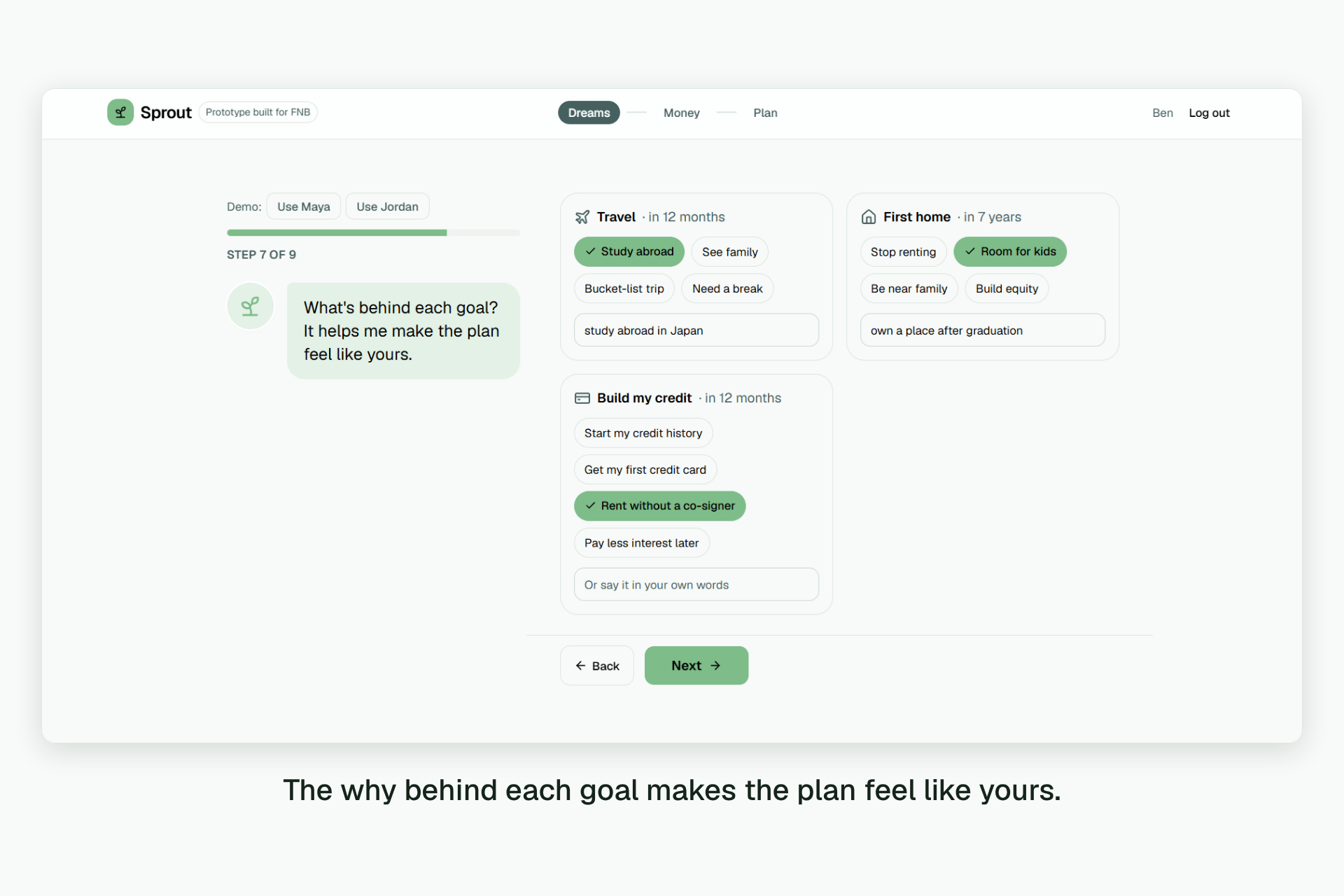
The why behind each goal makes the plan feel like yours.
Try it: getsprout.tech (no account needed to build a plan) · Video: [link] · Code: github.com/beansprout21/hackpsu-f26 · Demo persona: Maya, a sophomore saving to study abroad in Japan · Banker dashboard: role-protected; see the gallery
Tracks: Grand Prize · FNB Challenge · Nittany AI Challenge · MLH Best Use of Auth0
Sprout at a glance
- Implementation: Live at getsprout.tech. An overnight agent loop ran 3,084 generated users, audited 200 live AI plans and 400 Ask Sprout answers, and took failing checks from 3 to 0.
- Clarity: Six steps and one next action ("Move $20 into your travel fund right now"). Every number comes with a why.
- Creativity: Values first, not budget first: same money, opposite swipes, a different plan. The AI explains; a deterministic engine decides every number.
- Growth: Our first financial-planning engine, our first Auth0 role-based access, and our first time running a coordinated team of AI agents through GitHub.
- Impact: Federal Reserve, FINRA and Gallup data show young adults are falling behind with money and don't yet trust AI to help (see Inspiration). Sprout targets that gap, for students and young families, and is built to fit how a bank already works: branches, bankers and its own product catalog.
Inspiration
We didn't learn money from a bank. We learned it from a personal finance book that started with a different question: what do you want your life to look like? Once we had a plan built around that, money made sense, and banks started to feel like partners and accelerators instead of places that sell you things.
Most people our age never get that conversation. In the Federal Reserve's 2025 Survey of Household Economics and Decisionmaking, only 63% of adults ages 18 to 29 said they were doing at least okay financially, versus 73% of all adults (Fed SHED 2025). 61% of investors ages 18 to 34 have made an investment decision based on a social media personality's recommendation (FINRA Foundation). And about 1 in 4 Gen Z adults and millennials who sought financial guidance used AI, while only about 3 in 10 U.S. adults have confidence in AI to manage money (Edward Jones and Gallup via AP).
At opening ceremony, FNB asked: for a big money decision, who do you trust, a 30-year banker, a TikTok finance bro, or an AI agent? Our answer: an AI that hands you and your plan to the banker.
What it does
Most money apps track what you already spent. Sprout starts with what you want, and builds the plan backward from there.
We built Sprout for our peers, college students, and for young families, so personal finance stops being a scary topic people avoid and becomes an accelerator for the life they want.
- We start with what you value. Eight quick swipes reveal your money persona, like Experience Collector or Safety Builder.
- We start with your goals, not your credit score: studying abroad, a first home, building credit, placed on a timeline.
- We take money the way students actually have it: summer savings, aid refunds, family support, gig work, or no money coming in at all. Upload a statement or pay stub and our AI fills it in, then discards the file.
- We turn that into a plan you can start today. Step one is a personal move you can make in two minutes, like "Move $20 into your travel fund right now," with the FNB account that fits right under it, fees included and never hidden. Your month splits into a safety cushion, goals and guilt-free money, and every goal shows when you'll get there. When a goal is out of reach, we give you options instead of shame: more time, a smaller target, or moving money from guilt-free spending.
- We answer your questions. Ask Sprout explains your plan with your real numbers, runs what-ifs and remembers the conversation.
- We hand you to FNB when you're ready. No account is needed to build a plan. Sign in to save a banker-ready PDF or opt in to Share with FNB, and a banker sees your goals before you meet.
Same money, different values, different plan. In our demo, Maya, a sophomore saving to study abroad in Japan, gets a different first move and a different savings split when she swipes for security instead of experiences. Remove the AI and Sprout can't read your values, your statements or your questions: it becomes a calculator.
How we built it
AI is the core of Sprout, and we built an engine around it so it can be trusted with money.
Take the AI out and Sprout stops working: no goal profile in your own words, no plan explained to you, no document upload, no one to ask. Take the engine out and the AI could invent numbers. So each part does what it does best:
- The AI understands and explains. Claude Haiku turns your swipes and goals into a goal profile in your own words. Claude reads uploaded statements and pay stubs to fill in your money. Claude Sonnet explains why each step fits you and powers Ask Sprout, an agent that knows your whole plan, answers with your numbers and remembers the conversation.
- The engine decides. Every number is deterministic code with tests: income from irregular sources, the spending split, the safety cushion, goal timelines, and which FNB products fit and when they unlock.
- Guards verify. We replace any AI sentence with a number the engine didn't produce, drop any product outside FNB's catalog, and give every AI call a timeout and a template fallback, so the plan never breaks.
- Our stack: Next.js, TypeScript, Tailwind and shadcn/ui on Vercel; Auth0 for sign-in plus a banker role that protects the banker dashboard; Upstash Redis for opt-in shared plans (30-day expiry, delete anytime); a product catalog we researched from FNB's public pages.
We built it with a team of AI agents. We ran a lead Claude chat that owned the spec, contracts and backlog, and up to four Claude Code sessions that built in parallel, coordinating only through GitHub issues, PRs and labels. Overnight, we kept three agents going: one generated thousands of test users and checked 25 rules, one fixed what it found, and one audited the AI's live answers, while the lead triaged every hour.
Why it fits each track
- FNB: FNB asked for trusted decisions in the moments that matter, moving people from information to understanding to confidence to action. Sprout does that in order: it understands your goals, explains every number, gives you a first move today, and hands you and your plan to a banker.
- Nittany AI: the AI is the product, not a wrapper. Remove it and there's no goal profile, no explained plan, no document reading and no Ask Sprout. Our engine exists so that AI can be trusted with money.
- Auth0: we ask for sign-in only at the moment it's needed: saving a banker-ready PDF or sharing your plan with FNB. We use the Auth0 Next.js SDK with Universal Login. A post-login Action adds an Auth0 RBAC banker role to the token as a custom claim, and the server checks that role before any shared plan is shown, so a student account can never see another student's plan and the consent text's promise ("only FNB bankers see this") is enforced in code.
Challenges we ran into
- We made our first plan feel like an ad. Step one was "open an account." We rebuilt it so Step one is always personal, with the FNB product underneath as the fit.
- We caught ourselves giving bad advice. Our overnight stress test found Sprout telling students with no income to open a CD that takes $100 to open, suggesting a retirement account for a car fund, and matching a credit card to the safety cushion. We turned each one into a rule, a fix and a regression test before morning. That is why we built a deterministic engine: we can find a mistake and fix it for good.
- We had to model irregular income. Most tools assume a paycheck. We modeled aid refunds, summer savings and "no money coming in" honestly, without shaming anyone.
- We made a deliberate trade-off. We never let the AI produce a number, even though it makes the AI feel less magical, because a money coach that invents figures is worse than none.
Accomplishments that we're proud of
- We shipped a deployed, working product in 24 hours: real AI, sign-in, document upload, opt-in sharing and a banker view.
- We built a plan that changes with what you value, not only with your numbers.
- We ran an overnight agent loop over 3,084 generated users and audited 200 live AI plans and 400 Ask Sprout answers. We took failing checks from 3 to 0 by morning, with 0 crashes.
What we learned
- We learned that trust comes from showing the math, and from saying "not yet" when a product doesn't fit.
- We built our first financial-planning engine, used Auth0 roles for the first time, and ran AI agents as a coordinated team. Our agents moved fast when the spec, contracts and file ownership were clear, and broke things when they weren't.
- We learned that small, specific first steps beat big plans.
What's next for Sprout
We want to pilot Sprout at FNB's Penn State HUB branch and at orientation: students scan a QR code, build a plan, and book with a banker who already knows their goals. We'd measure success by the share of students who complete step one, plans shared, appointments booked, accounts opened, and banker prep time saved. After that, we want a live FNB product feed, compliance-reviewed copy, the plan delivered in FNB's own banker format, two-tap account opening, and Sprout as the goals planner inside the FNB app.
What isn't real yet: product details come from our research of FNB's public pages, not a live feed; there's no bank account linking yet; and shared plans live in a demo store for 30 days. A pilot replaces each with FNB's own systems.
Credits and notes
- We used Ramit Sethi's I Will Teach You to Be Rich as a starting guideline for Sprout's planning method (rich life first, conscious spending, automation, big wins). We adapted every number for students and FNB, and we are not affiliated with the author.
- We built Sprout as a prototype for FNB for HackPSU Fall 2026. We are not affiliated with or endorsed by FNB, and we use no FNB logos. Sprout is an educational prototype, not financial advice, and we store nothing unless you choose to share it with FNB.
- We built on open-source: Next.js, React, Tailwind CSS, shadcn/ui, Base UI, lucide-react, zod, @auth0/nextjs-auth0, @upstash/redis, @anthropic-ai/sdk.
- We built with AI tools and say so: Claude (Anthropic API) runs inside Sprout, and a lead Claude chat plus Claude Code sessions were our development team.
Built With
- anthropic
- auth0
- claude
- claude-code
- github
- next.js
- node.js
- react
- redis
- shadcn
- tailwindcss
- typescript
- upstash
- vercel
- zod


Log in or sign up for Devpost to join the conversation.