-
-

Sprout is an AI growth companion that helps children plan, adapt, and grow.
-
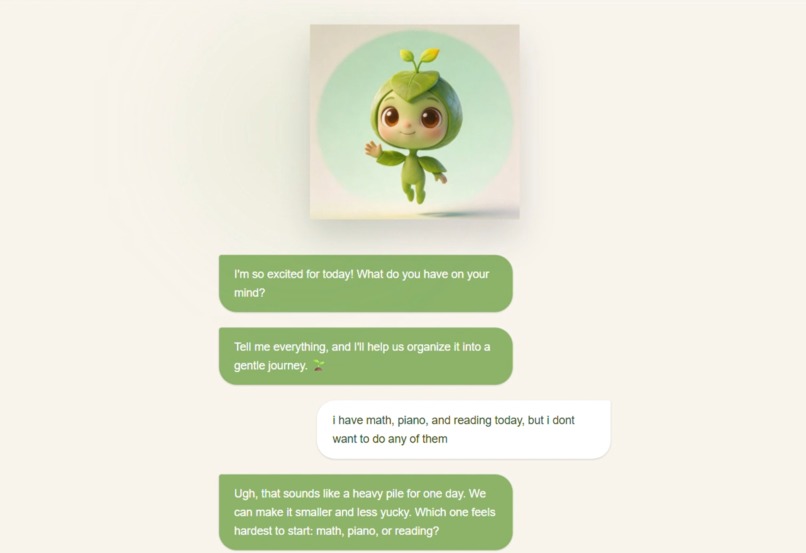
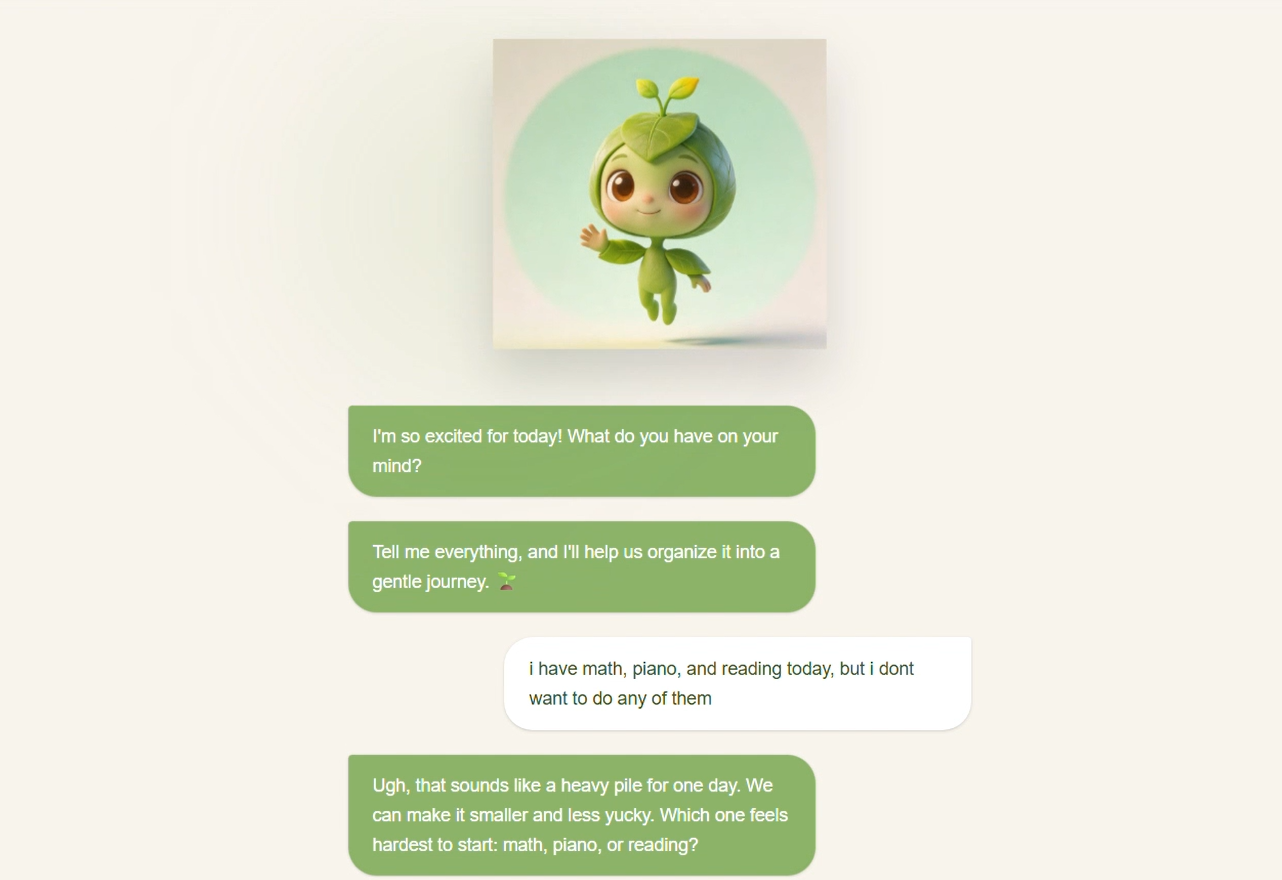
Sprout listens first and asks one supportive question at a time.
-
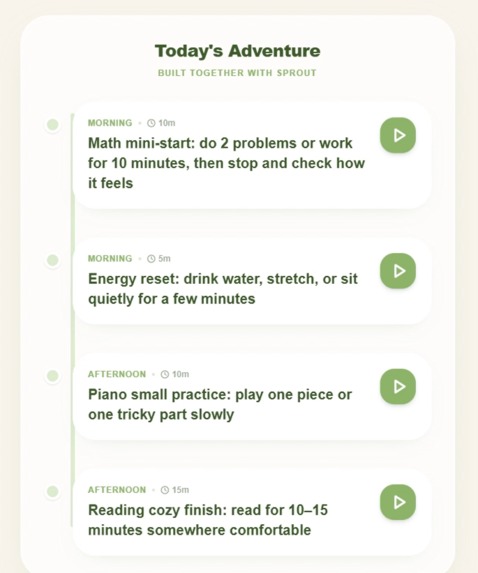
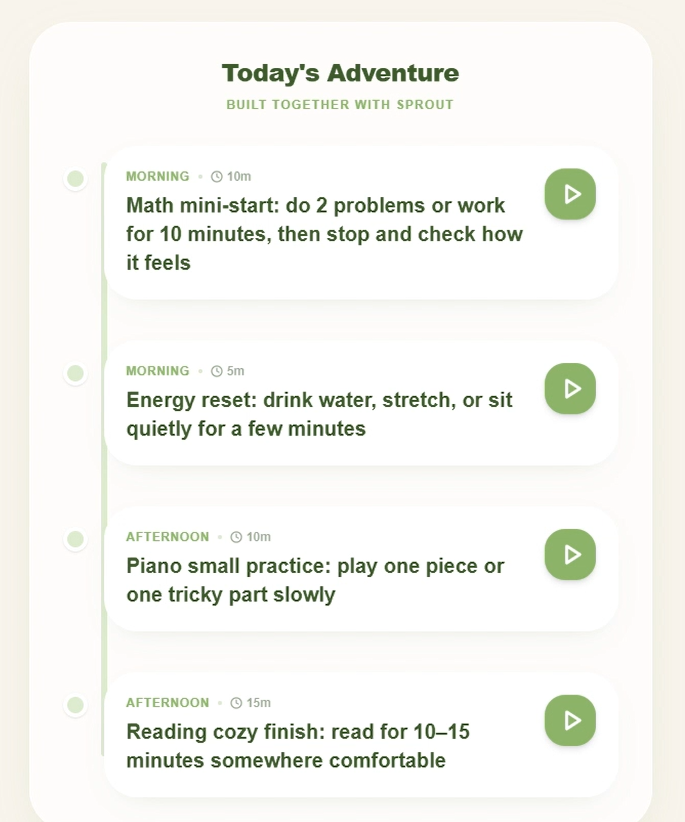
The child’s responsibilities become a balanced and manageable Today’s Adventure.
-
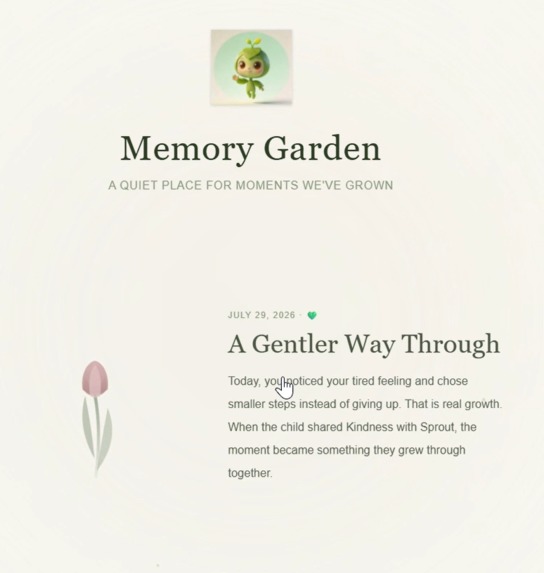
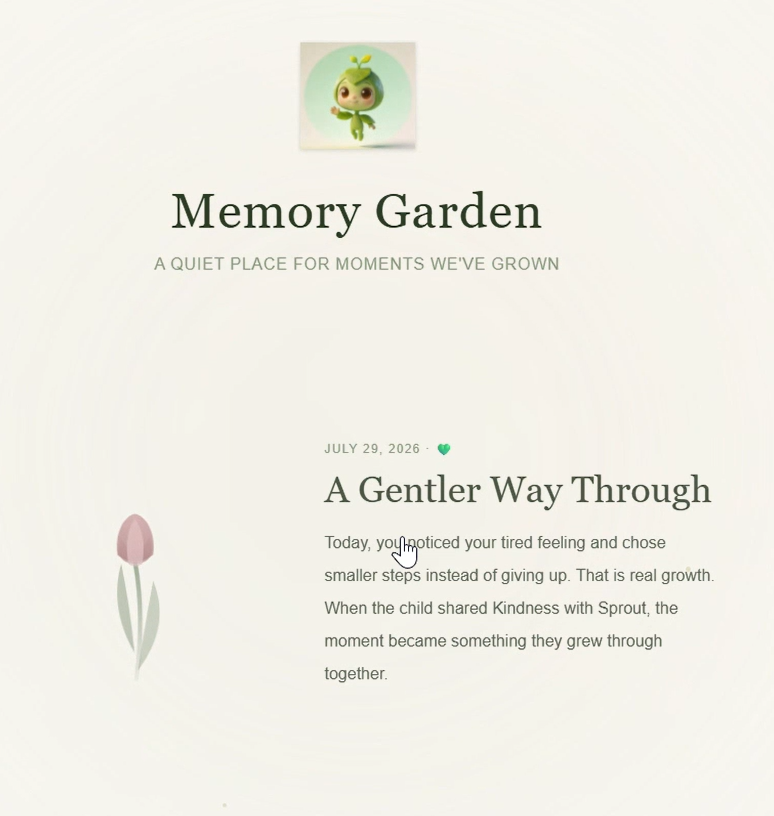
Meaningful progress is preserved in the Memory Garden, helping children recognize how far they have come.

Inspiration
Sprout was inspired by my younger brother, who has ADHD.
I often saw him struggle to organize his day. He usually knew what he needed to do, but when several tasks appeared at once, he did not know where to begin.
I noticed that giving him another checklist rarely helped. What worked better was asking one calm question at a time, helping him identify the hardest task, and adjusting the plan when he felt tired or wanted to give up. Small rewards also helped him stay motivated.
That experience showed me that children do not always need a stricter planner. They need patient guidance, flexibility, and encouragement.
Most planning apps feel static and impersonal, while many reward systems rely on points or coins that are quickly forgotten. I wanted to create something more meaningful: an AI companion that helps children plan, adapt, and grow.
That idea became Sprout.
What it does
Sprout is an AI companion for children ages 8–14 who need support with task initiation, time management, emotional regulation, and adapting plans.
Instead of immediately generating a checklist, Sprout begins by listening. It asks one thoughtful question at a time, helps the child understand what feels difficult, and turns their responsibilities into a balanced Today's Adventure.
When the child's energy or priorities change, Sprout revises the same plan instead of making them start over.
Adjusting a plan is not failure. It is part of planning.
After completing an adventure, the child earns a Care Gift that can be shared with Sprout. Progress becomes part of a relationship rather than disappearing as points.
The Memory Garden preserves meaningful moments, while parents receive a private Growth Story focused on confidence, flexibility, and independence—not transcripts of the child's conversations.
How we built it
I built Sprout as a solo project using Next.js, React, TypeScript, Tailwind CSS, and the OpenAI API.
The application is divided into planning, growth, care, memory, and parent experiences. I created a structured AI workflow that controls when Sprout should ask questions, create a plan, revise an existing plan, generate a reward, or produce a parent insight.
I also designed detailed prompts so Sprout would:
- Ask only one question at a time
- Respond to emotions before offering solutions
- Preserve all of the child's responsibilities
- Revise plans instead of replacing them
- Use warm but age-appropriate language
- Protect private conversations
I used OpenAI Codex as an AI engineering collaborator for implementation and debugging, while I led the product concept, UX, prompt design, testing, and technical decisions.
Challenges we ran into
The biggest challenge was preventing Sprout from becoming another generic AI planner.
Early versions moved too quickly into checklist generation and felt mechanical. I repeatedly refined the prompts, conversation stages, and output rules until the experience felt more patient, human, and supportive.
Another challenge was balancing open-ended conversation with reliable product behavior. Structured AI outputs helped me keep the experience conversational while still producing predictable plans, rewards, memories, and parent insights.
What we learned
This project taught me to evaluate every feature by asking:
Does this genuinely help the child, or does it only make the app look more complete?
I learned that product design is not about adding the most features. It is about making sure every part of the experience supports the user's real needs.
I also learned that prompt engineering is a form of interaction design. Small changes in language and structure can completely change how an AI feels and behaves.
What's next for Sprout
Next, I want to add voice interaction, deeper personalization, and more accessible ways for children to communicate with Sprout.
I also want to test the product with children, parents, teachers, and therapists to improve its safety and usefulness.
In the future, Sprout could become a fully interactive 3D companion that children can speak to, care for, and grow alongside.
Sprout is not meant to plan for children forever.
It is meant to help them learn how to plan for themselves.
Built With
- codex
- css
- github
- gpt-5.5
- json
- lottie
- lucide
- next.js
- node.js
- responses
- schema
- tailwind
- typescript


Log in or sign up for Devpost to join the conversation.