-
-
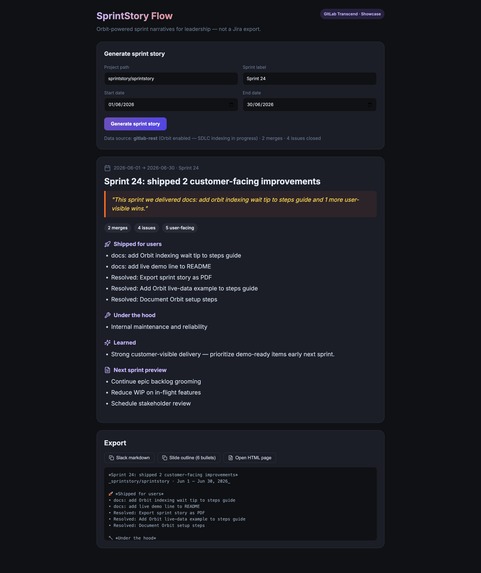
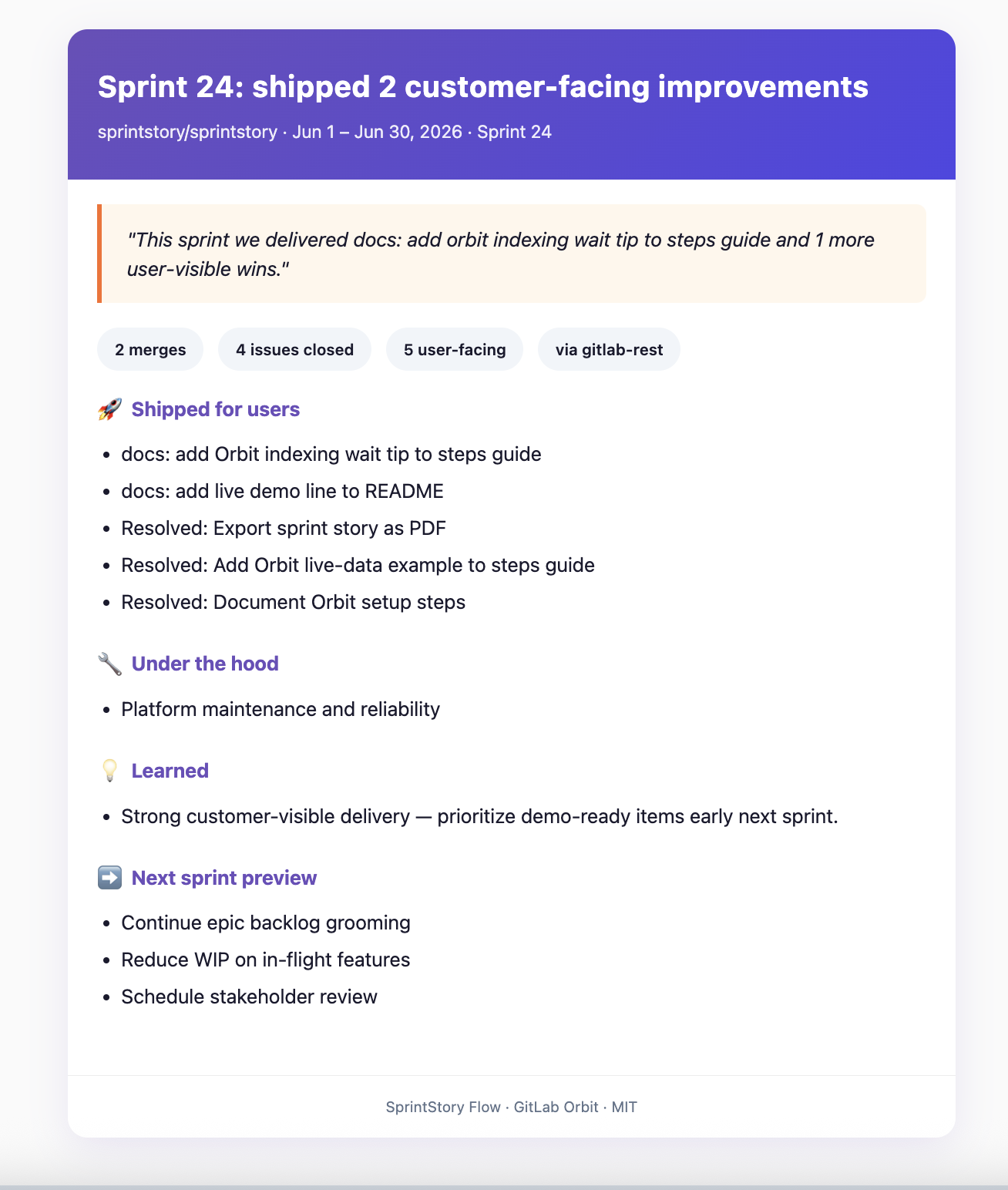
Web Version Showing Orbit Data
-
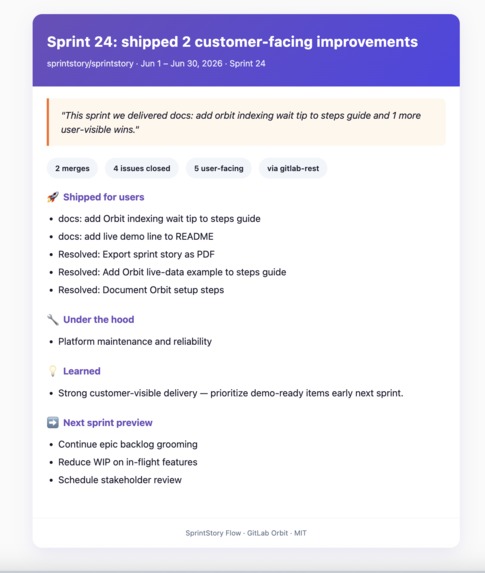
Web Version Html Output
-
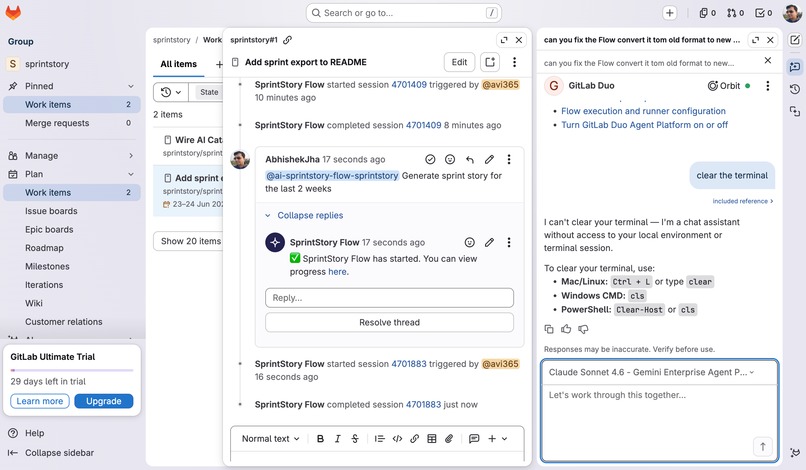
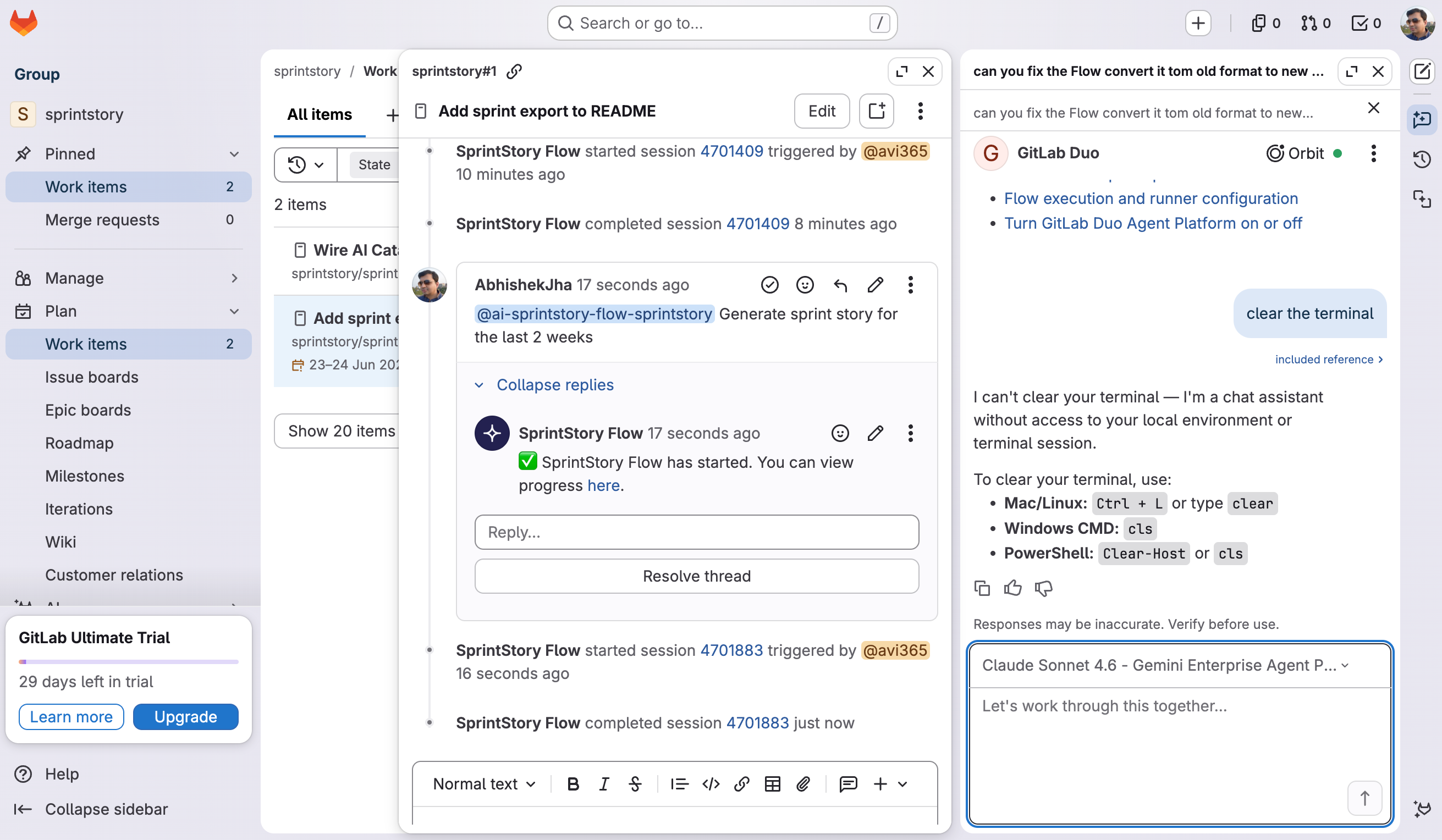
Comment @Mention On Any Issue and Sprint Story Flow will Start
-

Progress Report of Sprint Story Flow Inside Gitlab After Comment

Inspiration
Every sprint ends the same way: an engineering manager stares at a board full of merge requests and closed issues, then spends 1–2 hours writing an update for leadership, Slack, and all-hands. Leadership rarely reads raw GitLab exports. Generic AI summaries sound fluffy and aren't grounded in what actually merged.
GitLab Orbit gives AI a structured graph of MRs, issues, and project context. I built SprintStory Flow for the GitLab Transcend Hackathon (Showcase Track) to answer one question: What if Orbit could write the sprint story for you?
What it does
SprintStory Flow turns GitLab sprint data into leadership-ready narratives—Shipped, Learned, Next—not another unread Jira export.
It runs two ways:
AI Catalog Flow — A two-agent Duo pipeline (AI Catalog #1012003):
- Sprint collector — fetches merged MRs and closed/open issues
- Story writer — outputs headline, Shipped · Under the hood · Learned · Next, all-hands quote, Slack markdown, and a 6-bullet slide outline
Trigger on any issue: @ai-sprintstory-flow-sprintstory Generate sprint story for the last 2 weeks
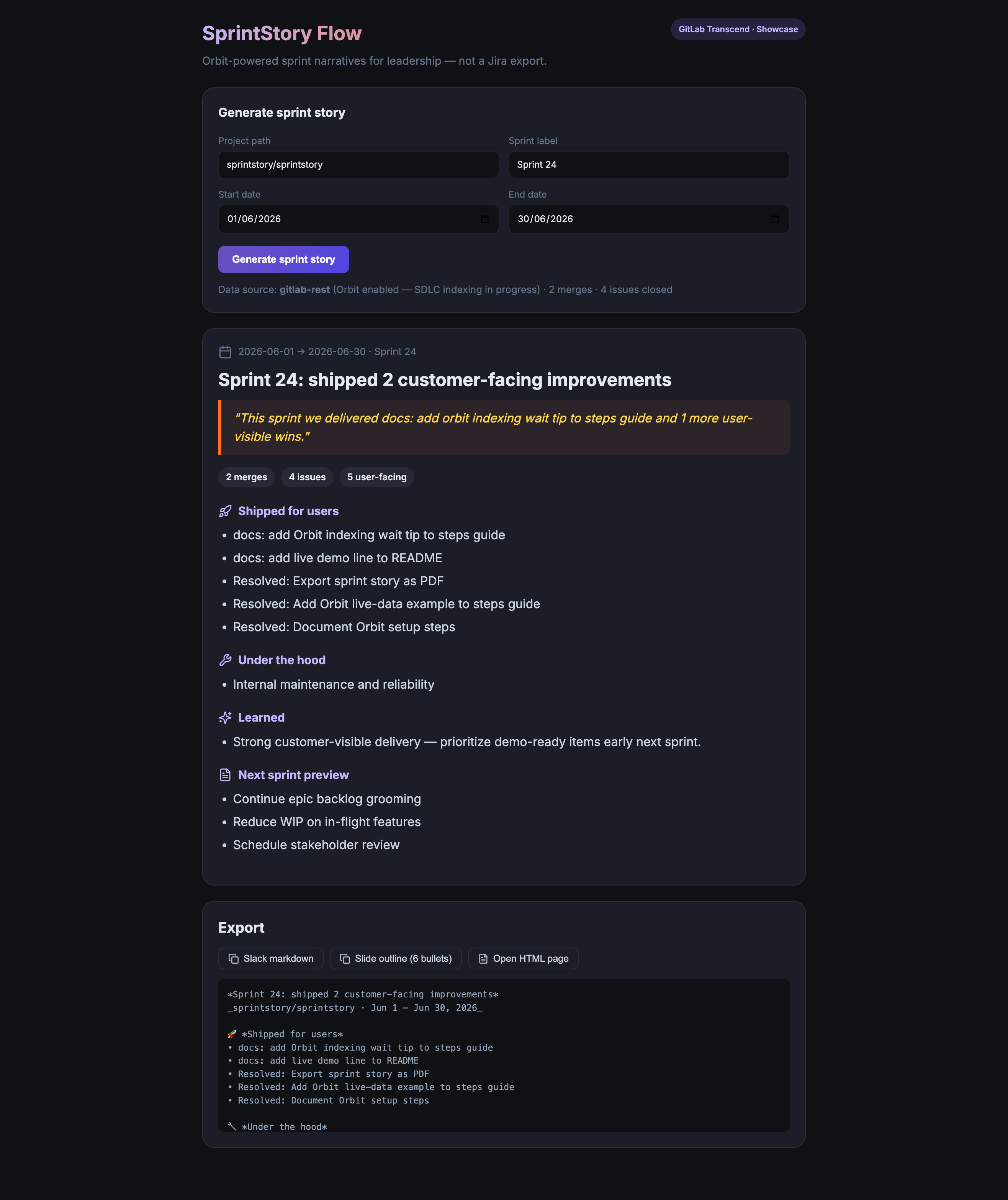
Web demo + CLI — Magazine-style sprint page, GET/POST /api/story, CLI export to HTML/Slack/slides, and Orbit traversal queries via glab orbit remote query.
Repo: gitlab.com/sprintstory/sprintstory
How we built it
| Layer | Stack |
|---|---|
| Web UI | React + Vite |
| API | Express / Vercel serverless |
| Data | Orbit REST API → GitLab REST fallback → demo mode |
| Flow | YAML v1, 2 AgentComponents, Mention trigger |
| Platform | sprintstory group — Orbit + Duo Agent Platform enabled |
Sprint window + project → Orbit/REST data → MRs + issues → SprintStory template → HTML · Slack · slides
Steps: built web app and API → authored flow YAML → published to AI Catalog → enabled flow + Mention trigger → validated with real project data via gitlab_api_get.
Challenges we ran into
- Orbit needs a top-level group — Personal namespaces couldn't enable Orbit; the
sprintstoryUltimate group fixed it. - AI Catalog YAML — Hidden required fields (
unit_primitives: [],toolset: []) and GraphQL validation that differed from Duo Chat advice. query_graphreturned fake data — GraphQL queries pulledorbit/coresamples; traversal via DAP returned synthetic 2025 MRs even for the correct project path. Fix:gitlab_api_getin the flow; Orbit REST in the web app.- Missing Mention trigger — Enabling the catalog item wasn't enough;
@mentiondid nothing until the trigger was added. - Orbit indexing delay — New projects need time before graph data appears; REST fallback keeps demos reliable.
- Wrong date windows — Agents sometimes used 2025 instead of 2026 until prompts were tightened.
Accomplishments that we're proud of
- Working AI Catalog flow — Public, enabled, triggerable via
@mention, finished in ~2 minutes with verified real data. - Grounded narratives — Stories from actual MRs like docs: add live demo line to README, not invented auth/CI fiction.
- Dual demo paths — GitLab-native flow automation + web app with Orbit queries and export.
- Full repo — Web UI, API, CLI, Orbit query files, skill, flow YAML, CI, MIT license, and docs.
- Leadership-focused output — Structured Shipped · Learned · Next with Slack and slide exports, not a ticket dump.
What we learned
- Context quality beats model hype — Real MR titles beat polished fiction.
- Flows need validation, not trust — Agents accept wrong dates and demo data unless tools enforce checks.
- Orbit is the differentiator — Structured SDLC data → workflow automation, aimed at engineering managers.
- Platform integration is layered — Orbit + Duo + AI Catalog + triggers each have their own setup surface.
- Fallbacks matter — REST fallback kept the demo reliable while Orbit indexing caught up.
What's next for SprintStory Flow
- Implement PDF export (#5)
- Post generated stories back as issue comments from the flow
- Group-level sprint aggregation across multiple projects via Orbit
- Only claim "shipped" when a linked MR exists, not just a closed issue
Built With
- express.js
- gitlab
- gitlab-duo-agent-platform
- gitlabaicatalog
- gitlaborbitqueryapi
- gitlabrestapi
- node.js
- react
- typescript
- vercel
- vite

Log in or sign up for Devpost to join the conversation.