-
-
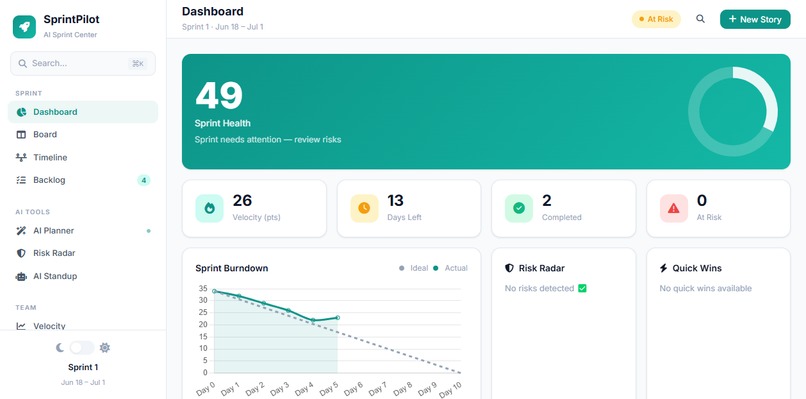
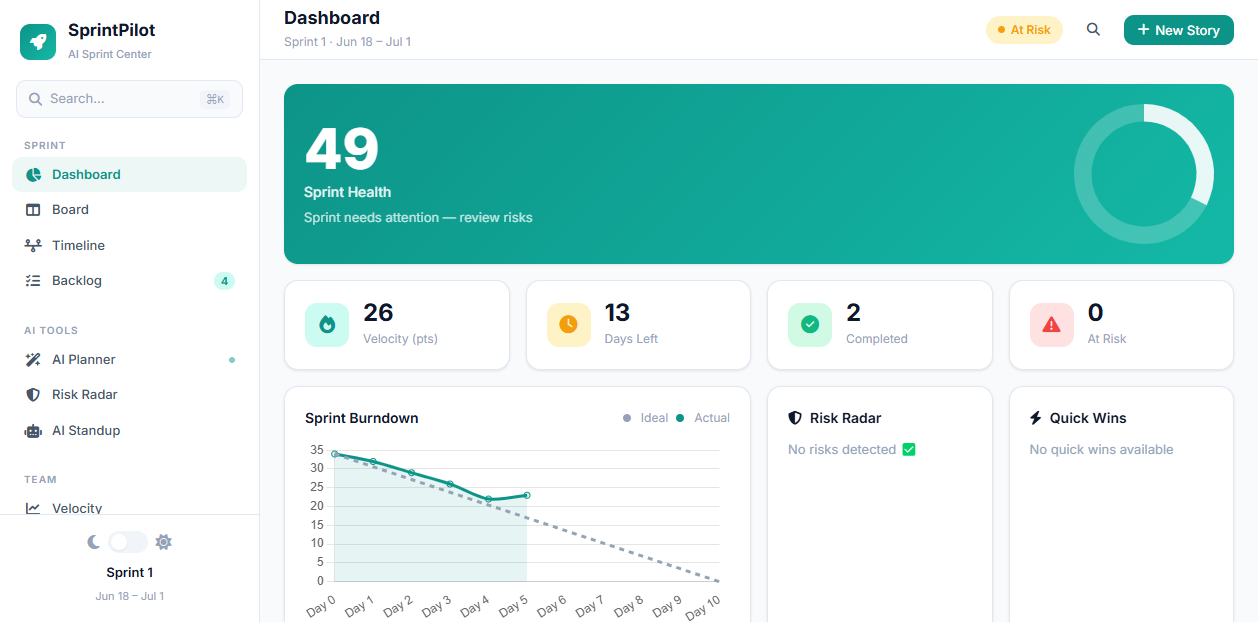
Dashboard with health score, stats, burndown chart
-
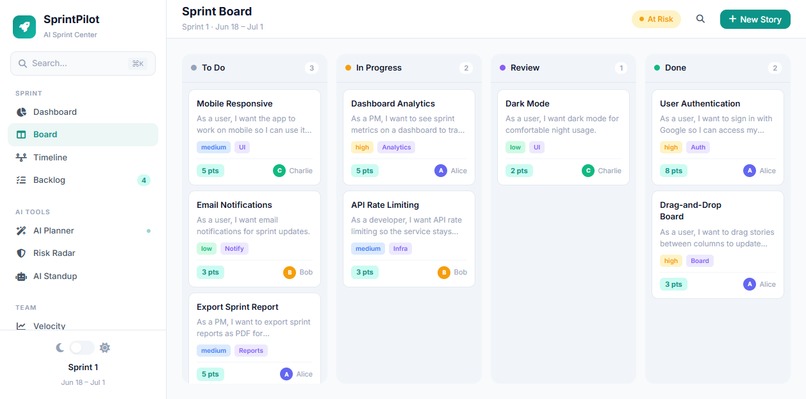
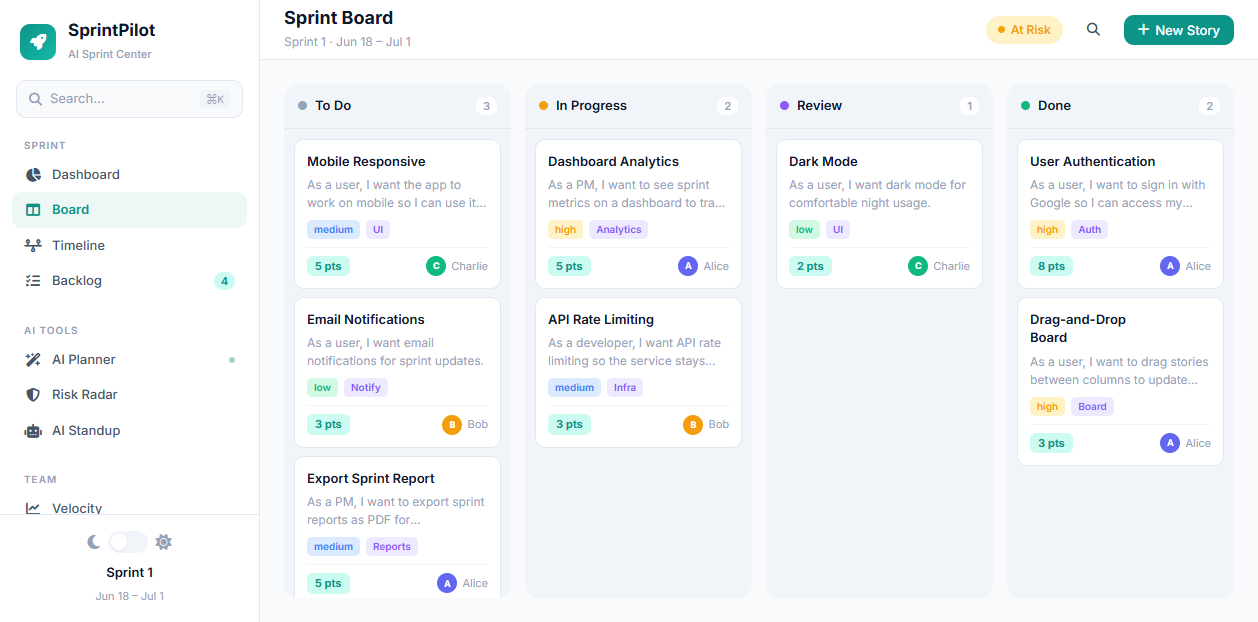
Sprint Board with all 4 columns and story cards
-
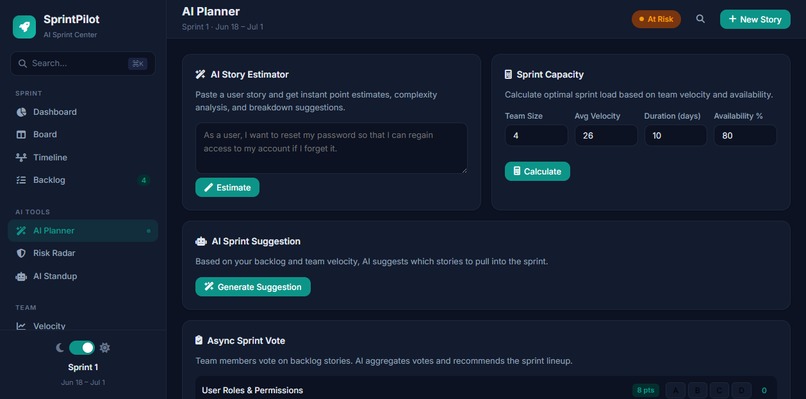
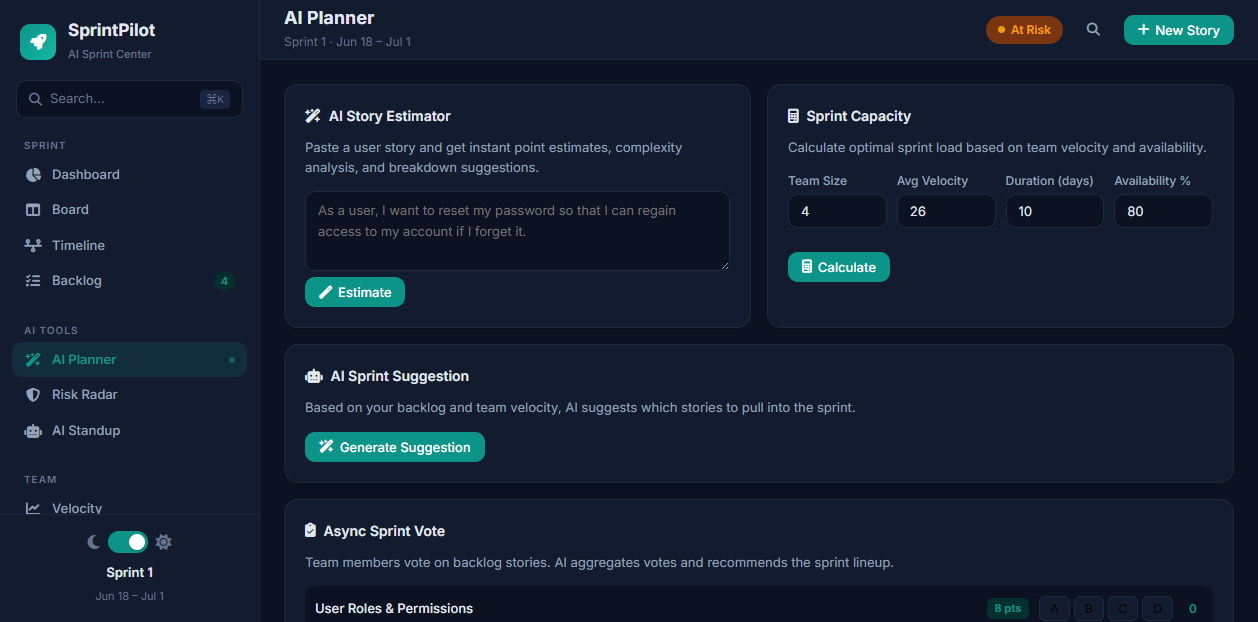
I Planner in dark mode
Inspiration
Sprint planning meetings are the #1 time sink for agile teams. We've all been there -- 2 hours in a room arguing over story points while half the team checks their phones. I wanted to build a tool that replaces that meeting with AI-powered automation while keeping the human element (team voting, retrospectives) intact. The inspiration came from watching how Linear and Shortcut are evolving -- they're not just tracking tools anymore, they're becoming AI-native development environments. But most teams still use Jira as a glorified spreadsheet. I wanted to build something that feels like $50/month SaaS product but runs entirely in the browser.
What it does
SprintPilot is an AI sprint command center with 10 major features: 1. Sprint Health Score (0-100) -- Weighted formula: done=100%, review=80%, in-progress=50%. Shows real-time sprint risk. 2. Risk Radar -- Auto-detects critical stories not started, large stories at risk, unassigned active stories, and sprint behind schedule. 3. Quick Wins Finder -- Identifies high-impact, low-effort stories for instant momentum. 4. AI Story Estimator -- Paste a story, get instant point estimates with complexity analysis and breakdown suggestions. 5. AI Sprint Suggestion -- Recommends which backlog stories to pull based on velocity. 6. Async Sprint Vote -- Team votes on stories without meetings. AI aggregates results. 7. AI Standup Generator -- Auto-generates daily standup summaries from status changes. 8. Team Workload Balancer -- Visual capacity cards per team member. 9. Command Palette (Ctrl+K) -- Linear-style instant search and navigation. 10. Sprint Timeline -- Visual Gantt-style view of story progress.
How I built it
Zero frameworks. HTML, CSS, and vanilla JavaScript only. This was intentional -- no build tools, no dependencies to install, just opencindex.html and use.
 - Chart.js for burndown charts, velocity trends, and donut charts
 - SortableJS for drag-and-drop on the Kanban board
 - CSS custom properties for the dark/light theme system
 - localStorage for data persistence (no backend needed)
 - Font Awesome 6 for professional iconography
The health score algorithm uses a weighted formula:
score = ((done * 1.0 + review * 0.8 + progress * 0.5) / total) * 100 - (high_risks * 10)
The risk radar runs 4 checks on every render: critical-not-started, large-story-risk, unassigned-active, and sprint-behind-schedule.
Challenges I faced
 1. Making it look premium without a framework -- Achieved through generous whitespace, consistent 200ms transitions, glassmorphism cards, and a cohesive teal color system.

 2. Burndown chart timing -- Chart.js needs the canvas to be visible before rendering. Solved with setTimeout(renderBurndown, 100) after the dashboard loads.

 3. Health score calibration -- The initial formula (done/total * 100) gave scores that were too low for sprints in progress. Fixed by weighting in-progress and review stories.

 4. Command palette -- Building a Linear-style Ctrl+K search that searches stories, navigation, and actions simultaneously required careful event handling and fuzzy matching.
What I learned
 - AI-powered tools don't need complex backends. Smart algorithms + good UX = powerful product.
 - The "health score" concept (like Lighthouse scores) is more intuitive than raw metrics.
 - Async-first ceremonies (voting, standups) reduce meeting fatigue significantly.
 - Premium UI is 80% whitespace, typography, and transitions -- not flashy graphics.
 - Command palettes (Ctrl+K) are the new standard for power-user navigation.
Challenges we ran into
Making it look premium without a framework -- Achieved through generous whitespace, consistent 200ms transitions, glassmorphism cards, and a cohesive teal color system.
- Burndown chart timing -- Chart.js needs the canvas to be visible before rendering. Solved with setTimeout after the dashboard loads.
- Health score calibration -- The initial formula gave scores that were too low for sprints in progress. Fixed by weighting in-progress and review stories.
- Command palette -- Building a Linear-style Ctrl+K search that searches stories, navigation, and actions simultaneously required careful event handling and fuzzy matching.
- Dark mode consistency -- Ensuring all 10 views, charts, modals, and side panels look correct in both themes required a systematic CSS variable approach.
Accomplishments that we're proud of
- Built a premium SaaS-quality tool with zero frameworks -- just HTML, CSS, and vanilla JavaScript
- 10 major features including AI estimation, risk radar, health scoring, async voting, and command palette
- The health score algorithm provides instant sprint visibility that competitors don't offer
- Dark and light themes with smooth transitions across all 10 views
- Responsive design that works on desktop, tablet, and mobile
- The entire app runs client-side with no backend, no build tools, no dependencies to install
- Looks and feels like a $50/month SaaS product, not a weekend hackathon project
## What we learned
AI-powered tools don't need complex backends. Smart algorithms combined with good UX create powerful products.
- The "health score" concept (like Lighthouse scores) is more intuitive than raw metrics for quick decision-making.
- Async-first ceremonies (voting, standups) significantly reduce meeting fatigue for distributed teams.
- Premium UI is 80% whitespace, typography, and smooth transitions -- not flashy graphics or animations.
- Command palettes (Ctrl+K) are becoming the standard for power-user navigation across modern tools.
- CSS custom properties make theming effortless when planned from the start.
- Chart.js requires the canvas to be visible before rendering -- timing matters for single-page apps.
What's next for SprintPilot
 - Real-time collaboration with WebSocket support for multi-user sprint planning
 - Integration with Jira, Linear, and GitHub Issues to import/export stories
 - AI-powered sprint retrospective analysis that identifies patterns across multiple sprints
 - Natural language sprint queries -- ask "what's blocking Bob?" and get instant answers
 - Mobile app with push notifications for standup reminders and risk alerts
 - Sprint history and analytics dashboard for tracking team improvement over time
 - Slack and Microsoft Teams integration for async ceremonies directly in chat
 - Custom health score weights so teams can tune the algorithm to their workflow
Built With
- chart.js
- css
- font-awesome
- github
- google-font
- html
- javascript
- localstorage
- novus-ai
- sortablejs

Log in or sign up for Devpost to join the conversation.