-
-
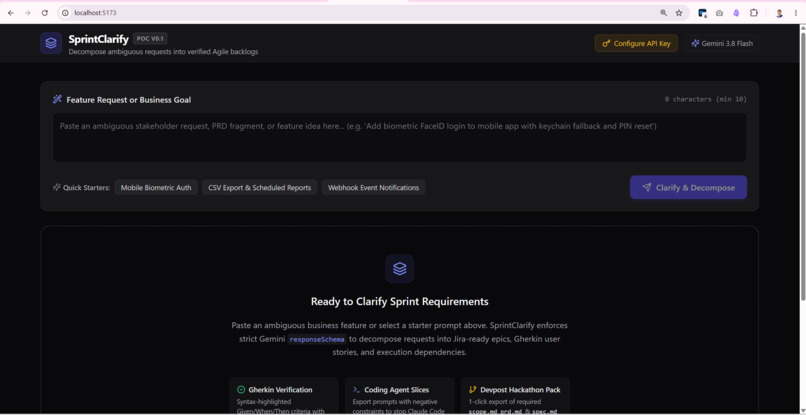
Input Dashboard
-
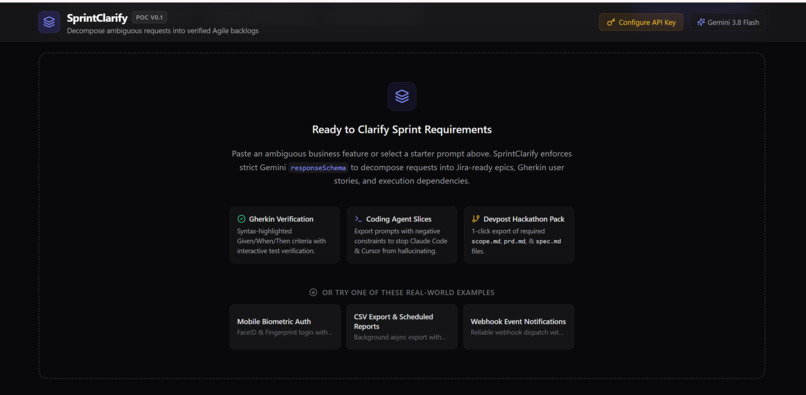
Input Dashboard
-
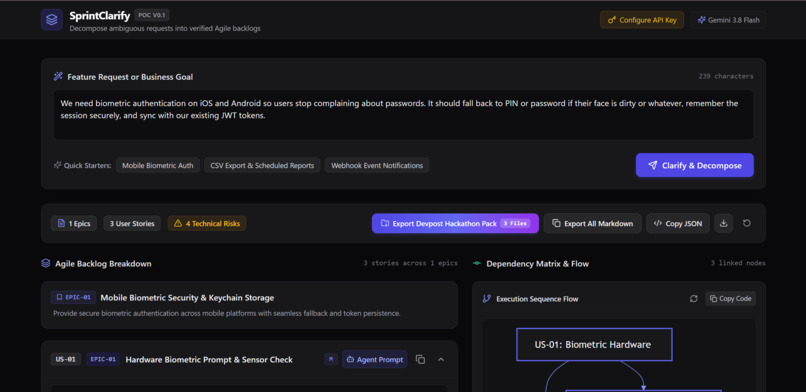
Output Overview & Export Bar
-
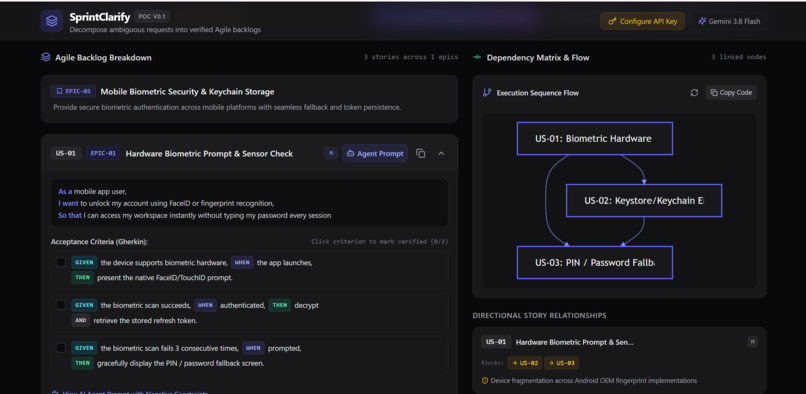
Output Story Cards & Dependency Flow
-
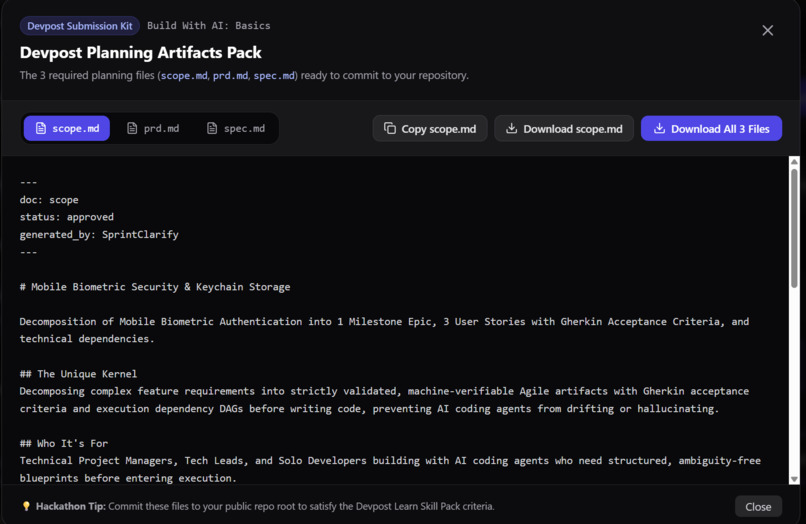
Devpost Planning Artifact packs - Scope
-
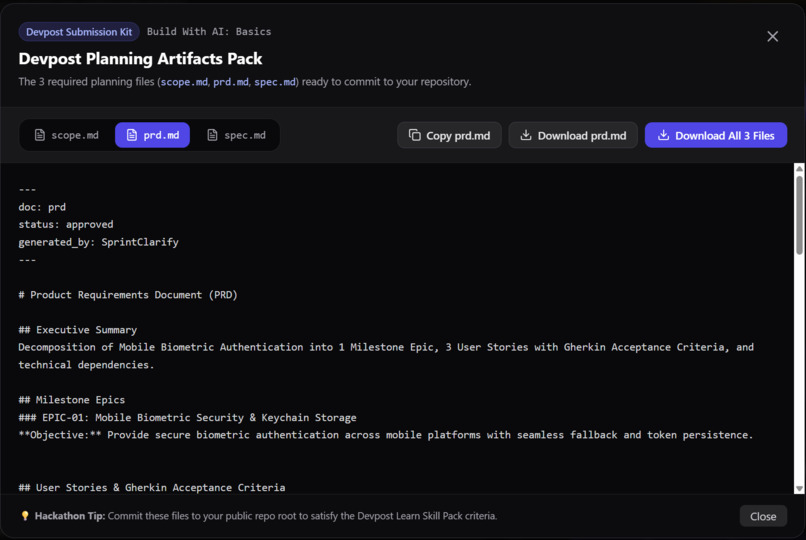
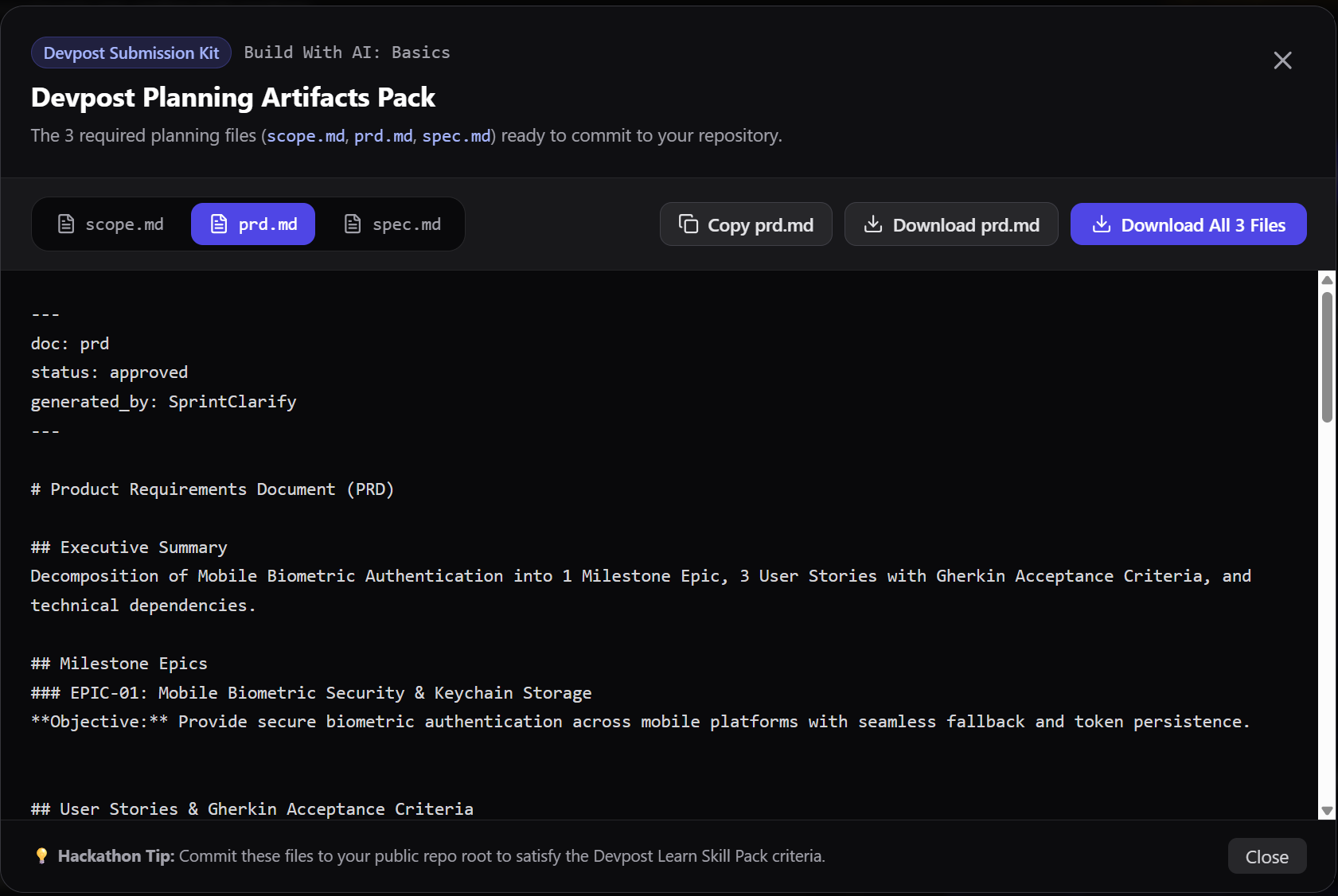
Devpost Planning Artifact packs - prd
-
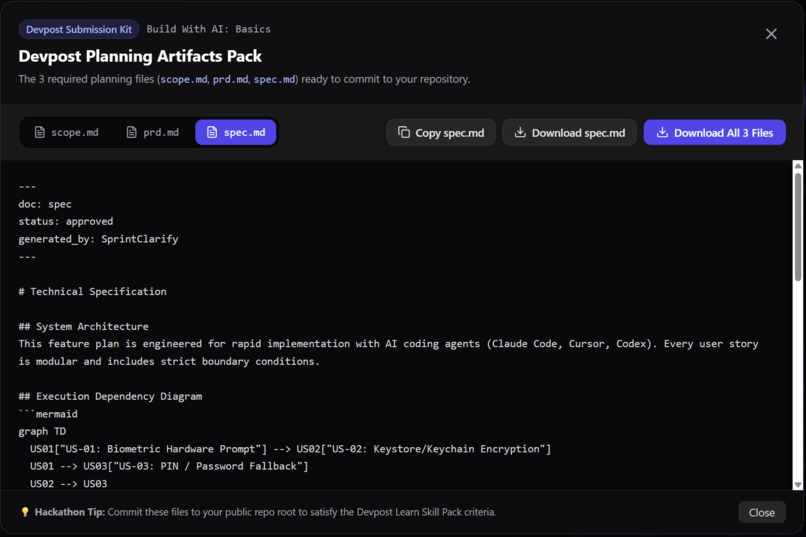
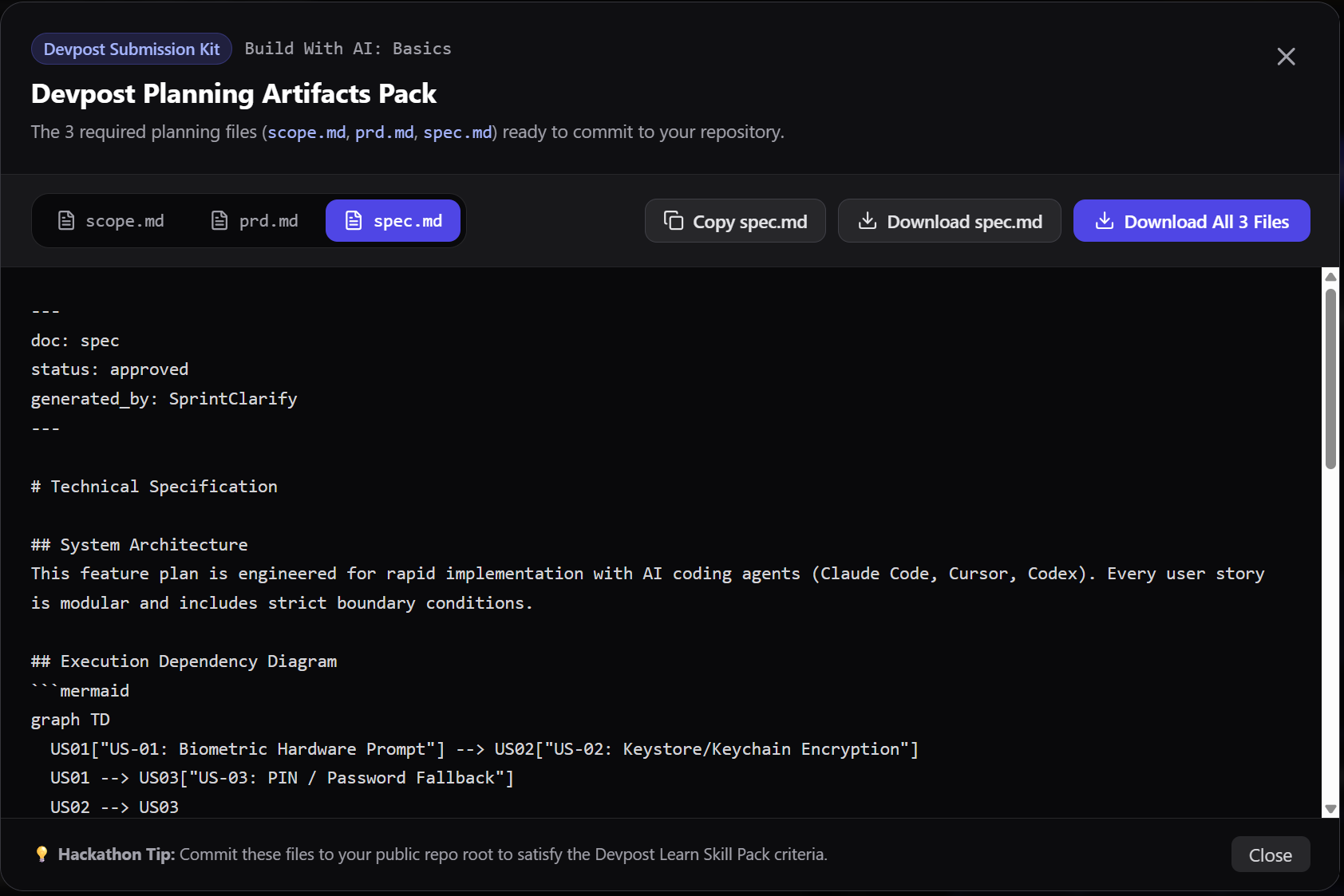
Devpost Planning Artifact packs - spec
Inspiration
In agile teams, business requirements frequently arrive as high-level, ambiguous statements. Technical Project Managers, Scrum Masters, and Tech Leads spend substantial manual effort breaking these one-liners down into epics, granular user stories, acceptance criteria, and technical task dependencies before sprint planning.
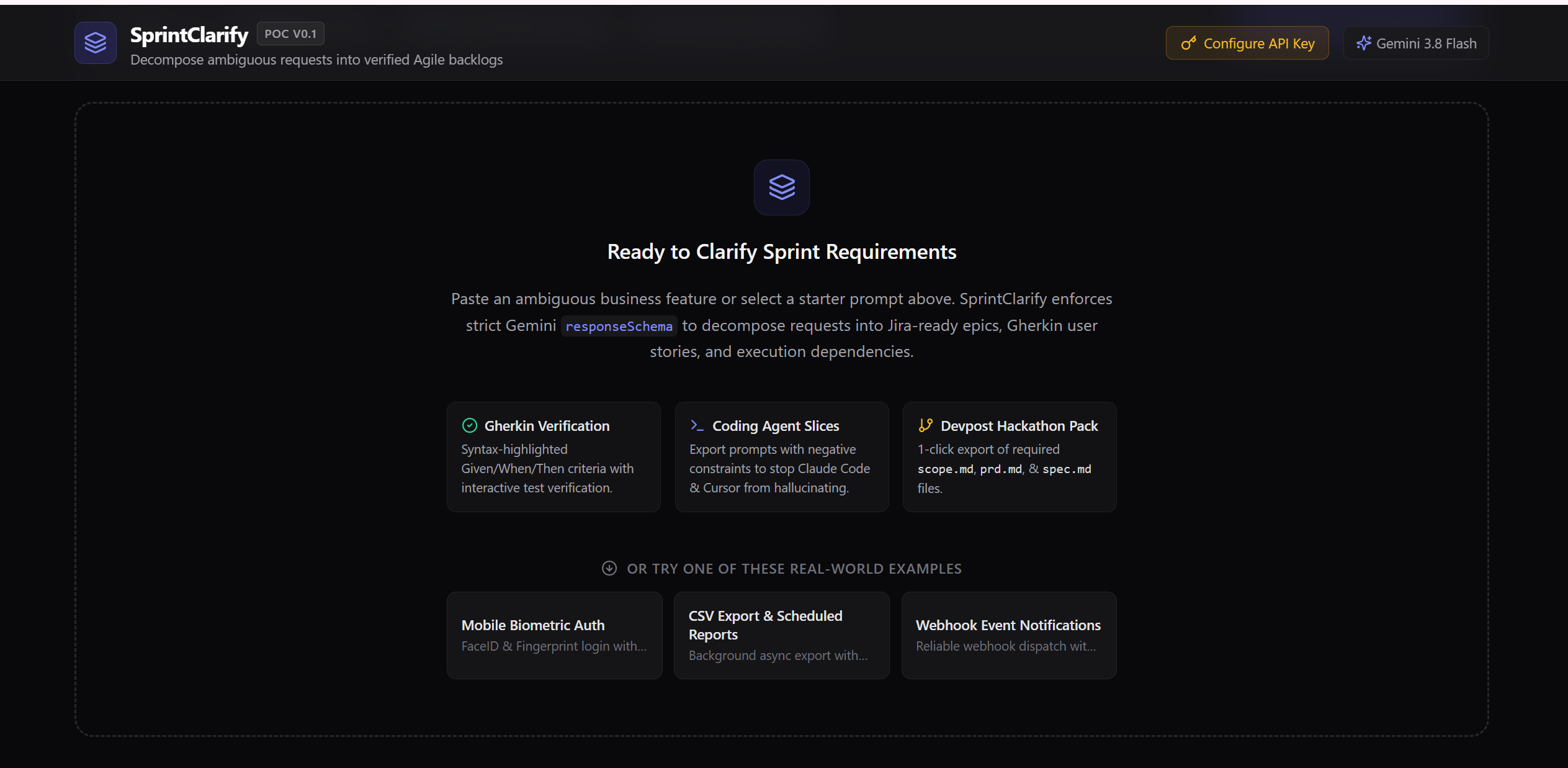
While generic conversational LLMs can generate text, open-ended chats often include unnecessary conversational filler and lack structured schema guarantees. We built SprintClarify to turn ambiguous product requests directly into validated, Jira-ready backlogs, coding agent prompts, and visual execution dependency flows in seconds.
What it does
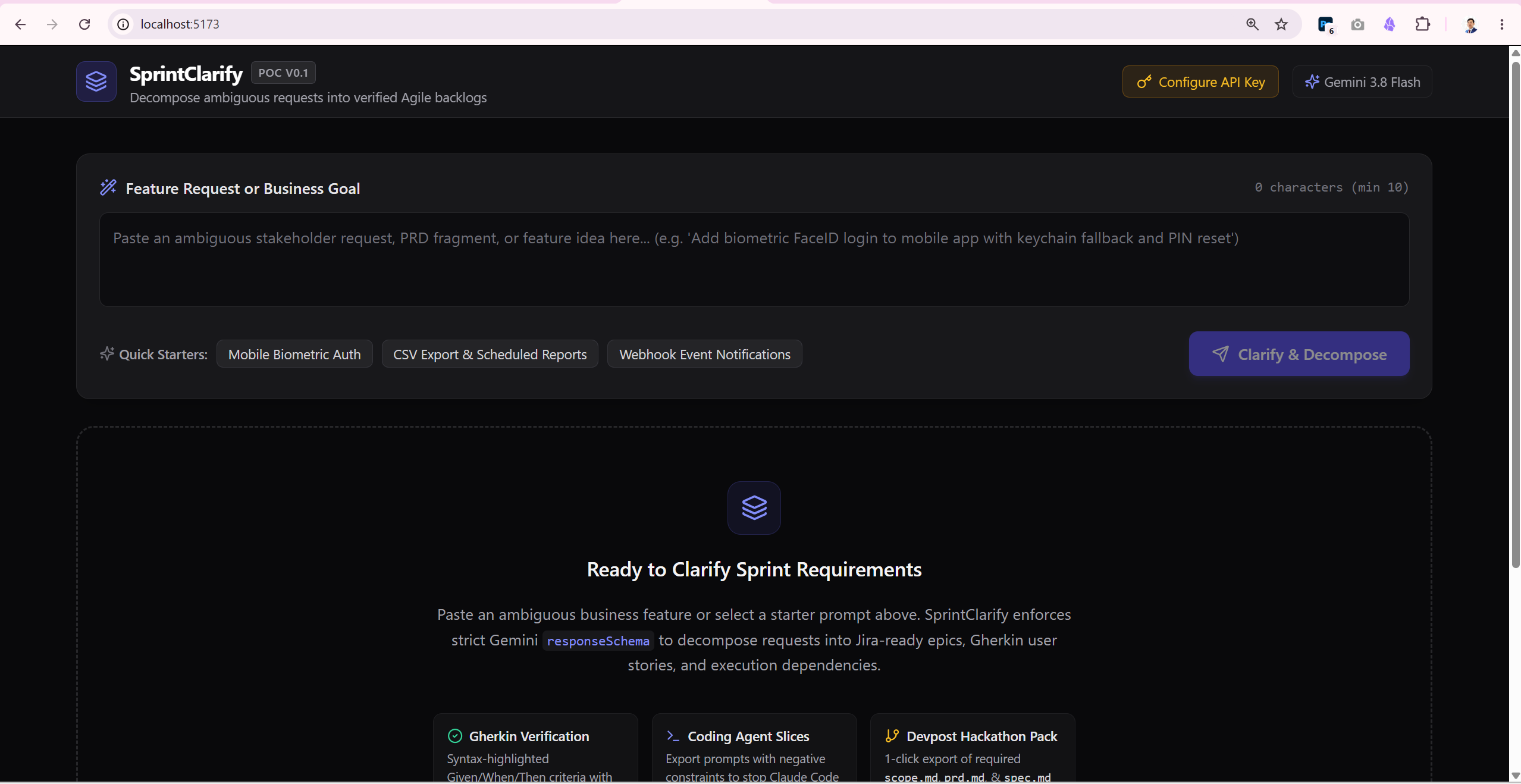
SprintClarify is a single-screen Agile workspace built with a dark Linear-style aesthetic:
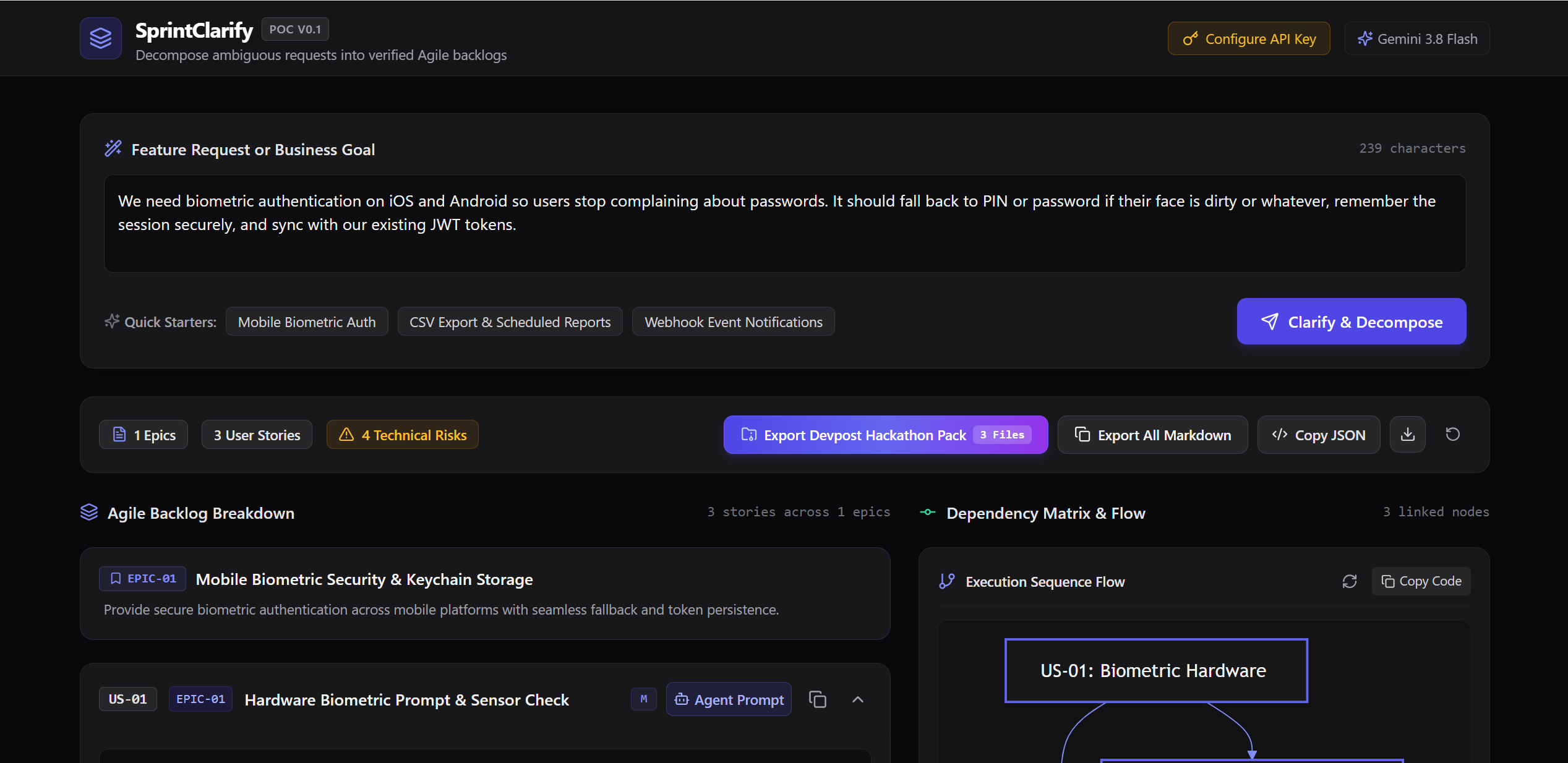
- Instant Requirement Input: Users enter freeform requirement statements or click curated quick-start prompts (such as "Mobile Biometric Auth").
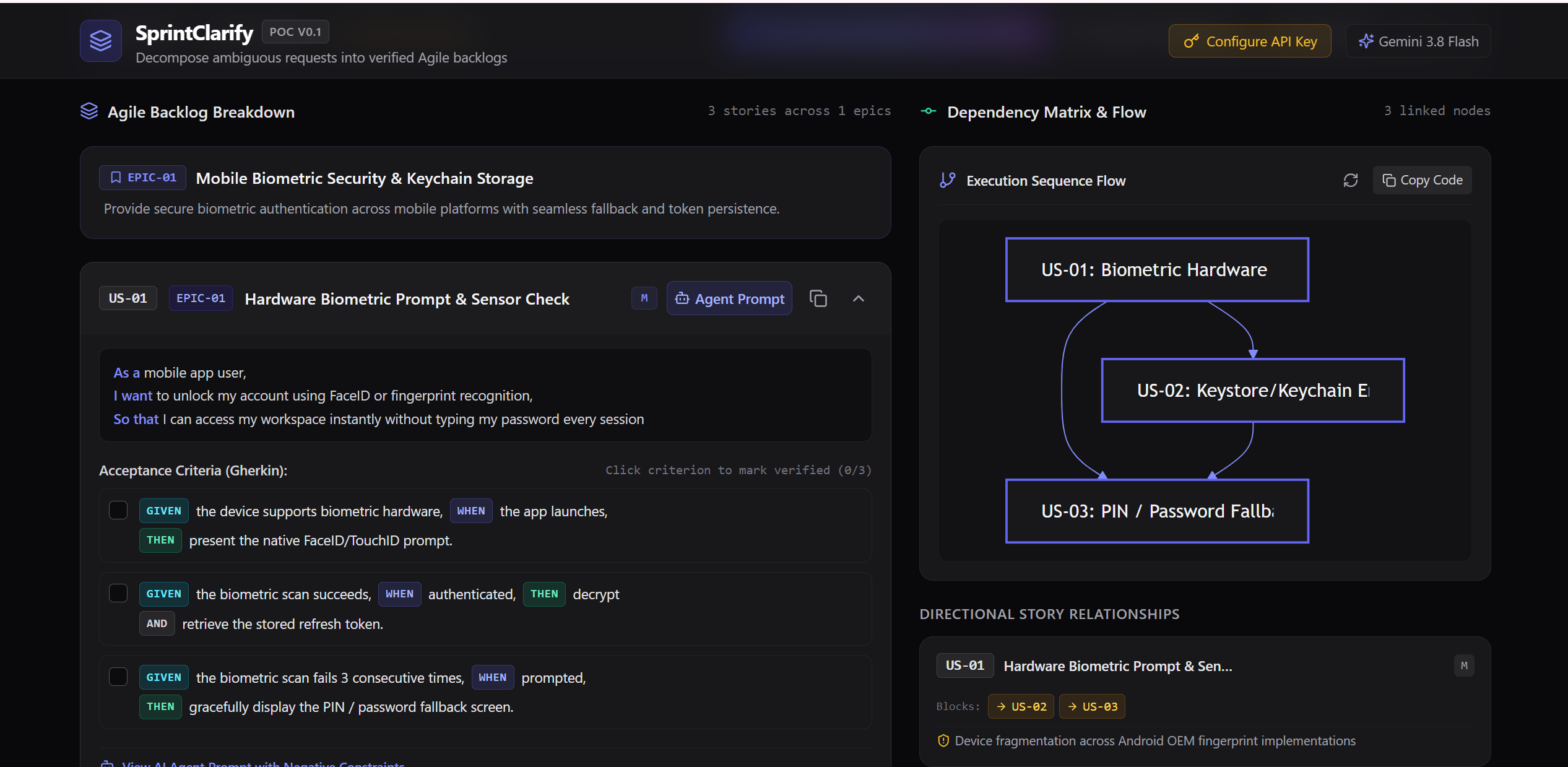
- Agile Backlog Synthesis: Powered by Gemini 3.8 Flash, it processes the input and generates structured epics, user stories ("As a... I want to... So that..."), Gherkin acceptance criteria (Given/When/Then), and technical risk flags.
- Interactive Gherkin Verification: Each acceptance criterion includes syntax-highlighted badges and interactive checkboxes so teams can track verification progress directly on every story card.
- AI Agent Prompts with Negative Constraints: Every story generates a context-locked prompt for coding agents (Claude Code, Cursor, Codex) with strict negative boundaries ("DO NOT modify unrelated files") to prevent agent drift.
- Dependency Flow Visualizer: Renders an interactive Mermaid.js sequence flow diagram and directional relationship matrix showing which stories block or depend on others.
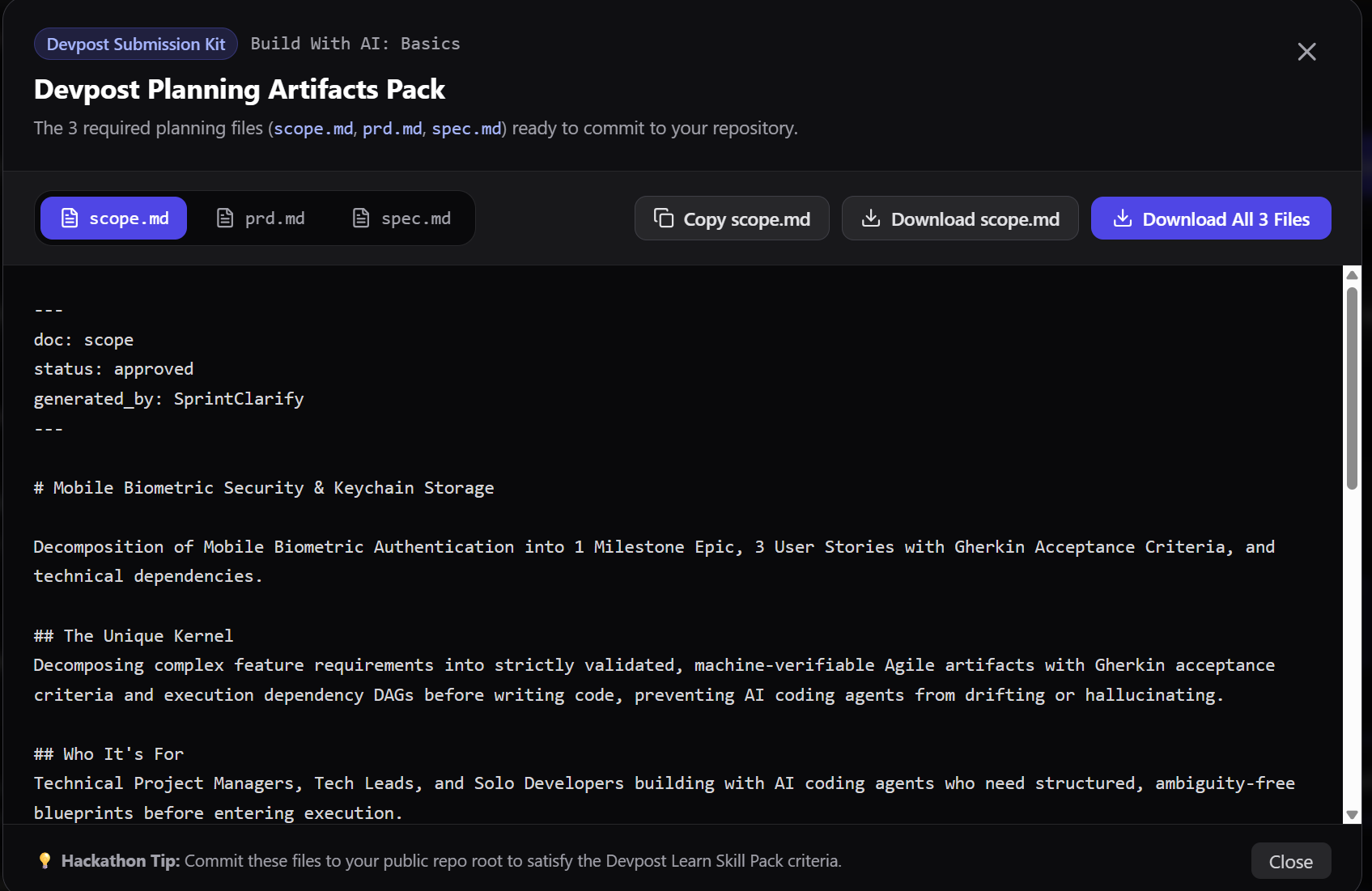
- One-Click Exports & Devpost Pack: Users can copy individual story cards, export the entire sprint backlog as Markdown or JSON, or open the Devpost Planning Pack modal to inspect and download
scope.md,prd.md, andspec.md.
How we built it
- Agentic Development Workflow: Built and integrated using Antigravity CLI (
agy) and Google AI Studio to run the skill pack, execute vertical slices, merge repository updates, and validate zero-error TypeScript builds. - Planning & Architecture (Devpost Learn Skill Pack): We used the Devpost Learn Skill Pack (
build-with-ai-basics) through a flipped-interaction workflow. We established the project scope indevpost/scope.md, defined user flows and UI specifications indevpost/prd.md, mapped the architecture indevpost/app-map.html, and decomposed the implementation into 5 vertical slices indevpost/spec.md. - Frontend Stack: Built with React 19, TypeScript, Vite, and Tailwind CSS, using Lucide React for iconography and Mermaid.js for client-side directed acyclic graph (DAG) rendering.
- AI Integration: Powered by the official Google Gen AI SDK (
@google/genai) callinggemini-3.8-flashwith a strictresponseSchemaconfiguration to guarantee deterministic, type-safe JSON responses. We also implemented a seamless offline fallback payload so reviewers can test the full interface immediately.
Challenges we ran into
- Strict Schema Validation vs. UI Rendering: Ensuring the model output consistently mapped into valid Mermaid.js node syntax without breaking graph rendering required careful schema constraints and sanitizing node labels for special characters.
- Preventing Coding Agent Regressions: While building the app in vertical slices, we needed to ensure each new feature integrated cleanly without breaking existing exports or state management.
Accomplishments that we're proud of
- Delivering a cohesive, zero-friction workspace that goes from a single sentence to a complete Agile backlog and dependency flowchart in seconds.
- Maintaining a 100% structured planning workflow from initial concept to final build, resulting in zero TypeScript or production build errors.
What we learned & The Skill Pack Experience
- The "Flipped Interaction" Mindset: Running the Devpost Learn Skill Pack transformed our workflow. Instead of us giving prompts to an agent to write code, the AI interviewed us about our user, core loop, and constraints first.
- Planning Artifacts Prevent Agent Drift: Generating
scope.md,prd.md, andspec.mdupfront established clear MVP boundaries and prevented the AI agent from hallucinating, repeating mistakes, or over-engineering the solution. - Strict Typing with Gemini 3.8 Flash: Using
@google/genaiwithresponseSchemaproved that structured JSON output is vastly superior to conversational AI for developer tooling, ensuring 100% predictable Agile artifacts every run.
What's next for SprintClarify
- Direct two-way API integrations with Jira, Linear, and GitHub Issues for automated ticket creation.
- Story point estimation calibration based on historical team velocity.
- Multi-sprint roadmap sequencing and capacity planning.
Built With
- antigravity-cli
- devpost-learn-skills
- gemini-api
- gherkin
- google-ai-studio
- google-gemini
- json
- lucide-react
- mermaid-js
- react
- tailwind-css
- typescript
- vite

Log in or sign up for Devpost to join the conversation.