-
-
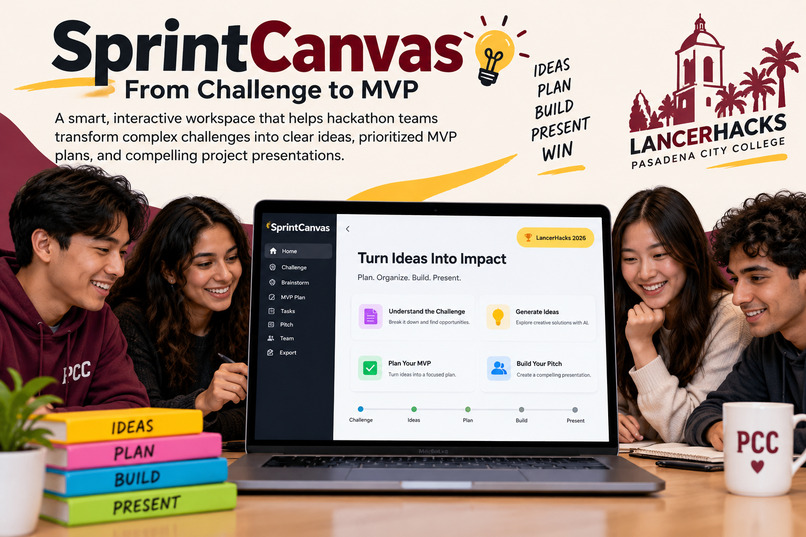
IMAGE
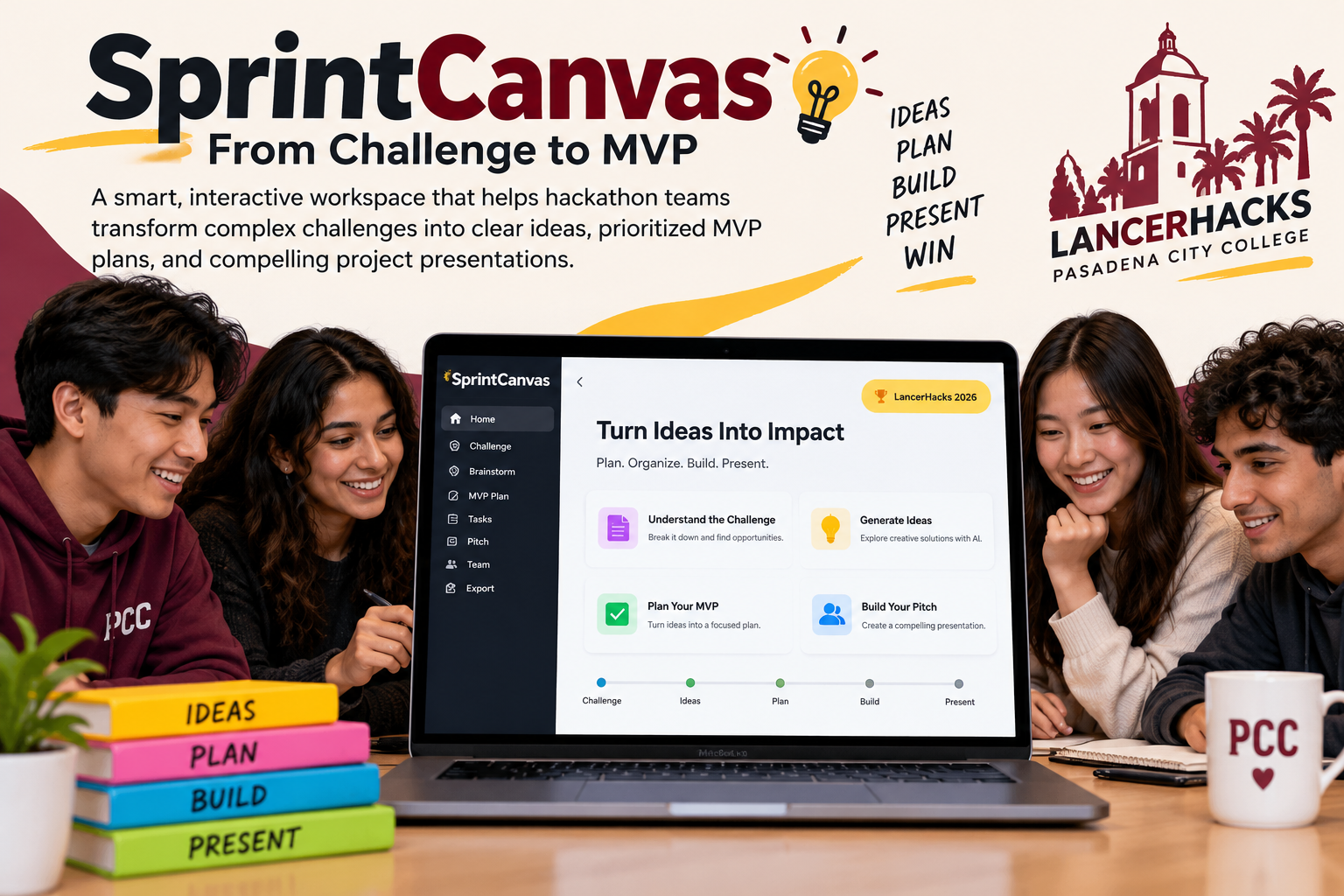
Inspiration
Hackathons are exciting, but turning an ambitious idea into a working prototype under a tight deadline can be challenging. Teams often spend too much time brainstorming, lose track of priorities, or struggle to explain their solutions clearly.
SprintCanvas was created to make that process simpler.
The inspiration came from a straightforward question: What if hackathon participants had one focused workspace to organize their thinking, define a realistic MVP, and prepare a compelling demonstration?
SprintCanvas brings product strategy, user-centered design, and lightweight development planning together in an accessible interface.
What It Does
SprintCanvas is a responsive, browser-based planning workspace designed to help hackathon participants move from an initial challenge to a focused development plan.
The current prototype includes:
Challenge Canvas: Capture the challenge statement, target audience, problem, and proposed solution.
MVP Planning: Define one critical user journey and prioritize up to three essential features.
Demo Planning: Outline the interactions and outcomes that should appear in a working demonstration.
Progress Tracking: Monitor preparation tasks using an interactive checklist and visual progress indicator.
Automatic Local Saving: Preserve planning inputs in the browser using localStorage.
JSON Export: Download a structured project brief for reference or further development.
Responsive Interface: Access the workspace through desktop and mobile browsers.
The application runs without user registration, external APIs, or a backend server.
How We Built It
SprintCanvas was developed using lightweight web technologies, prioritizing accessibility, responsiveness, maintainability, and ease of use.
Technology stack:
HTML5 for semantic content structure.
CSS3 for responsive layouts, reusable visual components, and interface styling.
Vanilla JavaScript for interactive functionality and state management.
Browser localStorage for saving project information.
JSON and the Blob API for exporting structured project briefs.
AI-assisted development tools for supporting interface planning, implementation, and documentation.
The interface follows a clear workflow: Discover → Focus → Prepare.
Rather than introducing unnecessary complexity, the implementation emphasizes fast loading, straightforward navigation, and practical functionality.
Challenges We Faced
Balancing simplicity and functionality
A planning platform can quickly become overwhelming. The challenge was identifying the essential information participants need without introducing unnecessary features.
The solution was to organize the experience into focused sections with a clear hierarchy and straightforward interactions.
Maintaining progress without a backend
We wanted users to retain their planning information without requiring accounts or cloud infrastructure.
Browser localStorage provided a lightweight solution, while JSON export offers a way to retain and transfer project information outside the application.
Designing before the challenge announcement
LancerHacks reveals its official challenge at the event opening. This meant creating reusable planning infrastructure without assuming what the competition problem would be.
We deliberately separated the planning prototype from the challenge-specific solution that must be developed during the event.
Accomplishments We're Proud Of
Creating a functional, responsive planning interface using standard web technologies.
Combining problem definition, MVP prioritization, and preparation tracking in one workspace.
Supporting local data persistence without external dependencies.
Providing a structured export that can support further development.
Designing an interface that emphasizes clarity, focus, and accessibility.
What We Learned
Developing SprintCanvas reinforced several important product-development principles.
First, a focused solution is often more valuable than a feature-heavy one, particularly under strict deadlines.
Second, thoughtful UX design can simplify complex workflows and reduce the cognitive effort required to organize a project.
Third, lightweight technologies remain powerful tools for rapidly building functional prototypes.
Most importantly, effective hackathon development requires balancing creativity with technical feasibility, usability, and clear communication.
What's Next
The current version is a pre-event planning prototype, not the completed solution to the LancerHacks Main Challenge.
Once the official challenge is announced, the next steps are to:
Define the challenge-specific problem and target users.
Develop and test the required core solution during the hackathon.
Document the implementation and publish the source code.
Record a demonstration of the working project.
Prepare the final presentation and submit the eligible entry.
Future improvements to SprintCanvas could include collaborative planning, GitHub integration, and AI-assisted prioritization.
Our vision: Make the journey from idea to meaningful prototype clearer, faster, and more accessible for hackathon participants of every experience level.
Built With
- blob-api
- css3
- html5
- javascript
- json
- localstorage
- responsive
- web-storage-api

Log in or sign up for Devpost to join the conversation.