-
-
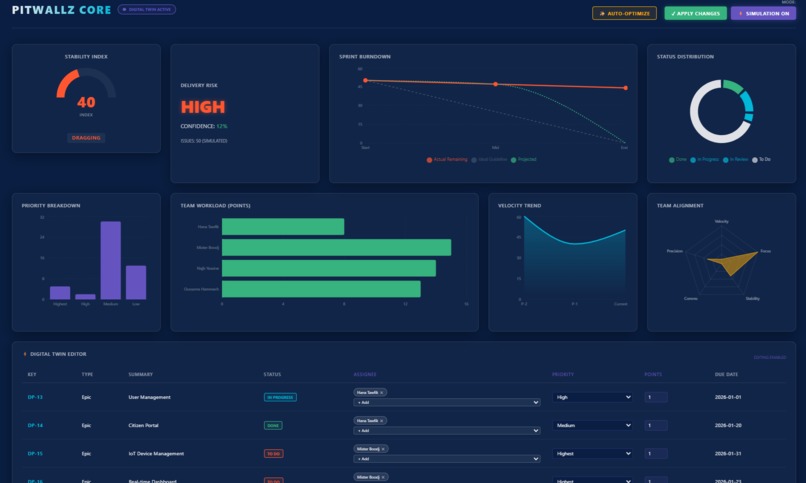
Dashboard
-
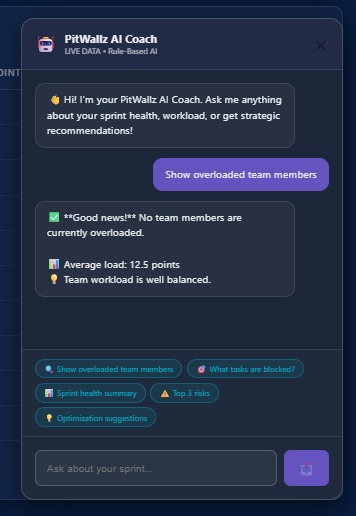
Rovo Ai Chat
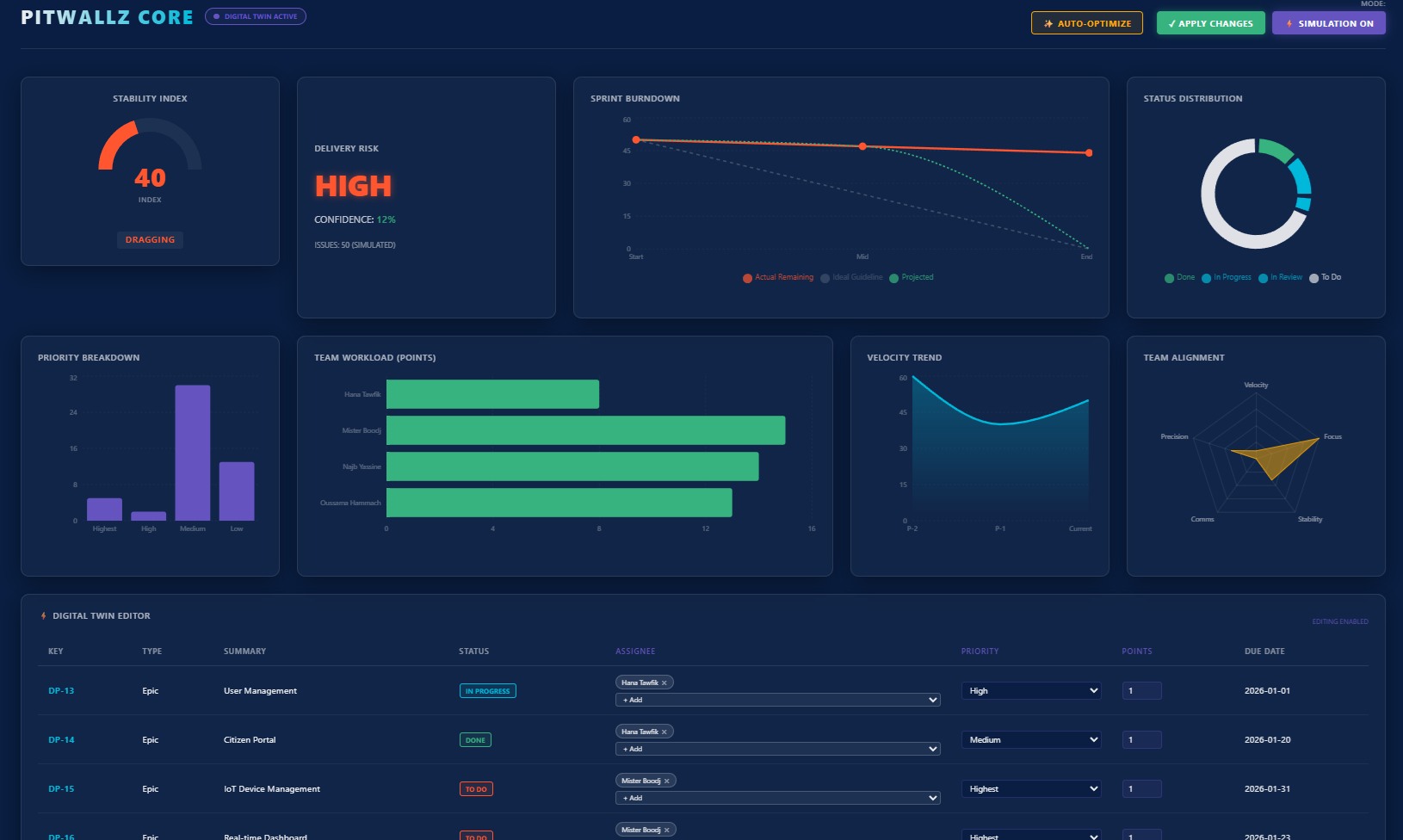
Inspiration The inspiration for Pitwallz comes from Formula 1 pit walls, where performance engineers use real-time data to predict failures, simulate strategy changes, and make split-second corrections. We realized that while Jira tells teams what happened in the past, it rarely tells them what will happen in the future. We wanted to move away from "heroic" last-minute saves and toward an engineered approach to teamwork.
What it does Pitwallz transforms Jira from a passive tracking tool into a self-correcting sprint system. It continuously analyzes sprint and team health to predict failures before they occur.
Key capabilities include:
Sprint Digital Twin: It maintains a live internal model to simulate "what-if" scenarios, such as reassigning tasks, without affecting actual Jira data.
Health Metrics: It calculates a Sprint Momentum Index™ based on forward progress, friction, and energy loss.
Cognitive Load Detection: It measures mental load and context switching rather than just ticket counts to prevent silent burnout.
Auto-Balancing Engine: It suggests or applies low-risk actions like rebalancing workloads or splitting oversized stories.
AI Rovo Coach: A conversational advisor that explains the "why" behind risks and suggests prioritized fixes.
How we built it We built Pitwallz as a Forge-native Jira app utilizing a modular architecture:
Backend: Developed using the Forge CLI, leveraging Jira APIs to collect issue changelogs, worklogs, and sprint data.
Intelligence Layer: A rule-first engine that computes the Cognitive Load Index (CLI) and failure prediction scores.
Simulation Engine: A digital twin environment that clones the sprint state for risk-free testing of adjustments.
Frontend: A Custom UI featuring health overview scores, risk explanation cards, and an interactive simulation panel.
AI Integration: We integrated Forge Rovo to act as the "Pitwallz Coach," providing a supportive, non-blaming conversational interface.
Challenges we ran into One of the primary challenges was moving beyond descriptive metrics (like velocity) to predictive intelligence. We had to figure out how to model "Energy Drain" and "Time-Pressure Accumulation" from raw Jira data like task churn and carry-over fatigue. Additionally, ensuring that auto-balancing felt safe and explainable—rather than micromanaging—required building strict guardrails and reversible action logs.
Accomplishments that we're proud of Successfully creating a Sprint Digital Twin that allows managers and teams to see the impact of a change before making it.
Developing the Sprint Momentum Index™, which provides a single, clear indicator of whether a team is Accelerating, Dragging, or Stalling.
Building a system that prioritizes human energy and burnout forecasting over simple capacity planning.
What we learned We learned that "two people can have five tasks—one is fine, the other is drowning". This taught us that composite health metrics are far more valuable than raw Jira numbers. We also realized the importance of neutral, supportive AI feedback; by using a "Coach" persona, we can provide interventions that feel like strategy rather than criticism.
What's next for Pitwallz The future of Pitwallz involves deepening our Machine Learning capabilities once the core rule-based logic is fully established. We plan to expand the Auto-Apply (opt-in) features for larger enterprises and refine our Burnout Risk Forecast to include long-term recovery and load-smoothing suggestions across multiple sprints.


Log in or sign up for Devpost to join the conversation.