-
-
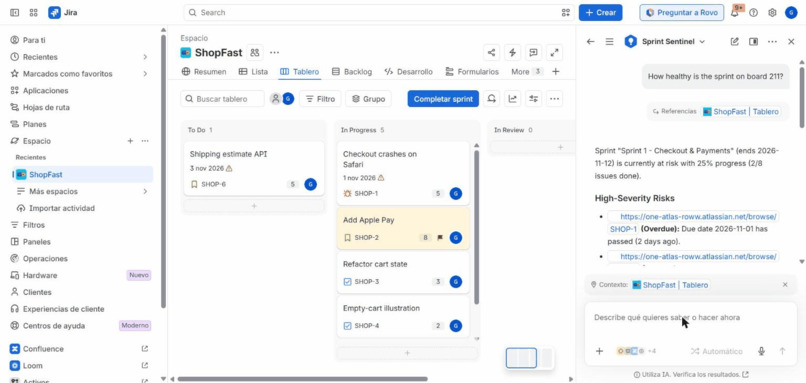
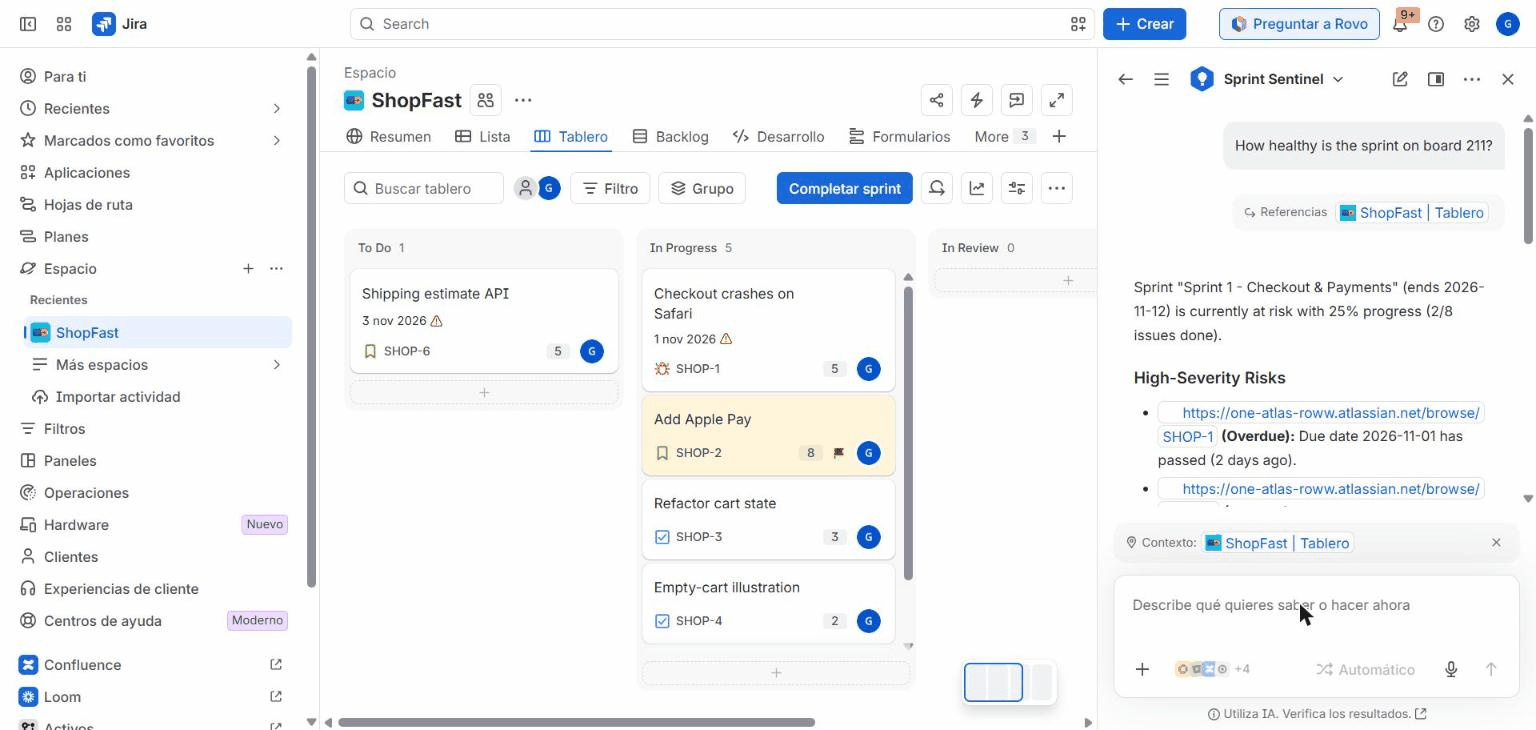
Sprint Sentinel reports live sprint health in Rovo - every finding cites its Jira issue.
-
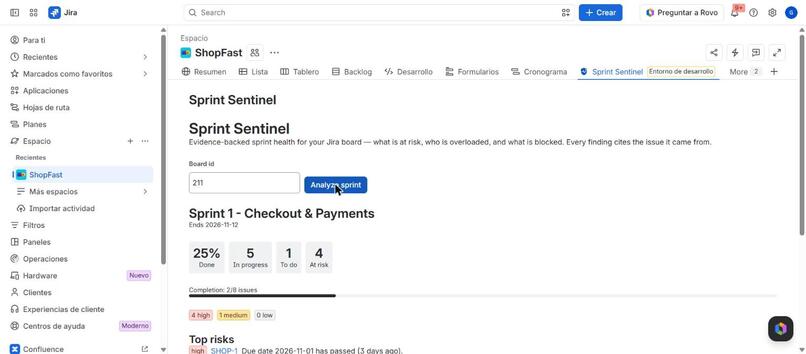
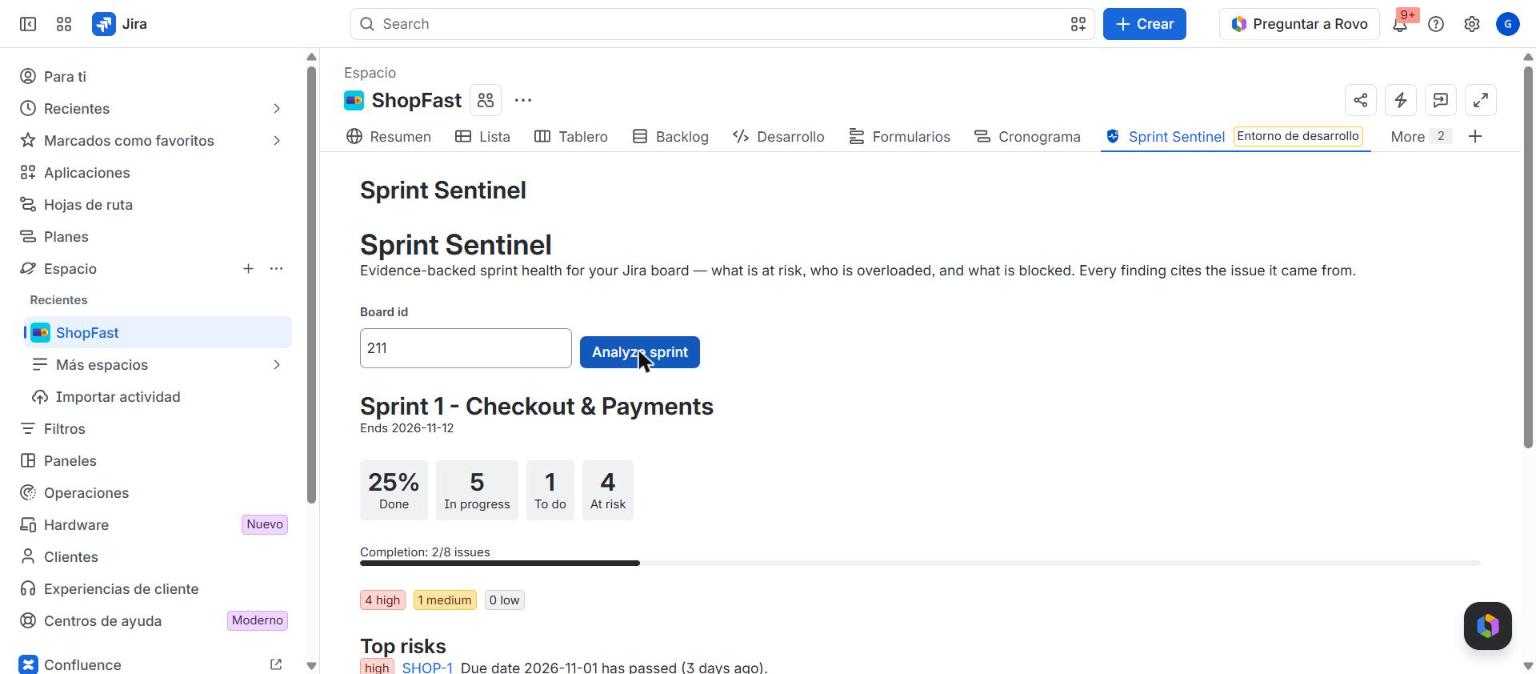
In-Jira dashboard (Forge UI Kit): progress, at-risk tiles, top risks as issue links, workload and blockers — same engine as the agent.
-
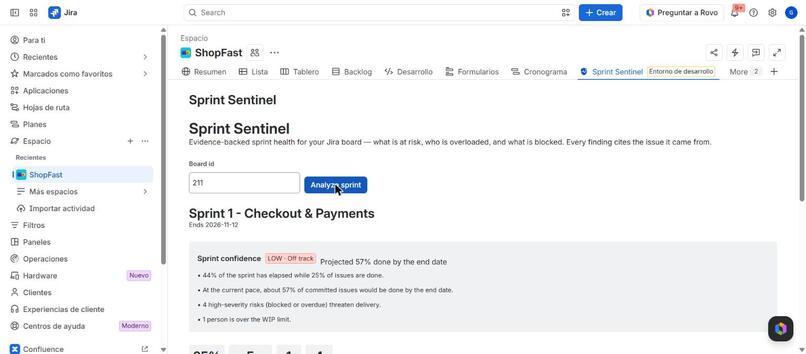
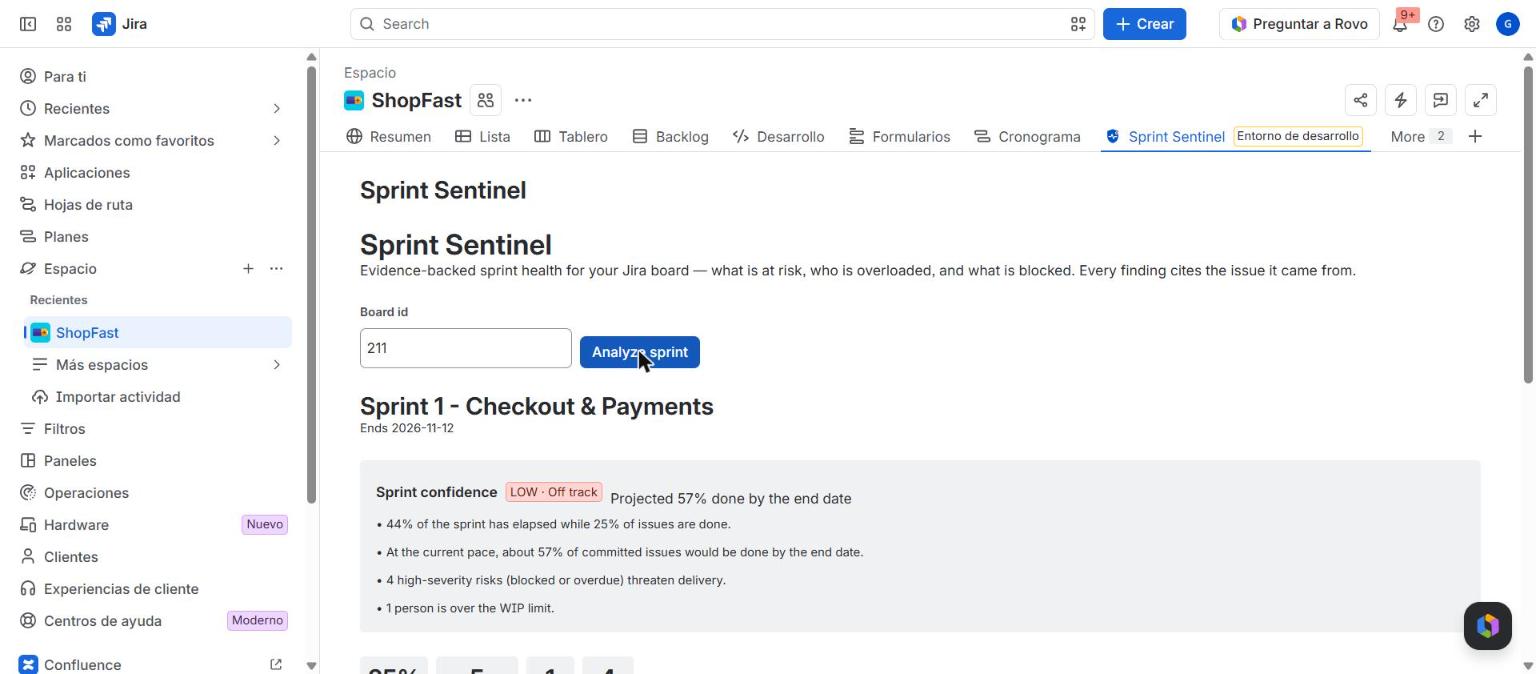
Auditable Sprint Confidence forecast: LOW · Off track, projected 57% done by the end date — with the drivers behind the number.
Inspiration
Every sprint check-in runs on gut feel: a standup, a glance at the board, a guess at what will slip. The signals that actually predict a missed sprint — work sitting untouched, one person buried, a quietly blocked ticket, a due date already in the past — are all on the board, but nobody has time to comb for them. The obvious move is to ask an AI "how's the sprint going?". The problem: a general-purpose assistant will happily invent a confident answer — a percentage, a risk, a name — that isn't backed by anything. In a delivery meeting that's worse than no answer. We wanted an assistant that is physically unable to make up a number, because the numbers don't come from the language model at all.
What it does
Sprint Sentinel reports the health of a Jira sprint, grounded strictly in live board data, and — the headline — projects whether the sprint will land: an auditable Sprint Confidence forecast (High / Medium / Low, a projected end-of-sprint completion %, and the exact drivers behind it), computed by the tested engine, never the LLM. It exposes four tools: a Sprint health report (progress, at-risk counts by severity, who's overloaded, what's blocked, top findings); At-risk issues (every at-risk issue with its reason and severity); Assignee workload (work-in-progress per person, flagging anyone over the WIP limit); and Blocked issues (flagged impediments and "is blocked by" links, naming each blocker). Every finding is reported with the issue key and the concrete reason behind it. Risk rules: blocked, overdue, stale (untouched for N days), unassigned, due soon, and churn (many comments yet unfinished). A real answer from the live demo board: "The sprint is at risk. 25% done (2/8 issues). SHOP-1 was due 1 Nov and is overdue; SHOP-2 is flagged and blocked by SHOP-6; one person holds 4 in-progress items at once; SHOP-6 is due today and not started" — each item linked to its issue. The same four tools also power a visual dashboard inside Jira (a Forge UI Kit project page): progress and at-risk stat tiles, a completion bar, the top risks as issue links, per-assignee workload with the over-WIP flag, and the blockers.
How we built it
One Forge app, targeting the main track plus two bonus categories at once: a rovo:agent whose prompt restricts it to relaying only what the tools returned, always citing the issue key; a rovo:mcp server exposing the same four tools to any MCP-capable agent (agent actions and MCP tools share one implementation); a jira:projectPage dashboard (Forge UI Kit) whose resolver reuses the same loadSprint + analysis pipeline; and four action modules backed by Forge functions on the nodejs24.x runtime, reading Jira through the Agile and Platform REST APIs with only the minimal scopes. The design that keeps the AI honest: the language model never computes or guesses anything. The Forge tools fetch the board; a pure, unit-tested analysis engine (no I/O) derives every finding; the agent only relays them. That logic is covered by a suite that runs with no Jira and no network — 21 tests, including the normalisation layer validated against the real Jira REST response shape.
Challenges we ran into
Testing against a real Jira site surfaced two bugs that hand-written mocks had missed: on a blocked issue, Jira returns the blocker as the link's outwardIssue (the "blocks" end), not inwardIssue as we'd assumed; and team-managed vs company-managed projects store story points in different custom fields. Both fixes came straight from running the deployed agent on a live board — exactly the kind of thing you only catch end-to-end.
Accomplishments that we're proud of
A genuinely trustworthy AI feature: it is architecturally incapable of inventing a metric, and every claim is clickable back to its evidence. One clean app earns the main track plus the Rovo-agent and MCP bonus categories from a single shared implementation — deployed and verified live on a real Jira site, not just a slide.
What we learned
End-to-end testing is non-negotiable for an integration: the two bugs we fixed were invisible until the agent read a real board. And "grounding" an LLM is less about prompting and more about architecture — if the model can't compute the number, it can't fake it.
What's next for Sprint Sentinel
A Teamwork Graph integration to pull in cross-project dependencies, a scheduled daily digest that posts the sprint-health report to a team channel, and Marketplace publication.
Built With
- api
- atlassian
- cloud
- forge
- javascript
- jira
- mcp
- node.js
- rest
- rovo
