Inspiration
Sponsored creator integrations look simple until one tiny mistake forces another revision.
A creator can record a perfectly good segment and still miss a required product name, say 70% instead of 73%, forget a campaign URL, use wording the sponsor explicitly prohibited, or place a call-to-action in the wrong part of the video.
The problem is that sponsor briefs are written for humans, but checking a finished video against them is still mostly manual: open the brief, scrub through the recording, compare every requirement, and hope nothing was missed.
We wanted to turn that brief into something executable.
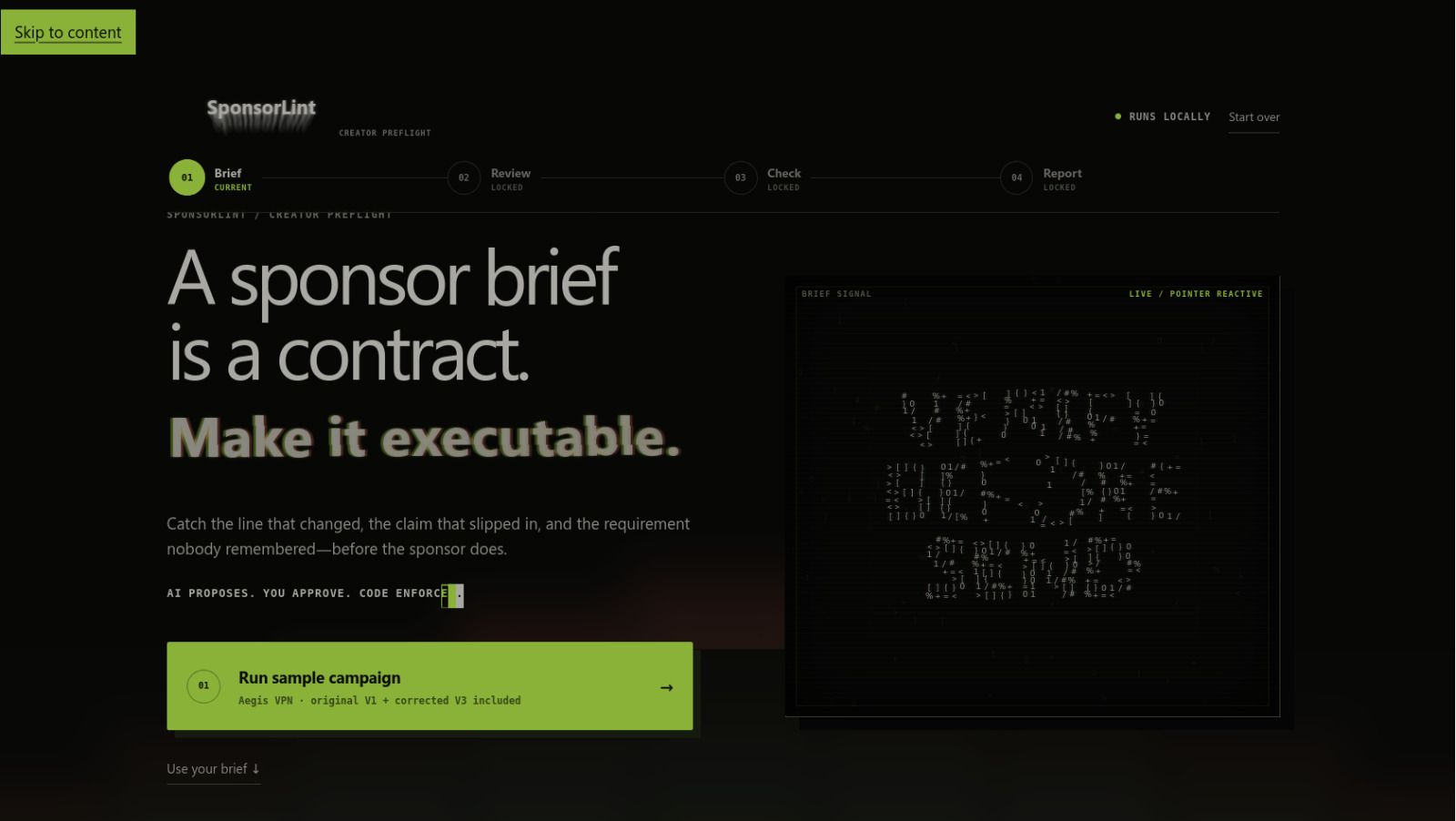
A sponsor brief is a contract. SponsorLint makes it executable.
What it does
SponsorLint is pre-flight QA for sponsored YouTube integrations.
The workflow is deliberately split into three trust boundaries:
AI proposes → You approve → Code enforces.
- Upload a sponsor brief as PDF, Markdown, text, or pasted copy.
- Gemini converts the brief into a structured proposed specification.
- Every extracted rule includes the literal source sentence it came from.
- The creator reviews, edits, adds, or deletes rules before approval.
- Upload the recorded sponsor segment.
faster-whisperproduces a timestamped transcript.- SponsorLint runs deterministic validators against the approved specification.
- The creator gets a timestamped evidence report with a readiness state:
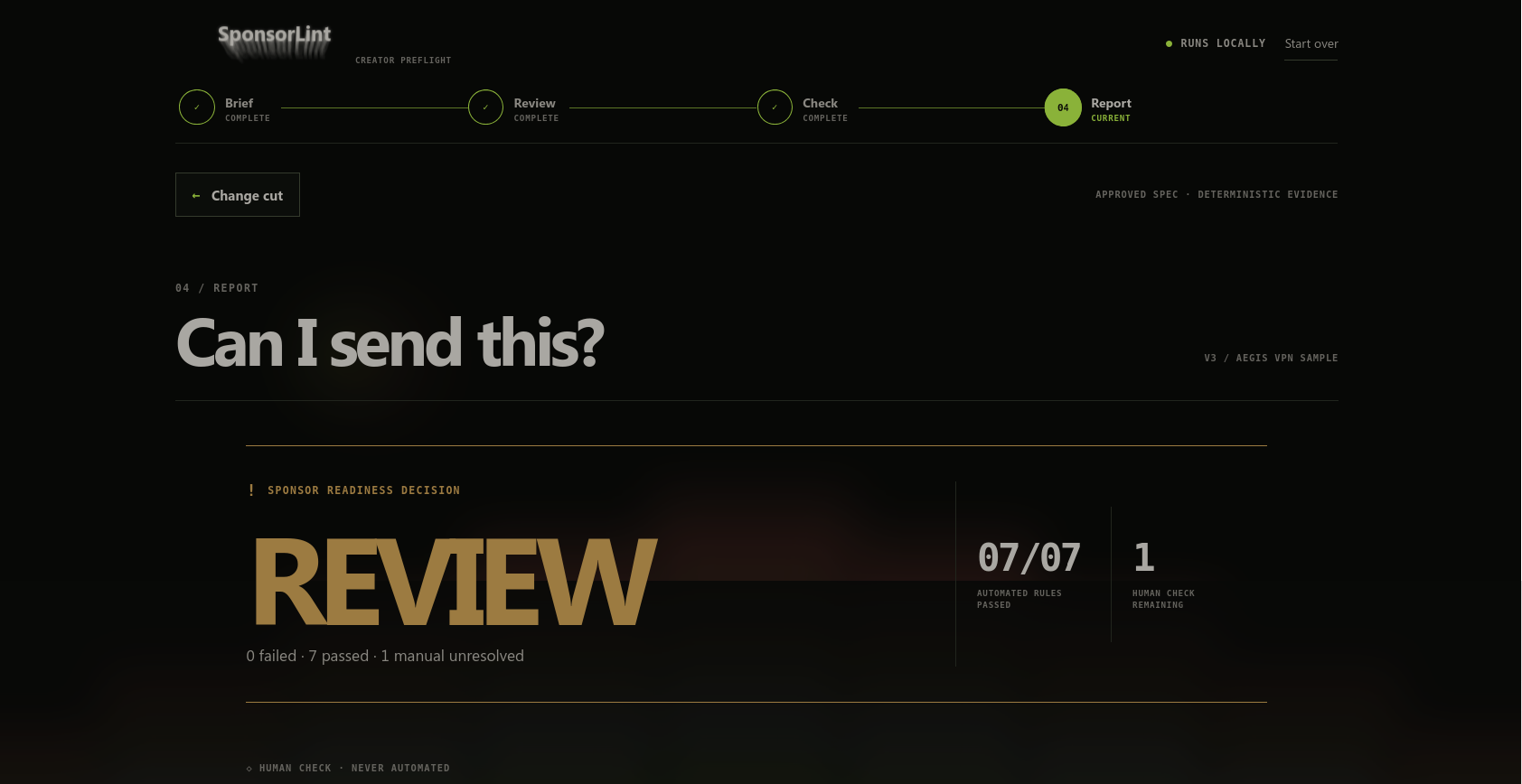
DO NOT SENDREVIEWSPONSOR READY
The LLM never sees the transcript and never decides whether a sponsor cut passes.
Verification is deterministic.
What SponsorLint checks
SponsorLint currently supports six executable requirement types:
MUST_SAY— required phrases or product namesMUST_NOT_SAY— prohibited wordingEXACT_VALUE— exact discounts, values, or codesMUST_DISCLOSE— sponsorship disclosureDURATION— required integration lengthURL_OR_CTA— campaign URLs, promo codes, and calls-to-action
Some requirements cannot honestly be verified from audio, such as whether a product interface stayed visible for five seconds.
SponsorLint does not pretend otherwise.
Those requirements are surfaced as human review items, and unresolved manual checks keep the final state at REVIEW.
The demo
Our sample campaign intentionally contains subtle mistakes.
In the first cut:
- the creator says
70%instead of the required73% Shield Modeis never mentioned- the prohibited phrase
completely anonymousis used
SponsorLint produces:
4 / 7 automated requirements passed → DO NOT SEND
The corrected version fixes those lines and produces:
7 / 7 automated requirements passed
If the remaining visual requirement has not been manually confirmed, SponsorLint still stops at REVIEW rather than inventing certainty.
That fail-closed behavior is intentional.
How we built it
SponsorLint is built around a strict separation between probabilistic extraction and deterministic enforcement.
Brief compiler
The compiler uses the Gemini API with structured output to propose a Pydantic-backed specification.
The model only sees the sponsor brief.
Every generated requirement must contain a source quote that literally occurs in the submitted brief. Invented citations are rejected rather than silently trusted.
The creator must then approve the specification before verification.
Media pipeline
Recorded MP4s are processed with:
ffprobefor authoritative media durationfaster-whisperbase.enfor timestamped transcription
Our real-media validation used raw Whisper output with no transcript cleanup.
Deterministic verifier
After approval, there are zero LLM calls during verification.
The verifier uses explicit normalization and six deterministic validator types. Numbers, URLs, promo codes, disclosures, duration windows, and required/prohibited phrases are checked independently and produce structured evidence.
A finding can therefore explain:
- what was expected
- what was detected
- where it occurred
- the relevant transcript evidence
- the source sentence from the original sponsor brief
Web application
The judge-facing workflow is built with:
- FastAPI
- Jinja templates
- vanilla JavaScript
- Pydantic
- Python
We intentionally kept the architecture lightweight instead of turning it into a large SaaS platform.
Challenges we faced
Speech recognition is messy
Whisper may produce digits in one sentence and number words in another.
For example:
73%, 73 percent, and seventy-three percent
need to represent the same expected value without allowing 70% to pass.
URLs create a different problem: fuzzy matching is dangerous because aegisvpn.com/alex and another URL are not “close enough” — one is simply wrong.
SponsorLint therefore uses different normalization strategies for human language and identifiers.
False passes are more dangerous than false failures
For this product, incorrectly approving a broken sponsor read is worse than asking a creator to review something uncertain.
That shaped the verifier.
Ambiguous cases are routed to REVIEW instead of being optimistically accepted.
The human approval boundary matters
We did not want an LLM to silently transform a vague sentence like “near the beginning” into an arbitrary number.
During our live Gemini compilation, qualitative placement rules were surfaced for human review. We explicitly approved the first/last 15-second thresholds before they became enforceable rules.
That interaction became one of the central ideas behind SponsorLint.
Validation
We tried to build SponsorLint as something that could be challenged rather than merely demonstrated.
Current validation includes:
- 203 passing tests
- 1 intentional xfail
- 46 adversarial evaluation fixtures
- 45 / 46 correct
- 97.8% evaluation accuracy
- 0 False PASSes
- Python 3.11, 3.12, and 3.13 CI
- a real live Gemini brief-compilation run
- real MP4 →
faster-whisper→ deterministic verifier validation - raw Whisper transcripts with no manual cleanup
The remaining documented limitations are intentional and visible rather than hidden.
SponsorLint does not perform OCR or visual recognition, does not guarantee sponsor approval, and does not make legal or regulatory compliance claims.
What we learned
The most important lesson was that adding more AI was not the answer.
LLMs are useful for turning messy human instructions into a proposed structure.
They are much less attractive as the final authority for exact requirements like:
73%- a specific campaign URL
- a prohibited phrase
- a 60–90 second duration window
SponsorLint became stronger when we gave the model a smaller role.
AI proposes the spec.
The creator owns the spec.
Deterministic code enforces the spec.
That is the core of the project.


Log in or sign up for Devpost to join the conversation.