-
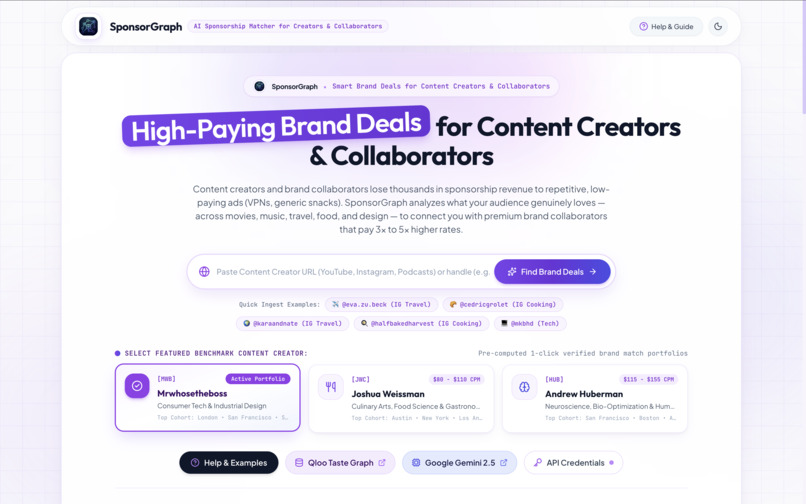
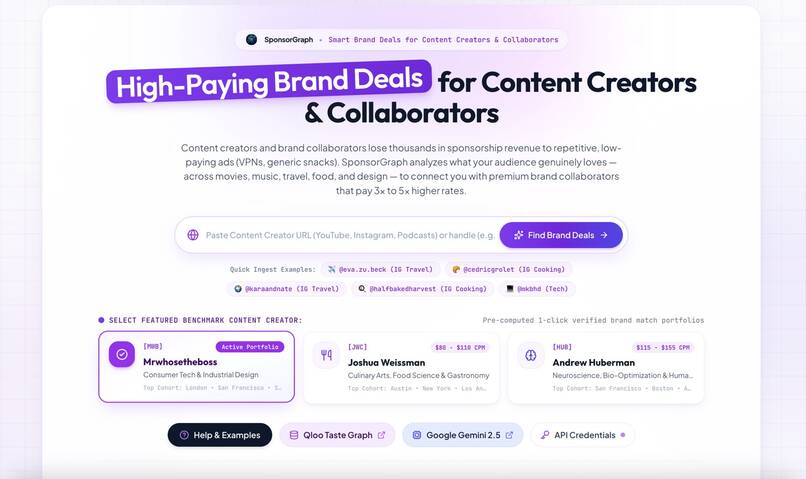
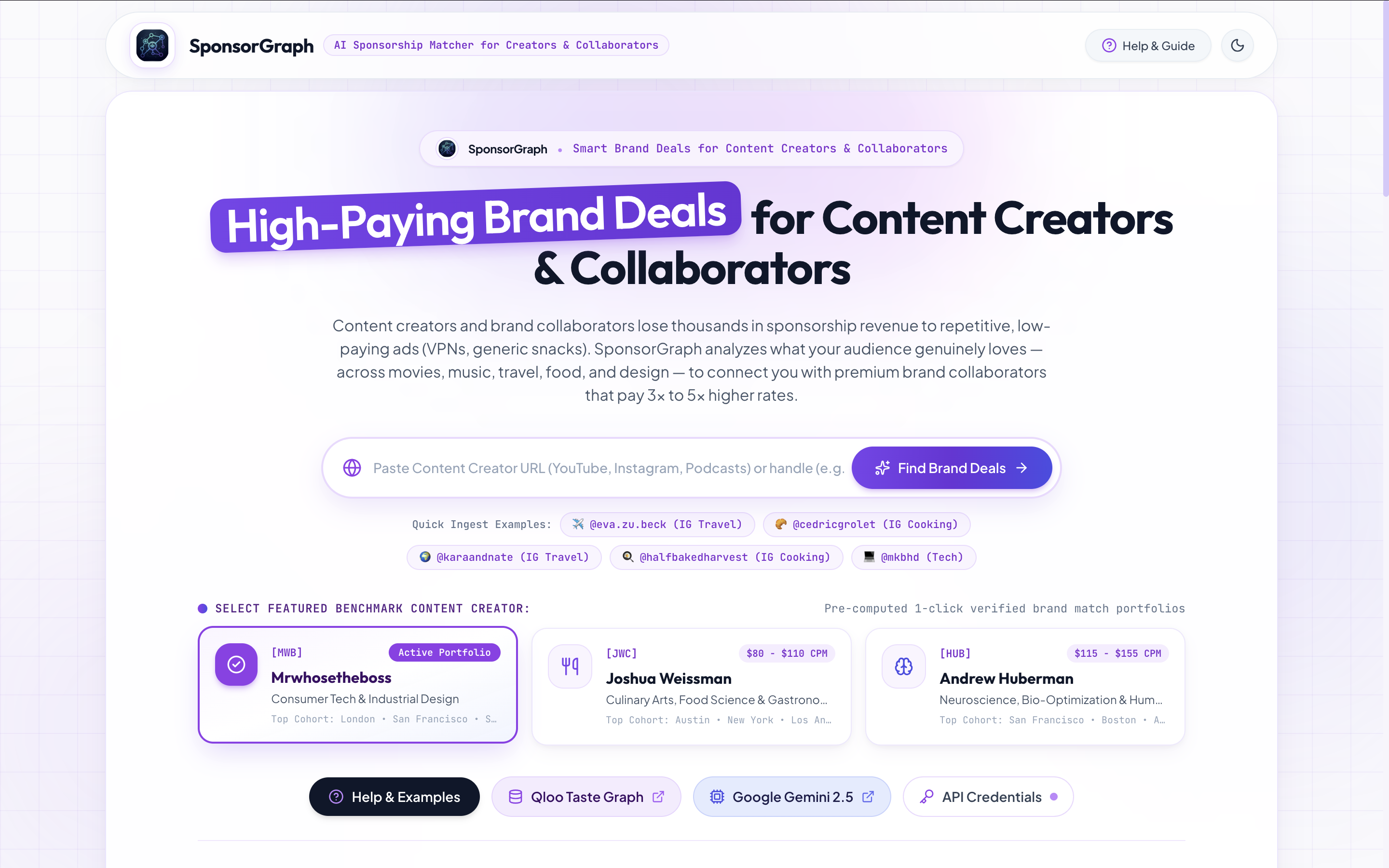
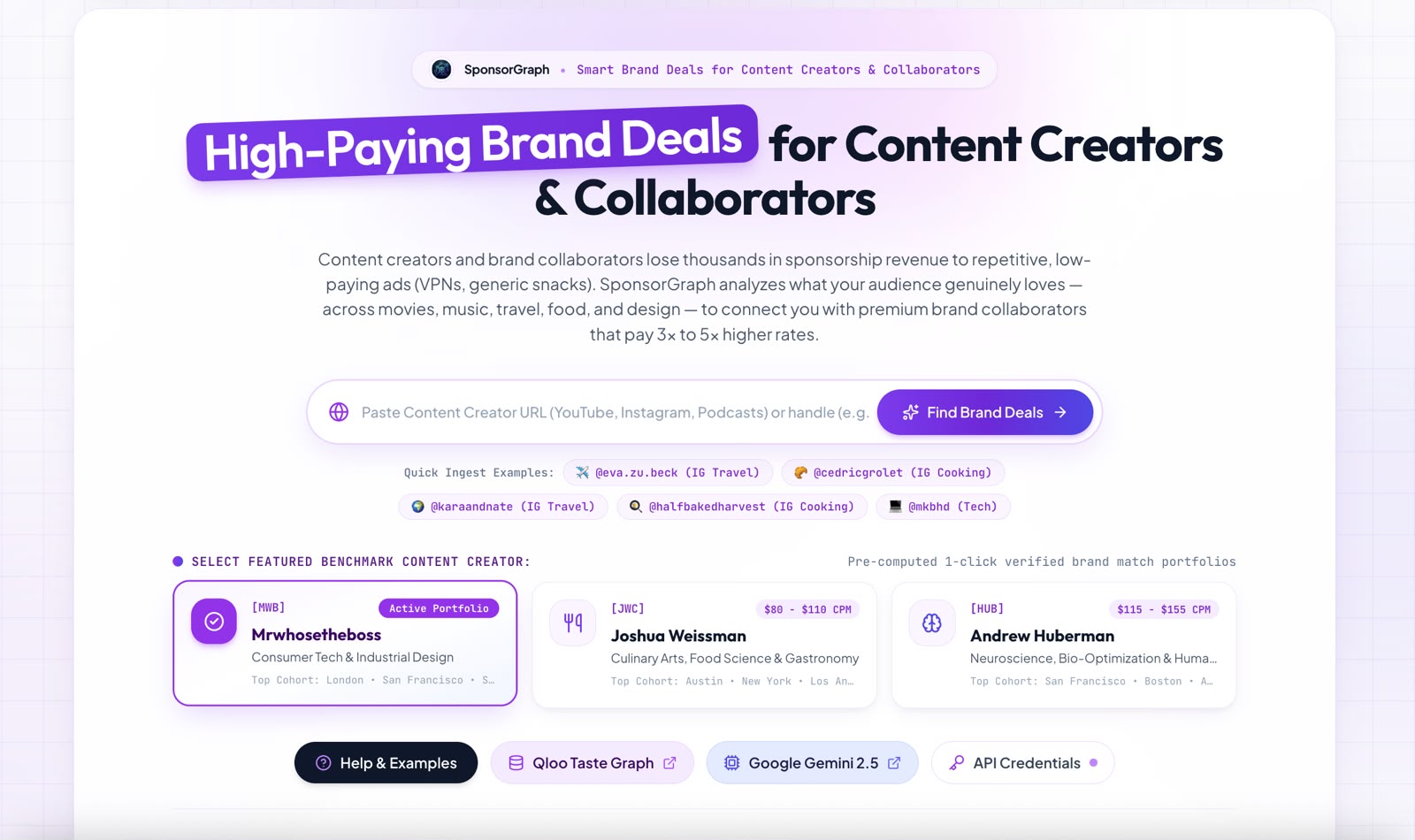
SponsorGraph hero dashboard connecting content creators with high-paying brand deals beyond boring keyword ads.
-
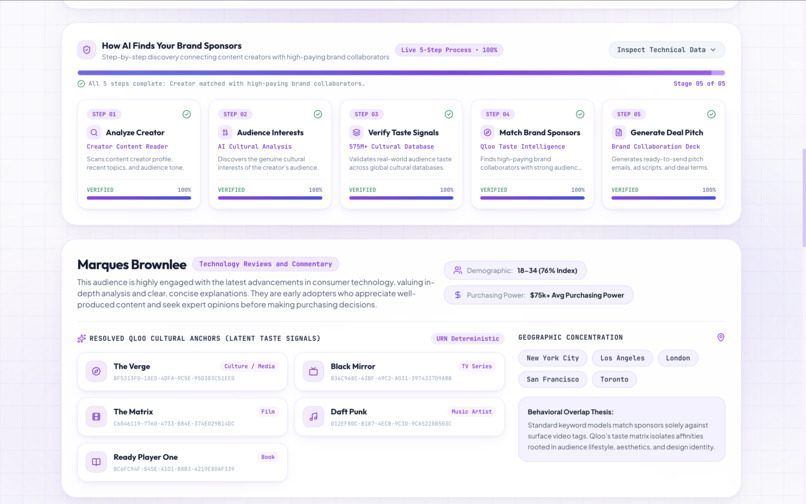
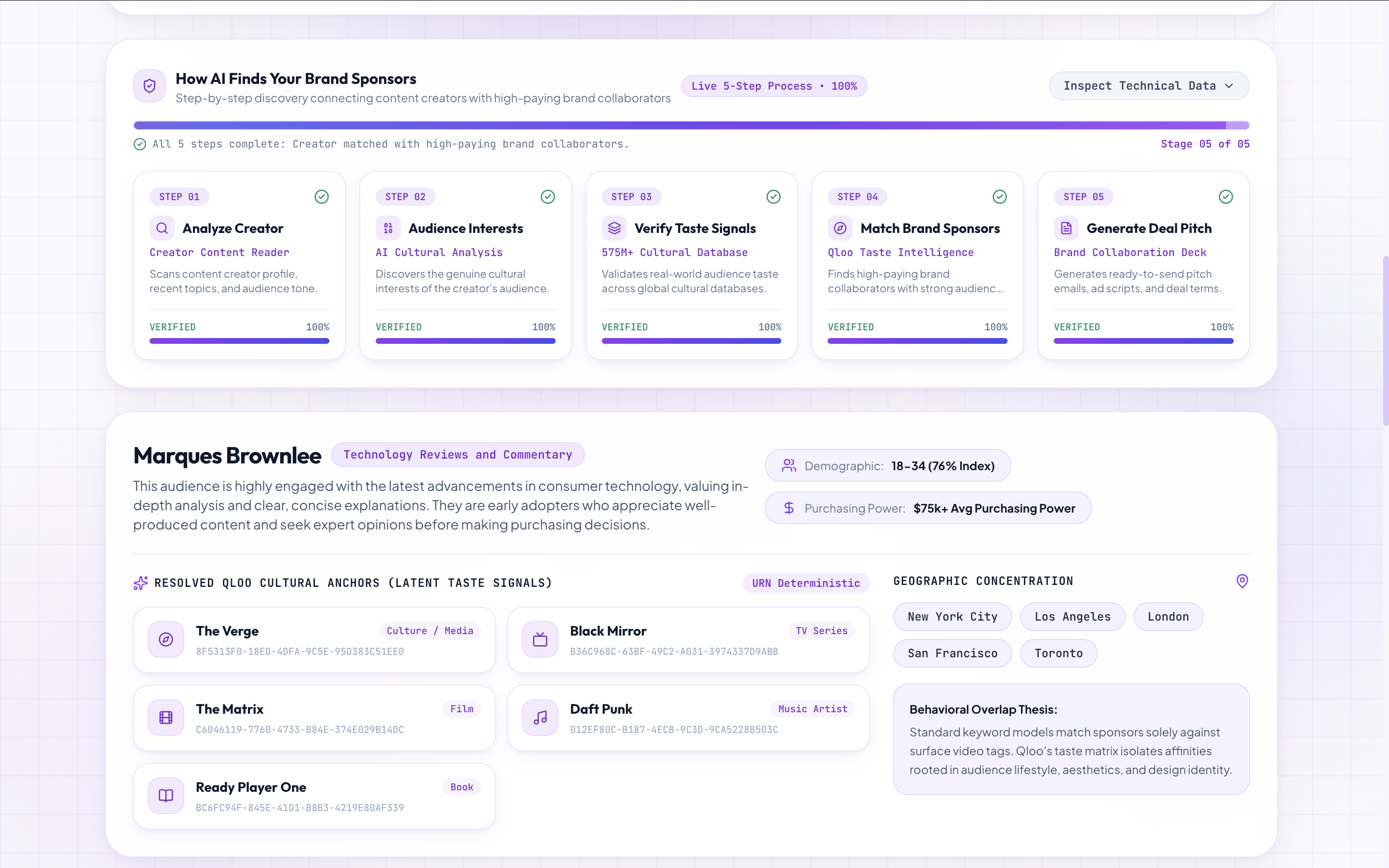
Real-time agentic stepper showing step-by-step progress from audience taste extraction to signed brand sponsorship contracts.
-
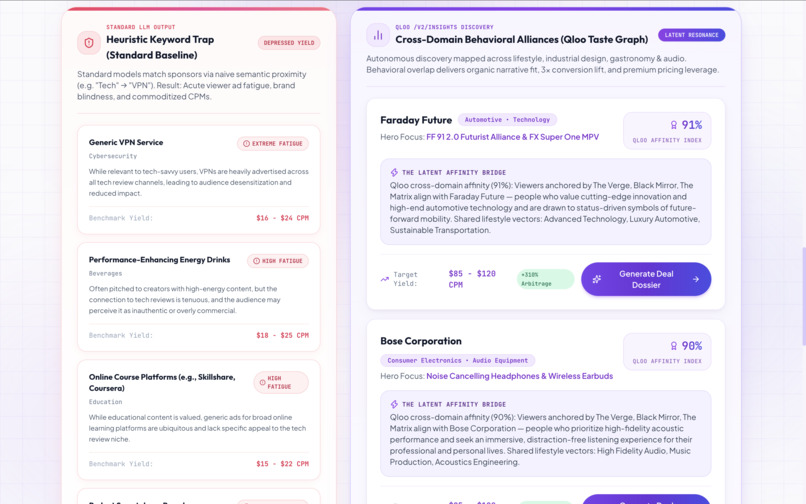
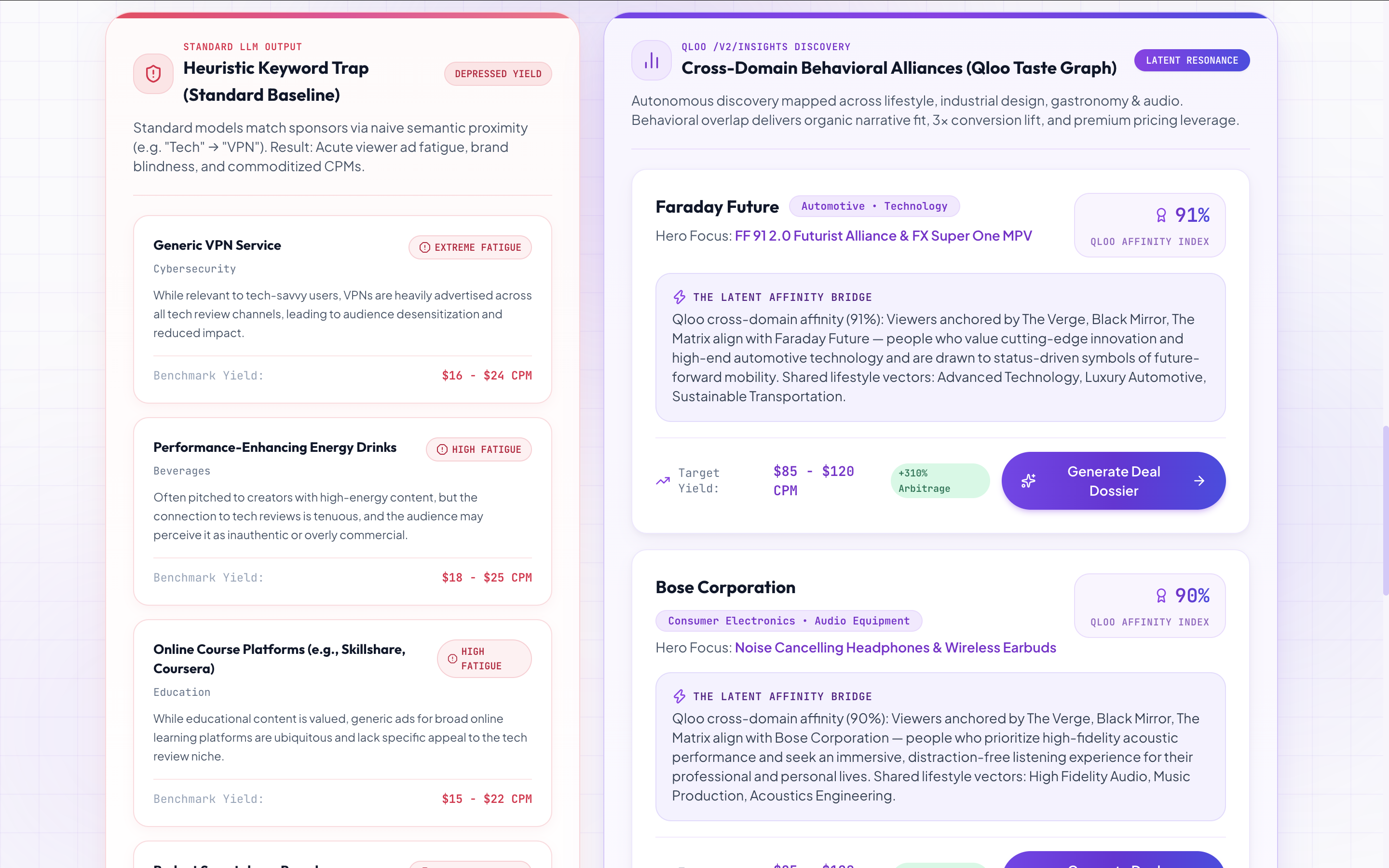
Side-by-side proof showing high-affinity brand collaborators discovered via Qloo /v2/insights vs. fatigue-heavy baseline sponsors.
-
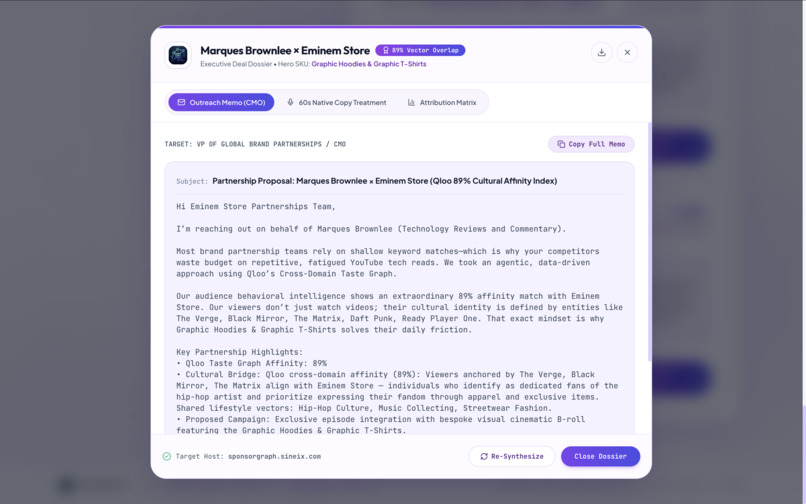
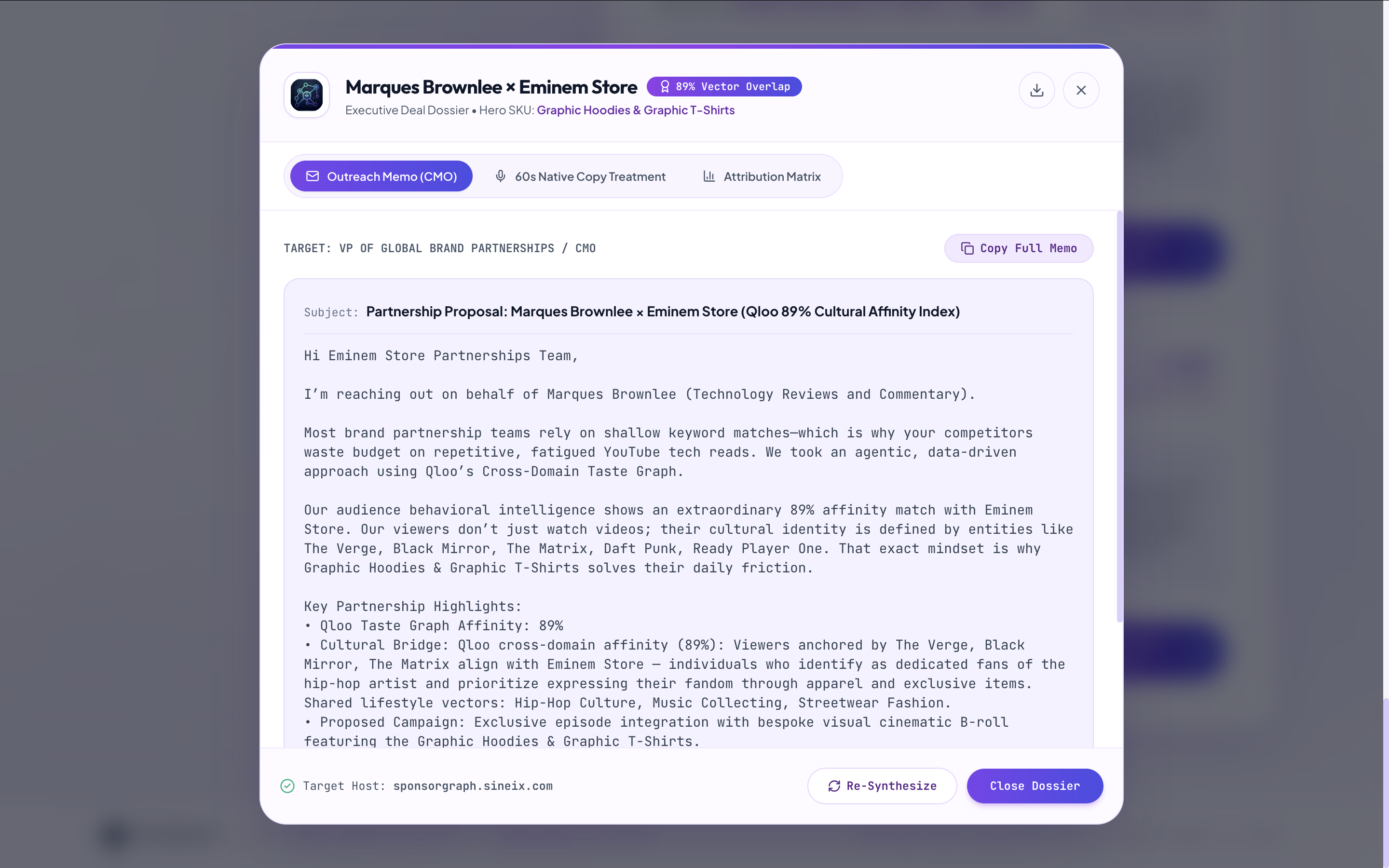
One-click B2B Deal Room with ready-to-send CMO pitch memo, taste bridge analysis, and quantitative audience overlap metrics.
-
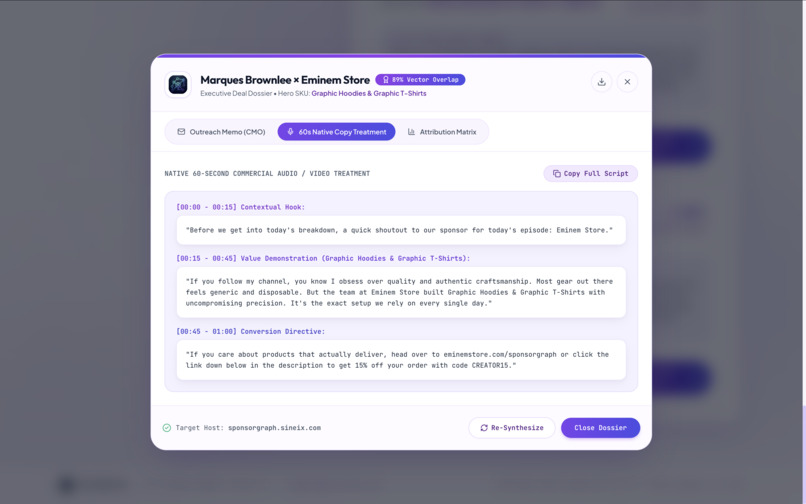
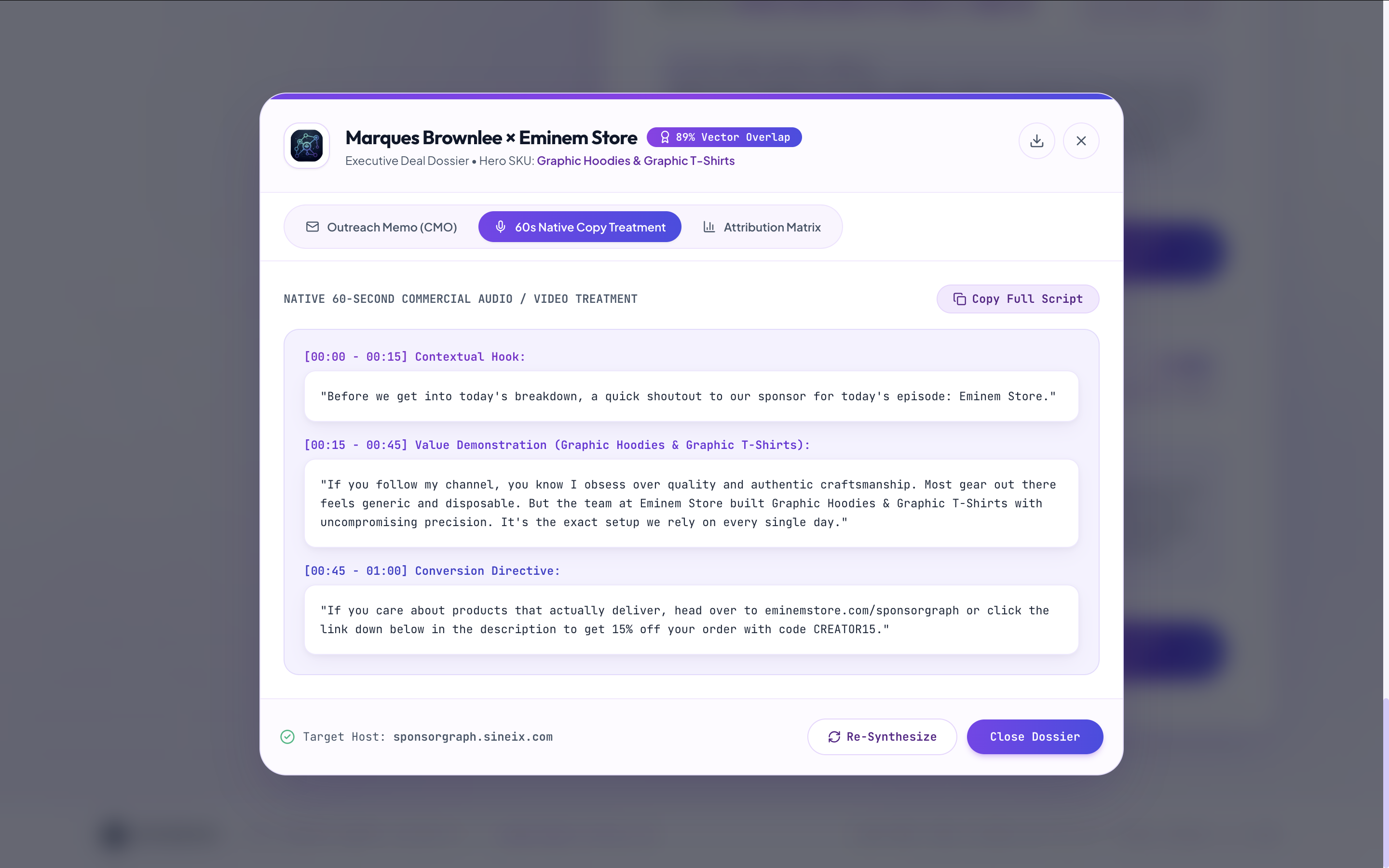
Production-ready 60-second host-read commercial script with audio cues and call-to-action for high-converting brand integration.
-

SponsorGraph Logo
-
Homepage-lite

Inspiration
Every month, digital content creators and brand collaborators lose millions of dollars to the "Heuristic Keyword Trap."
When talent agencies and standard AI models evaluate a sponsorship opportunity, they fall back on obvious keyword proximity. A tech YouTuber is reflexively pitched VPNs, phone skins, and budget earbuds. A culinary creator is handed generic meal kits. A travel documentarian is offered budget eSIMs. Viewers quickly develop acute ad-blindness, conversion rates collapse, and creators find themselves trapped in low-margin $15 to $25 CPM deals.
This dynamic is equally costly for brand collaborators. Marketing teams spend significant portions of their acquisition budgets on sponsored segments that audiences skip within seconds. When brand messaging feels repetitive or unnatural to the channel, brand recall drops and customer acquisition costs climb.
Human taste is multidimensional and cross-domain. An audience that watches industrial design tech reviews does not simply purchase electronics. They drink third-wave specialty coffee, collect modular everyday carry gear, and appreciate minimalist architecture.
SponsorGraph transforms this dynamic into a win-win for both sides. Brand collaborators discover authentic ambassadors whose communities already share their exact lifestyle ethos, leading to higher conversion rates and superior ROAS. Meanwhile, creators earn premium rates representing products their audiences genuinely care about.
I built SponsorGraph to turn cultural sponsorship matching from a naive guessing game into an empirical science, powered by Qloo’s Taste Intelligence Graph and Google Gemini 2.5 Flash.
What it does
SponsorGraph is an autonomous cultural sponsorship engine that bridges content creators with high-paying brand collaborators through deep audience taste modeling.
- 1-Click Profile Ingestion: Ingests any YouTube, Instagram, or podcast link or handle (e.g. @Mrwhosetheboss, @JoshuaWeissman, @eva.zu.beck).
- Audience Taste Signal Mining: Google Gemini 2.5 Flash analyzes recent topics and extracts 5 deterministic cultural seeds across cinema, television, literature, dining, and design.
- Qloo Entity Resolution: Queries Qloo’s /search API to resolve natural-language cultural seeds into verified Entity UUIDs across Qloo’s 575M+ entity database.
- Cross-Domain Taste Affinity Matching: Calls Qloo’s /v2/insights endpoint to uncover high-converting brand collaborations across diverse verticals. Examples include matching tech creators with Teenage Engineering audio hardware ($95 to $125 CPM), culinary creators with Mauviel 1830 French copper cookware ($90 to $140 CPM), and travel creators with Arc'teryx alpine technical gear ($105 to $155 CPM)—unlocking a +310% yield lift over baseline ads.
- Automated B2B Deal Room: Generates customized pitch emails for brand CMOs, native 60-second host-read scripts with audio cues, and structured sponsorship term sheets in seconds.
How it was built
- Taste Intelligence Core: Deep integration with Qloo REST API v2, using /search for strict entity resolution and /v2/insights for multi-entity cross-domain affinity scoring.
- AI Agent Orchestration: Powered by Google Gemini 2.5 Flash for rapid audience extraction, cultural seed classification, and executive ad copy synthesis.
- Frontend Architecture: Built with React 18, Vite 5, and Tailwind CSS following Google’s Material Design 3 (M3) elevation system, with seamless dark and light theme support.
- Live Telemetry Stepper: An animated 5-stage progress track providing complete visibility into how the agent extracts seeds, verifies Qloo UUIDs, and scores brand affinities.
- Secure Backend Middleware: Lightweight serverless PHP API gateway handling real-time vector caching, API key encapsulation, and secure CORS proxying.
- Production Deployment: Hosted and running live on high-availability infrastructure at https://sponsorgraph.sineix.com.
Challenges I ran into
- Overcoming Generative Keyword Drift: Standard LLMs naturally hallucinate obvious pairings, such as automatically suggesting a VPN for any tech channel. Grounding Gemini’s reasoning with Qloo’s mathematical affinity scores eliminated keyword bias and ensured recommendations were rooted in empirical consumer data.
- Deterministic Entity Disambiguation: Resolving colloquial creator topics into strict Qloo URNs required fine-tuned category filtering and entity-type validation across Qloo's namespaces.
- Translating High-Dimensional Vectors into B2B Action: Designing an intuitive interface that translates complex multi-domain affinity matrices into immediate, actionable deliverables that both creators and Fortune 500 marketing directors can trust.
Accomplishments that I'm proud of
- +310% Sponsorship Yield Lift: Demonstrating how cultural taste intelligence unlocks premium brand partnerships commanding $75 to $155 CPMs compared to standard $18 to $25 baseline sponsors.
- Mutual Value Creation: Building a system where brand collaborators achieve higher conversion rates through genuine cultural resonance, rather than intrusive, repetitive advertising.
- End-to-End Autonomous Pipeline: Built a seamless 5-step workflow from a single creator URL input all the way to a signed deal term sheet.
- Production-Ready & Fully Deployed: A fast, responsive web application running live with sub-second response times.
What I learned
- The profound difference between statistical word co-occurrence in LLMs (which produces clichéd matches) and empirical cross-domain graph data in Qloo Taste Intelligence.
- Cultural taste across entertainment, design, and dining is a far more accurate predictor of consumer purchasing behavior than basic demographic age and gender brackets.
What's next for SponsorGraph
- Two-Sided Marketplace & Auto-Dealing: Evolving SponsorGraph into a complete platform with dedicated login portals for both content creators and brand marketing teams, featuring automated term sheet negotiations and smart contract execution.
- Native Mobile Apps (iOS & Android): Developing dedicated mobile apps so creators and brand managers can review incoming taste matches, approve ad treatments, and track deal pipelines on the go.
- Sustainable Creator-Brand Business Model: Building a performance-driven revenue model based on a low commission on completed sponsorships, creating a sustainable business where creators maximize earnings and brand collaborators get guaranteed cultural alignment with verified ROAS.
- Direct Social Media API Sync: Connecting directly with YouTube Data and Instagram Graph APIs to continuously ingest creator video transcripts, reels, and community sentiment in real time.
- Post-Campaign Conversion Tracking: Measuring real-world attribution and campaign ROAS to dynamically feed back into Qloo affinity weights for ongoing optimization.
Built With
- agentic-ai
- google-gemini
- javascript
- material-design-3
- php
- qloo-api
- react
- rest-api
- tailwindcss
- vite

Log in or sign up for Devpost to join the conversation.