Inspiration
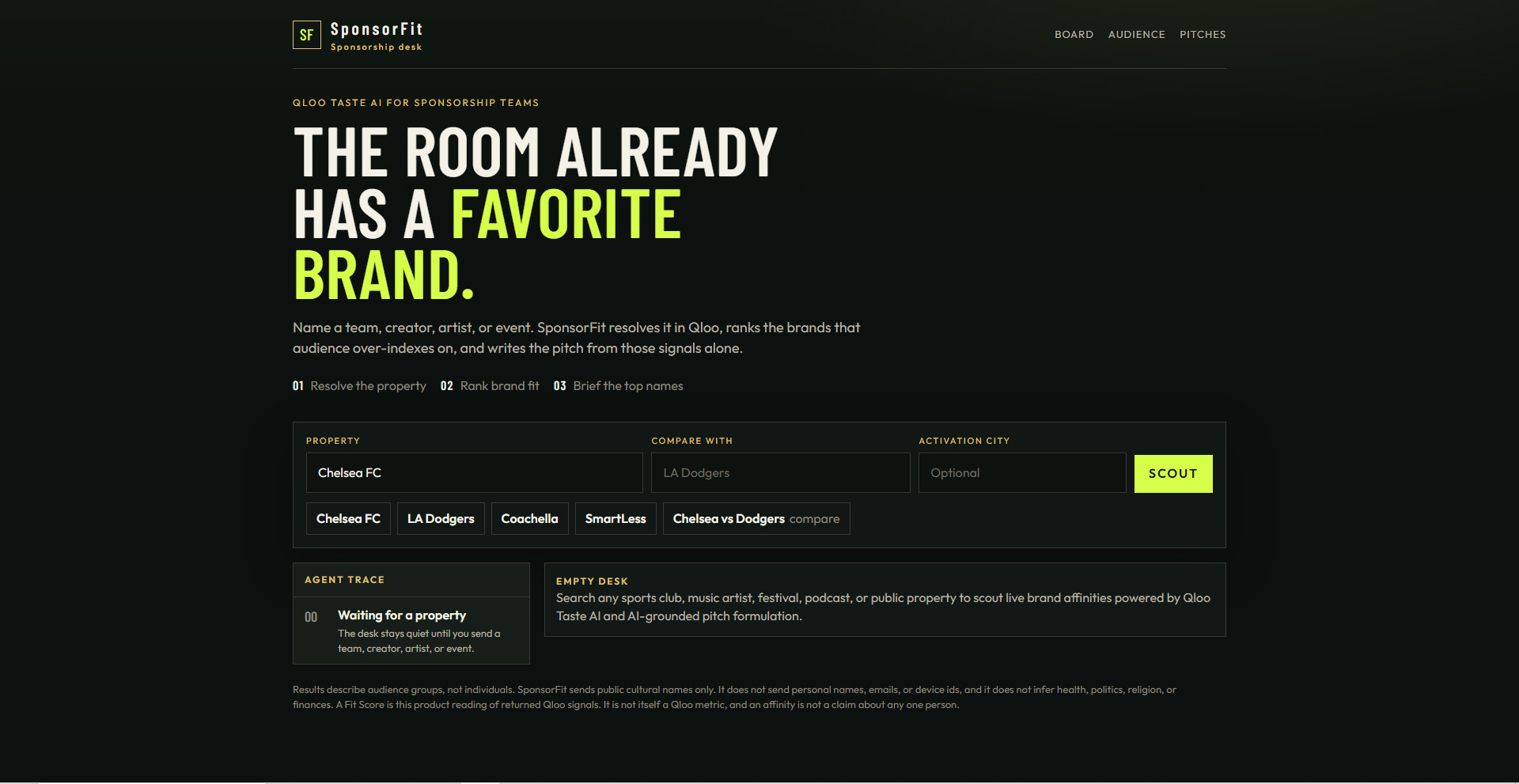
Sponsorship conversations still open with the property’s logo and a guess about the room. Whether it's Chelsea FC, the LA Dodgers, a major music festival like Coachella, or a hit podcast like SmartLess: the audience already concentrates on specific brands and walks past others.
We built SponsorFit to give partnerships directors, sports agents, and brand leads a decision desk they can put on a screen in a pitch meeting — not another consumer taste quiz, and not an opaque "cultural DNA" poster. It starts from real empirical concentration and will never invent a number to make the slide look good.
The hackathon judges include people who buy and sell these high-stakes partnerships every day (such as Todd Boehly, Michael Abrams, and Jason Calacanis). The desk had to survive the real question: "Show me Chelsea, now put the Dodgers next to them, and prove why this brand fits."
What it does
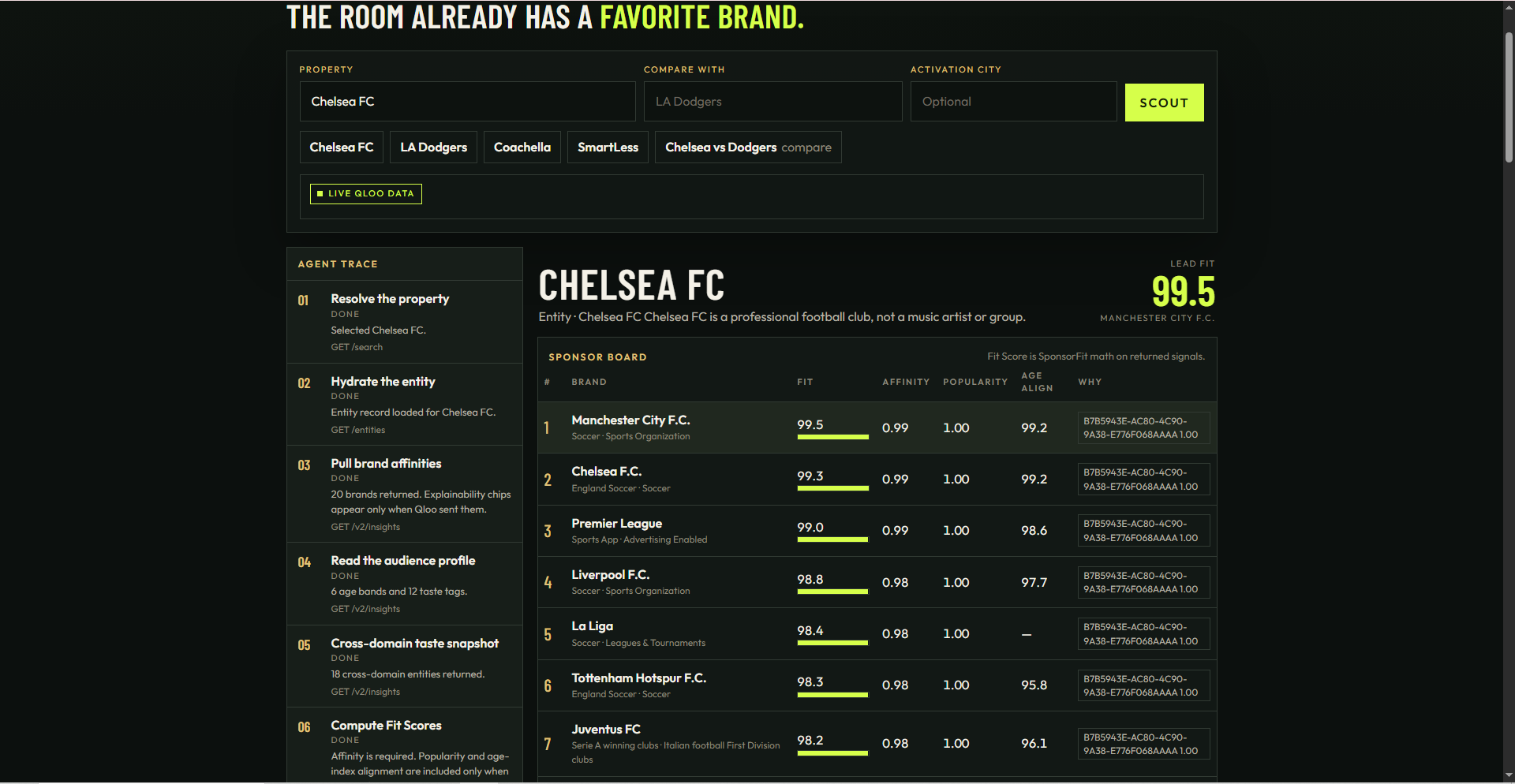
You enter any sports team, creator, artist, or event, or click a 1-click scout preset. SponsorFit’s autonomous agent pipeline:
- Resolves the entity: Uses Qloo's
/searchand/entitiesto load the exact cultural record. - Pulls brand affinities: Queries Qloo
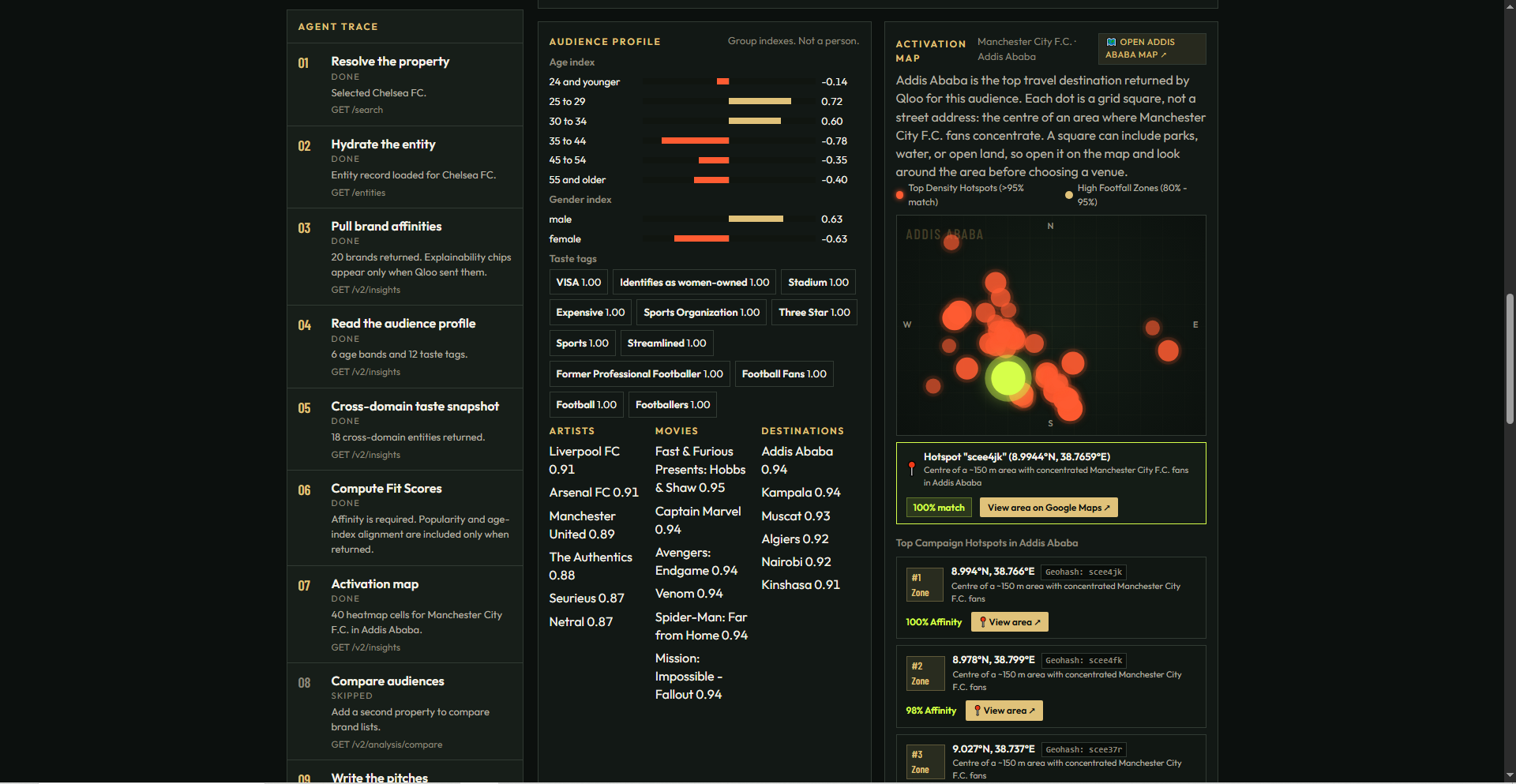
/v2/insightsfor audience affinity with explainability attribution chips. - Reads demographic & cultural profiles: Extracts signed age and gender index deviations, taste tags, and a cross-domain snapshot (associated artists, movies, and travel destinations).
- Computes transparent Fit Scores: Evaluates each brand using a formulaic multi-factor score: $$\text{Fit Score} = 60\% \times \text{Affinity} + 25\% \times \text{Popularity} + 15\% \times \text{Demographic Alignment}$$
- Generates an Activation Heatmap: Maps physical high-affinity geohash clusters inside the top returned destination or target activation city, filtering out remote outliers.
- Audience Comparison: Overlaps shared sponsor brands and comparative taste tags between two properties (e.g. Chelsea FC vs LA Dodgers).
- Drafts Anti-Hallucinated Pitches: Generates 3-angle customized sponsor briefs via LLM (AIML API), strictly protected by an evidence gate — if any number does not trace back to Qloo signals, the draft is discarded.
- 1-Click Export: Exports the brief directly to Clipboard, Markdown, or a print-ready single-page HTML report.
How we built it
- Framework: Next.js 15 (App Router, TypeScript), Tailwind CSS, deployed on Vercel.
- Data Architecture: 100% live Qloo Taste AI API calls (
/search,/entities,/v2/insights,/v2/analysis/compare). No mock data or pre-baked JSON fixtures. - Streaming Pipeline: Server-Sent Events (SSE) stream 9 distinct agent cues to the front-end in real time.
- Geospatial Engine: Geohash-to-coordinate decoding with universal median-distance cluster focus (
focusCluster) to cleanly map activation pockets. - Safe LLM Orchestration: AIML API (
gpt-4o-mini) strictly constrained by numerical grounding validation.
Challenges we overcame
- Payload & Latency Budgets: Qloo's
/searchreturns deep tag hierarchies that can exceed 2 MB. We optimized search payloads, tuned timeouts, and implemented fail-fast guards so upstream latency never blows serverless route limits. - Entity Disambiguation: Resolving cultural festivals vs municipal administrative areas (e.g. Coachella Festival vs Coachella City, California) required strict classification logic prioritizing cultural and event entities.
- Geospatial Clustered Outliers: Raw heatmap signals can span wide geographical regions. We engineered an adaptive median-distance outlier filter to focus activation maps purely on dense metropolitan commercial hubs.
- Eliminating AI Hallucination: Rather than letting LLMs invent sponsorship stats, fees, or metrics, every sentence in our generated pitch must trace to verified Qloo evidence chips.
Accomplishments that we're proud of
- True Live Qloo Integration: Every single board, chart, heatmap cell, and score is computed live at request time.
- Single-Screen Decision Desk: A complete sponsorship intelligence suite (agent trace, brand ranking, math breakdown, audience demographics, activation map, and comparison) all responsive on a single unified canvas.
- Robust Quality: 18 passing automated unit tests covering scoring math, response parsing, outlier clustering, rate limiting, and hallucination gates.
What we learned
- Affinity is not probability: Qloo affinity measures audience concentration relative to a global baseline.
- Demographic indexes are deviations: Age and gender indexes represent signed z-score shifts rather than raw percentages.
- Heatmaps are within-city activations: Heatmap geohashes answer "where inside this city do we activate?" while destination insights answer "which market should we enter?"
What's next for SponsorFit
- Category Exclusions: Allow partnership managers to pin negative tag filters (e.g. gambling, alcohol, or competitor categories) via Qloo's
filter.exclude.tags. - Live Deal Valuation Index: Correlate Qloo popularity and fit scores with public media value benchmarks for automated contract ballpark estimates.
- Multi-Property Tour Routing: Optimize multi-city activation routes for touring artists and sports franchises.
Built With
- next.js
- qloo-api
- react
- typescript

Log in or sign up for Devpost to join the conversation.