
Inspiration
Splitting a restaurant bill with friends should be simple, but it rarely is.
One person ends up doing all the work: figuring out who ordered what, calculating taxes and tips, splitting shared dishes, and reminding friends who haven't paid yet.
Real restaurant receipts make this even harder. Items can have different tax rates, discounts can be applied separately, and the actual tip often appears on a completely different payment receipt.
I wanted to build a digital sidekick that takes care of the tedious parts of splitting a bill while letting everyone participate in the process.
That's how SplitSnap was born.
What it does
SplitSnap turns a restaurant receipt into a real time collaborative workspace.
A user takes a photo of their receipt, and Google's Gemini extracts the menu items, quantities, prices, discounts, taxes, and tips.
The host reviews the extracted information, then invites friends through a shareable link. No account or app download is required.
Each participant can select their own items, assign quantities, and split shared dishes equally with friends. Changes appear in real time across connected devices.
Unlike a basic bill splitting calculator, SplitSnap also handles some of the situations that make real bills complicated:
- Multiple receipts: An itemized restaurant bill and a separate payment receipt can be combined to identify the actual tip and final amount.
- Quantity splitting: Thirty beers don't become thirty separate menu rows. Participants simply select how many they consumed.
- Shared items: Friends can split a dish equally, including individual portions of larger orders.
- Taxes and discounts: The calculation engine accounts for item discounts, order discounts, tax categories, and tips.
- Payment tracking: Friends can pay later or make partial payments without reopening the bill.
- Privacy: Only the host can view everyone's payment status. Participants can see their own payment information without seeing who else has paid.
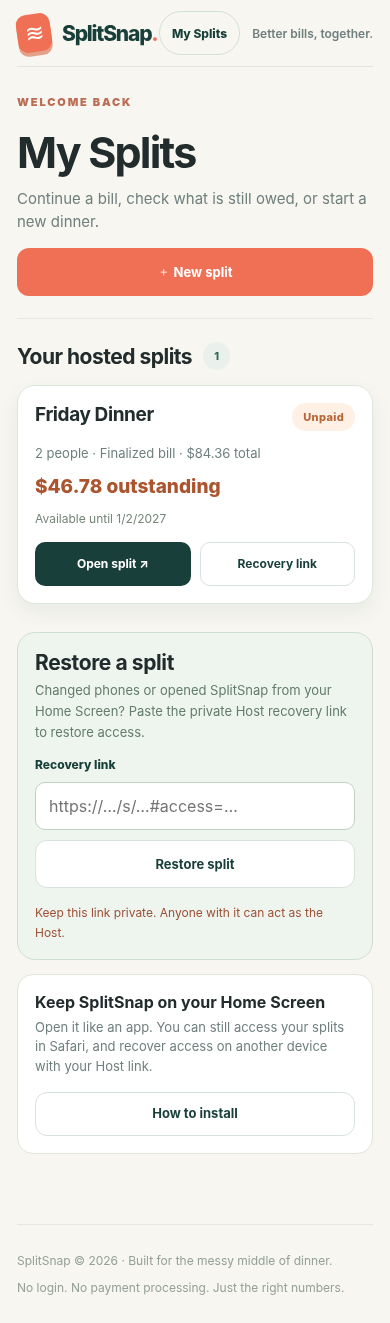
- Session recovery: Hosts can return to previous splits through a dashboard or a private recovery link.
SplitSnap is also a mobile first Progressive Web App, so users can add it to their phone's home screen.
How we built it
SplitSnap combines multimodal AI with a serverless real time collaboration system.
Google Gemini analyzes receipt images and converts unstructured restaurant bills into structured data. It identifies menu items, quantities, discounts, taxes, and payment information, including receipts containing multiple languages.
Cloudflare Workers powers the backend and serves the web application.
Cloudflare Durable Objects with SQLite provides persistent storage for each splitting session and manages its shared state.
WebSockets synchronize changes across participants, allowing everyone to work on the same bill simultaneously.
The frontend uses JavaScript, HTML, and CSS, with a responsive interface designed for mobile devices.
One important design decision was to separate AI interpretation from financial calculations.
Gemini extracts and interprets the receipt, but a deterministic calculation engine performs the actual splitting using integer cents. This avoids relying on AI generated arithmetic for financial results.
We also implemented session access tokens to distinguish hosts from participants and enforce payment information visibility on the server.
Challenges we ran into
1. Real receipts are messy
Restaurant receipts are surprisingly inconsistent. Some contain multiple languages, others have item specific discounts, and some separate food charges from the actual credit card payment.
We tested SplitSnap using real restaurant receipts containing English, Korean, and Chinese text.
The challenge was not simply extracting text, but interpreting the relationship between menu items, discounts, taxes, tips, and final payments.
2. Real time collaboration requires consistency
Multiple users may try to claim the same item at once.
The backend must prevent over allocation, synchronize changes, and ensure that the final amount still matches the original bill.
3. Financial calculations must be exact
Splitting a $25 item among three people creates a rounding problem.
We implemented deterministic cent level allocation so the sum of everyone's shares matches the verified bill total.
4. Mobile UX and privacy
A restaurant bill splitter must work on phones without requiring users to install software or create accounts.
Building a usable mobile interface, handling browser file selection, restoring sessions, and limiting access to sensitive payment statuses required several design iterations.
Accomplishments that we're proud of
We built a functional, deployed collaborative web application rather than just an AI demonstration.
SplitSnap brings together receipt understanding, live collaboration, exact financial calculations, and payment tracking in one workflow.
The application runs on Cloudflare's serverless infrastructure and can be accessed directly from a browser.
We also created 21 automated tests covering the splitting engine, receipt matching, session behavior, access control, and PWA functionality.
Most importantly, SplitSnap demonstrates how AI can help with a small but frustrating everyday problem without taking away users' control over their decisions.
What we learned
One of the biggest lessons was that AI is most useful when paired with traditional software engineering.
Gemini is effective at interpreting unstructured visual information, but financial calculations need predictable and verifiable logic.
We also learned that collaboration is more than synchronizing data. Good collaborative software needs clear ownership, meaningful permissions, recoverable sessions, and intuitive interactions.
What's next for SplitSnap
The current MVP focuses on splitting bills from one restaurant per session, with manual confirmation of payments.
Future improvements could include optional account synchronization across devices, payment reminders, multiple restaurants in a single session, and support for multiple people paying different parts of the original bill.
The long term vision is simple:
Make splitting a bill so effortless that nobody has to become the group's accountant.
Built With
- cloudflare-workers
- css3
- durable-objects
- google-gemini
- html5
- javascript
- pwa
- sqlite
- websockets
